


A Patek Philippe watch carries a history that begins in Geneva in 1839, when the company was founded as Patek, Czapek & Cie. That heritage gives each preowned example a context worth understanding. Condition, authenticity, and reference details matter alongside the name Patek Philippe.
For collectors, the appeal lies in both the object and its lineage. Patek Philippe introduced the Ref. 1518, the first serially produced perpetual calendar chronograph, in 1941. This guide explores what to consider when buying preowned, how that landmark lineage developed, and how the company’s beginnings shaped its watchmaking history. These details offer a deeper way to appreciate a Patek Philippe timepiece beyond its complication or appearance.
Key Takeaways
- Assess a preowned watch through its condition, reference details, and supporting documentation, not its name alone.
- Trace the perpetual calendar chronograph lineage to see how successive references shaped a landmark complication.
- Connect the company’s Geneva beginnings with the innovations and family stewardship that followed.
- Learn which details matter when assessing authenticity and when professional watch authentication can help.
Buying Patek Philippe watches on the secondary market
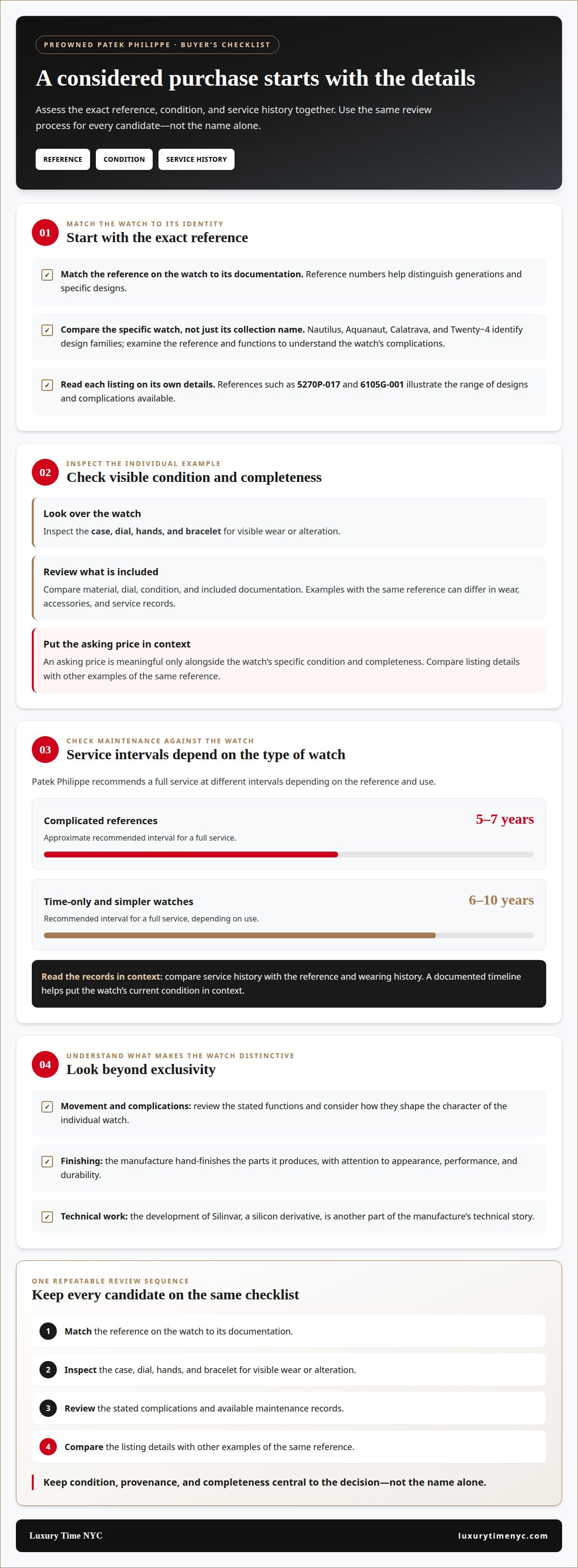
A considered Patek purchase starts with the exact reference, condition, and service history. Compare these details together before weighing the watch’s appeal.
Preowned Listings and Prices
Compare listings by reference, material, dial, condition, and included documentation rather than collection name alone. References such as 5270P-017 and 6105G-001 illustrate the breadth of designs and complications available. An asking price is meaningful only alongside the watch’s specific condition and completeness. Two examples bearing the same reference may differ in wear, accessories, or service records, so assess each listing on its own details.
Craftsmanship and Genevan History
Geneva’s watchmaking tradition is part of the appeal of Patek Philippe timepieces. The manufacture hand-finishes the parts it produces, with attention to appearance, performance, and durability. Its development of Silinvar, a silicon derivative, reflects another aspect of its technical work. When evaluating a Patek, look beyond exclusivity to the movement, finishing, and complications. These details offer practical ways to understand the character of an individual watch.
Servicing and Maintenance
Service history matters because complicated movements have different maintenance needs from simpler, time-only watches. Patek Philippe recommends a full service approximately every five to seven years for complicated references. For time-only and simpler watches, the recommended interval is every six to ten years, depending on use. Compare service records with the reference and the watch’s wearing history. A documented timeline helps put its current condition in context.
A Practical Review Before Buying
Use the same review process for every candidate. First, match the reference on the watch to its documentation. Next, inspect the case, dial, hands, and bracelet for visible wear or alteration. Then review the stated complications and available maintenance records. Finally, compare the listing details with other examples of the same reference. This sequence keeps condition, provenance, and completeness central to your decision instead of letting the name alone determine the watch’s appeal.
Perpetual calendar chronograph lineage
Patek Philippe introduced the Ref. 1518 in 1941, described as the first serially produced perpetual calendar chronograph. It combined a chronograph, which measures elapsed time, with a calendar complication. The reference established a distinctive place in Patek Philippe history, joining two demanding functions within one watch.
The Ref. 2499 continued that lineage, remaining in production for thirty-five years. Patek Philippe created only three hundred and forty-nine examples. Its extended production and limited number make it a notable reference for collectors tracing how the design evolved. Comparing examples across the family reveals a story told through successive generations of mechanical watchmaking.
In 2011, the Ref. 5270 carried the perpetual calendar chronograph tradition forward. Its place in the lineage connects a modern reference to the earlier achievement of the Ref. 1518. For collectors, reference numbers provide a useful way to follow those developments and distinguish one generation from another. The chronology also helps explain why this complication pairing holds a particular place in Patek Philippe’s history.
Collection names identify different design families, not necessarily a watch’s complications. The Nautilus and Aquanaut, for example, are distinct from the Calatrava in design language; Twenty~4 offers another point of comparison. Don’t assume a collection name alone identifies a perpetual calendar chronograph. Examine the specific reference and its functions to understand where a Patek Philippe watch fits. That distinction is useful when comparing Patek Philippe references across the broader catalogue.
Explore fine mechanical watchmaking to continue considering how heritage and complications shape a collector’s perspective.
The Reference 5270’s introduction in 2011 gives collectors a chronological marker for tracing its place among successive generations and the tradition it carries forward.
Company history and founding
The company’s story began in Geneva in 1839 as Patek, Czapek & Cie. In 1845, it was established as Patek & Cie, and Jean Adrien Philippe joined as head watchmaker. That same year, the company patented Philippe’s keyless winding and hand-setting system. The change made winding and setting a timepiece possible without a separate key, marking an important step in its technical history.
In 1851, the name Patek, Philippe & Cie was established. The partnership joined Antoine Norbert de Patek’s enterprise with Philippe’s watchmaking expertise, setting a foundation for the manufacture’s later identity. Patek Philippe created the first Swiss wristwatch in 1868, extending its work beyond pocket watches. In 1881, it patented a precision regulator; in 1889, it patented a perpetual calendar mechanism for pocket watches. These milestones show how technical development accompanied the company’s luxury watches.
Ownership changed in 1932, when the Stern family acquired the company. Charles Stern served as president from 1932 to 1958, followed by Henri Stern from 1958 to 1993. Philippe Stern then held the presidency from 1993 to 2009, and Thierry Stern has served since 2009. The sequence places family stewardship at the center of the company’s modern history, alongside its commitment to producing distinctive mechanical pieces.
The company’s inventions also connect its early history with later grand complications. Its 1889 perpetual calendar patent established a foundation for calendar watchmaking, while the Ref. 1518 later united a perpetual calendar with a chronograph. Today, collectors may encounter Patek Philippe timepieces in varied materials, including rose gold and platinum. Those choices describe individual watches, not the full history. To understand a piece, place its reference within the broader story of Geneva craftsmanship and consider how its mechanism reflects the manufacture’s evolving priorities.
How can I verify a Patek Philippe watch is authentic?
Start with the reference, serial number, and accompanying records. Compare the reference with the watch’s case, dial, and movement details, then check that the documents describe the same configuration. A box or certificate can support the watch’s history, but paperwork alone doesn’t establish authenticity. Consistency between the watch and its records matters.
Inspect the watch closely in good light. Look for clean, even finishing, legible markings, and components consistent with the stated reference. Note visible wear or mismatched parts, especially around the dial, hands, crown, and case. One detail rarely tells the whole story, so compare several features instead of relying on a familiar logo.
- Record the reference and serial markings, then compare them with the supplied documents.
- Review the case, dial, hands, and bracelet for consistency and signs of alteration.
- Have the movement examined by a qualified watch specialist using suitable tools.
The movement deserves particular attention. A qualified examination can assess its construction, markings, and consistency with the reference, rather than relying on exterior appearance alone. This is especially important for complicated watches, where the movement’s functions and architecture should correspond with the model. Avoid opening the case yourself. Specialist handling protects delicate components and provides a more meaningful assessment.
Consider the service history as part of the same review. Invoices or service records can help establish a timeline, while unexplained gaps provide less context about past work. Compare the dates, reference details, and services described in each record with the actual watch. For an intricate model such as a perpetual calendar chronograph, a professional inspection should cover the movement and its complications, not just the dial and case.
For a discreet, expert review, arrange professional watch authentication before completing a purchase.
Luxury Time NYC: Rolex Watches
Luxury Time NYC offers Patek Philippe watches alongside Rolex, Audemars Piguet, and Richard Mille timepieces. If you’re considering a pre-owned watch, assess its exact reference, condition, and documentation together. Luxury Time NYC also provides watch authentication to help inform a purchase when provenance or originality calls for professional examination. Seek this expertise before committing, especially when the movement, components, or records need closer review. A considered assessment keeps the focus on the watch itself, not reputation alone. Explore the available watches or discuss authentication with Luxury Time NYC. Contact the team to take the next step.
Make Your Next Watch Decision Deliberately
A meaningful addition to a collection starts with knowing what matters most to you: a particular reference, a complication, or how a watch feels on the wrist. Let that priority guide your next conversation. With a Patek, clarity about the model and its condition can make the decision more considered. The same thoughtful approach applies across fine watchmaking.
Luxury Time NYC offers Rolex, Patek Philippe, and Audemars Piguet watches. Whether you’re refining a collection or considering your first acquisition, focus on the details that will hold your interest beyond the initial impression. A measured decision leaves room to appreciate both the engineering and the individual character of the watch.
Contact Luxury Time NYC about a watch to discuss your next step. Approach the choice with discernment, and let lasting personal significance lead.
Frequently Asked Questions
What does “Patek” refer to?
“Patek” is commonly used as shorthand for Patek Philippe, the Geneva watchmaking company and its timepieces. In conversation, it may mean the maker generally or a particular watch. For precision, use the full brand name and reference number when discussing an individual piece. The reference helps distinguish specific designs and mechanical configurations, even within a familiar collection.
What is Patek Philippe known for?
Patek Philippe is known for fine mechanical watches, intricate complications, and a long tradition of Genevan watchmaking. A complication adds a function beyond displaying the time and a simple date. Examples include annual calendars, dual time zones, and World Time displays. These functions combine practical information with complex mechanics, making the movement and its finishing central considerations for collectors.
How much do Patek Philippe watches cost in the United States?
On the US market, wristwatch offers typically range between $57,000 and $140,000, with a median of about $69,000. This is a broad market snapshot, not a quote for a specific watch. The reference, materials, complications, condition, and completeness all influence individual asking prices. Compare examples of the same reference and account for their condition before judging whether listings are comparable.
What are the most expensive Patek Philippe watches ever sold?
The Henry Graves Supercomplication is associated with the manufacture’s history of complex watchmaking. To identify the most expensive watch ever sold, distinguish a documented auction result from an estimate or current asking price. Complexity and rarity make a watch historically important, but they don’t establish its sale ranking by themselves.
Where can I buy Patek Philippe watches in the United States?
US buyers can consider authorized retail channels or secondary-market specialists such as Luxury Time NYC, which offers Patek Philippe watches and watch authentication. View the selection online or visit the showroom by appointment. Before choosing a listing, compare its reference, condition, and accompanying records to assess whether that specific watch suits your collecting priorities.
How do I get on a Patek Philippe authorized dealer waitlist?
Identify the reference you want, then contact an authorized Patek Philippe retailer and ask how it records expressions of interest. Explain your preferences clearly, including alternatives you would genuinely consider. Ask the retailer to outline its process and the information it needs. Keep your contact details current and respond promptly if the retailer follows up about your requested model.


