


The right Rolex Datejust 36 is defined as much by its configuration as by its price. The 36 mm model pairs a choice of bracelet, bezel and dial with either Oystersteel or a combination of Oystersteel and Everose gold, while pre-owned listings offer another route into the collection.
That choice deserves a closer look. Bracelet feel and bezel finish shape the watch’s character, while material and condition help distinguish one listing from another. For the reference 126234, the Calibre 3235 brings an approximately 70-hour power reserve to the decision.
This guide compares the principal bracelet and bezel options, outlines the distinction between steel and Everose gold models, and explains what the movement contributes. It also considers how to assess pre-owned Datejust 36 listings, so you can weigh the details that matter before choosing a watch with enduring presence and mechanical substance.
Key Takeaways
- Compare Jubilee and Oyster bracelet designs alongside bezel finishes to identify the Datejust 36 configuration that suits your style and daily wear.
- Consider how Oystersteel and Everose gold create distinct looks, then narrow your choice by material and overall design.
- Use the Calibre 3235’s power reserve and precision specifications to understand the mechanical qualities behind the watch.
- When weighing pre-owned listings, compare each watch’s reference, condition, and configuration, and make authenticity a central part of your decision.
Bracelet and bezel options
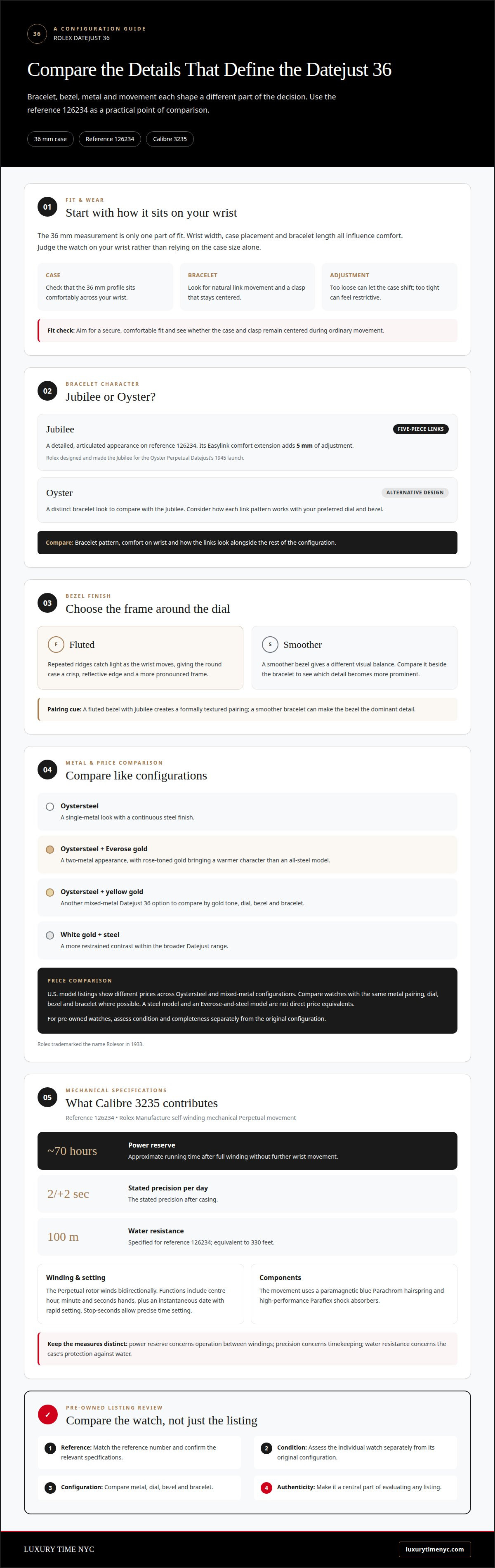
The 36 mm case gives the Datejust a balanced profile, but wrist shape and bracelet adjustment affect its feel. Try it on with the bracelet sitting comfortably, then assess whether the case and clasp remain centered during ordinary movement.
Bracelet choices
Jubilee and Oyster bracelets offer two distinct looks for the Datejust 36. The Jubilee’s five-piece links give reference 126234 a detailed, articulated appearance; its Easylink comfort extension adds 5 mm of adjustment. Rolex designed and made the Jubilee for the Oyster Perpetual Datejust’s 1945 launch. Compare how each bracelet’s link pattern looks against your preferred dial and bezel.
Fluted bezel
The fluted bezel brings a crisp, reflective edge to the Datejust’s round case. Its repeated ridges catch light differently as the wrist moves, giving the watch a more pronounced frame than a smooth bezel. Compare the effect beside the bracelet: a fluted bezel and Jubilee create a formally textured pairing, while a smoother bracelet can make the bezel the dominant detail.
For sizing, judge the watch on your wrist rather than relying on the 36 mm case measurement alone. Wrist width, case placement, and bracelet length all influence comfort. A bracelet that is too loose can let the case shift; one that is too tight can feel restrictive. Ask for link adjustment to achieve a secure, comfortable fit.
- Check the case: See whether the 36 mm profile sits comfortably across your wrist.
- Assess the bracelet: Note whether the links move naturally and the clasp stays centered.
- Compare the frame: Observe how the fluted bezel changes the watch’s presence beside a smoother option.
Reference 126234 combines a 36 mm case with a Jubilee option and fluted bezel. Treat that configuration as a useful point of comparison, then weigh bracelet comfort and bezel character together. The strongest choice is the one whose proportions and details feel coherent on your wrist.
Everose gold and steel models
Material changes the Datejust 36’s presence and its price position. Compare Oystersteel, Everose gold and steel, and yellow gold and steel by looking at the full configuration, not metal alone.
Everose gold and steel
Oystersteel paired with Everose gold gives the watch a two-metal appearance. The rose-toned gold contrasts with the steel components, creating a warmer character than an all-steel model. Rolex also offers Datejust 36 configurations combining Oystersteel and yellow gold. Compare the gold tone beside the dial and bezel, since each element contributes to the overall balance. Rolex trademarked the name Rolesor in 1933.
Steel and two-tone model choices
An Oystersteel Datejust 36 presents a single-metal look, while Everose or yellow gold adds contrast. The choice is visual as well as practical: consider whether you prefer one continuous steel finish or the distinction of mixed metals. A white-gold-and-steel configuration provides another restrained contrast within the broader Datejust range.
U.S. Rolex model listings show different prices across Oystersteel and mixed-metal Datejust 36 configurations. The specific combination matters, so compare like with like: metal pairing, dial, bezel, and bracelet. A steel model and an Everose-and-steel model aren't direct price equivalents, even when both share the 36 mm case size.
How to compare prices
Start with the exact configuration you want, then compare its listed price with watches in the same metal combination. Keep the dial and bezel choices consistent where possible to see the effect of the material more clearly. With a pre-owned watch, assess condition and completeness separately from the original configuration.
For a considered comparison, record each model’s metal, dial, bezel, bracelet, and listing status. Then weigh the visual distinction against your intended budget. The Datejust configuration selection offers a natural next step for comparing available Rolex watches.
Calibre 3235 movement
Reference 126234 measures 36 mm and uses Rolex Manufacture calibre 3235. It offers an approximately 70-hour power reserve, is waterproof to 100 metres (330 feet), and has stated precision of 2/+2 seconds per day after casing.
Movement details
Calibre 3235 is a self-winding mechanical Perpetual movement. Its Perpetual rotor winds the movement bidirectionally, supplying energy as the wearer moves. The approximately 70-hour reserve helps explain how long the watch can run after full winding without further wrist movement.
Its functions include centre hour, minute, and seconds hands, plus an instantaneous date with rapid setting. Stop-seconds allow precise time setting: the seconds hand stops when setting the time. The movement also uses a paramagnetic blue Parachrom hairspring and high-performance Paraflex shock absorbers. These components are key technical details to consider when comparing the reference.
Dimensions and performance specifications
The 36 mm case gives this reference its stated diameter. Case size alone doesn’t determine how a watch wears, so consider its proportions on your wrist alongside bracelet fit and dial layout. For technical comparison, keep the reference number and movement specifications together rather than assuming every Datejust shares identical details.
Calibre 3235’s approximately 70-hour power reserve describes its running time after winding. The stated precision is 2/+2 seconds per day after casing. Rolex’s water-resistance specification for reference 126234 is 100 metres (330 feet). These figures describe separate qualities: reserve concerns operation between windings, precision concerns timekeeping, and water resistance concerns the case’s protection against water.
Use the specifications as a practical comparison checklist. Match the reference, confirm the movement designation, then consider reserve, stated precision, and water resistance as distinct measures. For reference 126234, those details combine with the 36 mm case to define its technical profile. A movement’s construction and functions also help explain what the wearer interacts with each day, from setting the date to adjusting the time.
Pre-owned Rolex Datejust 36 listings
Authenticity depends on the complete watch, not a single detail or document. Check that the reference, dial, case, bracelet and clasp form a coherent Rolex configuration, then have the watch examined by a qualified authenticator.
For warranty and servicing, read the written coverage supplied with the specific pre-owned watch. Service needs depend on its condition, performance and documented service history, not the Datejust name alone.
Listings can vary substantially by reference and materials. Reference 126234, for example, gives you a specific model to compare against Oystersteel and white-gold or yellow-gold combinations. Match each listing’s reference and stated configuration before comparing its condition or asking price. A different dial, bezel, or bracelet can make two Datejust 36 listings meaningfully different.
Follow a consistent inspection sequence. First, compare the reference and visible configuration with the seller’s description. Then inspect the dial, hands, case, bracelet and clasp for consistency, wear and signs of alteration. Finally, review the available purchase and service documents. Papers can support a watch’s history, but they do not replace examining the watch itself.
- Configuration: Check that reference, dial, bezel, and bracelet details align.
- Condition: Look closely at case edges, bracelet links, clasp, and dial.
- Documentation: Review purchase records, service history, and written warranty terms.
- Authentication: Use a qualified watch authenticator to assess the complete timepiece.
When assessing value, distinguish originality and condition from cosmetic appeal. A polished case may look bright, but softened edges can change the appearance of its original lines. Bracelet stretch, dial condition and signs of replacement parts also matter when evaluating a listing. Compare watches with like-for-like references and configurations, not just the Datejust name.
Explore pre-owned Rolex watches as you narrow your Datejust shortlist and compare each watch’s configuration and condition.
Luxury Time NYC: Rolex Watches
Luxury Time NYC offers Rolex watches for buyers comparing Datejust 36 configurations and pre-owned listings. If you’ve narrowed your choice to a particular reference, material, or bracelet, its watch authentication service can help address authenticity as part of your buying decision.
When you’re ready to move from comparing specifications to considering a specific Rolex, Luxury Time NYC offers watches for sale and can help source a particular model. A shortlist of preferred details, such as steel or two-tone construction, a Jubilee or Oyster bracelet, and dial style, can help focus your search. Luxury Time NYC also carries Patek Philippe, Audemars Piguet and Richard Mille watches.
Contact Luxury Time NYC to discuss your Rolex Datejust 36 search.
Make Your Next Move With Confidence
A considered purchase starts with knowing how you want the watch to fit your life. Decide whether you’re choosing a daily companion, a milestone piece or an addition to a collection. That purpose can clarify your priorities and keep passing preferences from clouding the decision.
Before moving forward, write down what matters most to you. It might be the watch’s presence on the wrist, the balance of its design, or the confidence that comes from a carefully assessed purchase. Use those priorities to guide your decision, rather than treating any single specification as the whole story. The right Rolex Datejust 36 is the one that feels considered long after the first impression.
When you’re ready to take the next step, connect with Luxury Time NYC to discuss your watch search. A thoughtful choice begins with a clear conversation, and your next chapter as a collector can start there.
Frequently Asked Questions
What are the current Rolex Datejust 36 models and reference numbers?
Datejust 36 configurations include Oystersteel and combinations with white gold, yellow gold, or Everose gold. Reference 126234 is a 36 mm model discussed in this guide. Rolex reference numbers identify specific configurations, so compare the number on a watch with its listing details. This helps distinguish watches that share the Datejust 36 name but differ in materials or components.
What is the retail price of a new Rolex Datejust 36 in the United States?
U.S. retail pricing varies by the model’s material and configuration; the 36 mm size alone doesn’t determine the figure. For a useful comparison, identify the exact metal combination and dial, then compare that configuration with its current U.S. retail listing. Treat retail and pre-owned prices as separate measures, since condition and the individual listing affect the latter.
How much does a Rolex Datejust 36 cost on the US secondary market?
There’s no single secondary-market price for every Datejust 36. The reference, material, condition, and configuration all shape an individual listing. Compare watches with matching references and metal combinations first; then consider wear, originality, and included documentation. This like-for-like approach gives a more meaningful view than comparing listings based only on case size or the Datejust name.
What dial, bezel, bracelet, and material options are available for the Datejust 36?
Options include different dials, fluted or smoother bezel designs, Jubilee or Oyster bracelets, and Oystersteel or two-tone materials. Combinations matter: a fluted bezel can give the watch a more defined appearance, while the bracelet changes its visual texture. Compare the complete configuration, not each feature in isolation, and use the reference number to identify the exact watch described.


