


A box and papers can accompany a counterfeit, so they are not proof of authenticity. To understand how to buy watches on the secondary market with confidence, start with professional authentication, then assess condition, originality, documentation, and the seller’s transaction terms. Provenance adds context, but it cannot replace examining the watch itself.
A pre-owned timepiece can offer access to a reference with history and character, but confidence depends on more than appearance. Polishing, replacement parts, incomplete records, or unclear transaction terms can affect what you are buying. This guide explains what authentication and inspection can establish, how box, papers, and service records add context, and why condition and originality deserve close attention. It also outlines the roles of different sellers, including how a specialist retailer can support an informed purchase.
Key Takeaways
- Prioritize professional authentication and inspection; a box and papers alone don’t establish that a watch is genuine.
- Use service records and accompanying documentation to understand a watch’s history, while treating them as supporting evidence rather than a substitute for examination.
- Assess condition alongside originality: polishing and replacement components can affect both a watch’s character and its market value.
- Understand the differences between dealers, private sellers, and auction houses so you can weigh the expertise, selection, and buying experience each brings.
Authentication and expert inspection
If you are considering how to buy watches on the secondary market, begin with the watch, not its documents. A specialist compares the reference and serial markings with the case, dial, hands, bracelet, and movement, looking for inconsistencies or signs of replacement. On a Rolex, for example, the visible components and internal construction should align with the stated reference. A box and papers can support the watch’s history, but cannot establish authenticity on their own.
A thorough inspection may involve opening the case, examining the movement, checking timing, and documenting non-original parts or previous work. This can help identify a watch assembled with mismatched components. Professional authentication is particularly useful when photographs do not show the movement or fine details clearly.
To compare a pre-owned watch with retail pricing, match the exact reference, then account for condition, originality, and service history. Morgan Stanley’s watch-market analyses compare primary retail prices with secondary-market trading prices. Buyers can also consult at least two independent pricing sources for market context. A retail figure alone doesn’t establish a particular watch’s value.
Before paying a U.S. retailer, request an itemized total that shows applicable taxes, shipping, and any insurance or handling charges. The final amount may depend on the delivery destination and shipping arrangement. Reviewing these line items clarifies the full cost beyond the watch’s listed price.
A retailer typically prices a pre-owned watch by considering its reference, condition, originality, documentation, service history, and current demand. These factors explain why similar models can have different valuations. A professional can clarify how to buy watches on the secondary market by explaining authentication and transaction terms. Look for consistent reference details, clear photographs, and a written condition description. Treat unusual payment requests or conflicting listing details as reasons to pause.
Box, papers, and service records
A watch’s accompanying materials can add context to its history, but each serves a different purpose. Consider them alongside the reference, condition, and service documentation.
Boxes, Papers, and Accessories
A complete set includes the watch’s accompanying box, papers, and accessories, such as booklets or spare links when supplied. These items help establish what came with the watch and can support its provenance. They may also affect resale appeal, but neither a presentation box nor paperwork proves authenticity. A missing accessory is different from a flaw in the timepiece itself.
Compare the seller’s description with the contents of the set. Check whether the papers identify the watch and whether the accessories match the description. A complete set may appeal more to collectors, while missing materials can affect interest. The significance depends on the reference and market, so use documentation as context, not as a substitute for examining the watch.
Questions for the Seller
Before purchase, ask the seller to specify which box, papers, and accessories accompany the watch and describe its service history. Find out when it was last serviced, what work was done, and whether records or invoices are available. Clear details help you understand what you are buying and whether the listing accurately describes the supporting materials.
Service records are most useful when they identify the work performed and when it took place. A service within the past three years can have a marginally positive effect on a watch’s secondary-market price. Records also help distinguish routine maintenance from a more substantial repair, adding context to the watch’s present condition. Not every service affects value in the same way.
Keep the documents together as part of the watch’s provenance. For a purchase where paperwork and the timepiece both merit scrutiny, professional watch authentication can help assess the watch alongside its accompanying materials. A coherent history adds useful context; gaps or missing items should be accurately reflected in the description and considered in the overall valuation.
Condition and original components
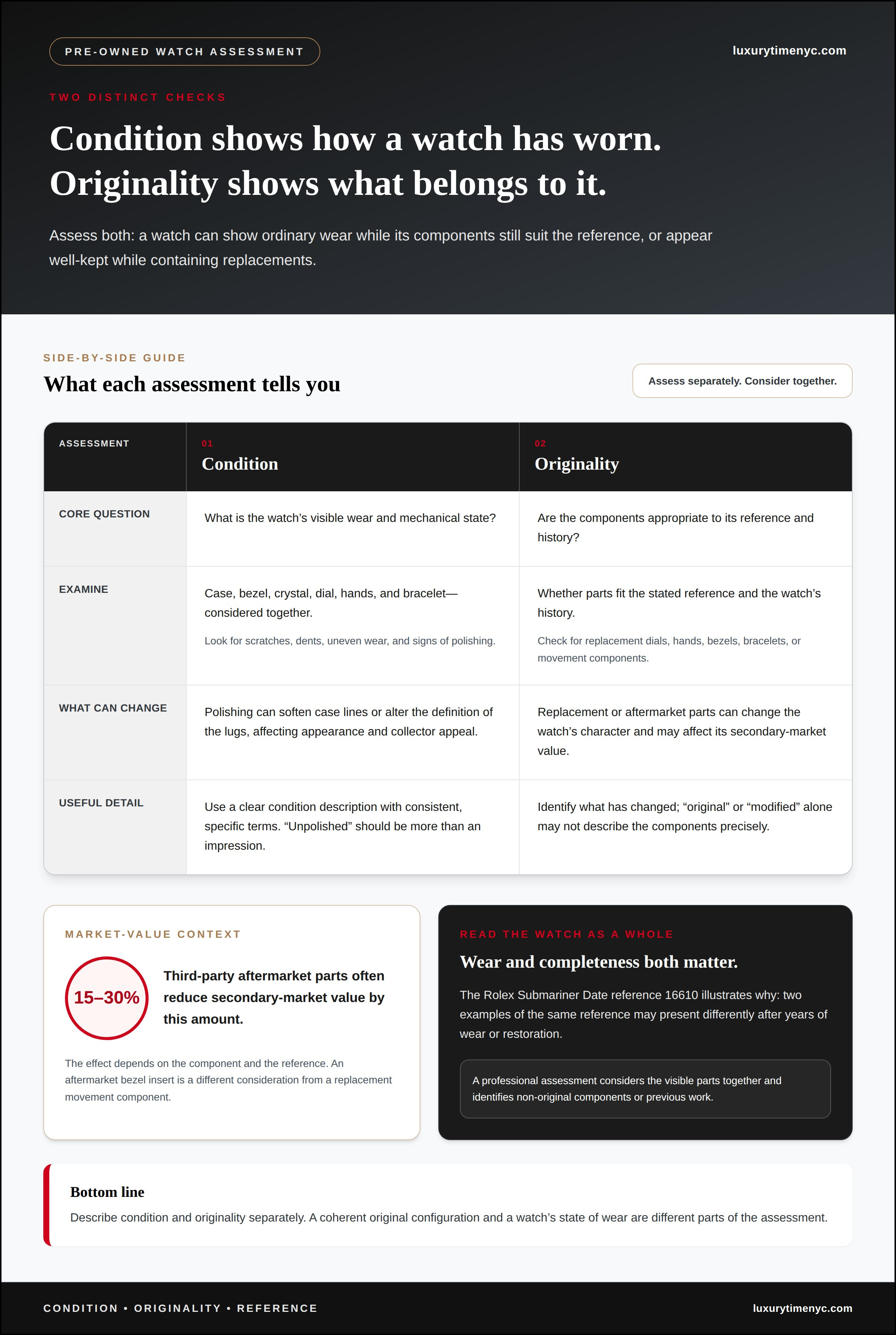
Condition describes a watch’s visible wear and mechanical state. Originality concerns whether its components are appropriate to the reference. Both inform a collector’s assessment of a pre-owned piece.
Assessing Watch Condition
A professional assessment considers the case, bezel, crystal, dial, hands, and bracelet together. Scratches, dents, uneven wear, and signs of polishing can affect appearance and collector appeal. Look for a clear condition description that uses terms consistently, so labels such as “unpolished” are specific rather than impressionistic.
Examine how the watch’s surfaces and edges relate to its design. Polishing can soften case lines or alter the definition of lugs, details that matter to collectors. The Rolex Submariner Date reference 16610 illustrates why condition and completeness are assessed together: two examples of the same reference may present differently after years of wear or restoration.
Checking Originality
Originality means assessing whether the components are appropriate to the watch’s reference and history. A replacement dial, hands, bezel, bracelet, or movement component can change its character, even if the watch remains functional. Collectors may value a coherent original configuration differently from one modified with later or third-party parts.
Third-party aftermarket parts often reduce a watch’s secondary-market value by 15-30%. The effect depends on the component and the reference, so an assessment should identify what has been changed rather than simply label the watch “original” or “modified.” For example, an aftermarket bezel insert is a different consideration from a replacement movement component.
Condition and originality should be described separately. A watch can show ordinary wear while retaining original components; a pristine-looking example may include replacements. A professional inspection relates visible details to the reference and records polishing, restoration, or non-original components. This gives collectors a clearer basis for weighing the watch’s current state against the qualities they value.
Secondary-market participants
The seller shapes the buying experience as much as the watch does. Dealers, private sellers, brokers, and auction houses differ in expertise, selection, and transaction structure.
A specialist dealer can present a watch with a documented description and explain its condition, history, and pricing. In a previous analysis cited by WatchCharts, watches bought from secondary-market dealers were generally 13% more expensive than those bought privately. That difference makes sense to weigh against the dealer’s expertise and the clarity of the transaction, not in isolation.
A private sale may offer direct access to an individual owner, but the buyer’s experience depends on the information and support provided. A broker can arrange a private transaction and represent a buyer or seller. Private-sale broker commissions typically range from 5-15%, depending on the watch’s value and the services involved. Auction houses offer another route; visitors may see 100-200 watches across brands, eras, and aesthetics in one venue. Seller commissions at auction houses typically range from 15-25%.
Warranty, return, and buyer-protection terms depend on the transaction and seller. New luxury-watch manufacturer warranties typically span 2-5 years, but a pre-owned watch’s coverage depends on any remaining manufacturer warranty and the seller’s stated terms. Read the written return policy and warranty conditions before committing, including what each covers and how a claim is handled.
Rolex and other major market participants have introduced Certified Pre-Owned programs, bringing manufacturer involvement into pre-owned sales. These programs are one example of the range of participants in the secondary market, which also includes private owners and independent dealers. Choose a seller whose expertise, documentation, and transaction terms suit the watch and the support you value.
For a considered purchase, explore pre-owned watch options with a specialist retailer.
Luxury Time NYC
Luxury Time NYC supports buyers considering pre-owned watches with professional authentication and specialist guidance. For collectors looking at Rolex, Patek Philippe, Audemars Piguet, or Richard Mille, an expert assessment can clarify a watch’s identity and condition.
Turn to Luxury Time NYC when you are weighing a particular timepiece and want professional support. Authentication helps assess the watch itself, while a discussion with a specialist can clarify details that matter to your decision, from the reference to the accompanying documentation and condition.
For guidance on a pre-owned luxury watch, contact Luxury Time NYC.
Make Your Next Move With Confidence
Begin by deciding what matters to you: a particular reference, a certain era, or a watch suited to daily wear. Let those priorities guide your search and discussion. They help you focus on the right example instead of choosing on reputation alone.
Learning how to buy watches on the secondary market means approaching the decision with patience and professional perspective. Luxury Time NYC offers pre-owned Rolex, Patek Philippe, and Audemars Piguet watches to consider as you refine your choice. If you have a specific timepiece in mind or are still defining what belongs in your collection, speak with a specialist to make your next step more informed.
Contact Luxury Time NYC about your watch and take the next step toward a considered purchase.
Frequently Asked Questions
How can a professional authenticate a pre-owned watch before you buy it?
A professional checks whether a watch’s identifying details and construction align with its stated reference. The assessment may include the serial number, movement, and signs of alteration, considered together rather than in isolation. This is especially useful when a listing shows few views or provides little context. A clear explanation of discrepancies helps you understand the watch before buying.
How can a professional help you evaluate price data when considering a watch as an investment?
A professional can put market data into context by comparing the same reference and configuration across pricing sources. Morgan Stanley’s watch-market analyses compare primary retail prices with secondary-market trading prices, a useful distinction when considering value retention. Treat these figures as market context, not a promise of future performance. Condition, originality, and demand can all affect how closely an individual watch aligns with broader pricing data.
What is the watch secondary market?
The watch secondary market is the resale market for timepieces previously sold or owned. Transactions may involve private owners, specialist dealers, brokers, or auction houses rather than a manufacturer’s original retail channel. For example, a collector may sell a Rolex to a dealer, who then offers it to another buyer. Each route has its own process, expertise, and terms, so the seller’s role matters.
Why do similar-looking watches have different prices?
Two watches that look alike may differ by reference generation, configuration, age, service history, or completeness. A subtle dial variation or a different bracelet can distinguish examples that share a familiar silhouette. Demand also varies among references and configurations. Make comparisons using the precise reference and details, not photographs that make different watches look interchangeable.
Where can you buy pre-owned watches safely in the United States?
Choose a seller that clearly explains its authentication process and transaction terms. Luxury Time NYC sells pre-owned luxury watches online and through its New York showroom, with an authenticity guarantee and a two-year global warranty covering manufacturer defects. Eligible watches may be exchanged within seven days if they remain unworn, un-sized, and un-altered; a restocking fee may apply. Review the applicable terms before purchase.
How can a professional verify a luxury watch’s authenticity before you buy it?
Professional verification considers the watch as a complete object, including whether its identifying marks, reference, and movement are consistent with one another. This can help distinguish a coherent example from one with mismatched components or unexplained alterations. For a high-value purchase, the useful outcome is a clear account of what was examined and any issues identified, so the decision rests on the specific watch rather than its reputation.


