


A replacement hand is a precision component, not a cosmetic afterthought. A watch hand replacement service starts with assessing the timepiece, then fitting a compatible hand and checking its movement across the dial. The work requires care around the dial, hands, and movement, especially on a treasured or complicated watch.
It’s understandable to want a replacement that looks seamless and preserves the watch’s original character. A certified watchmaker considers the hand’s shape, finish, and fit, then checks that it clears the dial and other hands as it moves. This article explains what the service involves, what affects its quality, timing, and cost, and how professional repair supports a timepiece’s integrity. You’ll also learn what information helps a watchmaker assess the work and what to expect from the initial examination through final inspection.
Key Takeaways
- A watchmaker assesses the timepiece and selects a compatible hand, then checks its fit and movement across the dial.
- For a nearby repair, look for professional watchmaking experience suited to the watch’s make and level of complexity.
- Replacement costs depend on the watch, the hand required, and the work involved; the assessment helps clarify the scope.
- Understanding how the watch’s design, condition, and parts affect the repair can help you know what to expect before proceeding.
Watch hand replacement
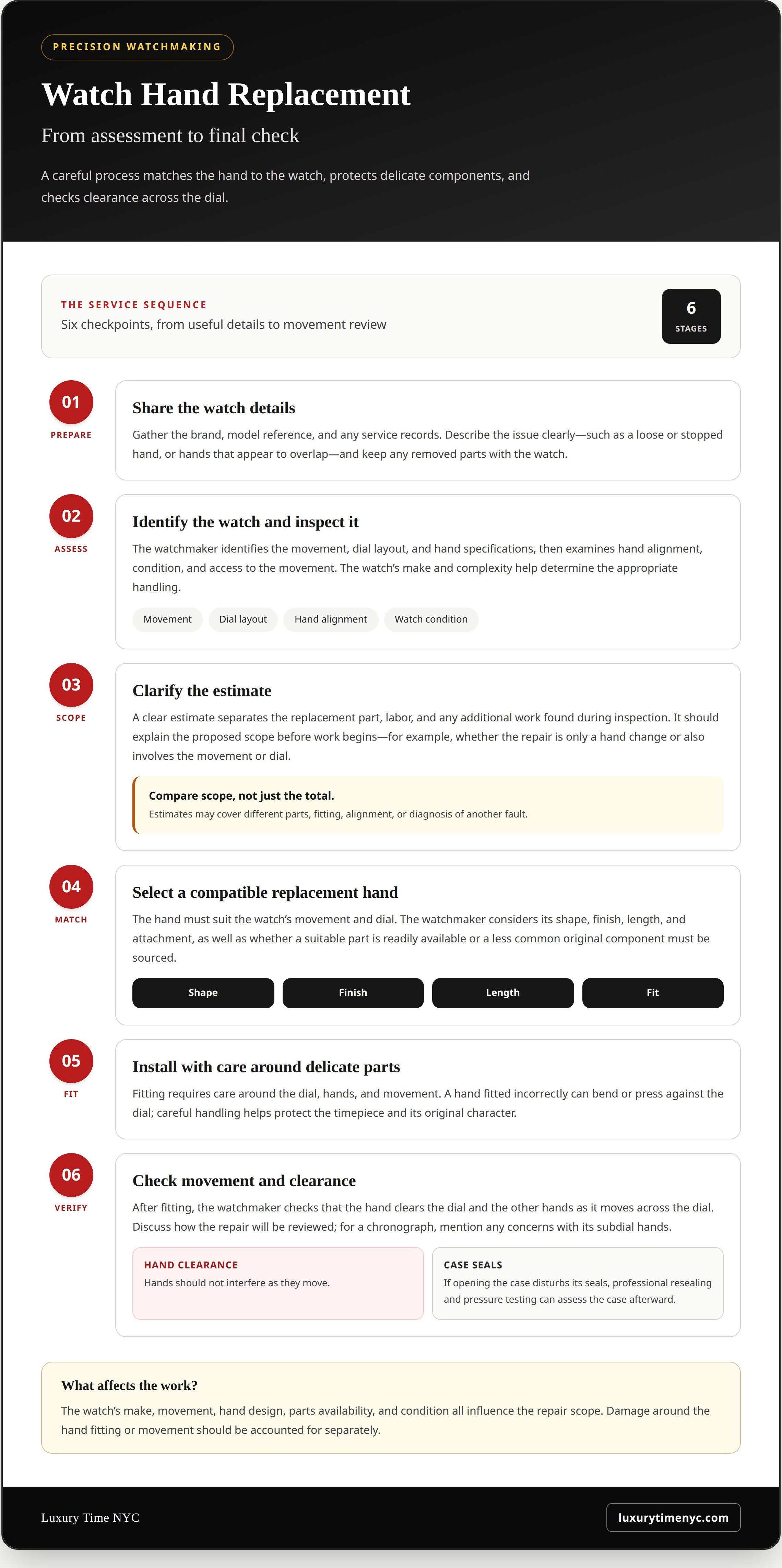
A watchmaker starts by identifying the movement, dial layout, and hand specifications. The replacement must fit the watch and clear every other hand.
Replacement Costs in the United States
In the United States, the cost depends on the watch and the work required, not simply on the number of hands. An estimate should separate the replacement part from labor and any additional work found during inspection. A straightforward hand change, for example, differs from a repair that also requires attention to the movement or dial. A watch hand replacement service should explain the proposed scope before work begins.
Factors Affecting Replacement Cost
The watch’s make, movement, and hand design all affect the work. A shaped or finished hand may require a closer match than a standard replacement, while a less common model can make suitable parts harder to source. The watch’s condition matters, too. If inspection reveals damage around the hand fitting or movement, that work should be accounted for separately. Ask for an itemized explanation of parts and labor.
Finding Nearby Replacement Services
Look for a local watch repair service with experience handling your watch’s make and movement. A nearby specialist can examine the timepiece in person, identify the required hand, and explain the inspection and fitting process. For example, a Rolex or Patek Philippe may call for parts and handling suited to that particular model. Before proceeding, understand how the watch will be assessed, what the proposed work includes, and how completion will be reviewed.
Cover the risks of watch hand replacement without professional service.
Without a watchmaker’s tools and experience, a hand can be bent, fitted incorrectly, or pressed against the dial. Misalignment can also make hands interfere as they move, affecting the time display or damaging delicate components. Opening the case can disturb its seals and affect water resistance; professional resealing and pressure testing can assess the case afterward. Warranty coverage depends on the applicable terms, and unauthorized work may affect it. A qualified assessment helps determine the appropriate repair and check hand clearance.
Where can I get watch hands replaced near me?
Start with a watch repair specialist who handles mechanical timepieces and replacement parts. An in-person examination can identify the watch’s make and model and assess whether the hands suit the dial and movement. For example, a dress watch with slim hands needs a different fit from a chronograph with several subdials. Familiarity with the design matters more than simple proximity.
Before arranging a visit, gather details that help identify the watch: its brand, model reference, and any service records you have. Describe the problem clearly, such as a loose or stopped hand, or hands that appear to overlap. Keep the watch together with any removed parts. These details support a more informed initial assessment and reduce guesswork.
During an in-person assessment, the watchmaker can inspect the dial, hand alignment, and access to the movement. Discuss how the repair will be evaluated after fitting, including whether each hand moves freely around the dial. If the watch is a chronograph, mention any issue with its subdial hands. These details help clarify the repair’s scope and whether additional work may be involved.
For a valuable or historically significant piece, seek a watchmaker experienced with its specific construction. A vintage model, for instance, may require a careful approach to preserve its original appearance. A nearby location is useful, but the watchmaker’s relevant expertise and explanation of the proposed work are stronger considerations. For discreet guidance on a fine timepiece, explore professional watchmaking guidance.
How much does watch hand replacement cost in the United States?
In the United States, watch-hand replacement costs depend on the timepiece and work involved. There is no useful universal figure for every model. Replacing a standard hand differs from sourcing a manufacturer-specific chronograph hand. An estimate should describe the repair itself, rather than rely on a generic service label.
First, identify what the estimate includes. A clear breakdown separates the replacement hand, labor, and related work. For example, the quoted scope may cover one hand, while a damaged hand fitting requires additional attention. That distinction explains why similar visible problems can lead to different estimates. The watch’s make and model also guide the choice of a compatible part.
Parts sourcing affects the work involved. A readily available compatible hand presents different requirements from a scarce original component. The watchmaker must match its dimensions, finish, shape, and mounting to the movement and dial. A chronograph with several hands can take more effort to identify than a simple display. These details affect both the part selected and the labor required for fitting.
Inspection may reveal a broader repair. If a watch has stopped, a loose hand might not be the only issue. The estimate should distinguish replacement from separate movement work. Clarify, for instance, whether it covers fitting and alignment or diagnosis of another fault. A defined scope makes each charge easier to understand.
Compare estimates by scope, not by total alone. Check that each describes the same hand, parts approach, and inspection. A lower amount may cover less work, while a higher estimate may include additional tasks. The estimate should state what findings could change the proposed work. This gives you a clearer basis for deciding and helps prevent misunderstandings about the repair.
What factors affect the cost of replacing watch hands?
The hand itself is one cost factor. A standard replacement differs from an original component designed for a specific model. Shape, finish, length, and attachment must suit the dial and movement. For example, a leaf-shaped hand requires a different visual match from a baton hand. The more specific the original part required, the more sourcing may affect the estimate.
Movement design also affects labor. A simple time display differs from a chronograph with additional subdial hands. Accessing and fitting the correct component depends on the watch’s construction. The watchmaker must also ensure the hands sit at appropriate heights and move without contacting one another or the dial. Intricate layouts can require more careful inspection and adjustment.
Condition matters. A bent hand, damaged fitting, or loose component may require more than replacement alone. If the hands stop because of a movement fault, fitting a new hand may not address the underlying problem. The assessment should separate the requested replacement from any additional repair, so the estimate reflects the actual scope.
Parts availability and the replacement approach can affect the work involved. A compatible component already accessible to the watchmaker differs from a rare, model-specific part that needs sourcing. The estimate should identify whether the proposed hand is original or compatible and explain any implications for appearance. For a collector’s watch, preserving the dial’s visual balance may guide the decision.
To understand an estimate, consider the part, sourcing, access, condition, and inspection together. Ask for a clear description of the proposed hand and the labor included. If the watchmaker discovers a separate fault, that should be distinguished from the original request. For a considered evaluation of a fine timepiece, request a watch assessment.
Luxury Time NYC
Luxury Time NYC is a natural next step when a fine watch needs professional repair. Its watch repair service helps owners understand the work a timepiece may require, including hand replacement. A watch’s make, reference, and condition help shape the assessment. This is especially relevant for Rolex, Patek Philippe, Audemars Piguet, and Richard Mille watches, where the correct component must suit the specific model.
Bring the watch’s reference details and describe what you’ve noticed, such as a loose or misaligned hand. This gives the repair assessment useful context and helps clarify the proposed work. Contact Luxury Time NYC to discuss your watch and its repair needs.
Choose a Considered Next Step
A watch’s hands are part of its visual identity, not merely indicators of time. Before arranging a repair, consider what you want to preserve: the original appearance, the correct model-specific fit, or both. A thoughtful assessment can help align the repair with the timepiece’s character and your priorities as its owner.
Luxury Time NYC offers Rolex, Patek Philippe, and Audemars Piguet watches, and provides professional repair for fine timepieces. If you’re considering a watch hand replacement service, share the watch’s make, model details, and the issue you’ve observed. That context gives the repair discussion a useful starting point, since each watch may require a different approach.
Contact Luxury Time NYC to discuss your watch and take the next step with care.
Frequently Asked Questions
Can a watch repair shop replace a single damaged hand?
Yes, a watchmaker can often replace one damaged hand if the correct compatible part is available and the remaining hands are sound. For example, a bent minute hand may need replacement while the hour hand remains suitable. The watchmaker assesses the hand’s fit and the surrounding components, then determines whether a single-part repair addresses the visible problem.
How long does watch hand replacement usually take?
Turnaround depends on the watch’s construction, the required part, and whether inspection reveals related work. A readily sourced replacement hand may follow a different schedule from a discontinued or model-specific component. After identifying the watch and examining its condition, the repair shop can provide a more useful estimate. Ask whether parts sourcing is included.
How do professional watchmakers remove and replace watch hands?
A watchmaker first identifies the movement and hand arrangement, then opens the case and protects the dial before removing the damaged component. The replacement is selected for compatibility and fitted onto its post with controlled pressure. The watchmaker then checks alignment and clearance throughout the hands’ travel, looking for contact with the dial, markers, or other hands.
Does replacing watch hands require a full watch service?
No, replacing a hand does not automatically require a full service. The watchmaker considers the movement’s behavior and the condition of nearby parts. For instance, if a hand is damaged but the watch otherwise runs properly, the work may be limited to replacement and testing. Signs of a separate movement problem can change the recommended scope.
Can replacement watch hands be matched to the original style and size?
Often, a replacement can be selected to suit the original design. Matching involves more than color: the hand’s length, shape, finish, and mounting must suit the specific watch. A vintage watch with aged markers, for example, may need a thoughtful visual match. The available part and the watch’s reference help determine how closely the replacement can follow the original.
How do I choose a reputable watch repair service for hand replacement?
Choose a repair service that can discuss your watch’s make, model, and movement in clear, relevant terms. Ask how it identifies compatible parts, protects the dial during work, and checks the finished installation. A useful estimate explains the scope and separates hand replacement from unrelated repairs. For a complex chronograph or collectible model, experience with that type of watch is especially valuable.


