


The Explorer II’s travel character changes more with its reference than its familiar silhouette suggests. A Rolex Explorer II review for travelers starts with fit: the reference 16570 has a 40 mm case, while the modern 216570 and 226570 measure 42 mm; the case is 12.5 mm thick. It’s described as wearing well on wrists measuring 6.5 to 7.5 inches.
The larger modern references have a more substantial presence, while the 16570 offers a more compact alternative. Either way, the Explorer II pairs a fixed 24-hour bezel with a separate GMT hand, giving travelers a way to read a second time zone at a glance.
If you’re considering the Explorer II, its proportions matter as much as its recognizable design. This guide covers how the watch wears, how its key references differ, and how its lume, lugs, and bracelet have evolved. You’ll also learn what those changes mean for everyday comfort and how to choose a reference that suits your wrist and travel habits.
Key Takeaways
- Trace how the Explorer II’s purpose and design developed from its 1971 debut to later reference milestones.
- Use lume type and drilled-lug details to help place a vintage 16570 within its production history.
- Compare bracelet refinements, including the Easylink extension, when considering day-to-day comfort.
- Distinguish references by movement and power reserve to find the travel-focused features that matter most to you.
How Does the Rolex Explorer II Wear?
Fit depends chiefly on reference: the 16570 measures 40 mm, while the 216570 and 226570 measure 42 mm. Case thickness, wrist size, and bracelet adjustment also shape comfort during travel.
Case Materials and Water Resistance
The Explorer II combines a steel case with a fixed, graduated bezel and water resistance to 100 meters (330 feet). Rolex introduced 904L steel in the 1980s, a material used in the brand’s steel watches. For travel, the construction offers a robust everyday profile, while the water-resistance rating describes a specification rather than permission for every water activity.
The 24-hour bezel is fixed, so it does not rotate to track elapsed time. Instead, its markings work with the additional hand to distinguish day from night and read another time zone. That layout gives the dial a purposeful, instrument-like appearance without adding a rotating bezel.
Case Dimensions and Wearability
The Explorer II 16570 measures 40 mm across, with a 12.5 mm case thickness. It is described as wearing well on wrists measuring 6.5 to 7.5 inches. Modern references 216570 and 226570 use 42 mm cases, creating a broader presence. Steel case and bracelet contribute to a substantial feel, while wrist shape and bracelet fit influence how that weight sits.
Compared with the 40 mm Rolex GMT-Master II, the modern Explorer II’s 42 mm case wears larger. The 16570 offers a closer case-size comparison with the GMT-Master II. For frequent travelers, the Explorer II’s fixed 24-hour bezel and independent GMT hand provide two-time-zone functionality without requiring the bezel to move.
Travel Comfort and Practicality
For long travel days, the Explorer II’s legible 24-hour scale and luminous display help distinguish time in changing light. Its 100-meter water resistance and steel construction suit varied daily settings, while the 42 mm references may feel prominent under close-fitting cuffs. Trying the 40 mm 16570 and a modern reference on the wrist reveals how case size and bracelet fit affect comfort.
An expensive Rolex can bring theft and insurance considerations. Travel coverage depends on policy terms, exclusions, and documentation. In the United States, keep purchase and service records, review how your personal-property coverage treats watches, and account for the reference and condition when arranging protection. For servicing, the watch’s reference, movement, and service history are relevant to maintaining its function and value.
Explorer II history and reference milestones
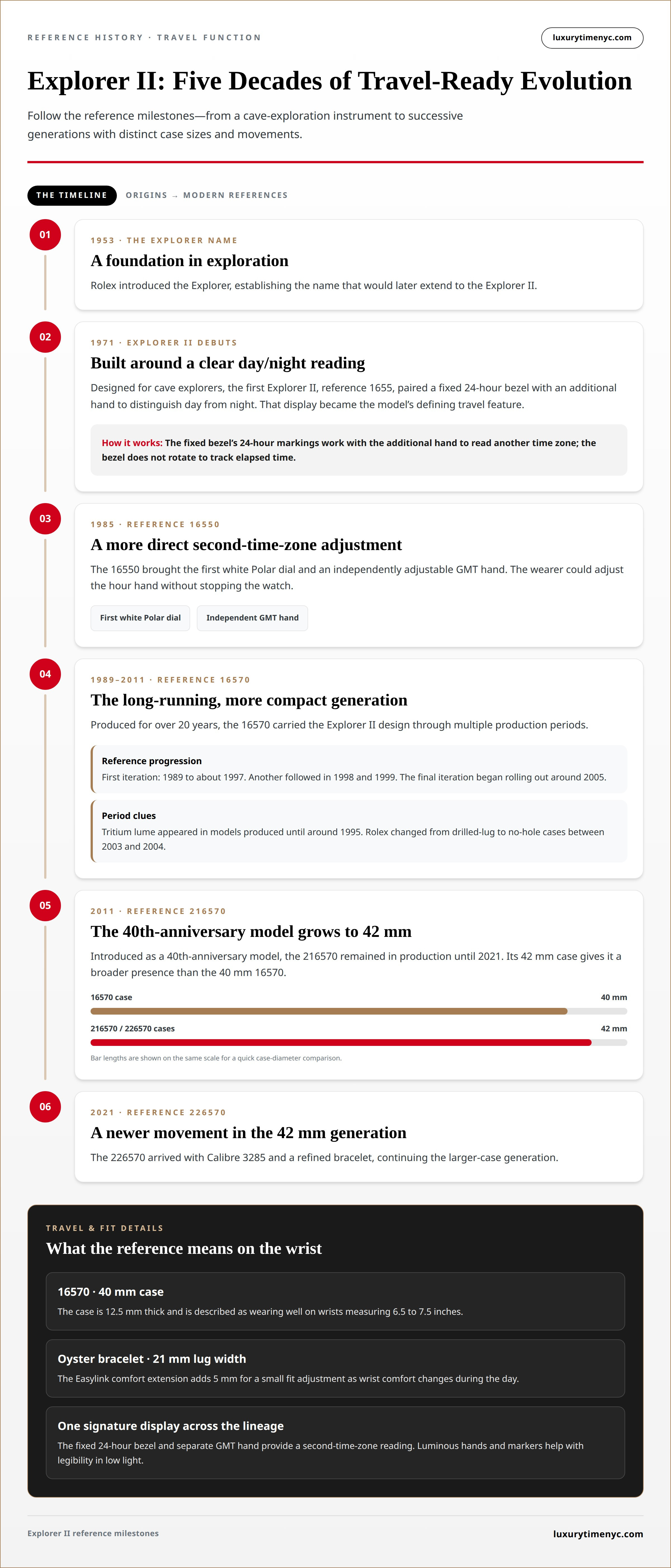
Rolex introduced the Explorer in 1953, establishing a name associated with exploration. The Explorer II followed in 1971, designed for cave explorers who needed to distinguish day from night. Its fixed 24-hour bezel and additional hand gave the model a clear identity within the broader Explorer family. For travelers, that original purpose explains why the Explorer II’s defining display prioritizes a second time-zone reading rather than a rotating timing bezel.
The reference 1655 began the line, with a brushed steel bezel that remains part of its visual language. In 1985, Rolex introduced the 16550, adding the first white Polar dial and an independently adjustable GMT hand. That change made the second-time-zone function more direct: the wearer could adjust the hour hand without stopping the watch. The 16550 therefore marks an important transition from the earliest Explorer II design.
Rolex produced the reference 16570 from 1989 to 2011, giving it a production span of over 20 years. Its first iteration ran from 1989 to about 1997; a second followed in 1998 and 1999. The final iteration began rolling out around 2005. Lume type can offer collectors a useful clue when assessing a 16570’s production period.
In 2011, Rolex introduced the 216570 as a 40th-anniversary model, with a 42 mm case. It remained in production until 2021. The 226570 arrived in 2021, using Calibre 3285 and continuing in production. Those milestones help distinguish successive generations: the 16570 is the long-running, more compact reference, while the later models adopt larger cases and newer movements.
For a traveler choosing among references, history is useful beyond collecting. The 16550 introduced the independent GMT hand; the 16570 sustained the design across distinct production periods; and the 216570 and 226570 represent later generations. Compare the reference number, dial, and movement together. That combination gives a clearer picture of the watch’s place in the Explorer II lineage than appearance alone.
Lume, drilled lugs, and bracelet changes
Lume makes the Explorer II’s hands and hour markers easier to read in low light. On the 16570, tritium lume appeared in models produced until around 1995. That detail helps place an example within the reference’s long production run. Lume is practical on overnight journeys, when cabin lighting changes or a traveler checks the dial after dark. Its condition also adds a visible point of comparison between older watches.
Drilled lugs are another useful detail on the 16570. Rolex changed from drilled-lug to no-hole cases between 2003 and 2004. Holes through the lugs provide direct access to the spring bars, which attach the bracelet to the case. Later no-hole cases have a cleaner exterior. For a traveler, this distinction matters most when assessing the watch’s period and bracelet configuration, rather than its time-zone function.
The Oyster bracelet’s 21 mm lug width gives the Explorer II a broad, balanced connection to the case. Its Easylink comfort extension adds 5 mm, allowing a small adjustment as wrist comfort changes during the day. That is useful after hours in transit, when a bracelet that felt comfortable at departure may feel snug later. The extension adjusts fit without changing the watch’s reference or replacing the bracelet.
The clasp completes that bracelet fit, so assess how it closes and sits against the wrist when trying an Explorer II. The 2021 model brought a refined bracelet alongside updated case proportions. These details distinguish newer examples from earlier 16570 configurations, though the fundamental Oyster-bracelet layout remains recognizable across the line. For a frequent traveler, the key practical choice is between a compact fit and later refinements, with the Easylink adjustment offering added flexibility. Examine the dial’s lume, lug shape, bracelet, and clasp together; those details can help identify a watch’s era and assess its wearing condition.
Differences among Explorer II references
The reference number identifies meaningful differences in fit and movement. A Rolex Explorer II review for travelers should begin with the distinction between the 40 mm 16570 and the 42 mm 216570 and 226570. Those dimensions shape wrist presence, but the generation also determines which calibre powers the watch. Comparing reference, movement, and daily wearing preference gives travelers a more useful basis for choosing than appearance alone.
The 216570 uses Calibre 3187, while the 226570 uses Calibre 3285. Introduced in 2021, the 226570 has an approximately 70-hour power reserve. That additional reserve can matter if the watch is set aside between trips. The 216570, introduced in 2011, offers the larger modern case with its earlier movement. Both share the 42 mm format, yet their calibre and generation distinguish them.
The 16570 remains the smaller option among these references. Its fixed 24-hour bezel and GMT hand provide two-time-zone functionality, while its 40 mm case gives it a different wrist presence from later models. Travelers who prefer a more compact profile may find that distinction more consequential than movement updates. Those who prioritize a longer reserve can weigh the 226570’s specification against its larger case.
For a Rolex Explorer II review for travelers, the practical takeaway is to rank priorities before selecting a reference. Start with case fit, then consider the movement and reserve in relation to how often the watch will be worn. The 16570 emphasizes a smaller case; the 216570 brings the modern 42 mm format with Calibre 3187; the 226570 pairs that format with Calibre 3285. This comparison turns reference numbers into clear, travel-relevant differences.
Luxury Time NYC: Rolex Watches
Luxury Time NYC offers Rolex Watches for readers considering an Explorer II after comparing its references, proportions, and travel features. The reference number, dial details, bracelet, and condition each shape how a particular watch fits your preferences. Watch Authentication is also available when establishing a timepiece’s authenticity is part of your decision.
When you’re ready to move from research to considering a Rolex, Luxury Time NYC can help you explore the watch you have in mind. A focused discussion of the reference and the details that matter to you can clarify your next step. Luxury Time NYC also offers Patek Philippe, Audemars Piguet, and Richard Mille watches.
Contact Luxury Time NYC to discuss Rolex Watches and Watch Authentication.
Choose the Reference That Fits Your Journey
The right Explorer II isn’t necessarily the newest or most collectible reference. It’s the one whose proportions, condition, and character suit the way you travel and wear a watch. A rolex explorer ii review for travelers can narrow the field, but your priorities should guide the final choice. Consider what matters most: an understated profile, a more contemporary presence, or a particular place in the model’s history.
Before deciding, take time to consider the watch as a complete object, not just a reference number. The way it sits on your wrist, the clarity of its dial, and the condition of its bracelet all contribute to everyday satisfaction. For a considered next step, discuss your watch preferences with Luxury Time NYC.
Choose carefully, and the Explorer II can become a considered companion for your journeys.
Frequently Asked Questions
What are the key features of the Rolex Explorer II for travelers?
The Explorer II combines a second-time-zone display, luminous dial details, and a fixed steel bezel in a mechanical watch designed for easy reading. When traveling between time zones, the additional hand can keep one time reference visible while the main hands show local time. Reference choice affects case presence and movement, so compare those details with your wearing preferences.
How does the Explorer II GMT hand and 24-hour bezel work across time zones?
The GMT hand completes one rotation in 24 hours and points to the corresponding hour on the bezel’s 24-hour scale. Set it to a chosen reference time, such as home time, then use the regular hour hand for local time. The Explorer II’s bezel is fixed, so the scale stays aligned rather than rotating to show a different time zone.
What is the Explorer II’s power reserve and water resistance?
Specifications depend on the reference. The 226570, with Calibre 3285, has an approximately 70-hour power reserve; other references use different movements and reserves. The Explorer II’s stated water resistance is 100 meters (330 feet). For a watch that has been stored between trips, its running time depends on its remaining reserve, so allow for resetting if it has stopped.
What is the current US retail price of the Rolex Explorer II?
There is no single retail price for every Explorer II reference and condition. Retail pricing applies to new watches, while pre-owned examples are assessed separately. The reference, condition, and specific watch all matter, so treat these as distinct buying categories rather than interchangeable figures. Luxury Time NYC offers Rolex watches alongside Patek Philippe and Audemars Piguet watches.


