


A trade-in can feel like a continuation of ownership. For U.S. tax purposes, it may still count as an exchange that realizes a gain: a watch held more than one year may qualify for long-term collectible treatment, capped at 28%, according to the IRS. The tax implications of selling a watch collection therefore turn on more than whether cash changes hands.
It’s understandable to assume that applying a watch’s value toward another timepiece simply carries that value forward. In the United States, however, like-kind exchange treatment generally no longer applies to personal property such as watches. Your holding period and adjusted basis help determine the tax result. In France, wristwatches are classified as jewelry under the flat-rate tax rules, so a watch’s classification can also matter.
This guide explains how sales and trade-ins are treated, how inherited ownership and purchase records may affect the calculation, and why rules differ by country. It also covers the distinction between collectibles and jewelry, how holding periods affect tax treatment, and which records can help establish a watch’s basis and sale proceeds.
Key Takeaways
- For inherited watches, the value used as tax basis can shape the gain when the piece is eventually sold.
- A trade-in may still count as a taxable exchange, so compare the watch’s adjusted basis with the value received.
- Holding period affects how a U.S. collectible gain is treated; keep purchase and sale records together.
- In France, a luxury wristwatch’s classification as jewelry can affect which tax regime applies to its sale.
Inherited collectibles and stepped-up basis
An inherited watch’s U.S. basis is generally stepped up to its fair market value on the decedent’s date of death. If heirs later sell it for that same value, taxable capital gain may be $0 USD. A sale above that value can create a gain. Preserve the estate valuation and sale record together: one establishes inherited basis, the other documents proceeds.
Basis and estate tax are separate considerations. U.S. estates worth about $15 million or more, including a watch collection, may be subject to federal estate taxes. The collection’s value should therefore be considered within the estate’s overall assets, not treated as a standalone income-tax calculation. In the Netherlands, an inherited watch is included in the estate for inheritance tax at its value on the date of death; income tax normally does not apply when the watch is later sold as private property.
Donating instead of selling can change the U.S. tax outcome. A qualifying related-use donation to charity may allow a deduction based on fair market value, generally limited to 30% of adjusted gross income. A qualified appraisal is required for a donated collectible when the claimed deduction exceeds $5,000. For unrelated use, the deduction is limited to the lesser of cost basis or fair market value, subject to applicable adjusted-gross-income limits. The charity’s use of the watch matters.
For 2026, the Internal Revenue Service generally requires a third-party settlement organization to issue Form 1099-K when a seller receives more than $20,000 and completes more than 200 transactions during the calendar year. That form reports payment activity; it does not by itself establish taxable income. Keep the inherited valuation, estate documents, and sale proceeds record, even when no form arrives.
Estate planning can also shape how a collection is transferred. In the United States, donating collectibles through an estate plan can reduce the taxable estate by their fair market value at the owner’s death. A documented valuation gives heirs a clearer basis for later decisions.
Can I trade my Rolex toward another watch and avoid capital-gains tax?
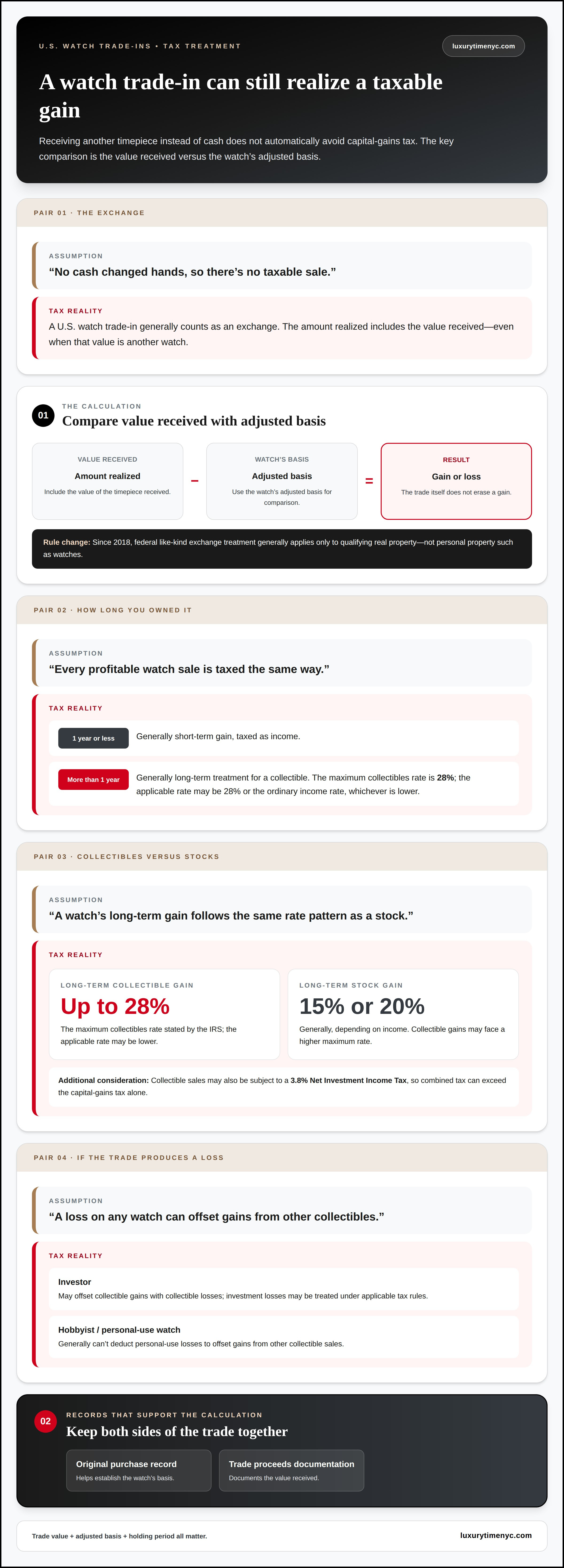
No. A U.S. watch trade-in generally counts as an exchange, so receiving another timepiece instead of cash does not automatically avoid capital-gains tax. The gain or loss is measured by comparing the amount realized, including the value received, with the watch’s adjusted basis. Since 2018, federal like-kind exchange treatment generally applies only to qualifying real property, not personal property such as watches.
Holding period and the watch’s use affect the tax treatment. A collectible held for more than one year may receive long-term treatment, and the Internal Revenue Service states that long-term gains on collectibles may be taxed at a maximum rate of 28%. The applicable rate may be the 28% collectibles rate or the ordinary income rate, whichever is lower. A watch held for one year or less is generally treated as a short-term gain and taxed as income.
Collectibles also differ from stocks. Long-term stock gains are generally taxed at 15% or 20%, depending on income, while collectible gains may face the higher maximum rate. That distinction makes the trade value, purchase basis, and ownership period material. A precise record of the original purchase and trade proceeds helps establish the calculation.
Capital losses can affect the result, but the owner’s purpose matters. A U.S. investor may offset collectible gains with collectible losses, while investment losses may offset gains under applicable tax rules. By contrast, hobbyists generally can’t deduct losses on personal-use property to offset gains from other collectible sales. A loss on a watch kept for personal enjoyment may therefore not reduce taxable gains elsewhere.
Before agreeing to a trade, identify the watch’s adjusted basis and the value received; the exchange itself does not erase a gain. For a discreet assessment of a potential Rolex trade-in, consider the timepiece’s condition, provenance, and market position.
Short- and long-term tax rates on collectible sales
For U.S. federal tax purposes, a watch held one year or less generally produces short-term gain, taxed as ordinary income. A watch held more than one year generally produces long-term gain, subject to the collectibles rate. The Internal Revenue Service states that collectible sales may also be subject to a 3.8% Net Investment Income Tax. Combined tax can therefore exceed the capital gains tax alone.
Profitable hobby sales are generally reported on Schedule D and Form 8949, with a separate entry for each item sold at a profit. Calculate each result from the amount realized and adjusted basis, using the original purchase record and sale documentation. A Form 1099-K reports payment activity, but its appearance does not by itself make the full amount taxable income. Platforms may issue one below the federal reporting threshold.
Frequent watch sales don’t automatically establish dealer activity, and there’s no single transaction count that decides the issue. In the United States, a dealer’s watch held as inventory and sold in the ordinary course of business produces ordinary income, regardless of holding period. The activity’s nature and profit purpose matter; Section 1.183-2 addresses whether an activity is engaged in for profit.
An installment sale may spread collectible-sale gain across multiple years, but it doesn’t eliminate the 28% collectibles rate. This timing option can affect when gain enters taxable income, rather than changing the asset’s tax character. Personal-use losses generally aren’t deductible against gains from other collectible sales; investment losses may receive different treatment.
Keep the original purchase receipt and the document showing sale proceeds. For inherited pieces, retain estate valuation records; for appraisals, tax valuations should comply with USPAP guidelines. Low-value rules depend on jurisdiction: in France, watches sold for €5,000 or less are exempt under the movable-property capital-gains regime. That exemption differs from U.S. reporting rules, where the Form 1099-K threshold concerns payment reporting, not whether a gain is taxable.
Luxury watches classified as jewelry
In France, wristwatches are classified as jewelry for the flat-rate tax on precious objects, regardless of material. The rule applies to both gold and steel watches. This classification can matter even when a collector considers a timepiece an investment asset. A transaction may therefore fall under the jewelry tax rule rather than the precious-metals rule.
The flat-rate tax is calculated on the sale price and is due when the item is sold. For jewelry, works of art, collectibles, and antiques, the rate is 6%; sales of precious metals are taxed at 11%. A French tax resident also owes a 0.5% CRDS charge on the flat-rate tax. Jewelry sales at or below €5,000 are exempt from this flat-rate tax, but the exemption does not apply to precious metals.
There is also a movable-property capital-gains regime. It taxes the gain at 19% income tax plus 17.2% social contributions, a combined rate of 36.2%. The regime reduces the taxable gain by 5% per year of ownership beyond the second year, with full exemption after 22 years. A watch sold for €5,000 or less is exempt under this regime as well. To apply it, the seller must document the purchase date and price.
The distinction has been tested in court. On December 12, 2023, the French Council of State overturned an appellate ruling concerning luxury wristwatches and their treatment as jewelry; the decision is no. 470249. The practical takeaway is to assess both the item’s classification and the applicable regime before calculating tax. Appreciation alone doesn’t determine the amount due.
If you’re preparing a French-market sale, arrange a watch authentication to establish the timepiece’s identity and provenance.
Luxury Time NYC
Luxury Time NYC helps collectors considering a sale or trade understand the watch transaction itself. Its experience buying, selling, and trading high-end timepieces can help clarify a watch’s identity, condition, and market context. Those details can inform your evaluation of an offer alongside tax records and professional tax advice.
Whether your collection includes Rolex, Patek Philippe, Audemars Piguet, or Richard Mille, consider carefully whether to retain, sell, or trade each watch. Review the transaction details before agreeing to terms, especially when a trade may be treated as a taxable exchange rather than a simple transfer of value. Tax treatment depends on your circumstances and jurisdiction, so consult a qualified tax professional for personalized advice.
For a considered discussion of selling or trading a watch, contact Luxury Time NYC.
Shape Your Collection’s Next Chapter
A considered plan for the tax implications of selling a watch collection begins before you agree to a transaction. Assess each timepiece individually: retain it, sell it, or trade it as part of your broader collecting strategy. Clear records of ownership and transaction terms help align financial planning with the collection’s provenance and long-term purpose. Tax treatment depends on your circumstances and the rules where you are taxed.
Luxury Time NYC offers Rolex, Patek Philippe, and Audemars Piguet watches for collectors considering what may complement their collection’s next chapter. The right move may be an acquisition, a carefully considered sale, or a pause before deciding. Approach each option with clarity and discretion.
For a conversation about your collection’s direction, contact Luxury Time NYC. Move forward with care, and let every decision reflect the value of the pieces you hold.
Frequently Asked Questions
Can one choose the most advantageous tax regime?
In some cases, local rules allow an election if the seller meets specific conditions. The tax implications of selling a watch collection can differ under a sale-price-based regime and a gain-based calculation. In France, a seller may choose the movable-property capital-gains regime for a watch sale if the purchase date and price are documented. Compare eligible methods using acquisition records; the outcome depends on the applicable rules and the watch’s history.
Do I pay tax if I sell my watch for less than I originally paid?
Usually, selling a watch for less than its adjusted basis creates no taxable gain. The original purchase price is not always the full basis: sales tax, certain acquisition expenses, and qualifying improvements may affect the calculation. In the United States, a loss on a watch held for personal enjoyment generally isn’t deductible against gains from other collectible sales. Investment-purpose losses may receive different treatment.
Does the holding period matter?
Yes. In the United States, a watch held for one year or less generally produces a short-term gain taxed as income; ownership for more than one year generally receives long-term treatment. The holding period affects the gain’s tax character, not whether you made a profit. Keep acquisition and sale dates with each watch’s records, especially if ownership passed through inheritance or the collection changed hands.
How is the Capital Gain Calculated?
Subtract the watch’s adjusted basis from the amount realized in the sale or exchange. If the amount received exceeds the basis, the difference is generally the gain before the relevant tax rules are applied. Basis can include the purchase price, sales tax, and certain acquisition expenses; qualifying improvements may also adjust it. Routine cleaning, polishing, or repair costs don’t automatically increase basis.
How are profits from selling a watch collection taxed in the United States?
U.S. treatment depends on each watch’s use, holding period, and whether the activity amounts to dealer inventory. The tax implications of selling a watch collection therefore aren’t determined by total proceeds alone; each item’s taxable gain and character matter. Hobbyist profits are generally reported on Schedule D and Form 8949, with entries for profitable items. Dealer inventory sold in ordinary business is ordinary income regardless of holding period.
Are collectible watches taxed as collectibles at the 28% capital gains rate?
Not as a flat rate in every case. For U.S. federal tax purposes, long-term collectible gains may be taxed at a maximum rate of 28%, according to the Internal Revenue Service. The applicable rate may instead be the taxpayer’s ordinary income rate if it is lower. A watch held for one year or less generally receives short-term treatment rather than the long-term collectible rate.


