


Audemars Piguet can hold value exceptionally well, particularly around key Royal Oak references, but performance isn’t uniform across the brand. The top 5 appreciating watch assets to consider are Rolex, Patek Philippe, Audemars Piguet, Richard Mille and Cartier, with the specific model, condition, originality and purchase price all shaping its prospects.
That selectivity matters when considering watches for a diverse portfolio. A celebrated name alone does not make a timepiece a sound investment, and past demand cannot guarantee future appreciation. Strong candidates tend to combine lasting collector interest, distinctive design, and enduring brand recognition.
This guide examines what can support value retention, why Audemars Piguet’s appeal is concentrated in particular references, and how each of the five brands may fit a broader collecting strategy. You’ll also see why condition, service history and a considered purchase price matter as much as the name on the dial.
Key Takeaways
- Assess a watch as a potential investment by weighing its reference, condition, originality, service history and purchase price together.
- Compare Richard Mille, Vacheron Constantin, Omega and Tudor with attention to how collector demand differs by model and market.
- Distinguish broad brand recognition from the stronger resale potential that may be concentrated in particular references.
- Consider how watches could complement other assets, while accounting for resale liquidity and the risks of relying on appreciation.
1. What Makes a Luxury Watch a Good Investment?
Entry-level and professional-grade watch investments differ in rarity, condition, provenance and buyer demand. A lower-cost entry point may provide access to established watchmaking, while a scarce reference may attract a specialized collector. Neither category ensures appreciation. For readers comparing the top 5 appreciating watch assets, the exact reference and purchase price matter more than the prestige of the name alone.
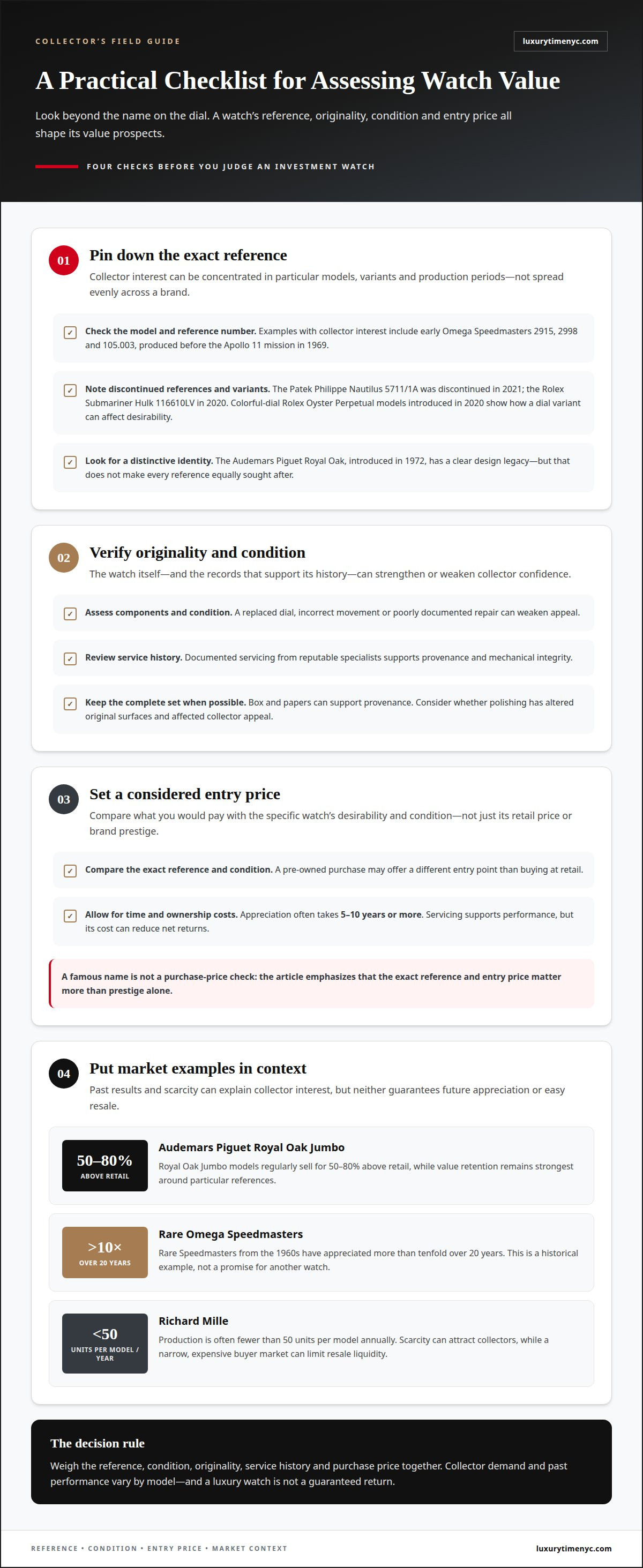
Collectible examples include early Omega Speedmaster references 2915, 2998 and 105.003, produced before the Apollo 11 mission in 1969. The Patek Philippe Nautilus 5711/1A, discontinued in 2021, and Rolex Submariner Hulk reference 116610LV, discontinued in 2020, also attract collector interest. Colorful-dial Rolex Oyster Perpetual models introduced in 2020 show how a dial variant can shape desirability.
Horological fundamentals matter. Assess whether a reference has a distinctive movement, coherent design history and sustained collector recognition. The Audemars Piguet Royal Oak, introduced in 1972, has a clear design identity. Heritage can support demand, but status alone is weaker evidence. Original components, documented servicing and a complete set help establish condition and appeal.
Omega offers examples beyond its Speedmaster chronographs. The Speedmaster was introduced in 1957, and rare examples from the 1960s have appreciated substantially over time. The Seamaster may interest buyers for its own lineage, but potential value depends on the specific reference, originality and condition.
Market timing calls for patience. True watch appreciation often takes 5–10 or more years, and a pre-owned purchase may offer a different entry point than buying at retail. Compare the asking price with the reference’s desirability and condition. Include maintenance in your calculations: servicing supports performance, but adds ownership costs that can reduce net returns.
Risks remain. A replaced dial, incorrect movement or poorly documented repair can weaken collector confidence. Master the essentials before buying: identify the reference, assess originality, review service records and set a considered entry price. A luxury watch can complement other holdings, but it shouldn’t be treated as a guaranteed return. Those same criteria help evaluate the top 5 appreciating watch assets without relying on brand reputation alone.
2. Selective value retention among Richard Mille, Vacheron Constantin, Omega, and Tudor
Value retention varies by reference, even among prestigious brands. Richard Mille production is often fewer than 50 units per model annually, creating scarcity that attracts collectors. Its narrow, expensive buying market also limits the pool of potential resale buyers.
The Patek Philippe Nautilus and Audemars Piguet Royal Oak illustrate how values have changed over time. Royal Oak Jumbo models regularly sell for 50–80% above retail, while value retention remains strongest around particular references.
Vacheron Constantin offers a different profile: select collector pieces retain value, but resale demand is less deep than for Rolex. Omega’s rare Speedmasters from the 1960s have appreciated more than tenfold over 20 years. Tudor’s prospects also depend on the exact model, condition and collector interest, rather than the name alone.
Craftsmanship and history matter, but they work alongside market factors. Collectors respond to constrained supply, recognizable design, cultural relevance and a healthy resale ecosystem. The Audemars Piguet Royal Oak, introduced in 1972, has a distinct design legacy; that heritage helps explain demand for select examples, not every model.
For an investment purchase, assess the reference, originality, condition and entry price together. A replaced dial or incorrect movement can weaken collector confidence. Keep the box and papers when possible, and preserve documented service records from reputable specialists. These details support provenance and mechanical integrity.
Care affects ownership economics. Regular servicing supports performance and longevity, while polishing can alter original surfaces and affect collector appeal. Before buying a pre-owned timepiece, review its condition and records as part of the value assessment. Watch authentication can help establish a watch’s identity and originality.
3. Which watch brand holds value best overall?
Rolex is often a broad value-retention choice because demand and resale activity span many references. Patek Philippe and Audemars Piguet also attract strong collector interest, but premiums concentrate in select models, including the Nautilus and Royal Oak. No brand performs uniformly across its collection.
Rolex Daytona, GMT-Master II and Submariner prices have varied by reference, condition and market cycle. The Daytona 116500LN has traded significantly above retail since its introduction; Rolex models can sell 20–100% or more above original retail. GMT-Master II and Submariner resale prospects likewise depend on the individual watch and its condition.
Market conditions temper those premiums. The secondary watch market peaked in April 2022, and in Q3 2026 the luxury watch market remained about 29% below that peak despite an 8.3% year-over-year rise. Knight Frank’s Luxury Investment Index recorded a 5.1% rise for watches in 2025, a reminder that results depend on the period measured.
Retail and secondary-market prices answer different questions. Retail reflects a brand’s current list price; resale reflects what buyers are willing to pay for a specific reference. In early 2026, over half of Rolex models traded above their original retail prices. That does not mean every Submariner or Daytona carried a premium.
Richard Mille offers a useful contrast. Production is often fewer than 50 units per model annually, yet its narrow buyer pool can make resale less liquid. Scarcity may attract collectors, while broad recognition and an active market can make a Rolex easier to resell.
For a market comparison, match the exact reference, year, dial, condition, and completeness. Compare recent transactions for like-for-like examples, not just asking prices. Authentication and a condition assessment can help distinguish original components from replacements. Complications, provenance, and timeless design may strengthen interest, but demand for the specific reference remains decisive.
4. Portfolio diversification with luxury watches
A luxury watch can add a tangible collectible to a portfolio, but it behaves differently from shares, gold, or other collectibles. There is no single reliable ranking of watch appreciation against those assets: results depend on the specific piece, purchase timing, ownership costs, and eventual resale. Treat watches as a complementary holding, not a substitute for assets with different liquidity and pricing mechanisms.
Concentration matters. Rolex, Patek Philippe and Audemars Piguet accounted for approximately 64% of secondary-market value in 2026. That reflects their market weight, not a promise that every reference will rise. A portfolio built around several watches from the same brand, or one highly sought-after model family, may still depend on a narrow collector base.
Collectors can consider distinct demand drivers. One piece may attract interest for its recognizable design, another for its rarity or horological significance. A Rolex Submariner and a Patek Philippe Nautilus, for example, appeal through different brand histories and reference profiles. Distinctive examples may broaden a collection, but resale value still depends on condition, originality, and buyer demand.
Liquidity deserves particular attention. A recognizable reference with an active secondary market may be easier to sell than an unusual piece sought by a smaller group. Compare the exact reference and condition, then consider how long you could hold it without relying on an immediate sale. Servicing, authentication, and transaction costs can also reduce the return at resale.
Use a measured allocation approach: establish a limit for collectible assets, preserve records for each watch, and avoid assuming prestige alone will protect value. Secondary-market prices can shift with demand and broader market conditions. The practical takeaway is clear: choose watches for their horological merit and collector appeal, while keeping your wider portfolio diversified across assets. Explore authenticated luxury watches when assessing a potential addition.
Luxury Time NYC
Luxury Time NYC is a natural next step when you’re assessing a luxury watch for a collection or portfolio. Its selection includes Rolex, Patek Philippe, Audemars Piguet, and Richard Mille watches, so you can consider distinct brands and references in one place.
For a potential purchase, focus on the exact reference, condition, originality, and documented history. Watch authentication can help establish a timepiece’s identity and originality, important considerations when weighing its collector appeal and resale prospects. The right choice depends on your collecting priorities, not prestige alone.
For a considered next step, contact Luxury Time NYC.
Make Your Next Acquisition Deliberate
Let a watch earn its place in your portfolio through careful selection, not prestige alone. Use the top 5 appreciating watch assets as a starting framework, then define what you want a new acquisition to contribute: horological interest, collecting pleasure, or a different source of potential value. Your priorities should guide the reference you consider and the time horizon you can accept.
Luxury Time NYC offers Rolex, Patek Philippe, and Audemars Piguet watches for collectors considering established maisons. A thoughtful discussion can help connect your interests with a timepiece, while authentication can support confidence in the watch’s identity. The goal is an informed decision, not a hurried purchase.
Contact Luxury Time NYC for watch advice and take a considered next step toward a collection that reflects your own judgment.
Frequently Asked Questions
Does Audemars Piguet hold value well?
Yes, selected Audemars Piguet watches can retain value strongly, especially sought-after Royal Oak references. That strength is concentrated, not consistent across every model. For a specific watch, consider its reference, originality, condition, and collector demand. A less sought-after model from a prestigious maison may behave differently from a sought-after Royal Oak, so brand reputation alone is not a reliable valuation method.
Is Patek Philippe better than Rolex for value retention?
Neither is categorically better: Patek Philippe can command exceptional interest in select references, while Rolex benefits from broad demand across its range. In June 2026, Patek Philippe watches traded at an average of 15.4% above retail, compared with 9.8% for Rolex watches. Those figures describe different brand averages, not a guarantee for an individual Nautilus, Daytona or other reference.
What Makes a Luxury Watch a Good Investment?
A luxury watch is a stronger investment candidate when its reference has collector demand, its components remain original, and its ownership history is well documented. Mechanical condition matters, too. For modern watches, manufacturer service is typically recommended every 5–7 years. A complete service record can help explain the watch’s care, while future maintenance should be included in your assessment of its potential return.
What matters most if I care about resale value?
Prioritize the exact reference, originality and condition, then retain the original box and papers when possible. Original box and papers typically command a 10% to 20% premium in the secondary market. A replaced dial or incorrect movement caliber can reduce market value by up to 30%. These details make documentation and a careful condition assessment central to resale planning.
Which watch brand holds value best overall?
Rolex is often a broad value-retention choice, with resale demand across families such as Datejust, Submariner Date, GMT-Master II, and Day-Date. Patek Philippe and Audemars Piguet can be compelling in particular references, but results are more selective. Choose based on the exact model and likely buyer demand, rather than treating any brand-wide ranking as a prediction for every watch.
Which luxury watch brands and models have appreciated most in value over the past 5–10 years?
There is no single dependable ranking for that entire period, since results vary by reference and measurement window. Early Patek Philippe Nautilus reference 3700 watches have appreciated in recent years. A separate short-window example is the Rolex Datejust 31 reference 6827, whose ownership values rose 68.42% between late 2025 and April 2026. That shorter interval shouldn’t be mistaken for a 5–10-year return.


