


Selling a Rolex without original papers is still possible. Missing documents can affect buyer confidence and the offer, but they don’t automatically make the watch unsellable. Authenticity, condition, originality, and model all help shape its assessment.
A missing warranty card can feel like a gap in the watch’s history, especially when you know its provenance but can’t present the original documents. The distinction matters: a watch can still be authenticated and valued without papers, while any remaining factory warranty has its own documentation requirements.
This guide explains what papers and warranty cards establish, how their absence may influence resale value, and what a professional assessment considers. You’ll also learn which records and accessories can support a sale, how to prepare the watch and its history for review, and when to seek an expert valuation. A transparent, well-organized presentation gives prospective buyers the clearest picture of the timepiece, whether or not the original paperwork is available.
Key Takeaways
- You can sell a Rolex without its original papers; authentication relies on the watch itself, including its serial and reference details.
- Missing papers can affect an offer, but condition, originality, model desirability, and service records also shape value.
- A warranty card can support remaining factory coverage when it corresponds to the watch, while service records help document its history.
- A professional assessment can establish authenticity and condition, helping you present the watch and any supporting records clearly.
Can You Sell a Rolex Without Papers?
Yes. Selling a Rolex without original papers is possible when a professional assesses the watch’s authenticity, condition, and reference. For a U.S. sale, describe the missing papers accurately and don’t imply they’re included. This practical disclosure doesn’t replace any legal obligations that may apply to the transaction.
-
How a specialist checks serial and reference numbers
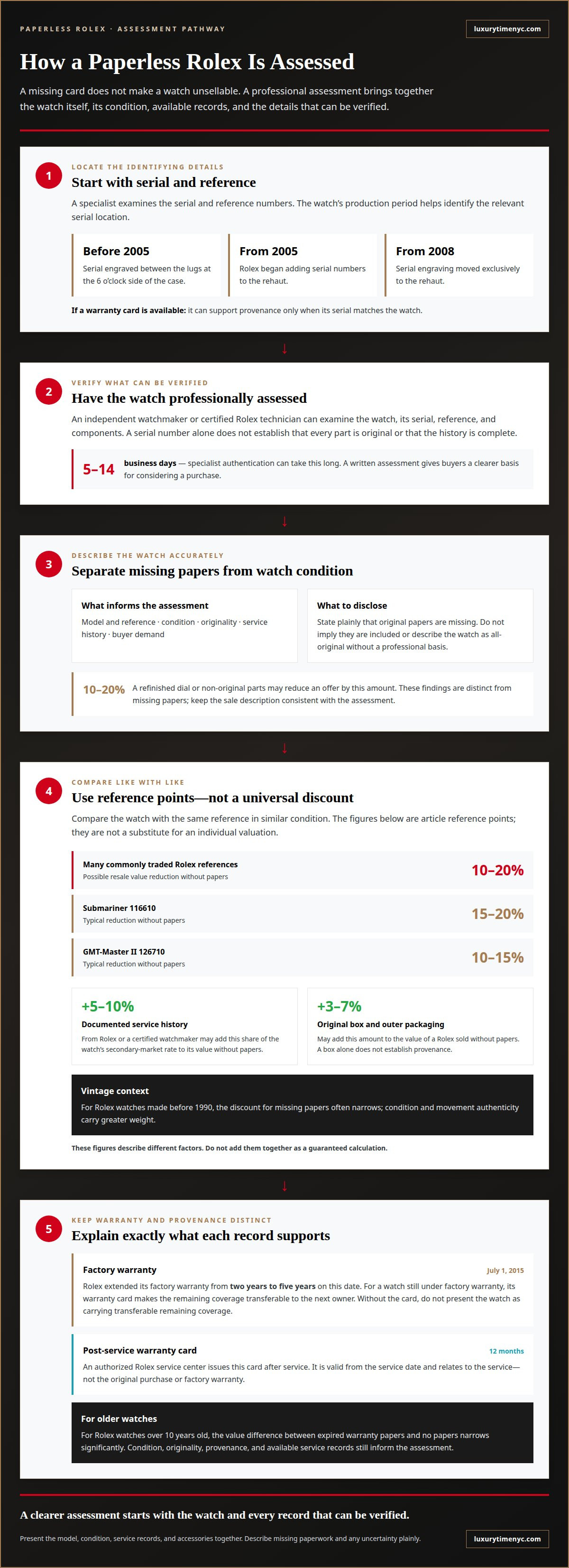
Have a specialist examine the serial and reference numbers as part of the authentication. Before 2005, Rolex serial numbers were engraved between the lugs at the 6 o’clock side of the case. Rolex began adding serial numbers to the rehaut in 2005, then moved serial engraving exclusively to the rehaut from 2008. The watch’s production period helps explain which location is relevant. A matching warranty card can support provenance, but only when its serial matches the watch.
-
How a professional verifies authenticity
Arrange a professional assessment if authenticity or provenance is uncertain. An independent watchmaker or certified Rolex technician can examine the watch, its serial, reference, and components. A serial number alone doesn’t establish that every part is original or that the watch’s history is complete. For example, a Submariner’s reference helps identify the model, while condition and originality inform the assessment. Specialist authentication can take 5-14 business days. A written assessment gives buyers a clearer basis for considering a purchase.
-
Consider paperless sale risks
Set expectations clearly before presenting the watch to buyers. Without original papers, a buyer may have less documentation for assessing provenance, and authentication can become a central concern. A refinished dial or non-original parts may reduce an offer by 10-20%. These findings are distinct from missing papers, so don’t describe the watch as all-original without a professional basis. A pre-sale assessment can clarify its condition and help distinguish verifiable details from unknown history. Keep the sale description consistent with the assessment.
How Much Do Box & Papers Affect Value?
Assess the watch as a whole, not by its missing documents alone. Model, condition, originality, service history, and buyer demand all influence resale value.
-
Assess the impact of missing papers
Compare the watch with the same reference in similar condition. Missing papers can reduce resale value by roughly 10% to 20% for many commonly traded Rolex references. The effect varies by model: a Submariner 116610 without papers typically shows a 15-20% reduction, while a GMT-Master II 126710 typically shows a 10-15% reduction. Treat these as reference points, not a substitute for an individual valuation.
-
Consider service history
Gather service documentation and receipts before a professional inspection. Documented service history from Rolex or a certified watchmaker may add 5-10% of the watch’s secondary-market rate to its value without papers. The records help establish what work was completed and when. Service papers support the watch’s history, but they don’t replace its original documentation.
- Include the original box and related packaging if available. An original box and outer packaging may add 3-7% to the value of a Rolex sold without papers. A box alone doesn’t establish provenance, since accessories can be purchased separately. For vintage Rolex watches made before 1990, the discount for missing papers often narrows; condition and movement authenticity carry greater weight.
- Present the model, condition, service records, and accessories together for a balanced assessment. A desirable luxury watch may retain significant value when it’s well-maintained and all-original, even without papers. Demand also matters, so avoid treating one reference’s discount as universal. A professional watch authentication assessment can help clarify how the watch’s documented history and physical condition inform its valuation.
Warranty cards and remaining factory warranty
Distinguish remaining factory coverage from the watch’s broader provenance and resale appeal. The warranty card matters most when coverage is still active.
- Establish whether the watch may still be under factory warranty. Rolex extended its factory warranty from two years to five years on July 1, 2015. For a Rolex still under factory warranty, its warranty card makes the remaining coverage transferable to the next owner. Without the card, don’t present the watch as carrying transferable remaining coverage.
- Describe the card accurately as evidence of warranty coverage, not a complete account of the watch’s history. Its relevance depends on the watch’s age and whether coverage remains. For Rolex watches over 10 years old, the value difference between expired warranty papers and no papers narrows significantly. A collector assessing an older model will weigh condition, originality, and provenance alongside documentation.
- Keep factory warranty papers distinct from service documents. An authorized Rolex service center issues a post-service warranty card valid for 12 months from the service date. That card relates to the service, not the original purchase or factory warranty. Include it with service records, and describe its purpose and date plainly during resale.
- Present the watch’s model, condition, and available records together during valuation. The absence of an original warranty card doesn’t determine resale value on its own: demand for the reference, originality, and documented service history also matter. Recent service records can help explain the watch’s maintenance, while an expired warranty card may have limited value for an older Rolex. Tie any claims about coverage to the actual paperwork.
How a professional prepares a watch for sale without its warranty card
A missing warranty card changes what can be documented, not what the watch physically presents. A professional can organize the available records and assess the timepiece before sale.
-
Provide available sale documents for review
Gather purchase records, service receipts, and any Rolex service papers for review. These records can help describe the watch’s ownership and maintenance history, but they don’t replace its original papers. Rolex does not issue replacement warranty cards. Keep each document associated with the correct watch, and distinguish service paperwork from proof of original purchase or factory warranty.
-
Ask which documents can support a sale when Rolex papers are missing
No document replaces the original Rolex warranty card or papers. Purchase records, service receipts, Rolex service papers, and a written authentication assessment can support a sale by documenting specific details. A professional can explain what each record establishes without presenting service paperwork as original warranty documentation. This distinction helps keep the sale description accurate about the available evidence.
- Arrange a professional inspection of the watch’s condition and originality. The assessment considers the case, dial, movement, and bracelet, along with the model and serial details. Describe visible wear or non-factory work accurately. A genuine Rolex should be represented according to what the inspection establishes, not simply its appearance or accompanying accessories.
- Prepare a clear inventory of the watch and supporting materials. Include the model and reference, condition notes, available service history, and any box or accessories. Keep copies of communications and offers with the sale records. This organized presentation helps buyers distinguish documented facts from unknown provenance. For an expert review, request professional watch authentication before presenting the watch for sale.
Luxury Time NYC: Rolex Watches
Luxury Time NYC offers Rolex watches and watch authentication for owners preparing a timepiece for sale. Turn to a professional assessment when missing papers leave questions about authenticity, condition, or how to present available records. An informed review can distinguish what the watch itself establishes from what its documents show, helping you approach a sale with a clearer account of its provenance.
Bring the watch and any purchase or service records for assessment. The serial, reference, condition, and originality all contribute to its evaluation. Luxury Time NYC also offers Patek Philippe, Audemars Piguet, and Richard Mille watches.
Contact Luxury Time NYC to discuss your Rolex and its available documentation.
Choose a Clear Next Step for Your Rolex
Selling a Rolex without its original papers is best approached as a considered transaction, not a question of paperwork alone. Decide what you want a prospective buyer to understand about the watch, then make sure its presentation reflects the available evidence. A precise account of its history and condition gives the next conversation a stronger foundation.
Luxury Time NYC offers Rolex, Patek Philippe, and Audemars Piguet watches, with watch authentication among its offerings. If you’re weighing how to present your Rolex or want a professional perspective on its authenticity, contact Luxury Time NYC about your Rolex. A discreet discussion can help you move forward with clarity and confidence.
Frequently Asked Questions
What If You Only Have the Box (or Only the Papers)?
You can still present the watch with whichever item you have, but describe the set accurately. A box alone is an accessory, not proof of the watch’s history. If you have a warranty card, its serial number must match the watch to support provenance. For example, list the box as an included accessory, while treating the watch’s authenticity and history as separate matters for assessment.
What’s more important: the box or the papers?
The papers generally carry more evidentiary weight, especially if the warranty may still be active. A matching warranty card connects the documentation to the specific watch; a box can be acquired separately and doesn’t establish provenance. For an older Rolex with expired coverage, however, collectors may focus more on condition, originality, model desirability, and service history than on either accessory.
Can you sell a Rolex without its original papers?
Yes. A missing card or booklet doesn’t by itself prevent a sale. The watch can be presented for professional authentication, with its model, condition, and known history described accurately. If you have purchase or service records, keep them available as supporting documents, not substitutes for the original papers. This distinction helps a buyer understand exactly what accompanies the watch.
How much less is a Rolex worth without papers?
The reduction depends on the reference, condition, originality, and buyer demand. As examples, a Daytona 116500 without papers typically shows a 10-20% reduction compared with one with papers; an Explorer I 214270 typically shows a 20-25% reduction. These model-specific comparisons illustrate why a single discount cannot reliably price every paperless Rolex.
How do Rolex papers affect resale value by model and age?
Model and age shape how much buyers weigh missing papers. For example, a Datejust 126334 without papers typically shows a 15-20% reduction against one with papers. For vintage Rolex watches made before 1990, the discount often narrows, as condition and movement authenticity become more important. A meaningful comparison uses the same reference and similar condition.
How can a buyer verify a Rolex is authentic without papers?
A buyer can have the watch examined by an independent watchmaker or certified Rolex technician. Professional verification should consider more than an engraved serial: the reference, construction, movement, and visible condition all contribute to the assessment. A serial number can help identify a watch, but it doesn’t establish originality or provenance on its own. Any accompanying card should match the watch’s serial number.


