


Box and papers can support an authentication assessment, but they don’t establish a watch’s authenticity on their own. Knowing what to look for in watch authentication papers means checking whether the documents match the watch’s reference, serial details, configuration, and era. The watch itself matters most: its movement and components must be assessed together, since papers can be forged, swapped, or unrelated to the timepiece they accompany.
It’s natural to find a complete set of box and papers reassuring. But authenticity and originality are separate questions, and a genuine watch may still contain service replacements or altered parts. This guide explains how authentication works in practice, how to distinguish authenticity from originality, and how to assess a watch’s reference, configuration, box, and papers. You’ll learn what documents can support, what they can’t prove, and why the watch’s details deserve close attention.
Key Takeaways
- Compare the papers’ details with the watch’s serial, reference, and era; documents alone can’t authenticate a timepiece.
- Assess authenticity and originality separately, since a genuine watch may include replacement parts or signs of alteration.
- Check the configuration against the correct reference and model generation, where small details can matter.
- Treat the box and papers as supporting evidence. Their presence may add context, but the watch itself remains central to the assessment.
How does watch authentication work in practice?
Authentication considers the watch, movement, and papers together. Match each stated reference, serial, model detail, and date to the timepiece.
Provenance and Paper Review
Provenance is the documented ownership and service history accompanying a watch. It matters because a paper can be genuine yet belong to a different timepiece. Compare document dates with the model’s release timeline and the watch’s apparent era, then read service records as part of that chronology. Documented servicing can support value by reducing buyer uncertainty and showing that the watch has been cared for. Treat gaps or inconsistencies as reasons to examine the watch and records more closely, not as proof on their own.
Reference and Serial Number Checks
A reference identifies a watch model, while its serial helps distinguish an individual piece. Compare the reference and serial on the watch with any corresponding document entries. Check whether the serial format and paperwork dates fit the model’s era. On a pre-owned or vintage watch, markings may be in different places depending on the design. A correct serial alone cannot authenticate the whole watch. It matters only when it agrees with the reference, movement, and other details.
Matching Certificate Details to the Watch
Certificate details should match the watch’s recorded identity and configuration. Compare the reference, serial, model description, and any stated date. Check whether the described configuration suits that model generation. A mismatch may indicate swapped papers, an incorrect description, or a watch assembled with mixed parts. It calls for a broader examination, not an instant conclusion. The certificate supports the assessment, but does not replace inspection of the watch itself.
Movement inspection provides a separate technical check. An examiner can verify the movement and, when possible, whether its caliber is correct for the reference. Functional details matter too: winding, setting, crown engagement, and chronograph operation where applicable. For a vintage piece, compare the dial, hands, bezel, and crown with features consistent with its period. Cross-checking these elements can reveal alterations that paperwork cannot resolve. Authentication rests on their combined consistency.
Distinguishing authenticity from originality
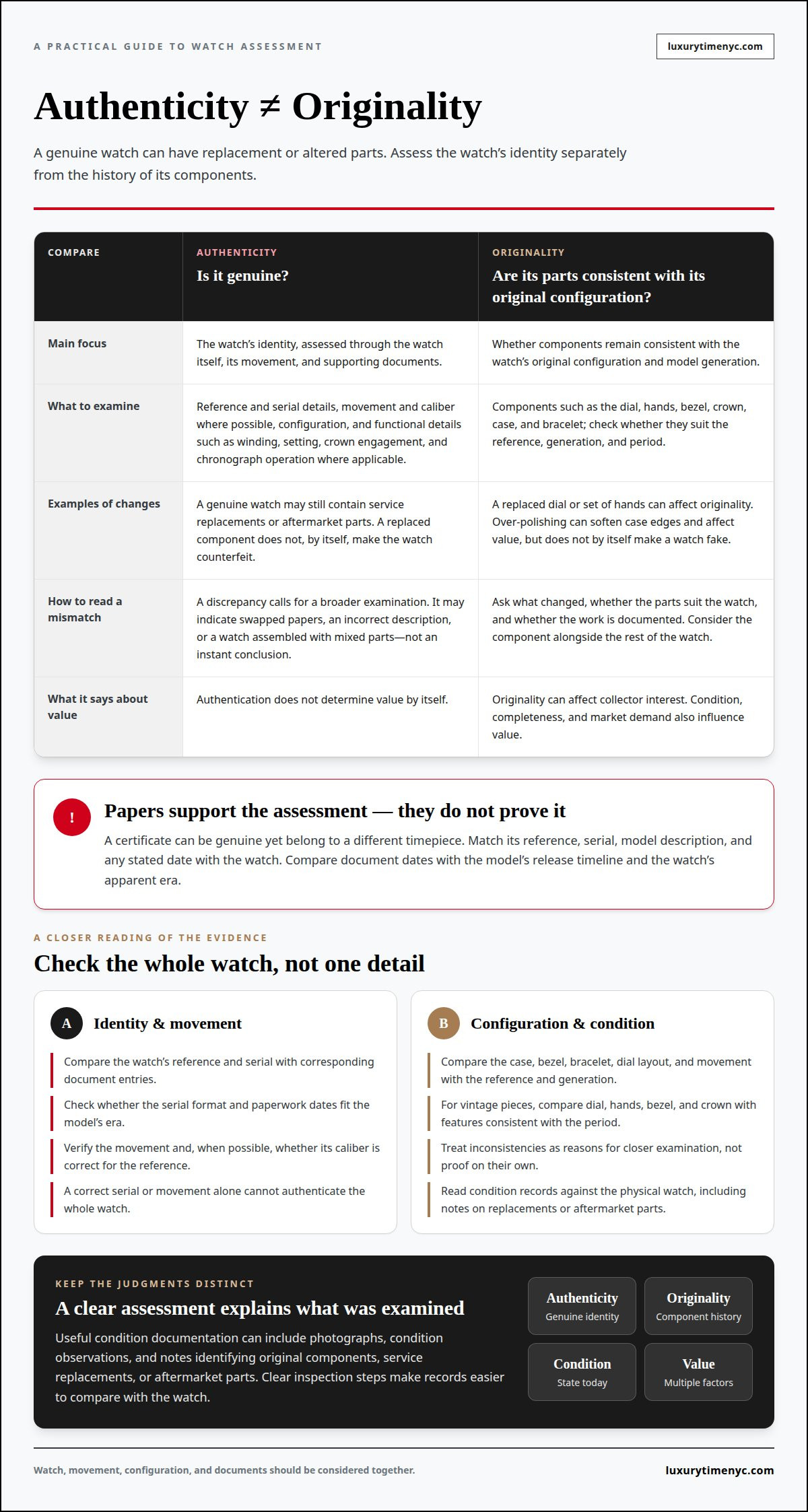
Authenticity asks whether a watch is genuine; originality asks whether its components remain consistent with its original configuration. These are separate judgments. A genuine watch may contain service replacements or aftermarket parts. That distinction matters because a replacement can affect collector interest without making the watch counterfeit. Assess the watch’s identity separately from the history of its components.
A replaced dial or set of hands can affect originality, particularly when the work isn’t disclosed. Over-polishing can soften case edges and affect value, but it doesn’t by itself make a watch fake. Ask what changed, whether the parts suit the watch, and whether the changes are documented. A clear account helps distinguish legitimate service work from undisclosed alterations.
Condition documentation should describe the watch as it is now, rather than simply repeat its certificate details. Useful records can include photographs, condition observations, and notes identifying original components, service replacements, or aftermarket parts. Compare those observations with the physical watch. For instance, a record identifying a replacement dial gives context that a generic authenticity statement cannot. Documentation is most useful when its inspection steps are clear and repeatable.
Keep authenticity, originality, condition, and value distinct. Authentication doesn’t determine value by itself. Condition, originality, completeness, and market demand also influence value. A watch with replacement components may still be genuine, while heavy polishing may affect desirability without changing authenticity. For older watches, condition and originality can matter more than the original box and papers. A written assessment should state what was examined and disclose when a watch is authentic but not fully original. That gives you a clearer basis for understanding the watch, its documented history, and the limits of any conclusion.
Verifying the reference and configuration
A reference identifies a model family, while configuration describes its specific arrangement. Compare both with the watch, since details can vary between generations.
Start with the reference recorded on the watch or its documents. Then compare the watch’s visible design and stated configuration with that reference. A matching reference is a starting point, not a final verdict. One model family may include distinct generations or configurations, so the exact combination matters. The same reference number on paper cannot establish that every fitted component belongs together.
Consider the watch as a coordinated whole. Compare its case, bezel, bracelet, dial layout, and movement with the expected configuration for that reference and generation. For example, a bracelet or dial that seems inconsistent with the model’s period deserves closer examination. A discrepancy may indicate a replacement, modification, or mismatch in the recorded description. Interpret it alongside the other features, rather than treating it as proof on its own.
Configuration also provides context for the movement check. Confirm whether the caliber corresponds to the reference when that information is accessible. Then consider whether the movement and external components form a coherent combination. A correct movement alone does not establish that the watch’s configuration is correct. Likewise, a changed component may affect originality without necessarily changing the watch’s authentic identity. The distinction depends on what changed and how it relates to the model.
An authentication assessment has limits. Some watches cannot be fully authenticated because of brand policy restrictions or unavailable production records. In those cases, an assessment can still describe observable details and explain where verification stops. That boundary matters: a clear account of the reference, configuration, and examined components is more informative than a broad conclusion without supporting detail. It also helps you understand which findings are directly observable and which depend on records that cannot be accessed.
Box and papers as supporting documentation
A box and papers provide context, but neither proves that the watch is authentic.
Digital and Physical Warranty Cards
A digital warranty card is an electronic record of warranty information. It doesn’t automatically replace physical papers as supporting provenance or establish authenticity by itself. Treat it as one document to compare with the watch’s reference, serial, and configuration. A matching record can add useful context, but the timepiece still needs to be examined.
Papers for Resale and Warranty Service
Papers aren’t essential for a resale assessment: a watch can be appraised based on the timepiece and relevant market data. Warranty-service requirements depend on the manufacturer’s process, so possession of papers alone doesn’t establish eligibility. If you’re considering a pre-owned watch without papers, assess its reference, serial, movement, configuration, and condition. An authentication assessment examines the watch itself, while an appraisal can document its description and value for a specific purpose.
Value of the Original Box and Papers
There’s no fixed amount by which a box and papers increase a watch’s value. They can sometimes support value by reducing uncertainty, particularly for higher-end brands and more modern vintage watches. Their influence depends on the watch’s condition, originality, completeness, and market demand. For an older piece, condition and originality may matter more than a complete set. A box can add to completeness, but it cannot resolve a mismatch between the papers and the watch.
For a watch without papers, keep any available ownership or service records and assess the timepiece on its own merits. The absence of documents doesn’t prevent appraisal, but it does mean those documents can’t support its history or identity. If you want a closer examination of the watch and its records, explore professional watch authentication.
Luxury Time NYC: Rolex Watches
Luxury Time NYC offers watch authentication for anyone assessing a timepiece’s identity, condition, and supporting documents. Consider this service when papers raise questions, a reference or configuration needs closer examination, or a pre-owned watch has no accompanying documents. The assessment considers the watch itself, since papers and boxes cannot establish authenticity alone.
For collectors considering a Rolex, Patek Philippe, Audemars Piguet, or Richard Mille, a clear understanding of authenticity and originality can inform the next decision. The same care applies when evaluating the documents accompanying a watch. Luxury Time NYC also offers these manufacturers’ watches for collectors seeking a timepiece. To discuss a watch authentication assessment, contact Luxury Time NYC.
Let the assessment inform your next decision
An authentication review gives you a considered pause before a significant acquisition or change in ownership. Use the findings to decide what documentation to keep and which questions still matter to your decision. This keeps your attention on the individual watch, not simply the reputation of its maker.
Knowing what to look for in watch authentication papers can sharpen your judgment, but its lasting value comes from applying that knowledge calmly. A considered choice may mean proceeding, taking more time, or keeping a piece with a clearer account of its history. Let the evidence guide your pace, especially when a watch holds personal or collection significance.
When you’re ready to discuss an assessment, connect with Luxury Time NYC. Give your next decision the same care as the watch itself.
Frequently Asked Questions
What documents should come with a watch when buying it?
For watch authentication papers, what to look for includes a warranty card, certificate or papers, purchase receipt, and service records, when available. The original box may also be part of a complete set. With a pre-owned watch, ownership or maintenance records can help explain its history. Compare each document with the specific timepiece. A watch can still be assessed without paperwork, so missing documents alone don’t establish that it’s inauthentic.
How can you verify a watch warranty card is authentic?
Knowing what to look for in watch authentication papers means comparing the card’s identifying details with the watch and its other records. Check that the reference and serial information is consistent, the date fits the model’s timeline, and the description suits the timepiece. A convincing appearance isn’t proof: the card may belong to another watch. Treat any mismatch as a reason to examine the watch and documentation together.
How do serial and reference numbers help authenticate a watch?
A reference points to the model, while a serial identifies an individual watch. Together, they help establish whether the documents and timepiece describe the same piece. For example, a serial on a card that differs from the watch is an inconsistency that needs further examination. Matching numbers are useful evidence, but they don’t authenticate the movement or establish that every component belongs with that configuration.
How can you verify watch papers with the manufacturer or an authorized dealer?
Use the manufacturer’s official customer channel or an authorized dealer to ask whether the documents can be reviewed against the watch’s identifying details. Provide the reference, serial, and relevant paper information through the requested process. A brand may limit verification because of its policies or unavailable production records. Understand a response about paperwork alongside a physical assessment, not as confirmation of every component.
What are common signs of forged watch papers?
Warning signs include details that conflict with the watch, such as a mismatched serial, an implausible document date, or a model description that doesn’t fit its reference. Papers may be genuine but swapped from another watch, so a convincing appearance alone proves little. Consider the card alongside the watch’s movement, configuration, and history. A discrepancy calls for closer review, not an automatic verdict.


