


The Pasha’s appeal is its rare balance of bold design and genuine Cartier heritage. Redesigned in 1985 with Gérald Genta’s assistance, it carries a history that reaches back to an early-1930s commission and its entry into Cartier’s permanent collection in 1943. A considered review of the Cartier Pasha’s history and design explains why collectors look beyond the dial to understand its character.
Its rounded case, distinctive crown cover and protective dial grid give the watch an unmistakable presence, while its evolution across decades offers more than a single modern interpretation. If you’re weighing whether a Pasha merits a place in your collection, the key is to understand how its design, lineage and reference-specific details shape the choice. This guide traces Cartier’s path from jeweller to watchmaker, explores the Pasha’s signature features, and explains what influences its market value without reducing a historic timepiece to a price alone.
Key Takeaways
- Recognize how the Pasha’s crown cap and dial details create its distinctive wrist presence.
- Compare references by case proportions and complications to find the design that suits your preferences.
- Assess a Pasha’s value through its reference, materials, condition, and mechanical features rather than relying on the name alone.
- See how Cartier’s heritage as both jeweller and watchmaker informs the Pasha’s balance of ornament and engineering.
Why Should You Buy Pasha De Cartier Watches?
The Pasha’s appeal comes from a design history that predates its modern form. Thami El Glaoui ordered a Pasha-like watch in the early 1930s, and a 1943 photograph shows a watch with a crown cover and protective metal dial grid. Cartier’s permanent collection included the Pasha in 1943. A Cartier Pasha review and history guide helps place these early design cues in context, rather than treating the watch as a recent stylistic departure.
In 1985, Cartier redesigned the Pasha with Gérald Genta’s assistance. Its rounded case and capped crown gave the design a distinct presence, balancing formal elegance with sports-watch character. Genta’s contribution shaped the modern Pasha, while the earlier commission and photograph reveal the design’s deeper roots. That layered story is part of its appeal to collectors.
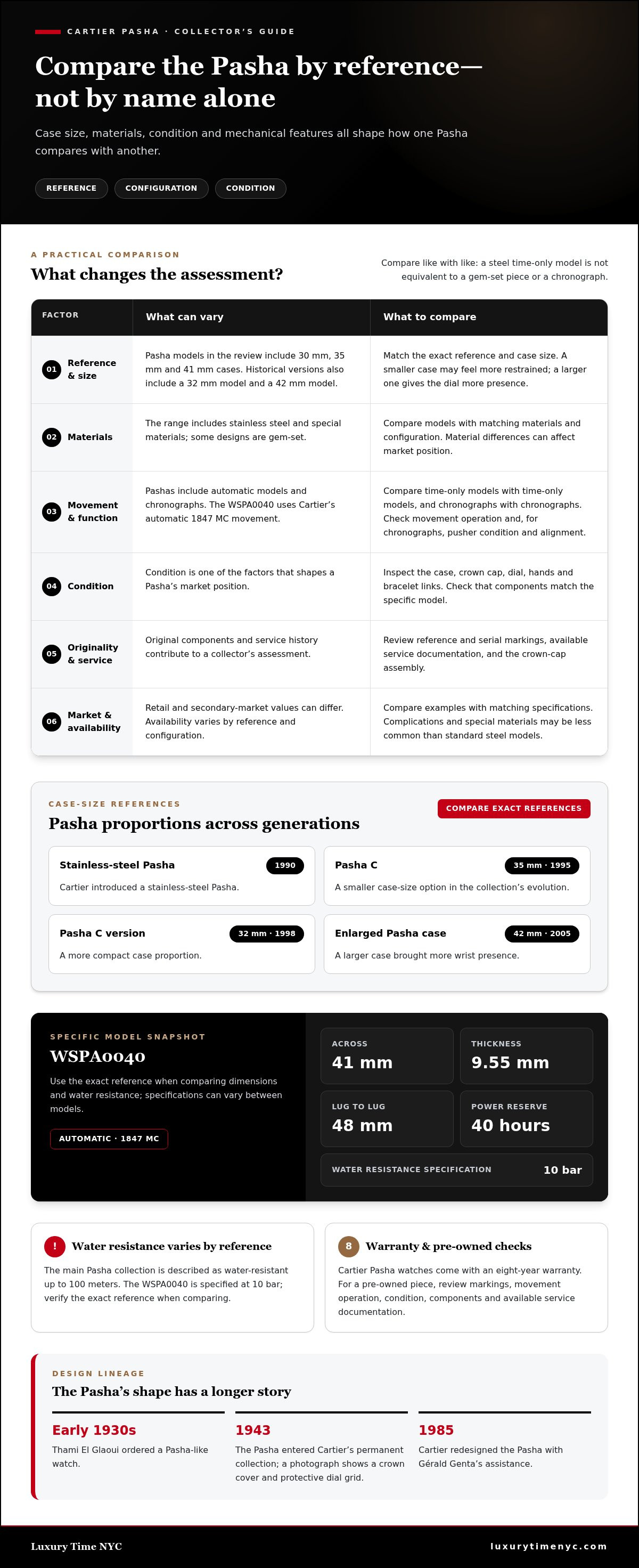
Cartier’s later models reflect changing proportions and materials. The brand introduced a stainless-steel Pasha in 1990, followed by the 35 mm Pasha C in 1995 and a 32 mm version in 1998. Cartier enlarged the case to 42 mm in 2005. These variations let collectors compare wrist presence and period character when choosing among models.
Bezel details also shape a Pasha’s appearance. A fluted bezel adds ridges around the dial, but it is not an elapsed-time scale. A salmon dial brings a warmer color, and its tone and pattern can change the watch’s overall impression without altering the recognizable case design.
A Cartier Pasha review and history is more useful when it compares the watch with alternatives. The Santos has a more angular silhouette, while the Rolex Datejust has a classic round profile. The Pasha stands apart with its rounded case and crown cap. Compare the shape and wrist presence of each before choosing the design that suits your preferences.
Signature dial, crown cap, and case details
The Pasha’s crown cap is more than a decorative detail. It gives the round case a distinctive profile and draws attention to the crown. A cabochon set into the cap adds a polished touch of color against the metal. On some versions, the cap screws down over the crown, making it part of the watch’s tactile character. When comparing individual pieces, examine the cap and how it attaches.
Case dimensions help explain how the Pasha wears. The stainless-steel WSPA0040 measures 41 mm across, 9.55 mm thick, and 48 mm lug to lug. These measurements describe more than diameter: lug-to-lug length affects how the watch spans the wrist, while thickness shapes its profile beneath a cuff. The main Pasha collection is described as water-resistant to up to 100 meters. The WSPA0040 is specified at 10 bar, so use the exact reference when comparing resistance.
Dial details vary by reference. Where present, a guilloché pattern adds texture that shifts in the light; a clean dial keeps the focus on the hands and markers. Consider how the pattern, color, and case finish work together rather than judging the dial alone. Check the specifications for the crystal material, too. Sapphire crystal is a feature to confirm for the specific model, not assume across every generation.
Chronograph Pashas add pushers to the case, creating a busier layout around the crown cap. Their placement and operation distinguish them from time-only models. Check the pushers’ condition and alignment along with the crown assembly, since these controls are essential to using the chronograph. Cartier’s Santos offers a different case design, while the Pasha’s rounded form and capped crown remain distinctive. Assessing these details makes reference comparisons more precise.
Price and technical specifications
A Pasha’s market position depends on its reference, materials, complication, condition, and whether it’s new or pre-owned. Retail and secondary-market values can differ, so compare like with like: a steel time-only model isn’t equivalent to a gem-set piece or chronograph. Bracelet configuration, original components, and service history also shape a collector’s assessment. A cartier pasha review and history is most useful when it distinguishes these reference-specific factors.
At the time of the review, Pasha models measured 30 mm, 35 mm, or 41 mm. The range includes automatic models and chronographs, with different case sizes and dial displays. A smaller case may suit a restrained fit, while a larger one gives the dial more presence. Compare the exact reference and configuration rather than treating every Pasha as interchangeable.
The WSPA0040 uses Cartier’s automatic 1847 MC movement and has a 40-hour power reserve. That reserve describes how long the watch runs after being fully wound and removed from the wrist. Numerals, dial layout, case material, and strap or bracelet can vary by reference. Some Pasha designs draw on the Pasha of Marrakesh legend, connecting the watch’s visual character to its history.
Cartier Pasha watches come with an eight-year warranty. For a pre-owned example, examine the reference and serial markings, movement operation, case condition, crown cap, and bracelet links. Compare the dial, hands, and components with the specific model, then review available service documentation. These practical checks help assess originality and condition before purchase.
Availability varies by reference and configuration. Complications and special materials may be less common than standard steel models. First decide which size, movement type, function, dial style, and bracelet you prefer. Then compare examples with matching specifications. In a Cartier Pasha review and history, these details make price comparisons more meaningful than broad listings.
Cartier’s history as a jeweller and watchmaker
Cartier’s story began in 1847, when jeweller’s apprentice Louis-François Cartier founded the maison. That origin matters to the Pasha: its appeal rests not only on mechanical function, but also on a jeweller’s sensitivity to form, surface, and proportion. Cartier’s watches bring those disciplines together, giving the Pasha a design language that feels at home in both horology and fine luxury.
The transition into watchmaking gathered force with the Santos in 1904. Cartier’s history of watches therefore reaches beyond later icons, linking the maison’s early craft to a landmark wristwatch. The Santos, introduced in 1978, shows how Cartier continued to present watch design through a distinctive case and recognizable silhouette. Comparing it with the Pasha reveals different expressions of the same house identity.
Cartier also shaped its identity through broader changes in luxury. In 1977, the maison launched Le Must de Cartier, a diffusion line that marked a new chapter in its commercial history. Alain-Dominique Perrin served as Cartier’s CEO from 1975 to 1998, a period that included this launch. These milestones provide context for the Pasha’s place within a maison balancing heritage with evolving design.
The Pasha reflects Cartier’s dual heritage. Its case and crown emphasize visual distinction, while its movement and power reserve address the technical demands of watchmaking. Neither element stands alone: Cartier’s jewellery origins help explain the focus on finish, and its watchmaking history gives the design a practical horological foundation. The result is a luxury watch shaped by both craft traditions.
For collectors, this history offers a useful lens when comparing an edition or reference: consider its design alongside its movement, condition, and place in Cartier’s evolving watchmaking story. To continue your research, explore the maison’s watches through a specialist retailer.
Luxury Time NYC: Rolex Watches
Luxury Time NYC offers Rolex watches for collectors comparing the Pasha’s distinctive design with other watchmaking traditions. If you’re weighing case profiles, dial styles, or brand histories, exploring Rolex alongside Patek Philippe, Audemars Piguet, and Richard Mille can help you clarify your preferences. Each brand brings its own design language and horological character, making this a useful next step after considering the Pasha’s heritage and specifications.
Turn to Luxury Time NYC when your search extends beyond Cartier and you’re considering one of these established watchmakers. Contact Luxury Time NYC to discuss your watch interests.
Choose the Collection That Speaks to You
Use this Cartier Pasha review and history to inform your next step, not dictate it. A watch becomes a lasting choice when its proportions, design, and place in your collection feel right to you. Consider what matters most: a distinctive silhouette, a particular maker’s heritage, or a new direction for your collection.
If your search extends beyond Cartier, Luxury Time NYC offers Rolex, Patek Philippe, and Audemars Piguet watches. Comparing these brands can help you refine what you value in a timepiece, from visual character to horological tradition. The right choice is the one that reflects your collecting priorities.
For a considered next step, contact Luxury Time NYC to discuss your interest in fine watches. Continue your search with confidence, guided by the details that matter to you.
Frequently Asked Questions
What is the history of the Cartier Pasha watch?
The Pasha’s story includes both distinctive design and increasingly complex watchmaking. Cartier introduced an automatic perpetual-calendar Pasha in 1989. The Collection Privée Cartier Paris (CPCP) period ran from 1998 to 2008, beginning with a tourbillon model in 1998. Cartier produced four Pasha CPCP tourbillon models, each limited to 10 pieces. These editions show how the line developed beyond its signature case design.
When was the Cartier Pasha first introduced, and who designed it?
Cartier added the Pasha to its permanent collection in 1943. The modern design was later redesigned in 1985 with Gérald Genta’s assistance, so he contributed to its evolution rather than originating the earlier Pasha. Cartier expanded the collection with a stainless-steel version in 1990 and the 35 mm Pasha C in 1995, giving the design new material and size expressions.
What are the key design features of the Cartier Pasha?
Recognizable elements include a round case, a crown protected by a cap, and a dial design with strong visual presence. Complications create further distinctions between references: Cartier presented the Pasha Day & Night as a limited edition of 20 pieces in 1999. For collectors, comparing the reference’s dial layout and complication helps distinguish a time-only design from a more elaborate Pasha.
What are the movement, water-resistance, and power-reserve specifications of current Pasha models?
Specifications vary by reference and complication. The 2020 collection offered 35 mm and 41 mm cases, with 100 metres of water resistance. The 41 mm Pasha Chronograph launched in 2021; its automatic calibre 1904-CH MC has a 47-hour power reserve and 100 m water resistance. Check a specific reference’s specifications, since figures for one Pasha shouldn’t be applied to another.
What do owners and watch experts say about the Cartier Pasha?
A balanced assessment considers the Pasha’s distinctive design, reference-specific features, and suitability for the wearer. Its capped crown and rounded case set it apart from more conventional designs. Collectors may also consider whether a complication, such as a perpetual calendar or tourbillon, adds meaningful interest. For any individual example, condition, originality, and service history offer a more useful basis for evaluation than general impressions alone.


