


The best way to liquidate watch assets in NYC is to document the watch’s condition and authenticity, gather its box and papers, then compare written offers and sale terms. A specialist dealer may provide a direct route for modern Rolex or Patek Philippe watches. A rare or historically significant piece may suit an auction, where timing and proceeds depend on the sale. Start by establishing exactly what you own.
The offer matters, but so do the terms behind it. Condition, documentation, the type of buyer, and payment timing can all affect the outcome. A rushed sale may also mean accepting less than you might receive by allowing time to find a buyer.
This guide covers how to prepare a luxury watch for sale, compare selling routes in New York City, and keep a clear record of the transaction. You’ll learn what to gather before an appraisal, why Rolex and Patek Philippe watches may call for different approaches, and what to document when payment is made. A measured process helps you weigh timing against potential proceeds and avoid surprises.
Key Takeaways
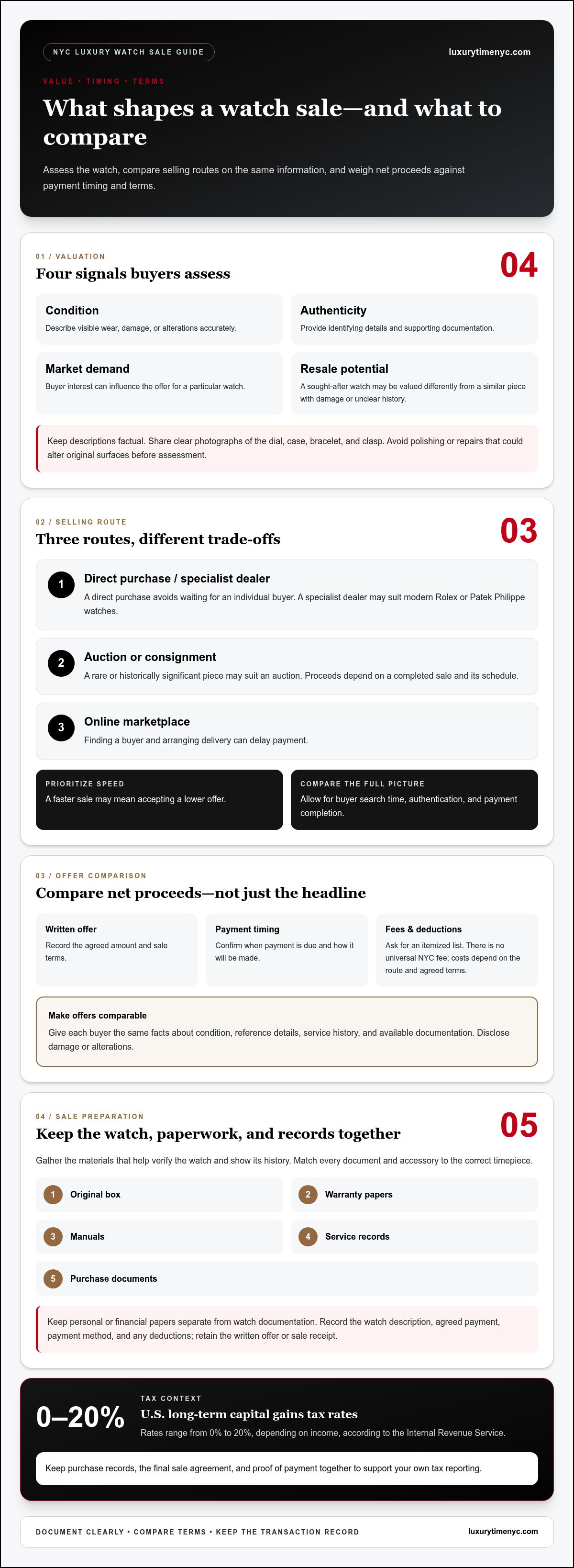
- Assess condition, authenticity, and market demand before weighing offers; avoid rushing into a steep discount for speed.
- Gather the original box, warranty papers, and service records to support verification and present the watch’s history clearly.
- Compare payment timing and settlement terms across selling routes, then keep a written record of the agreed amount and transaction.
- Choose a New York City sale route that suits the watch: a direct professional buyer, specialist dealer, or auction may fit different pieces and priorities.
- Include tax context in your planning: according to the Internal Revenue Service, long-term capital gains tax rates in the United States range from 0% to 20%, depending on income.
Factors that influence a watch’s resale value
Start with a careful valuation, then compare likely net proceeds with the timing and terms of each selling route. Condition, authenticity, demand, and resale potential all influence offers in New York City.
-
Assess Resale Value Factors
Record the maker, reference details, visible condition, and service history before requesting offers. Buyers consider authenticity, demand, and resale potential, so a sought-after Rolex in strong condition may receive a different valuation from a similar watch with damage or unclear history. Keep your description factual. Unsupported claims about rarity can undermine confidence.
Don’t overlook basic physical maintenance, but avoid polishing or repairs that could alter original surfaces before assessment. Provide clear photographs of the dial, case, bracelet, and clasp. These details help buyers evaluate condition consistently and identify questions that may affect payment. Compare professional quotes on the same information, rather than judging one offer without context.
-
Consider Liquidation Timelines
Choose a selling route based on how soon you need payment and how much price uncertainty you can accept. A direct purchase avoids waiting for an individual buyer. Auction or consignment proceeds depend on a completed sale and its schedule. Online marketplaces also require finding a buyer and arranging delivery, which can delay payment.
A fast sale may require accepting a lower offer. Weigh that trade-off against the time needed to reach buyers, authenticate the watch, and complete payment. Get the terms in writing, including when payment is due and what deductions apply. Compare net proceeds, not just headline offers.
- Request an itemized list of fees and net proceeds before accepting an offer. NYC watch dealers, auction houses, and consignment businesses do not have one universal fee. Costs depend on the selling route and agreed terms. Review any commission or other deductions in the agreement, then compare the final payment across offers.
For an in-person New York City appraisal, bring the watch, its reference details, service history, and available documentation. Share clear photographs and disclose damage or alterations. Compare valuations based on the same information about condition so you can understand why offers differ.
- Include tax planning in your sale records. In the United States, long-term capital gains tax rates range from 0% to 20%, depending on income, according to the Internal Revenue Service. Keep purchase records, the final sale agreement, and proof of payment together to support your own tax reporting.
For example, disclose an incomplete service history for a Patek Philippe before comparing offers. Buyers can assess the watch using the same facts, and you can decide whether timing, sale terms, or potential proceeds matter most.
Original boxes, warranty papers, and other factory documentation
Gather the watch’s accompanying materials before presenting it for sale. Original boxes and warranty papers can support authenticity checks and increase resale payout.
- Collect the original box, warranty papers, manuals, service records, and purchase documents in one place. Match each item to the correct watch, especially when sorting several family pieces. Mixing a Rolex box with Patek Philippe papers can create confusion and slow the review.
Check that warranty papers match the watch’s identifying details, and organize documents by purchase or service date. Include receipts or records for completed work when available. Don’t make assumptions about service history; let the documents show what was done and when.
- Separate watch-related materials from family keepsakes and unrelated papers before clearing a home or estate. Set aside letters, photographs, credit statements, and legal or financial records rather than placing them with items for sale. This helps keep personal documents out of the transaction.
If you’re clearing several rooms or collections, photograph the contents before moving items. Make a short inventory identifying each watch and its matching box or papers. For example, create a folder for each watch and list its warranty card, service receipt, and original packaging.
- Prepare identification and transaction records for the appointment. Bring valid identification when completing a watch sale in New York City, and keep a copy of the written offer or sale receipt. Record the watch description, agreed payment, payment method, and any deductions together.
Keep financial records separate from the watch’s factory documents. A bank statement or credit record may contain private information that does not belong in the sale package. Before handing over papers, distinguish documents that support the watch’s history from personal records or account information.
- Present the materials in a clear order: watch, matching warranty papers, service history, then box and accessories. This lets buyers assess the watch and its documentation together. If a document is missing, describe the set accurately rather than implying it is complete.
For a focused review of identifying details, organize the paperwork alongside the timepiece before exploring watch documentation and authentication. Keep the originals secure until the sale terms are agreed, then note which materials transfer with the watch. A precise record protects the clarity of the transaction for both parties.
Sale settlement timelines and recordkeeping
Plan the estate schedule around each watch’s selling route, payment timing, and building access requirements.
- Plan the estate-clearance sequence before moving or selling anything. Photograph rooms and their contents first; the images can help assess potential value. List each watch separately, then record its location, accompanying items, and next step.
In a New York City building, visitor rules and security procedures can complicate an on-site estate sale. Before arranging access, establish who will handle packing and transport, what the buyer will purchase, and how payment will be made. This keeps the clearance plan aligned with real estate deadlines.
- Match the selling route to your required payment timing. An outright purchase can provide payment without waiting for individual items to sell. With consignment, payment follows the sale. Online marketplaces require finding a buyer and arranging delivery before payment.
An auction’s schedule and bidding affect both timing and final proceeds. Moderately liquid assets can take several days to a few weeks to sell, depending on demand and redemption rules. Treat that range as a general liquidity comparison, not a watch-sale deadline.
- Write down the transaction terms before transferring a watch. Record the agreed amount, payment method, payment timing, and any deductions. For consignment, note how the sale will be reported and how an unsold watch will be returned under the agreement.
Keep the signed sale record with proof of payment and the watch’s identifying details. For example, a Rolex file can include its reference information, transaction date, and receipt. This creates a clear record if you later need to reconcile estate accounts.
- Coordinate building access and transport separately. Ask whether the buyer is insured and can meet the building’s certificate-of-insurance requirements. Confirm who will pack and carry each item, and arrange access according to the property’s security procedures.
Keep a simple timeline of appraisal appointments, handover, payment, and estate-clearance milestones. Record the next action and the person responsible at each stage. If a watch sells before the remaining contents are cleared, update the inventory and keep its settlement record with the estate file.
Selling a luxury watch in New York City
Choose a selling route by comparing payment terms, buyer fit, and the time needed to complete the transaction. New York City’s Diamond District is a local option for in-person watch sales.
- A direct purchase gives you an offer for the watch, while an auction’s final price depends on bidding and timing. A private sale requires finding a buyer and arranging delivery. Compare net payment and timing rather than assuming one route will always produce more.
Compare Watch Sale Prices
Compare written offers based on the same watch details, condition, and documentation. Ask each buyer to state the payment terms and deductions, then compare the resulting net amount. Auction results depend on bidding, while private sales depend on buyer interest and delivery. Market conditions and the watch’s appeal also matter, so compare like with like.
- Choose a buyer category that fits the watch. Specialist dealers may suit high-end modern pieces; auctions may suit rare investment-grade or historic vintage watches. An auction follows its schedule, while a direct professional purchase can provide a more immediate in-person transaction.
Identify Dealers and Auction Houses
Look for New York City specialist watch dealers and local watch buyers who handle luxury timepieces. For a rare or historically significant watch, consider auction houses that accept this category, while accounting for auction scheduling. Compare professional quotes and written terms. Bring valid identification when completing an in-person sale, and retain the transaction record.
- For a seller, the practical steps are straightforward: bring valid identification and keep a clear record of the sale. New York City and New York State tax provisions also address specific business matters, including unpaid business-tax judgments and corporate dissolution.
The New York City Department of Finance can levy bank accounts and seize non-exempt assets to collect unpaid business-tax judgments. Separately, a New York corporation with New York City tax liability must obtain written consent to dissolve from the New York City Commissioner of Finance. These provisions concern debt enforcement and corporate dissolution, not the price of a watch sale.
- Keep the watch handover separate from any personal or business debt matter. Selling a watch does not itself settle a business-tax judgment or complete a corporation’s dissolution. Record the buyer, payment, and date, and keep the signed sale documents with your financial records.
Before accepting an offer, verify that the written terms match the watch and agreed payment method. Compare direct purchase, auction, and private-sale routes against your priorities. An auction estimate is not a guaranteed result, and a private inquiry is not a completed sale.
Selling Rolex and Patek Philippe watches
Choose a route that reflects each watch’s condition, documentation, rarity, and required timing. Rolex and Patek Philippe pieces can attract different buyers, so assess them individually rather than treating a collection as one lot.
- Identify each watch before requesting offers. Record its reference details, visible condition, service history, and whether its original box and papers are present. A Rolex with complete documentation and a Patek Philippe with a distinctive history should be assessed separately. These details help buyers evaluate the specific watch, not just its brand.
Photograph the dial, case, bracelet, clasp, and any visible wear. Describe repairs or alterations factually. Don’t assume age alone makes a watch rare or that every watch from a respected maker has equal demand. Accurate details make valuations easier to compare.
- Compare direct professional offers with auction terms before choosing. A direct purchase can suit sellers who want a straightforward transaction. Auctions may suit rare investment-grade or historic vintage watches, but timing depends on the schedule. Ask how each route handles authentication, reserve terms, payment, and deductions.
Consider the watch’s likely audience. A modern Rolex or Patek Philippe with box and papers may suit a specialist dealer. A historically significant piece may be better suited to an auction department with relevant expertise. Compare potential net proceeds and timing, not just an estimate or initial offer.
- Decide whether selling watches individually or as a collection better serves your goals. Separate watches with distinct documentation or provenance, then compare individual offers with any combined proposal. A buyer may value a complete, coherent collection differently from unrelated pieces. Ask how each valuation was reached before agreeing to transfer multiple watches.
Prioritize security during an in-person handover. Keep the watch with you until the transaction terms are clear, and document the agreed payment method and transfer. Bring valid identification when completing a sale in New York City. Keep the receipt and record which accessories or papers accompanied each watch.
- Decide whether speed or access to a wider audience matters more. An auction requires an appropriate schedule and interested bidders; a direct sale avoids waiting for an auction result. Neither route guarantees the same outcome for every Rolex or Patek Philippe. Demand, condition, documentation, and buyer interest all affect the offer.
To discuss a Rolex or Patek Philippe sale, share your watch details for a professional review. A considered comparison can help maximize clarity around the watch, proposed terms, and settlement before you proceed.
Luxury Time NYC: Rolex Watches
Luxury Time NYC buys, sells, and trades luxury watches, including Rolex, Patek Philippe, Audemars Piguet, and Richard Mille. If you’re liquidating more than one piece, you can discuss each watch individually or consider how it fits into the collection.
Talk with Luxury Time NYC when you want to discuss a luxury watch with a New York buyer familiar with these brands. Bring the watch’s details and available documentation for a focused conversation about its condition, authenticity, and possible next steps. The right route depends on your priorities, including timing and payment terms.
Contact Luxury Time NYC to discuss your watch.
Choose Your Next Move With Care
The best way to liquidate watch assets in NYC is the route that aligns with your priorities, not simply the first offer you receive. Before taking the next step, decide what matters most: a direct transaction, a particular payment timeline, or keeping your options open while you consider the watch’s place in your collection. That decision gives the conversation a clear purpose.
Luxury Time NYC buys, sells, and trades luxury watches, including Rolex, Patek Philippe, and Audemars Piguet. If you’re considering selling or trading a watch from one of these makers, bring its details and your preferred outcome to the discussion. A focused conversation can clarify the next steps while keeping your priorities in view.
Contact Luxury Time NYC to discuss your watch. Take the next step with care and clarity.
Frequently Asked Questions
What are the best ways to sell or liquidate a watch collection in NYC?
The best way to liquidate watch assets in NYC depends on whether you prioritize speed, control over the sale, or access to collectors. For a collection with varied models, separate modern pieces from rare or historic watches before choosing a route. A direct sale can suit pieces you want to sell together, while an auction schedule may better fit watches that need a specialized audience. Compare the terms for each piece.
What documents and proof of ownership are needed to sell a watch in NYC?
Bring identification and any records connecting you to the watch, such as a purchase receipt, insurance schedule, or estate inventory. These ownership records differ from factory papers, which help identify the watch and document its history. For an inherited watch, estate paperwork can clarify its origin. Keep copies of records you hand over, and note which originals accompany the watch.
How long does it take to sell a watch through an NYC dealer, auction, or consignment shop?
Timing depends on the selling route and whether a buyer is ready. An in-person professional buyer may pay after an on-site appraisal, while an auction follows its schedule and consignment payment comes after a sale. Online transactions also require a buyer match and delivery. For planning, treat appraisal, acceptance, handover, and payment as separate milestones, then schedule the estate clearance or move around the slowest step.
How can I avoid scams, theft, and underpayment when selling a watch in NYC?
Use a face-to-face transaction in a secure showroom or a reputable specialty marketplace, and compare written offers. Before creating an online account, review the platform’s ratings and reviews. Agree on payment terms in writing, avoid untrusted payment options, and keep the receipt. For an in-person handover, bring identification and retain the watch until the terms are clear and payment is complete.
What taxes may apply when selling a watch collection in New York?
U.S. federal capital gains tax may apply when a sale produces a taxable gain. Short-term gains on assets held for less than a year are taxed at ordinary income rates; long-term capital gains rates range from 0% to 20%, depending on income, according to the Internal Revenue Service. Keep acquisition and sale records to calculate the result. Tax treatment depends on your circumstances, so consult a tax professional for individual advice.
How much do NYC watch dealers, auction houses, and consignment shops charge in fees?
There is no universal fee amount; fees and deductions depend on the selling route and agreed terms. Request an itemized fee and net-proceeds breakdown before accepting an offer.
What NYC and New York State rules apply to selling secondhand watches?
When completing a watch sale in NYC, bring valid identification and keep the written sale record and proof of payment. U.S. long-term capital gains rates range from 0% to 20%, depending on income.


