


Selling each watch privately isn’t the only way to upgrade. To understand how to trade multiple watches for one, have each piece assessed, combine the accepted trade-in values as credit toward your chosen watch, then pay the remaining balance. The final offer reflects each watch’s authenticity, condition, and mechanical health.
A collection can hold substantial value, but the arithmetic is only part of the decision. Original boxes, papers, warranty cards, and bracelet links can also affect an assessment. Knowing the cash gap helps you decide whether the target watch is the right next acquisition.
This guide explains how to prepare an initial estimate, which supporting items can matter, and how trade-in credit is applied. It also considers the practical distinction between trading watches in one transaction and selling them privately, including what can shape the process and its timing.
Key Takeaways
- Prepare a concise inventory of each watch, including its reference, condition, and service history, to make an initial estimate more useful.
- Gather original accessories and ownership documents before assessment; completeness can strengthen a watch’s trade-in value.
- Compare the combined trade-in credit with the new watch’s price to see the cash difference before committing to an upgrade.
- Weigh the convenience of one coordinated trade against the time and effort involved in selling watches privately.
- Understand that inspection considers authenticity, condition, and mechanical health, all of which shape the final offer.
Getting an initial trade-in estimate
Start with an inventory, not one collection-wide estimate. For each watch, record the manufacturer, model, reference, approximate purchase date, and condition. If you’re considering how to trade multiple watches for one, list the details for every piece separately. A Rolex Submariner and a Patek Philippe dress watch need individual assessments, even when offered together. Clear photos of the dial, case, clasp, and movement paperwork help describe each watch accurately.
An initial estimate is an indication, not a final trade credit. A dealer considers authenticity, condition, and mechanical health during inspection. The offer also reflects the resale margin needed after acquisition. A watch with visible case wear, an irregular-running movement, or altered components may be valued differently from a comparable example in stronger condition. Disclose known damage and service history to make the initial estimate more useful.
Prepare these details before requesting an estimate:
- Identify the watch: Note the maker, model name, reference, and distinctive configuration.
- Describe its condition: Record scratches, dents, bracelet stretch, missing parts, or operational concerns.
- Gather records: List service documentation and ownership papers available for each piece.
- Set the intended purchase: Name the watch you hope to acquire, so the estimate relates to that goal.
Request a separate value for every watch, then ask how those figures combine into the proposed credit. This shows whether one piece contributes most of the value or whether the offer reflects the collection as a whole. Compare the credit with each watch’s likely resale position, not its original purchase price. Retail price and trade-in value serve different purposes.
In the United States, a watch trade may have tax consequences, depending on the transaction and your circumstances. The trade value is based on the documented offer for each watch after review, not on the new watch’s retail price.
Keep the estimate in writing, identifying each watch and showing its proposed value separately. If inspection changes an initial figure, ask what finding explains the adjustment. Comparing the initial and revised values helps you decide which pieces to include. It also clarifies the combined credit toward your intended watch, without confusing an early estimate with a completed offer.
A practical approach to how to trade multiple watches for one starts with clear, individual values and a defined purchase target. Use those details to decide which pieces to include before accepting the final offer.
How box, papers, and proof of purchase affect a trade-in
Accessories contribute to a watch’s completeness and can affect its trade-in value. An original box, warranty card or papers, and all bracelet links can add value. Keep each item with its matching watch rather than presenting a mixed collection. A Rolex with its own box and links provides a more complete set than a watch presented alone.
Gather the original materials before arranging an assessment. Group each watch’s warranty card, instruction booklet, service records, and purchase documentation. Match cards and receipts to the watch’s reference and serial details. Set aside paperwork that belongs to another piece. This simple sorting step reduces confusion when several watches are assessed together.
Proof of purchase supports the ownership history and helps connect a watch with its records, but it does not replace an authenticity assessment. The watch still needs examination, and the paperwork must match that specific piece. A receipt for a Patek Philippe, for example, does not establish the history of a separate Audemars Piguet.
- Box: Include the original box where available, and keep its interior in presentable condition.
- Warranty card and papers: Match documents to the correct watch before the appointment.
- Bracelet links: Gather every link removed during sizing; missing links can affect completeness.
- Purchase and service records: Arrange dated documents in chronological order for a clear ownership and maintenance history.
Condition and completeness are separate considerations. A full set cannot erase a dented case, worn bracelet, damaged crystal, or mechanical fault. A watch without its box can still be assessed on its own merits. Describe repairs or polishing accurately, since refinishing can affect the case’s original lines. Avoid polishing a watch solely to improve its appearance before a trade. Preserve its current condition for inspection.
For a multi-watch trade, label each group of accessories with its watch reference. Photograph each watch with its accompanying materials, then keep the images with your inventory. This helps prevent a loose card or bracelet link from being assigned to the wrong piece. If a document is missing, present the records you do have, such as service invoices or dated correspondence. Clear organization matters more than volume.
Before presenting the collection, use a short checklist: match each watch to its documents, gather its box and links, and note any condition concerns. For a discreet way to organize your watch records, keep each piece’s paperwork and accessories together from the outset.
Calculating the cash gap for an upgrade
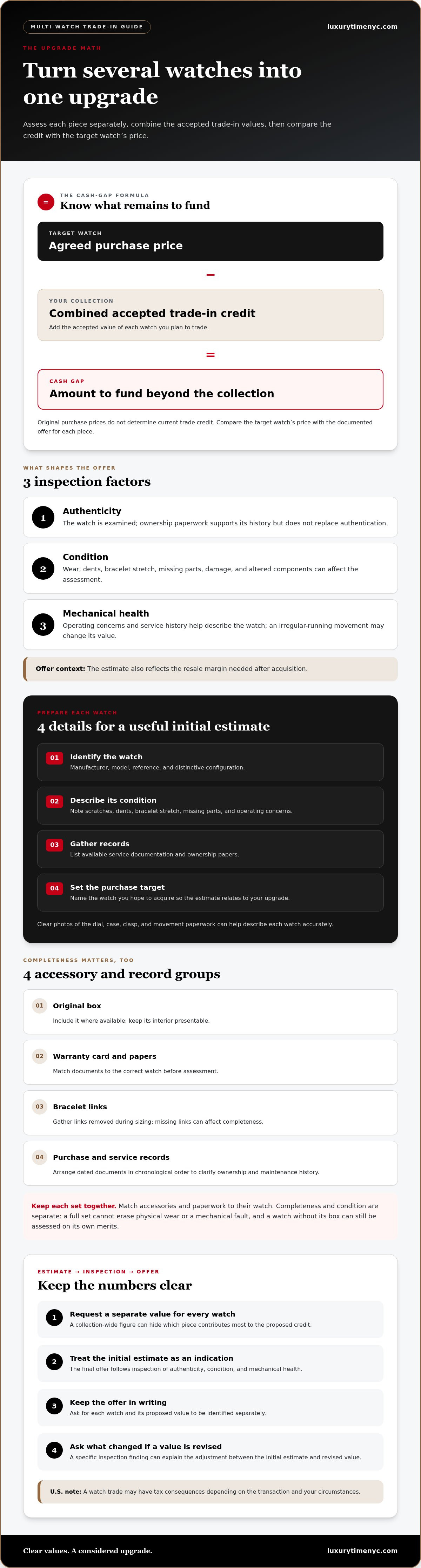
The cash gap is the agreed price of the target watch minus the combined trade-in credit. Start with the purchase price, then subtract the separate values assigned to the watches you’re trading. The result is the amount you’ll need to fund beyond the collection. The watches’ original purchase prices do not determine their current trade credit.
With several watches, add the accepted trade values first, then subtract that total from the target watch’s price. This calculation shows whether the exchange fits your budget before you finalize the transaction.
Use a written comparison to keep the figures clear:
- Target watch: Record the agreed purchase price for the specific model.
- Trade pieces: List every watch separately with its proposed credit.
- Combined credit: Add only the values accepted toward this transaction.
- Cash gap: Subtract combined credit from the target watch’s price.
Suppose your collection includes a Rolex, a Cartier, and another timepiece. The combined credit depends on the individual offers, not simply the number of watches. If one piece contributes most of the value, compare the total with and without it. This shows how much each item changes the balance and helps you decide whether to retain or trade it.
Review the calculation again after inspection. An initial estimate and a final offer can differ if the assessment changes after reviewing authenticity, condition, or mechanical health. If a value changes, update the written total and recalculate the cash gap. Don’t treat an earlier estimate as accepted credit. Use the agreed values for the watches actually included in the final calculation.
Separate the watch price from the trade credit on the transaction summary. This makes it easier to see the purchase amount, each watch’s contribution, and the remaining balance. If the target watch’s price changes, recalculate using the revised figure. Don’t treat an attractive trade allowance as a discount without comparing the target price and total credit together.
Before agreeing, confirm the arithmetic in one line: target watch price minus accepted trade credits equals cash due. Keep a copy alongside the itemized offer. This gives you a clear reference if the watches included in the exchange change or an inspection adjusts a valuation. A precise cash gap lets you evaluate the upgrade on its actual terms.
Trading watches instead of selling privately
A private sale may give you more control over the asking price, but you’ll manage each listing, negotiation, and handover yourself. A trade brings several decisions into one transaction: you receive a proposed value for each watch, apply accepted credit toward another timepiece, and avoid coordinating separate buyers for every piece.
The trade-off is value versus convenience. A dealer’s offer is generally below a watch’s current market resale value because the dealer needs a resale margin. Private sales may appear to offer more, yet marketplace fees are often more than 10%. Add the effort of preparing listings, answering inquiries, arranging secure delivery, and waiting for payment. Compare the likely net proceeds, not just a private asking price, with the trade credit.
For example, one collector described trading a Planet Ocean, TAG Heuer Carrera 1, and Tudor S&G for a Rolex Explorer 2. The useful lesson is the structure: several watches can contribute toward one chosen piece. Before agreeing, compare each watch’s individual trade value with the combined credit. A group offer is easier to assess when the written figures show what each item contributes.
Private selling may suit a watch with a strong independent market if you’re willing to manage the sale. A trade may better suit someone prioritizing a coordinated upgrade, especially when several watches can be assessed together. Consider the following before choosing:
- Time and effort: A private sale means handling separate listings, questions, and handovers.
- Net value: Compare expected proceeds after marketplace fees with the trade credit offered.
- Transaction simplicity: A trade can consolidate several watches and the new purchase into one arrangement.
- Offer clarity: Request a watch-by-watch breakdown, not only a single collection total.
How do you verify a dealer and avoid scams when trading luxury watches? Match the dealer’s business identity and physical address to the written offer, and insist on itemized terms before transferring any watch. Keep a signed receipt identifying every piece and recording the agreed credit and payment arrangement.
For a considered decision, compare the trade offer with realistic private-sale proceeds after fees and the work involved. A retail asking price does not guarantee the amount a watch will sell for. An accepted trade value, by contrast, is applied directly to your intended purchase. Weigh the actual credit, time saved, and likelihood of completing one coordinated exchange. This comparison shows whether the convenience suits your collection.
How do watch trade-ins or watch swaps work?
A trade-in applies the assessed value of one or more watches toward another timepiece. Understanding how to trade multiple watches for one starts with identifying each piece and choosing the intended purchase. An initial offer reflects the details provided, while an inspection can refine the assessment. For a collection, request an itemized review so each watch’s contribution remains clear.
During inspection, the dealer assesses authenticity, condition, and mechanical health. A Rolex with a healthy movement may receive a different offer from a similar model that needs service. Expected service work can affect the valuation because it influences preparation for resale. The offer also accounts for the dealer’s resale margin, so it generally falls below current market resale value.
- Prepare the details: Identify each watch by maker, model, reference, and condition.
- Receive an initial estimate: Share watch details and the intended purchase for a preliminary view.
- Present the watches: Allow inspection of authenticity, condition, and mechanical operation.
- Review the final figures: Compare each accepted value with the preliminary estimate.
- Apply the credit: Subtract the combined accepted values from the new watch’s price.
After inspection, review the written terms before handing over the watches. Confirm which pieces are included, the value assigned to each, and how the credit applies. If an estimate changes, the revised amount should correspond to a finding, such as condition or mechanical health. Keep the final calculation with your transaction record.
A swap may mean a direct exchange, while a trade-in typically applies the outgoing watches’ combined value toward a selected purchase. In either case, focus on the accepted values and any remaining cash balance. If an offer changes after inspection, recalculate using the updated figures. This keeps an initial estimate from being mistaken for final credit.
For a multi-watch trade, decide whether every piece belongs in the exchange before accepting. Compare the combined credit with the value each watch contributes. A lower-value watch may add useful credit, while a piece with personal or collecting significance may be worth keeping. The decision balances the desired acquisition against the character of your collection.
A practical answer to how to trade multiple watches for one is to assess each piece as part of the intended upgrade, while preserving a clear record of its individual contribution. Have your watches assessed for a trade by submitting your collection for consideration. An itemized review gives you a clear basis for considering the offer alongside your next acquisition.
Luxury Time NYC: Rolex Watches
Luxury Time NYC helps collectors considering a Rolex as their next acquisition review trade-in values. The collection also includes Patek Philippe, Audemars Piguet, and Richard Mille watches, offering distinct options for a considered upgrade.
Turn to Luxury Time NYC when you’ve identified the watches you may trade and want to explore your next timepiece. Bring your inventory details and relevant records to support a clear discussion of your collection and intended purchase. A focused conversation can help you weigh the target watch against the pieces you’re ready to part with.
Contact Luxury Time NYC to discuss your watch trade and next acquisition.
Choose the Next Chapter for Your Collection
A considered upgrade is more than an exchange. It’s a decision about the character you want your collection to carry forward. Once you know which pieces you’re ready to release, focus on the watch that best reflects your priorities, whether you value versatility, a refined complication, or a distinctive design.
A thoughtful approach to how to trade multiple watches for one begins with that intention. Let your next acquisition guide the conversation, rather than letting the size of your collection dictate the choice. Luxury Time NYC offers Rolex, Patek Philippe, and Audemars Piguet watches for collectors considering a new direction.
When you are ready to explore that direction, begin a conversation with Luxury Time NYC about your collection and the watch you hope to acquire. A clear next step can bring renewed focus to the pieces you keep and the one you choose next.
Frequently Asked Questions
How long does the process take?
The process depends on the time needed to identify the watches, review their details, complete inspection, and agree on the transaction. A collection with clear references and organized records is easier to assess than one with uncertain model details or missing service history. The selected watch also affects the final stage, since the exchange must align with its availability and agreed terms.
Why Trade Instead of Selling Privately?
Trading may suit collectors who value a coordinated upgrade over managing separate sales. One transaction brings the outgoing watches and intended purchase into a single discussion. Private selling requires individual listings, buyer correspondence, and payment arrangements. Private sales may make more sense if maximizing proceeds is your priority and you’re prepared to handle those tasks. Compare convenience with likely net proceeds before deciding.
How to estimate the resale value of used watches before trading them?
Start with the exact reference, then compare the watch with recent completed sales of the same or a closely comparable configuration. Asking prices show what sellers hope to receive, not necessarily what buyers paid. Note differences in condition, bracelet links, service history, and completeness. Treat this resale estimate as a benchmark, not a promised trade offer: a dealer’s offer also reflects inspection findings and resale margin.
What affects a watch's trade-in value: brand, model, condition, box, and papers?
Brand and model establish the comparison set, while reference and configuration distinguish one example from another. Condition and mechanical operation affect the assessment because they influence the watch’s readiness for resale. An original box, warranty card or papers, and all bracelet links can add trade-in value. For example, a complete watch with a matching card presents a fuller set than the same watch without its accessories.
How to get multiple watch appraisals or trade-in quotes?
Prepare a consistent record for every watch, including its reference, condition, service history, and accessories. Request a separate value for each piece, then compare written trade offers based on the same details. An appraisal describes an assessed value; a trade quote states the credit offered toward a purchase. Keep those terms distinct, and note whether an offer may change after physical inspection.
What documents and proof of ownership are needed to trade watches?
Bring purchase receipts, warranty cards, papers, and service records that match each watch. Match documents to the watch’s reference or serial details, and keep each piece’s records separate. A service invoice can help establish maintenance history, while purchase documentation supports its ownership history. If a document is unavailable, organize the records you have and identify the watch each belongs to.
What are the risks of trading watches privately versus through a dealer?
Private exchanges require you to manage the buyer, payment, delivery, and any later disagreement about condition or authenticity. A dealer trade centers on inspection and documented terms, but its offer generally reflects a resale margin and may be below current market resale value. Either way, record each watch, its agreed value, and the handover terms before transferring ownership.


