


No, it isn’t weird to buy yourself a luxury watch. If you’re wondering whether it’s weird to buy yourself a luxury watch, the better question is whether the watch suits your taste and your finances. It can mark a personal milestone, reflect your appreciation for fine mechanics, or simply be something you enjoy wearing.
Still, the appeal of a prestigious name or sought-after model can make it easy to move faster than your budget allows. A considered purchase should feel rewarding well after the moment you buy it, not burdensome in the months that follow.
This guide will help you choose according to personal preference, research a watch’s features and market position, and set a budget that leaves room for your wider financial priorities. You’ll also learn how to weigh the lasting pleasure of ownership against practical considerations such as future servicing, so the decision feels deliberate, personal, and comfortably your own.
Key Takeaways
- Choose a watch for its design, comfort, and craftsmanship, not simply because it is popular.
- Give yourself time to consider the purchase and protect the financial priorities that matter to you.
- Compare a watch’s features, condition, authenticity, and ownership considerations before deciding.
- Set a clear spending limit, then focus your search on watches that fit it comfortably.
- Use a specialist retailer’s selection of Rolex, Patek Philippe, Audemars Piguet, and Richard Mille watches to explore possibilities that match your preferences.
1. Choosing a watch based on personal preference rather than popularity
It isn’t weird to buy yourself a luxury watch. The choice is personal: a timepiece can mark a milestone, reflect your interest in mechanical craft, or suit your daily style. Popularity may introduce you to a model, but it can’t determine whether you’ll enjoy wearing it.
A luxury watch can retain, gain, or lose value. Resale appeal depends on factors such as model, condition, originality, and demand, so treat future value as uncertain rather than as a reason to buy. Choose a watch you would still appreciate if its market price changed.
Consider the difference between wanting a particular watch and wanting the status attached to it. One collector’s comparison framed the choice as enjoying a Speedmaster 19 years sooner rather than waiting to save for a Daytona. The useful lesson isn’t that one model is superior. It’s that delaying a watch you genuinely prefer for a more popular alternative may not feel worthwhile.
Before choosing, name the qualities you value most. A restrained dial, chronograph, distinctive case, or particular bracelet may matter more to you than recognition. Someone drawn to an understated dress watch, for example, may find a highly visible sports model less satisfying, even if it attracts more attention.
Try the watch on before deciding. Two watches with the same diameter can feel different because case shape, thickness, lug design, and bracelet affect how they sit on your wrist. Notice whether the watch feels balanced, the clasp is comfortable, and the dial is easy to read in your usual setting.
Give your taste room to evolve. A commenter noted that preferences may change over ten or twenty years, or even five years. That makes versatility worth considering: ask whether the watch suits several parts of your life, rather than only the occasion that first made it appealing.
Details can clarify what you actually like. One respondent mentioned owning Rolex sports models made from 904L stainless steel, while another referred to Rolex watches made in 18K gold. Those materials create different visual and wearing experiences. Consider which finish, weight, and presence feel right to you, rather than assuming precious metal or a sports profile is automatically preferable.
Think through the complete configuration, too. A bracelet can shape a watch’s appearance and comfort as much as its case. Buying the watch with the bracelet you want may be preferable to sourcing one later. Decide based on the whole piece you want to wear, not a temporary compromise.
Finally, picture wearing the watch on an ordinary day. Would you reach for it with your usual clothing, and do its proportions suit your wrist? If your answer depends mainly on its reputation, pause. If you like its design, feel, and function in their own right, personal preference is a sound reason to choose it.
2. Avoiding financial stress when buying a watch
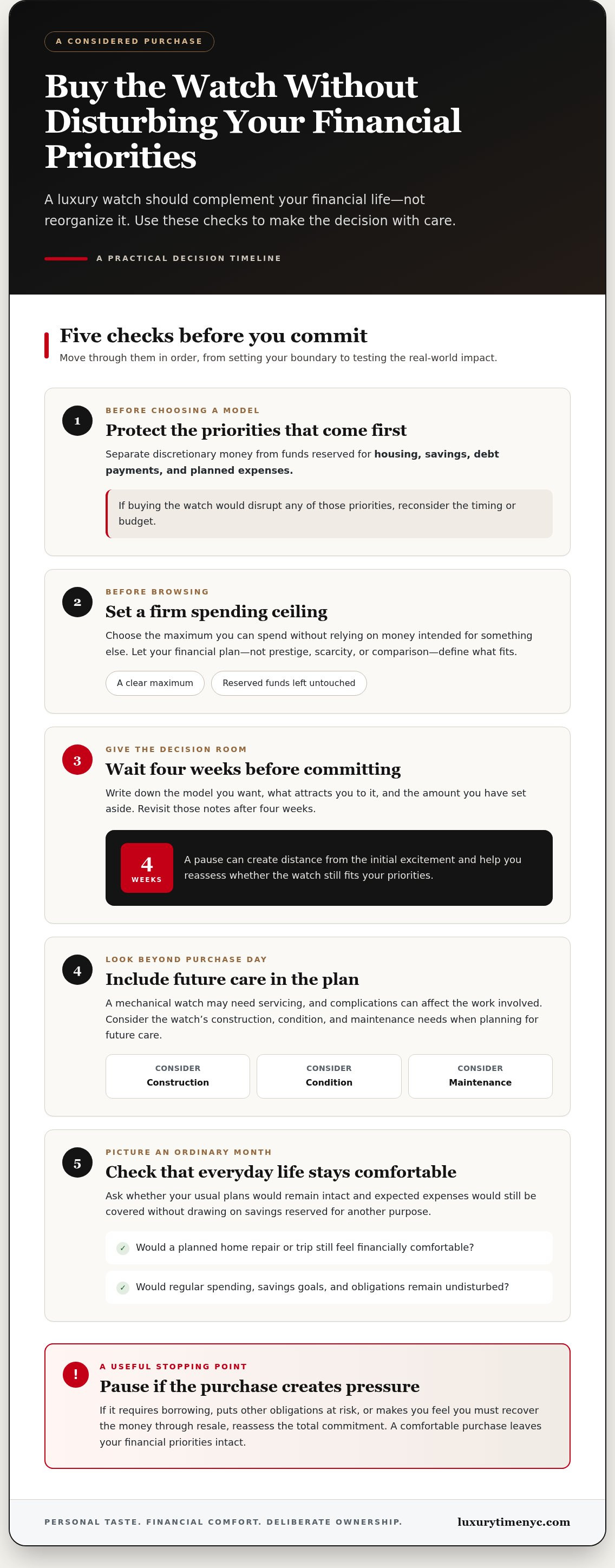
A luxury watch should complement your financial life, not reorganize it. Before choosing a model, separate money available for discretionary purchases from funds reserved for housing, savings, debt payments, and planned expenses. If buying the watch would disrupt any of those priorities, reconsider the timing or budget.
Set a firm spending ceiling before browsing. Choose an amount you can spend without relying on money intended for another purpose. This limit helps contain the influence of prestige, scarcity, and comparison. A sought-after name can make a higher-priced option feel necessary, but only your financial plan can determine whether it fits.
Then wait four weeks before committing to a major purchase. During that time, write down the model you want, what attracts you to it, and the amount you’ve set aside. Revisit your notes after four weeks. If the same watch still suits your priorities, you’ll be deciding with more distance from the initial excitement.
Use the waiting period to consider ownership beyond the initial transaction. A mechanical watch may need servicing, and complications can affect the work involved. Include future care in your planning rather than treating purchase day as the only financial decision. The amount to set aside depends on the watch’s construction, condition, and maintenance needs.
A useful test is to imagine an ordinary month after the purchase. Would your usual plans remain intact? Could you cover expected expenses without drawing on savings reserved for another purpose? If buying the watch would make a planned home repair or trip feel financially uncomfortable, postpone the purchase or choose a less costly alternative.
Resist turning a popular model into a deadline. One commenter suggested enjoying a less expensive watch rather than waiting 20 years to save for a Daytona. That comparison is not a rule to buy immediately. It illustrates a choice: decide whether the specific model matters enough to wait, or whether another watch offers genuine enjoyment within your current limit.
Consider what “affordable” means in practice. It isn’t simply having access to the purchase amount. A comfortable decision leaves your regular spending, savings goals, and obligations undisturbed. If the purchase requires borrowing or creates pressure to recover the money through resale, pause and reassess the total commitment.
Keep the decision personal. A colleague’s collection, a milestone gift, or online attention shouldn’t set your spending limit. If you’re buying to celebrate an achievement, connect the watch to a budget you established beforehand instead of raising that limit to match the occasion.
Finally, set a clear stopping point before shopping: your maximum spend, the funds you won’t touch, and the future care you’ve considered. If a watch exceeds that boundary, walk away without treating it as a failure. A luxury purchase is more rewarding when the decision preserves your financial comfort as well as your enjoyment of the watch.
3. Researching prices and features
Begin with the exact reference, not just the brand or model family. A collection can include different movements, materials, dial layouts, and production periods. Write down the reference number and configuration you’re considering. Then compare like with like, rather than treating every watch with a familiar name as equivalent.
Separate the features you’ll use from those that mainly sound impressive. A chronograph, for example, adds timing functions and a more detailed dial. A date display may be useful every day, while an elaborate complication may matter chiefly for its engineering. Choose functions that suit your routines, then assess their design and mechanical appeal.
For a mechanical watch, research ownership beyond the initial purchase. A commenter recommends considering servicing every 5 to 7 or 10 years. The interval depends on the watch and its use, so factor future maintenance into your comparison. A model with more complications may require more involved service than a simpler design.
Assess timekeeping in context, too. A commenter says a mechanical watch’s daily deviation of 3 to 5 seconds per day can be normal. Mechanical watches serve as finely engineered instruments, but their appeal isn’t measured by precision alone. Consider the movement, finish, heritage, and wearing experience alongside timekeeping performance.
For a pre-owned watch, treat condition and provenance as part of the specification. Compare the case, dial, hands, bracelet, and movement with the details for that exact reference. Look for consistency across the watch and its documentation. Box and papers can provide useful context, but they don’t replace an assessment of authenticity or condition.
Age changes what deserves attention. For a used luxury watch more than 10 years old offered online, one commenter recommends looking for a recent manufacturer service certificate. Also review the seller, warranty coverage, included box and papers, and authenticity. These details help you judge what the listing represents, rather than relying on polished photographs alone.
Read discounts with care. A 40% reduction doesn’t automatically make a watch good value; some deeply discounted listings may reflect inflated original asking prices or weak demand. Compare the specific reference, condition, completeness, and service history. A lower listed figure means little if the watch differs from the examples used for comparison.
Keep a short research record for each candidate. Note its reference, features, condition, documentation, service history, and any remaining questions about its ownership. This makes comparisons more deliberate. If two watches look similar, your notes can reveal meaningful differences in configuration or completeness.
Finally, distinguish market appeal from personal worth. A watch may attract attention without matching your preferences, while a less discussed reference may offer the details you value. Research helps clarify the difference. Use it to understand what you’re considering, not to let a discount or reputation make the decision for you.
Price research can also show how much expectations vary. Those figures describe different claims, not a universal price guide. Use them as prompts to check the exact reference, condition, and completeness rather than as targets. When considering a pre-owned watch, examine the seller, warranty coverage, included box and papers, and authenticity. This scrutiny helps put a low asking price in perspective.
Specifications deserve the same context. Read such comparisons alongside the movement and functions you actually want, not as a substitute for inspecting a candidate. One respondent also described a watch as water resistant to 300m. Treat a stated depth rating as one feature to verify for the particular watch, and weigh it against your intended use. Taken together, these examples underline why reference, condition, seller details, and practical priorities belong in the same comparison.
Setting a budget
A useful budget turns a broad preference into a practical search. Start with the amount you’re comfortable allocating to a watch, then treat it as a firm ceiling. A clear limit helps narrow choices by reference, material, condition, and configuration, rather than by prestige alone.
Keep your spending ceiling separate from funds set aside for other plans. If your watch budget overlaps with money reserved for a home project, travel, or savings, revise the target before comparing models. The purpose isn’t to justify a purchase, but to define what fits your wider financial picture.
Next, decide what your budget needs to cover. The purchase price is only one part of ownership. Consider the watch’s condition, potential future maintenance, and whether the chosen configuration includes the features you value. A pre-owned watch with a lower asking price may require a different ownership allowance from a well-maintained example.
Use a shortlist to connect your limit with your preferences. Record each candidate’s reference, material, movement, condition, and included components. Then remove watches that exceed your ceiling or require compromises you don’t want. If a bracelet matters to you, for example, compare complete bracelet configurations rather than choosing based on the case alone.
Build flexibility into the search, not the spending limit. Compare different dial designs, materials, or production periods while keeping the same maximum. You may find a watch with the character you want without letting a rare configuration or popular name quietly raise your budget.
A budget also helps distinguish essential features from attractive extras. Decide whether a chronograph, precious metal, or particular complication is worth a larger share of your limit. If you value a clean dial more than extra functions, prioritize that preference. The best allocation reflects how you’ll wear the watch, not a catalogue’s hierarchy.
Compare candidates on equal terms. A listed price can’t be judged alone if one watch includes its bracelet and documentation while another differs in condition or completeness. Note those distinctions beside each reference. This makes the trade-offs visible and prevents a lower initial price from dominating the decision.
Keep the final amount below any point that would make routine choices uncomfortable. If the purchase would change how you manage ordinary expenses, the budget is too high for now. A less costly reference, a different configuration, or more saving can bring the decision back within your chosen boundary.
Before committing, review your shortlist and ask whether each candidate satisfies the same priorities. If none does, keep the budget intact and refine the search instead of raising the limit. To compare possibilities within your preferred range, explore luxury watch selections with your criteria in mind.
Set a spending budget and research which watches and features fit it. Check each candidate against your limit before becoming attached to its appearance or reputation. Research should answer practical questions: does the watch offer the features you want, does its configuration suit your preferences, and is its condition acceptable to you? Keep the answers with your shortlist so comparisons stay tied to your priorities as you consider other options.
When two candidates appeal to you, assess both using the same criteria. Consider what you would give up by choosing one over the other, and whether that difference matters in everyday use. If a preferred feature pushes one candidate beyond your ceiling, decide whether it’s essential or whether another configuration would serve you just as well. A consistent process makes it easier to pause when the available choices don’t fit. You can keep researching, adjust your preferences, or wait for a suitable candidate without treating a higher budget as the automatic answer. The goal is a considered choice that respects your priorities and your spending limit.
Luxury Time NYC: Rolex Watches
Luxury Time NYC offers Rolex watches for buyers drawn to the brand’s distinctive designs and watchmaking heritage. If you’re weighing a Rolex against another kind of luxury timepiece, clarify which reference, features, and wearing experience suit your priorities before deciding. That keeps the choice connected to your preferences and budget, rather than reputation alone.
Luxury Time NYC also offers Patek Philippe, Audemars Piguet, and Richard Mille watches. Comparing these makers can help you focus on the designs and craftsmanship that resonate with you. Explore specific watches once you’ve set your criteria and are ready to compare options.
For a considered next step, contact Luxury Time NYC or visit luxurytimenyc.com.
Make the Next Choice Your Own
The question “is it weird to buy yourself a luxury watch” matters less than whether the decision reflects your values and feels comfortable to own. A personal purchase can carry meaning without another person’s occasion or approval. Start by identifying a watch you’d be pleased to wear, then give yourself space to decide whether it belongs in your life now.
If you’re ready to explore specific options, Luxury Time NYC offers Rolex, Patek Philippe, and Audemars Piguet watches. Keep your priorities in mind, and let the details guide your decision rather than outside expectations.
Contact Luxury Time NYC to explore your options. Choose with intention, and enjoy the pleasure of a decision that feels distinctly yours.
Frequently Asked Questions
Is it socially acceptable to buy yourself a luxury watch?
Yes, buying yourself a luxury watch is socially acceptable. A personal milestone, career achievement, or longstanding interest in horology can make the purchase meaningful without it being a gift. If someone asks about your watch, you can simply say you chose it for yourself. The decision is yours, and it needn’t be framed as a display of status or an explanation of your finances.
What income or savings should you have before buying a luxury watch?
There’s no specific income or savings threshold. Buy only with discretionary funds, while keeping money for housing, savings, debt payments, planned expenses, and future servicing untouched.


