


A service interval is a useful guide, but it cannot diagnose a movement. Most watch manufacturers recommend servicing a timepiece every three to five years, making that range a practical reference for a watch servicing timeline in NYC. The right timing for a particular watch depends on what an inspection reveals.
It’s reasonable to want a clear schedule for a watch worn daily or carefully preserved in a collection. But an overhaul is more than a calendar date. It involves attention to the movement and its lubrication, with the watch’s condition determining the work and timing.
This article explains what may prompt servicing, what an overhaul and lubrication involve, and why inspection should come before setting a service timeline. It also covers the factors that shape the process, helping you make the next decision with greater clarity.
Key Takeaways
- Understand why an overhaul involves more than routine attention, including the role of movement lubrication.
- Learn which details of a watch and its required work shape the servicing timeline.
- See why service scope and brand influence the assessment, without relying on a one-size-fits-all price.
- Know how to think about authorized service and what a physical inspection contributes before timing is set.
Servicing recommendations in NYC?
In New York City, servicing recommendations depend on a watch’s condition, movement, and service history. A physical inspection helps distinguish routine maintenance from repair or restoration.
Choosing a NYC Service Provider
NYC has both brand-authorized service centers and independent watchmakers for luxury watch repair. An authorized center works through the manufacturer’s service channel, while an independent specialist may offer a more direct repair relationship. The right route depends on the model, required work, and warranty terms. The Diamond District is a historic center of New York’s watch trade, so check a shop’s address and hours before visiting.
Preparing a Watch for Service
Before drop-off, note the watch’s visible condition, operating issues, and known service history. Describe symptoms clearly, such as a stopped movement or a crown that no longer turns smoothly. For shipping, use protective packaging and tracked, insured delivery, and keep the shipment record. Send only the watch and documents requested for assessment, not presentation boxes or unrelated accessories.
Independent watchmakers and authorized centers differ in their relationship with the manufacturer, not just in the name on the door. Choose a service route based on the watch’s warranty status, model, and repair needs. Check the manufacturer’s warranty documents, since independent work may affect coverage.
Repair warranties vary by NYC shop and the work performed. Before approving a service, review the written terms for covered components, workmanship, and exclusions. Clear coverage details help distinguish a repair warranty from the manufacturer’s original warranty.
For warranty-covered work, follow the requirements in the relevant brand documents. For other servicing, request an assessment that identifies the movement’s condition and proposed work. The inspection should clarify whether the watch needs an overhaul, lubrication, a targeted repair, or restoration after damage.
How long does watch servicing take in New York City?
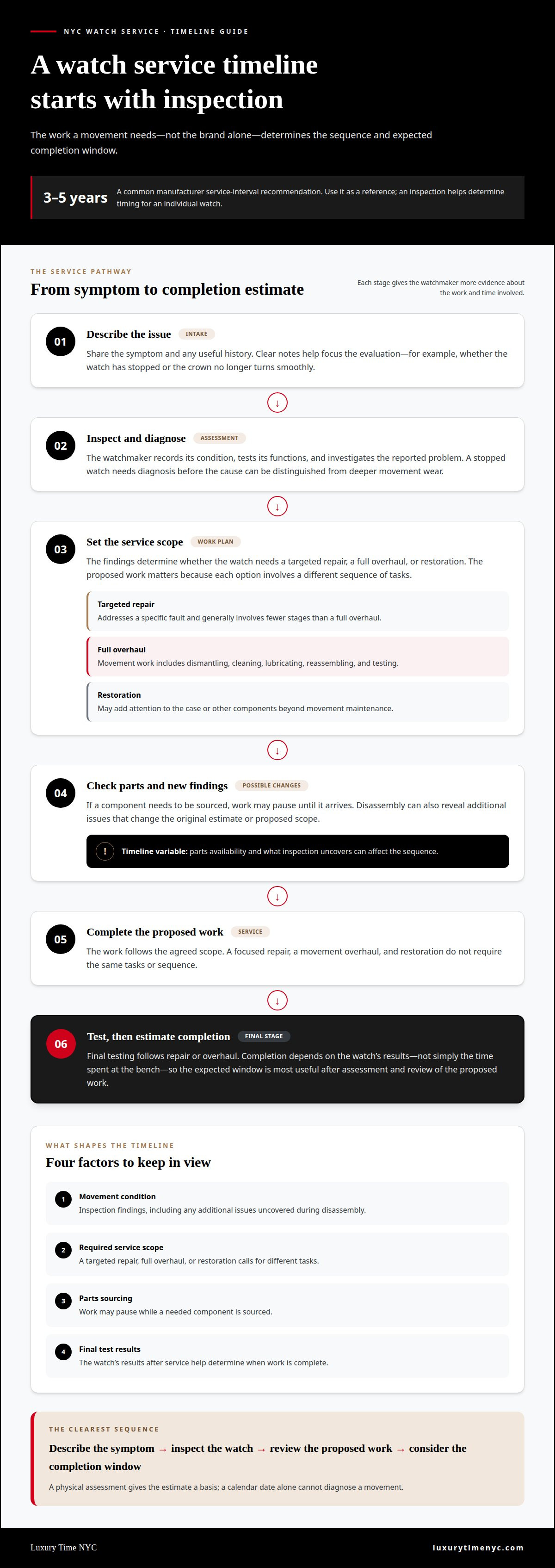
An NYC service estimate depends on the work a movement needs, not just the watch’s brand. Intake inspection, diagnosis, parts sourcing, and final testing all affect the timeline. A calendar estimate is useful only after the watch has been examined. A watch servicing timeline in NYC starts with understanding these stages, not assuming every service follows the same schedule.
The first stage is assessment. A watchmaker records the watch’s condition, tests its functions, and investigates the reported issue. For example, a stopped watch needs diagnosis before a watchmaker can distinguish a simple fault from deeper movement wear. The findings, not the symptom alone, determine the recommended work. Clear notes about the problem help focus the evaluation.
The scope of work matters. A targeted repair generally involves fewer stages than a full overhaul, which requires dismantling, cleaning, lubricating, reassembling, and testing the movement. Restoration may add work if the case or other components need attention. Each task changes the sequence and time required, making the proposed service an important part of the estimate.
Parts are another variable. If a component needs to be sourced, work may pause until it arrives. Disassembly can also reveal additional issues, which may change the original estimate. Final testing follows a repair or overhaul, so completion depends on the watch’s results, not simply the time spent at the bench.
For a watch servicing timeline in NYC, the useful sequence is straightforward: describe the symptom, have the watch inspected, review the proposed work, then consider the expected completion window. A physical assessment gives the watchmaker evidence to estimate each stage. For guidance on a specific timepiece, arrange a watch assessment before planning around a return date.
What is the typical cost of watch servicing in NYC by brand and service type?
There is no single NYC price for every watch service. The estimate depends on the work required, the movement, and any parts needed. Brand and model help identify the watch, but do not determine the final scope. A Cartier Tank Française needing battery attention is a different job from a mechanical watch requiring a complete overhaul.
Service type is a major cost factor. A focused repair addresses a specific fault, while an overhaul involves more extensive movement work. Case refinishing is separate from movement maintenance. If inspection identifies damaged or worn components, parts and additional labor can also affect the estimate. The watch’s condition matters as much as the name on its dial.
For a useful comparison, separate the estimate into diagnosis, labor, parts, and any additional work. Then compare proposals with the same scope. A quote for battery service cannot be compared directly with one for a mechanical overhaul. A brand name alone does not make two repair estimates equivalent.
Before approving work, review what the estimate includes and what findings could change it. Ask whether the proposed service covers the reported problem, movement work, replacement components, and final testing. If damage requires restoration, clarify which cosmetic or structural tasks are separate from movement service.
For an accurate cost assessment in New York City, follow a practical sequence: inspection, written scope, then approval. This keeps the discussion specific to the watch instead of relying on a broad price range. A vintage model, a complicated movement, and a straightforward battery service each need a different evaluation. Compare written estimates for the same work and parts, not brand names alone.
Treat that figure as a reference for that type of service, not as a price for a mechanical overhaul, parts replacement, or refinishing. The final estimate still depends on inspection and the work included. When comparing proposals, make sure each covers battery service on the same basis and lists additional work separately. Don’t use it to infer the cost of other repairs.
Where can I get an authorized watch service in NYC
For authorized service in New York City, start with the watch’s manufacturer. Use its official service locator or customer-care channel to find the authorized route for your model. Rolex, Patek Philippe, Audemars Piguet, Richard Mille, and Cartier have distinct service networks; authorization for one brand does not establish authorization for another.
Confirm that the relevant brand identifies the specific NYC location as authorized. A shop’s experience with luxury watches alone does not prove manufacturer authorization. This distinction matters if you want service recorded through the brand’s channel or need to follow warranty conditions. Read your watch’s warranty documents, since terms can vary by brand and model.
Before arranging service, establish these details for the exact watch:
- Brand and model: provide the reference or model information available to you.
- Service route: confirm whether the location handles your brand and requested work through an authorized channel.
- Work scope: clarify whether the issue calls for diagnosis, repair, or a movement overhaul.
- Documentation: ask what service records or warranty papers accompany the process.
An independent watchmaker may offer a different repair approach and service relationship, but that is not the same as manufacturer authorization. For a watch under warranty, consult the written terms and the manufacturer’s authorized-service information. For a vintage or out-of-warranty timepiece, weigh the required work and the watchmaker’s capabilities against your priorities.
Authorization alone doesn’t define the service timeline. The watch still needs assessment, and the movement’s condition, required parts, and scope of work shape the estimate. A written evaluation should identify the proposed work before service proceeds. For a separate assessment of a luxury timepiece, request a watch evaluation.
Luxury Time NYC
Luxury Time NYC helps watch owners assess servicing needs and choose an appropriate next step. A physical inspection can show whether the movement needs an overhaul, lubrication, or a targeted repair, and help clarify the likely timing. The watch’s condition, service history, and required work all matter.
For owners of Rolex, Patek Philippe, Audemars Piguet, or Richard Mille watches, this assessment provides a considered starting point. It can help distinguish routine maintenance from work prompted by a specific fault, without treating a general service interval as a diagnosis. The result is a clearer understanding of what the timepiece needs.
Contact Luxury Time NYC to discuss your watch and its servicing needs.
Make the Next Service Decision with Care
A considered watch servicing timeline in NYC is part of preserving a timepiece’s long-term story. Use the next service decision to document its condition and keep its history clear. That record can guide future care and support a more informed discussion about the watch.
Luxury Time NYC offers Rolex, Patek Philippe, and Audemars Piguet watches. For owners considering the care or future of a fine timepiece, a thoughtful discussion can clarify the next step without rushing the decision. Every watch deserves attention based on its own condition and history.
When you’re ready to discuss your timepiece, contact Luxury Time NYC. A thoughtful next step begins with a clear conversation.
Frequently Asked Questions
How often should a mechanical watch be serviced?
Most watch manufacturers recommend servicing a mechanical watch every three to five years. Treat this as a maintenance interval, not a diagnosis: the watch’s condition and service history matter too. If it stops, runs inconsistently, or develops another fault, arrange an assessment sooner. For a vintage or rarely worn piece, keep service records to help guide future care.
What does a standard watch service include?
A standard mechanical watch service may include examining the movement, dismantling and cleaning its components, applying lubrication, and reassembling it. The watchmaker then tests its operation. The exact scope depends on the movement and the watch’s condition; a specific fault or damaged component may require additional repair. Ask for a clear description of the proposed work before authorizing service.


