


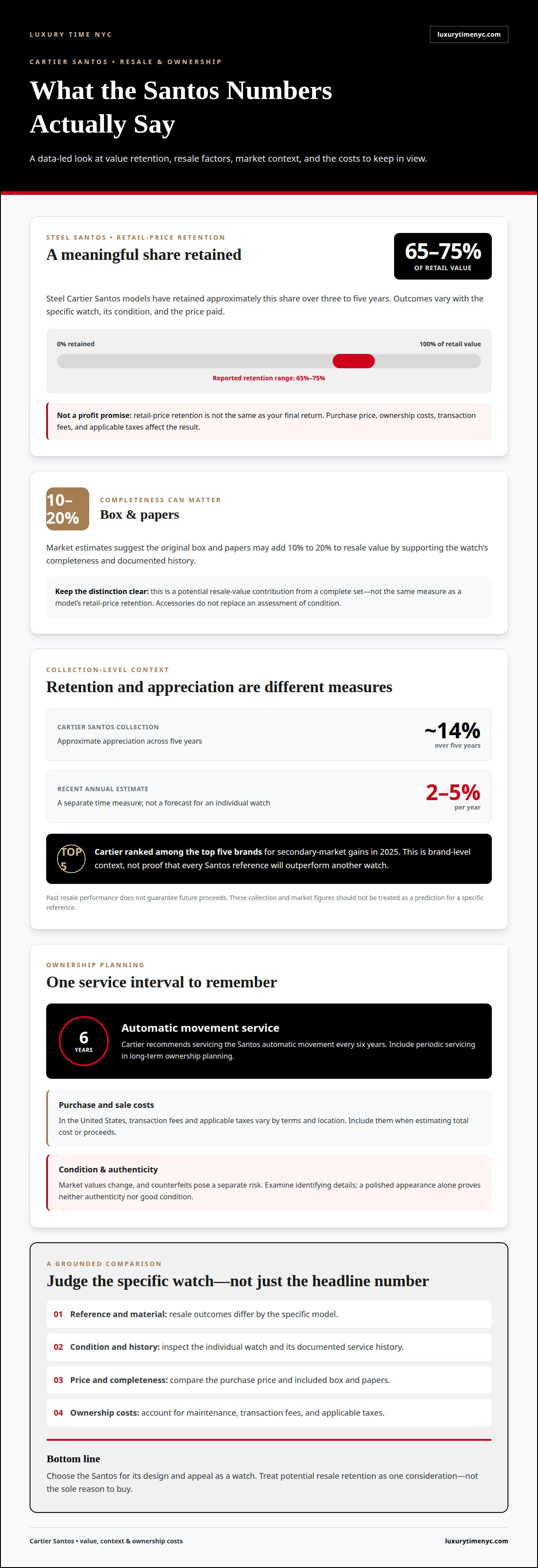
A Cartier Santos can be a compelling first luxury watch, with value retention that rewards careful selection rather than assumptions of rapid appreciation. Steel Santos models have retained approximately 65% to 75% of retail value over three to five years. Whether a Cartier Santos is a good investment depends on the reference, material, condition, and price paid.
The appeal is clear: the Santos combines a distinctive design with a long horological heritage. But buying new and buying pre-owned involve different trade-offs in price, condition, and potential resale value. A good decision starts with knowing which factors matter most to you.
This guide compares new and pre-owned Santos models, explains how material and reference can influence value, and considers what resale figures can realistically tell you. You’ll come away with a clearer sense of which watch suits your priorities, whether you’re buying for daily wear, long-term enjoyment, or potential resale.
Key Takeaways
- Assess a Santos as a first luxury watch by balancing its distinctive design and resale prospects against your priorities as a wearer.
- Compare new and pre-owned examples by reference, material, condition, and included documentation before deciding which offers the better fit.
- Learn why value retention and appreciation differ, and which characteristics can influence a Santos’s resale appeal.
- Use the comparison with other luxury watches to clarify what matters most to you, then follow the decision guide to narrow your choice.
Is the Cartier Santos a Good First Luxury Watch?
A Santos can suit a first-time luxury-watch buyer who values its design and potential resale appeal. Its investment prospects depend on the purchase price, condition, and exact reference.
Resale and Retail-Price Retention
Steel Cartier Santos models can retain a meaningful portion of their retail value, though resale outcomes vary by watch and condition. That makes resale retention a meaningful consideration, not a promise of profit: the amount recovered depends on the specific watch and its condition. Whether a Cartier Santos is a good investment also depends on the price paid and costs incurred during ownership.
In the United States, transaction fees and applicable taxes vary with the terms and location of a purchase or sale. Include them when calculating your total cost or proceeds, rather than treating retail-price retention as your final return.
Box and Papers
The original box and papers can strengthen a Santos’s resale presentation by supporting its completeness and documented history. Market estimates suggest they may add 10% to 20% to resale value. That potential advantage differs from general retail-price retention, which describes how a model’s resale value compares with its retail price over time.
For a first purchase, consider accessories as part of the overall package, not as a substitute for the watch’s condition. A complete set can help distinguish otherwise comparable examples, while missing accessories may affect the resale calculation.
Comparisons with Other Luxury Watches
Cartier ranked among the top five brands for secondary-market gains in 2025. That provides context for the Santos, but it doesn’t establish that every reference will outperform Rolex, Omega, or another luxury watch. A meaningful comparison weighs the specific model, condition, purchase price, and resale demand rather than relying on brand reputation alone.
For a first-time buyer, the Santos offers a design-led alternative in the luxury-watch market. Compare it with Rolex and Omega based on your preferred style and ownership priorities, then assess resale figures for the specific references you’re considering.
Investment Risks and Costs
Market values change, and past resale performance does not guarantee future proceeds. Counterfeits pose a separate risk, so carefully examine the watch and its identifying details before buying. A polished appearance alone proves neither authenticity nor good condition.
Maintenance adds to ownership costs. Cartier recommends servicing the Santos automatic movement every six years, so include periodic servicing in your long-term ownership plans. Condition, authenticity, and maintenance history each affect the risk profile in different ways.
| Option | Retention evidence | Key consideration |
|---|---|---|
| Steel Santos | Approximately 65% to 75% over three to five years | Purchase price and condition |
| Santos with box and papers | May add 10% to 20% to resale value | Completeness and documentation |
| Cartier versus other brands | Cartier ranked among the top five for secondary-market gains in 2025 | Compare specific references |
Choose a Santos if its design and appeal as a watch stand on their own. Treat potential resale retention as one consideration, not the sole reason to buy.
New versus pre-owned purchasing
A new Santos gives you a clear reference point in Cartier’s current retail pricing for a specific model. A pre-owned watch must be judged by its individual condition and secondary-market demand. The decision is not simply new versus old: it is a retail purchase versus a particular watch with its own history.
Use reference numbers to keep comparisons precise. In 2026, the Medium steel Santos de Cartier WSSA0029 and Large steel Santos de Cartier WSSA0018 provide clear model-specific examples. Their different case sizes mean they suit different preferences, so compare like with like before judging the relative value of a listing.
Pre-owned choices also extend beyond the core steel models. The Santos-Dumont XL hand-wound WSSA0032 offers a different wearing experience from an automatic Santos de Cartier. Its hand-wound movement and distinct design make it a separate comparison, not a direct substitute for the Medium WSSA0029 or Large WSSA0018.
For either option, start with the exact reference. Assess visible condition, completeness, and documented service history, which help explain differences between individual examples. The model name alone cannot show whether a specific pre-owned watch offers sound value or merits closer inspection.
- Choose new if you want to evaluate a model against its retail position and prefer an example with no previous ownership.
- Choose pre-owned if you’re open to an earlier ownership history and can assess that individual watch’s condition and documentation.
A disciplined comparison records the reference, material, case size, condition, and included items for each candidate. Keep the same criteria across WSSA0029 and WSSA0018 listings; otherwise, a price comparison may confuse model differences with condition differences.
For a closer look at Cartier watch options, consider how the reference and condition align with your priorities before choosing between new and pre-owned.
Cartier Santos value retention and appreciation
Value retention describes how much of a watch’s purchase value remains at resale. Appreciation means its market value rises over time. The Cartier Santos collection appreciated roughly 14% over five years, while recent annual appreciation has been estimated at 2% to 5%. These measures describe different periods and shouldn’t be treated as a forecast for an individual watch.
Reference and condition matter. The Santos de Cartier Medium steel WSSA0029 and Large steel WSSA0018 are identifiable modern references, while the Santos 100 XL steel reference 2656 represents a different generation. Their resale trajectories need not match. Compare the exact reference, material, condition, and completeness rather than applying a collection-wide growth figure to every example.
Rarity can alter the equation. Limited-edition Cartier Santos models can command premiums of 30% to 50%, reflecting collector demand for particular versions. That premium applies to sought-after examples, not automatically to every limited release. A distinctive edition may attract attention, but its market appeal still depends on its condition and the interest of buyers seeking that reference.
Vintage examples require a different lens. Cartier Santos watches from the 1970s to 1990s with original bracelets may be attractive to collectors. Bracelet originality and the watch’s overall condition help shape its appeal. For a vintage Santos, preserving period-correct components can matter as much as choosing a recognizable reference.
- Separate the measures: compare five-year collection appreciation with recent annual estimates, not as interchangeable returns.
- Identify the reference: distinguish modern WSSA models from a Santos 100 or vintage example.
- Assess collector appeal: examine edition status, condition, and originality, especially on vintage bracelets.
Assess the individual watch first, then consider its reference in the context of wider collection trends. The Santos may appreciate in value, but market figures describe patterns, not guaranteed outcomes for individual owners.
How does the Cartier Santos hold its value compared with Rolex, Omega, and other luxury watches?
Cartier ranked among the top five brands for secondary-market gains in 2025. That brand-level position offers context, not a direct forecast for every Santos. Rolex and Omega comparisons are most useful at the reference level, where model, condition, and purchase price can be assessed consistently.
Compare watches in the same broad category and material. For example, weigh a steel Santos against a steel Rolex or Omega, considering each reference’s retail price and resale demand. A brand’s general reputation cannot tell you which particular watch will retain more value.
Cartier’s Santos has its own collector profile. The design’s recognizable form and long history distinguish it from the many luxury watches buyers evaluate primarily through brand-wide resale patterns. For vintage examples, Santos watches from the 1970s to 1990s with original bracelets may attract collector interest. That appeal depends on the specific watch, not merely its era.
Use a consistent comparison before deciding:
- Match the category: compare material, condition, and intended use across Cartier, Rolex, and Omega.
- Identify the reference: distinguish a current Santos de Cartier from a vintage Santos or another collection.
- Assess demand: consider whether buyers seek that exact reference and configuration.
- Account for ownership: weigh purchase terms and maintenance needs against likely resale appeal.
This approach helps separate an appealing design from an assumed financial advantage. A Cartier Santos may suit someone drawn to its distinctive character, while a Rolex or Omega may better match another collector’s taste. Compare specific watches rather than relying on broad brand reputations.
For a reference-specific assessment, explore Cartier watch options alongside other luxury timepieces and compare the details that shape their resale appeal.
Luxury Time NYC: Cartier Watches
Luxury Time NYC offers Cartier watches for collectors considering a Santos purchase, sale, or trade. If you’ve narrowed your choice to a reference or are weighing a pre-owned example, discuss its condition, authenticity, and ownership details with the team.
Authentication can help address concerns about a watch’s authenticity. Comparing a Santos with Rolex, Patek Philippe, or Audemars Piguet may also help if you’re weighing alternatives. The right choice depends on your collecting priorities and the specific watch, not resale figures alone.
Contact Luxury Time NYC to discuss Cartier watches and your next step.
Choose a Santos With Your Priorities in Focus
Before committing, decide what you want the watch to bring to your collection. It could mark a personal milestone, become a daily companion, or be a considered acquisition. That purpose puts resale figures in perspective without letting them dictate your choice. Ask yourself which Santos you would still value if market conditions changed. Your answer can help determine whether a Cartier Santos is a good investment for your priorities, not just on paper.
Luxury Time NYC offers Cartier watches alongside Rolex, Patek Philippe, and Audemars Piguet timepieces. Comparing these brands can help you decide how the Santos fits your collecting interests and the kind of watch you want to own.
Contact Luxury Time NYC about your options and take the next step toward a watch that feels right for your collection.
Frequently Asked Questions
What Are the Most Collectible Cartier Santos Models?
Collectors may gravitate toward distinctive references such as the Santos Skeleton, Santos 100, and Santos Galbée. Their appeal differs: a skeletonized dial offers a striking mechanical display, while the Santos 100 and Galbée reflect different chapters in the collection’s design history. Condition, originality, and documented provenance help distinguish a noteworthy example from a watch chosen only by model name.
How have Cartier Santos prices and resale values changed over the past 5-10 years?
Cartier Santos resale values have varied across references and over time. When looking at a five-to-ten-year period, distinguish asking prices from completed sales and account for changes in demand, condition, and availability. For a useful comparison, follow the same reference and material over time. Collection-wide averages can hide important differences between individual watches.
What are current resale prices for popular Cartier Santos models and sizes?
Resale value depends on the exact reference, size, material, condition, and completeness. A Medium steel Santos and a gold model are not equivalent comparisons. Look at recent examples with the same reference and configuration, and note whether they were listed or sold. An asking price shows what the seller wants, not necessarily what a buyer paid.
Which Cartier Santos models, materials, and dial colors have the strongest resale demand?
Steel Santos models have shown notable resale retention, while distinctive references and original components may also attract collector interest. Demand for a particular dial color varies by reference and buyer preference, so color alone does not indicate stronger resale prospects. Compare the exact configuration and condition, and consider how established its collector audience is.
What factors affect a Cartier Santos watch’s resale value, including condition, box, papers, and service history?
Condition, completeness, authenticity, and service documentation all influence a Santos’s resale appeal. A clear service record helps explain maintenance history, while the original box and papers provide supporting documentation. Consider the watch and its records together: discrepancies, missing components, and visible wear can affect buyer confidence differently across references.
How much do Cartier Santos watches typically depreciate when bought new from an authorized dealer?
No single depreciation figure applies to every Santos bought new. The outcome depends on the reference, condition, and resale demand. Retail price and eventual sale proceeds are different measures, and selling soon after purchase may have a different result from holding the watch longer. Whether a Cartier Santos is a good investment depends in part on that difference, as well as your reasons for owning it.


