


Could a cleaner case make a treasured watch feel less like itself? A watch case refinishing service may soften the marks of wear, but a collector’s decision is about more than appearance. Original edges, finishes, and signs of a watch’s history can matter as much as a refreshed surface.
It’s reasonable to pause before refinishing a valuable timepiece. The right approach depends on the condition of the case and what you hope to preserve. Cosmetic work addresses surface appearance; dents, deformation, or other damage may call for case repair instead. The distinction matters when the watch’s form and provenance are part of its appeal.
This guide explains what refinishing can address, when restraint may be preferable, and how to assess the work with confidence. You’ll learn what separates cosmetic polishing from structural repair and what to consider when choosing a service for a luxury watch. Luxury Time NYC offers watch polishing and professional repairs, with watches inspected and serviced by certified watchmakers at its Diamond District showroom.
Key Takeaways
- Learn what case refinishing can address and why polishing is only one form of cosmetic work.
- Understand how a watch’s material, existing finish, and condition shape the appropriate approach.
- Use the differences between polishing, broader refinishing, case repair, and full-watch restoration to clarify the work your timepiece may need.
- Choose a watch case refinishing service with a clear sense of what you want changed and which original details should remain untouched.
- Explore Luxury Time NYC’s watch polishing and repair services, with watches inspected and serviced by certified watchmakers at its Diamond District showroom.
What Does a Watch Case Refinishing Service Actually Do?
A watch case refinishing service is cosmetic work intended to refresh the visible surface and finish of a watch case. Its scope may be limited to one surface treatment or address a broader appearance goal. Polishing is one form of refinishing, not a synonym for every type of restoration.
The distinction matters because a watch case is more than a backdrop for the dial. Its proportions, edges, and finish contribute to the character of the timepiece. In Horology, the study of timekeeping, a watch is understood as both a precision instrument and an object shaped by design and craft. A cosmetic decision should respect both aspects.
Which visible signs might lead an owner to consider refinishing?
Light surface marks, fine scratches, or a dull finish can draw attention during daily wear. These are appearance concerns, not automatic reasons to refinish. A mark may be a familiar trace of use, while the same blemish might distract an owner who wants a more composed presentation. Collectors may also prefer to retain honest wear as part of a watch’s history.
Look beyond the surface, too. A scratch is different from a case that appears bent, cracked, or otherwise misshapen. Those signs may point to a structural concern that cosmetic work alone won’t address and should be assessed separately. Consider your purpose before deciding: are you preparing the watch for regular wear, preserving its original character, or seeking a specific appearance? Your answer helps define whether service is appropriate and how limited its scope should be.
What is the difference between polishing and refinishing?
Polishing is a surface treatment that addresses the appearance of a case. It may be part of refinishing, but the terms don’t describe identical work. Refinishing is broader: it refers to refreshing or restoring the intended surface appearance, with the appropriate scope shaped by the case and its existing finish.
That broader term doesn’t mean every service includes several treatments or a complete restoration. A watch may need only a focused cosmetic treatment, or its condition may call for a different assessment. The goal is not simply to make the case look newer. It’s to decide what should change, what should remain, and whether the intended result suits the watch.
- Surface marks: Decide whether they affect your enjoyment or are acceptable signs of use.
- Finish and form: Note the existing surface character and case details you want preserved.
- Damage: Treat an apparent crack or change in shape as a separate concern from dullness or light scratches.
Before proceeding, describe the desired outcome in precise terms. A considered discussion can distinguish cosmetic refinement from a repair need and help keep the work aligned with the watch’s character.
How Watch Case Refinishing Works: From Assessment to Finish
A case assessment should come before refinishing because the right scope depends on the watch’s condition, not simply on what the owner hopes to change. Material, existing finish, and visible condition all influence which cosmetic work may suit the watch. A mark on an otherwise sound surface presents a different question from a case that appears deformed or damaged.
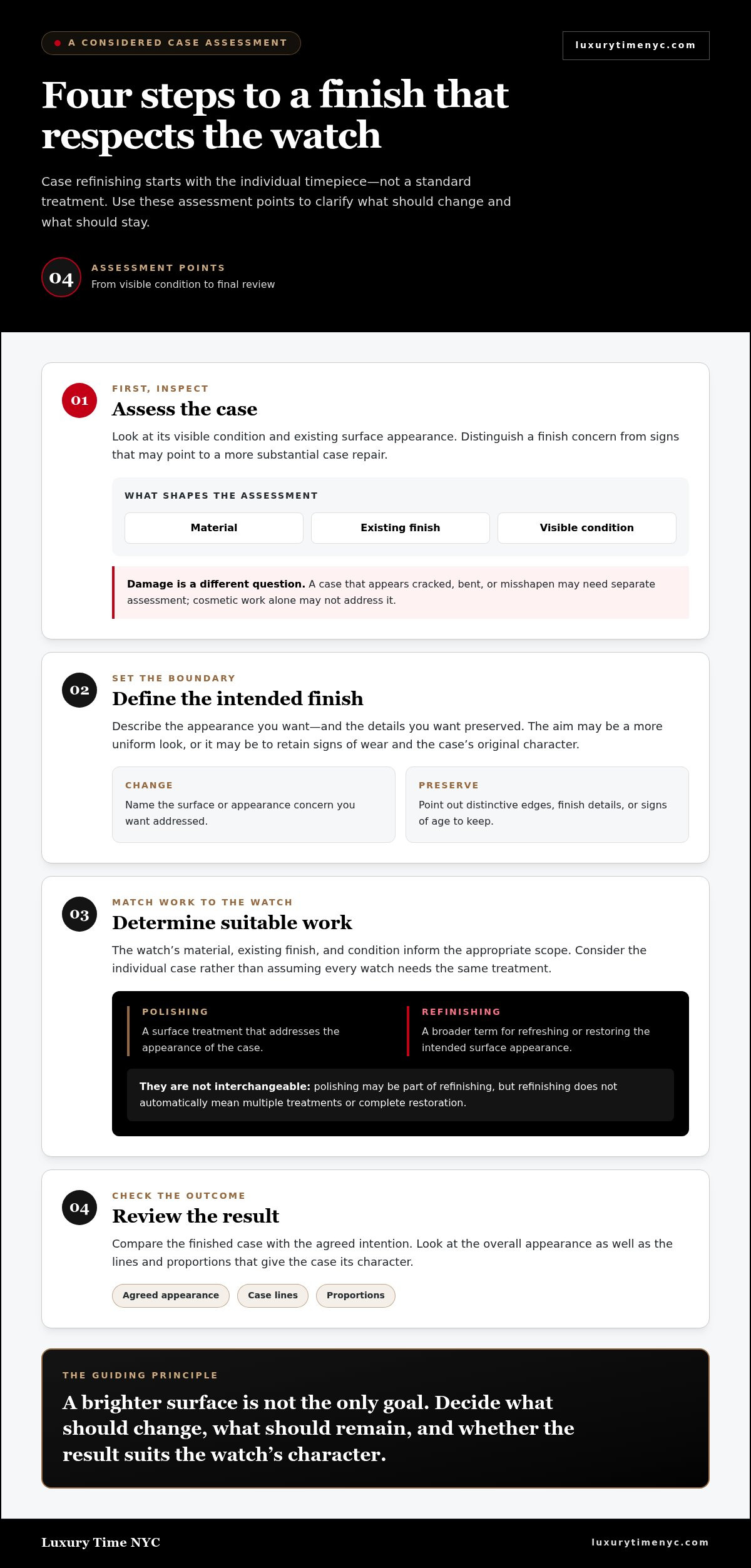
A careful assessment considers four points. Each helps clarify the intended result before work begins.
- Assess the case. Consider its visible condition, existing surface appearance, and any signs that might point beyond a cosmetic concern. The aim is to distinguish a finish issue from a possible need for more substantial case repair.
- Define the intended finish. Describe what you want the case to look like and, just as importantly, what you want preserved. One owner may want a more uniform appearance; another may prefer to retain evidence of wear.
- Determine suitable work. The watch’s material, finish, and condition inform the appropriate scope. Refinishing should be considered in relation to the individual case, rather than treated as a standard treatment with the same objective for every watch.
- Review the result. Compare the finished case with the agreed intention. Consider the overall appearance as well as the lines and proportions that give the case its character.
Why the original case finish matters
A case may have areas with different surface appearances. Their contrast can be part of its design, not an inconsistency to remove. The transitions between those areas, along with the case’s proportions, contribute to a composed finish. A broad cosmetic change that ignores those details could alter the impression of the watch. For a collector, the goal is not simply a brighter surface; it is a result that remains faithful to the timepiece’s character. Don’t assume that a particular profile or finish can be reproduced without considering the individual case.
What should a service assessment establish?
A useful discussion begins with three points: the case’s visible condition, its existing finish, and the appearance you want. Together, these give the owner and watchmaker a clearer basis for defining the scope. The American Watchmakers-Clockmakers Institute offers broader information about the watchmaking profession and its educational resources.
Be precise about boundaries. You might want a surface to look more composed while keeping distinctive edges or signs of age intact. If the case seems cracked, misshapen, or otherwise structurally compromised, that concern belongs in a separate repair assessment, not an assumed polishing objective. Clear expectations help keep cosmetic work distinct from repair and prevent “refinishing” from being mistaken for a complete restoration.
Luxury Time NYC offers watch polishing and professional watch repairs, with watches inspected and serviced by certified watchmakers. If you’re considering a cosmetic refresh, explore the watch polishing service as part of a considered assessment of your timepiece.
Polishing, Refinishing, or Case Repair: Which Service Fits the Watch?
The right choice depends on what needs attention and what you want to preserve. A surface concern may call for cosmetic work; a change in the case’s shape or a damaged component is a different matter. More visible work isn’t automatically better for a collectible watch. Match the scope to the condition instead of pursuing the most extensive treatment by default.
| Service | Purpose | Condition it addresses | Owner’s intended outcome |
|---|---|---|---|
| Surface polishing | Refresh the visible surface through polishing. | Surface wear or marks, when a cosmetic change is appropriate. | A cleaner-looking surface, while accepting that polishing changes the case surface. |
| Broader refinishing | Refresh the case’s intended overall appearance. | A finish that no longer presents as desired, assessed in context of the case. | A more considered appearance, with the scope guided by the owner’s priorities. |
| Structural case repair | Address damage to the case or a component. | Deformation, substantial material loss, or a damaged part. | Resolve a physical issue, rather than treat it as a surface-finish concern. |
| Full-watch restoration | Address the timepiece as a whole, potentially including cosmetic and mechanical needs. | Concerns that extend beyond the case alone. | Consider the watch’s broader condition, not only its exterior appearance. |
When is a cosmetic finish the relevant objective?
Cosmetic work may suit an owner who wants the case to look more composed and whose concern is limited to its visible surface. That doesn’t make it right for every watch. An owner may find light wear distracting; a collector may value those marks as evidence of use and history. Neither preference is universal. Weigh the current appearance against your reason for owning and wearing the watch before deciding whether a refreshed finish would serve your purpose.
When might the issue extend beyond refinishing?
A case that appears bent, a damaged component, or substantial material loss raises a different question from surface dullness. These conditions may call for structural case assessment or repair, not a cosmetic treatment alone. Polishing shouldn’t be treated as a substitute for resolving physical damage. If the concern goes beyond appearance, identifying that distinction helps define the work the watch needs before any finish is considered.
A watch case refinishing service should be judged by how closely its scope matches the owner’s objective, not by how much work is performed. Cosmetic work may suit a sound case and a clear appearance goal; restraint may better suit a piece whose wear is part of its appeal. No treatment guarantees a particular resale outcome, so preservation and appearance deserve separate consideration. Luxury Time NYC offers watch polishing and professional watch repairs, with watches inspected and serviced by certified watchmakers.
How to Choose a Watch Case Refinishing Service with Confidence
A considered choice begins before any cosmetic work is authorized. A clear record of the case, a defined appearance goal, and an agreed scope help keep the decision focused on the watch rather than on a general promise of a cleaner finish. For a valuable timepiece, precision in the discussion matters as much as the decision to proceed.
Use this checklist to prepare for a conversation about a watch case refinishing service:
- Describe the condition. Identify the marks or areas that prompted your inquiry. Note whether the concern is surface-level, or whether you see deformation, a damaged component, or another sign that may need repair assessment.
- Define the finish. Explain the appearance you’re seeking, such as a more composed surface, and point out any existing finish or case details you want preserved.
- Set the boundaries. Be explicit about what should change and what should remain untouched. If retaining signs of age or distinctive lines is important, say so before agreeing to cosmetic work.
- Clarify the scope. Establish whether the objective is cosmetic polishing, a broader case assessment, repair-focused work, or service for the watch as a whole.
Specific language makes expectations easier to understand. “Address the marks on this surface while retaining the case’s defining edges” is more useful than simply requesting that the watch look new. It describes a priority without presuming how the work should be performed or promising a particular result.
Questions to resolve before authorizing case work
Bring the conversation back to the reason for service: which marks or areas concern you, and what appearance would feel right afterward? Identify details that should remain unchanged, including the character of the existing finish. Then establish whether the concern is cosmetic, repair-focused, or connected to wider servicing. These distinctions help define the scope before work is authorized.
Collector considerations for originality and documentation
Before authorizing work, record the case’s condition with clear photographs from several angles. Include distinctive edges, surface transitions, and visible marks. Originality and personal preference both matter; a collector who values an untouched appearance may make a different choice from an owner seeking a refreshed presentation. Those priorities also inform considerations discussed in a Rolex buying guide for NYC collectors.
For broader service context, Luxury Time NYC’s luxury watch repair in NYC guide can sit alongside this checklist as you consider the timepiece’s needs. A written account of your priorities, supported by photographs, gives you a useful reference for discussing the intended scope and reviewing the watch afterward.
Luxury Time NYC offers watch polishing and professional repairs, with watches inspected and serviced by certified watchmakers. To explore the company’s watch-polishing service, begin with the details you want preserved and the finish you hope to achieve.
Luxury Time NYC Watch Polishing: A Discreet Next Step
Once you’ve clarified the case’s condition and the appearance you want, the next step is a measured service discussion. Luxury Time NYC offers watch polishing and professional watch repairs. Watches are inspected and serviced by certified watchmakers, with an approach informed by authenticity, transparency, and value.
That distinction is useful when a watch’s visible wear raises questions but doesn’t, by itself, determine the right scope. A surface concern may lead you to consider polishing; a damaged or altered case may need a broader repair assessment. Start with a clear account of what you’ve noticed and what you hope to preserve. Don’t assume a cosmetic result before the timepiece has been considered.
A New York Diamond District setting for luxury-watch care
Luxury Time NYC is located in New York’s Diamond District at 15 W 47th St, Suite 302, Third Floor, New York, NY 10036. The address places the showroom in a recognized center of the city’s luxury trade. It’s context, not a promise of a particular refinishing method or cosmetic outcome. The relevant standard is careful attention to the individual watch, its condition, and the owner’s priorities.
For collectors, that measured perspective matters. The same visible mark can be insignificant to one owner and central to another’s decision. A thoughtful discussion can keep those preferences in view while distinguishing cosmetic polishing from a repair concern. Luxury Time NYC’s stated emphasis on authenticity, transparency, and value aligns with a considered approach to a timepiece’s presentation and history.
A considered first step for your timepiece
Before proceeding, describe the areas that concern you, the appearance you’re seeking, and any case details you want left untouched. If the issue appears structural rather than cosmetic, make that distinction clear. This gives the service conversation a practical focus and helps establish whether your priority is a surface refresh or professional watch repair.
A watch case refinishing service should begin with the watch as it is, not with a preset expectation of how it ought to look. Bring your questions and preferences to Luxury Time NYC’s showroom or use the company’s support channels to begin a conversation about watch polishing and repair. The goal is a well-considered decision, not change for its own sake.
Explore Luxury Time NYC’s watch services and take the next step with your timepiece’s condition and intended appearance in mind.
Let the Watch’s Character Guide Your Next Step
A decision about a watch case refinishing service doesn’t need to begin with the marks themselves. Begin with what the timepiece means to you, how you intend to wear it, and which details make it unmistakably yours. That perspective can help distinguish a surface you’d like refreshed from patina you’d rather preserve.
Before moving forward, note the areas that draw your attention, the finish you prefer, and any features you want left unchanged. A clear intention creates a more thoughtful starting point for discussing your watch. The finest choice may be a restrained cosmetic refresh, a separate repair assessment, or no change at all. Each can be right when it reflects the condition of the piece and your priorities.
When you’re ready to consider the next step, explore Luxury Time NYC’s watch services and decide how you’d like to proceed.
Explore Luxury Time NYC’s watch services. A considered choice helps your timepiece remain true to the qualities you value.
Frequently Asked Questions
How often should a luxury watch case be refinished?
There’s no fixed interval for refinishing a luxury watch case. The decision depends on its condition, how the watch is worn, and whether the owner wants a change in appearance. A case that still looks right to you may not need cosmetic work, even after years of regular wear. Don’t confuse case refinishing with mechanical servicing: they address different needs and should be considered separately.
Can a watch case refinishing service remove deep scratches or dents?
A watch case refinishing service may address surface appearance, but deep scratches and dents can extend beyond a cosmetic finish. Trying to make substantial damage disappear through surface treatment alone could affect the case’s original contours. The appropriate response depends on the damage and the watch. Have the mark assessed before deciding on cosmetic work, especially if the case looks misshapen or material appears to be missing.
Does watch case refinishing affect water resistance?
Case refinishing alone doesn’t confirm or guarantee a watch’s water resistance. The result depends on the watch’s condition and whether work involves components that contribute to its seal. If the case is opened or seals are disturbed during related work, pressure testing can help assess water resistance against the watch’s stated specification. Until its condition is established, don’t assume a refinished watch retains its previous water resistance.
How long does watch case refinishing take?
There isn’t one reliable completion time for every watch case refinishing job. Timing depends on the watch’s condition, the agreed scope, and whether the assessment identifies needs beyond cosmetic work. A straightforward surface treatment and a case concern that requires additional attention aren’t equivalent jobs. Before authorizing service, have the expected timing explained in relation to the specific work, rather than relying on a general estimate for all watches.
Is refinishing advisable for a vintage or collectible watch?
It can be appropriate, but a vintage or collectible watch deserves an especially deliberate decision. Compare the case’s present condition with your collecting priorities: do you value an untouched appearance, or would a cosmetic refresh improve your enjoyment of wearing it? Record notable wear and distinctive details before any work. For a particularly rare or historically important watch, originality may carry more weight than a uniformly refreshed appearance.
What happens to a manufacturer’s warranty after case refinishing?
The effect on a manufacturer’s warranty depends on the specific warranty terms and the work performed, so there’s no universal answer. Before authorizing service, review the written warranty for conditions related to external work, case opening, or repairs outside the manufacturer’s service process. Keep the service documentation with the watch’s records. This gives you a clear reference if warranty questions arise later.
Can refinishing affect a watch’s engravings or serial markings?
Yes, refinishing can affect shallow engravings or markings if work changes the surface around them. The risk depends on the marking’s depth, location, and the scope of treatment. Photograph serial markings, inscriptions, and other identifying details before service, and identify any areas that must remain untouched. If a marking is faint or especially important to the watch’s provenance, make that a central point in the scope discussion.


