


A working Rolex isn’t always a more valuable Rolex. If you’re asking, “is my old rolex worth fixing,” the answer depends on more than whether it still keeps time. A service may restore function, but polishing or replacing original components can change the character of a vintage watch.
It’s understandable to hesitate when the fault is unclear and repair could affect originality. Before choosing a path, consider the watch’s condition, reference, provenance, and the work it needs. A professional inspection can clarify the watch’s condition and proposed service before you decide whether restoration makes sense.
This guide explains how condition and original parts shape the decision, what details to gather for a useful assessment, and how to weigh repair against keeping or selling the watch as-is. Luxury Time NYC’s certified watchmakers inspect and service watches, with services including movement overhauls, polishing, and pressure testing. The goal is a considered choice guided by the individual timepiece.
Key Takeaways
- “Is my old rolex worth fixing” depends on the diagnosis, the watch’s originality, the proposed repair scope, and how you plan to use it.
- A watch that has stopped may need different attention from one with visible damage or missing components. Age alone won’t reveal the cause.
- Before considering repair, record when the watch last ran, what changed, its visible condition, and any service history you have.
- Compare repairing, keeping the Rolex as-is, and selling it in its current condition as distinct choices.
- Movement overhauls, polishing, and pressure testing address different service needs. An inspection helps determine what is relevant to your watch.
Is an Old Rolex Worth Fixing? Start With the Watch’s Condition
An older Rolex may be worth fixing, but age alone can’t settle the question. The answer depends on what an inspection reveals, whether original components remain intact, the work required, and what you want from the watch. A stopped timepiece with no obvious damage calls for a different assessment from one with a cracked crystal, a damaged case, or a missing crown.
If you’re asking, “is my old rolex worth fixing,” first separate the watch’s condition from its history and your purpose. An inspection can assess the movement and clarify the work involved. Without that assessment, neither a long period of inactivity nor a visible symptom establishes whether repair is practical or financially sensible.
The history of Rolex helps explain why these watches can carry meaning beyond their immediate function. But heritage alone doesn’t determine the right course for an individual piece. Its originality, current condition, and place in your life all matter.
What “worth fixing” means for an older Rolex
Worth can be sentimental, practical, or financial. A Rolex inherited from a family member may merit attention because of its personal history. A watch you intend to wear may be worth restoring for use, even if resale isn’t your priority. If you’re weighing the decision financially, compare the watch’s condition and originality with the confirmed scope of work. Repair may not increase its market value or recover the full cost.
Which visible signs deserve attention first?
Observe and record what the watch does without trying to diagnose it. Does it run, stop intermittently, or keep time inconsistently? Note when the behavior began and what changed beforehand. These details give the watchmaker useful context during an inspection.
- Movement symptoms: Record whether the watch runs, stops, or behaves inconsistently, and when it last ran normally.
- Visible condition: Note wear or damage to the crystal, case, bracelet, crown, or dial. Mention any component you believe is missing, without trying to replace it.
- Originality and records: Gather service paperwork or other history you have, and note any known changes to the watch.
Photograph the watch from several angles before cleaning it or attempting any repair. A clear record gives you a reference for discussing its condition and can help distinguish long-standing wear from recent damage. Avoid cosmetic changes before an assessment, particularly if preserving original parts and finish matters to you.
At Luxury Time NYC, certified watchmakers inspect and service luxury watches. An inspection is the practical starting point: it can assess the movement and identify whether the concerns involve mechanical function, visible damage, or both. With a clearer scope, you can weigh restoration against keeping the Rolex as-is or considering a sale, guided by the watch and your intentions rather than its age alone.
What Determines the Repair Needs of an Old Rolex?
A Rolex that has stopped may have several possible causes. One that runs inconsistently presents a different symptom: it may continue operating but lose or gain time, pause unpredictably, or behave differently from day to day. Neither pattern identifies the fault on its own. Age provides context, but it can’t establish the movement’s condition or determine whether a particular watch needs a specific service.
An inspection defines the work; appearance alone does not. The case may look well preserved while the movement needs attention, or visible wear may be largely cosmetic. An inspection by a watchmaker helps distinguish these possibilities and determine what the watch requires.
Movement condition and symptoms
Describe what you observe as precisely as possible. Note whether the watch has stopped entirely, runs only intermittently, or continues running while its timekeeping seems inconsistent. Record when the behavior occurs and whether it began after a known event. These observations are useful context, not a diagnosis. Internal wear or damage can’t be assessed reliably from the dial or case exterior.
A movement overhaul is one possible service if an inspection indicates that the movement needs comprehensive attention. It isn’t an automatic recommendation for every older or stopped Rolex. The appropriate work depends on the findings, the watch’s condition, and your priorities.
Originality, parts, and previous work
For collectors, originality can be an important part of a watch’s identity. Original components and documented replacements may have different significance depending on the model, the parts involved, their condition, and the watch’s history. A replacement part doesn’t automatically reduce value. Its relevance depends on context, so it’s useful to understand what has been changed before considering further work.
Gather any service receipts, previous assessments, and records that came with the watch. Note known repairs or component replacements, but treat that history as background rather than proof of the current fault. A watch serviced in the past may still need a fresh assessment. Paperwork helps describe its history, but doesn’t establish its present condition.
The repair scope can also extend beyond the movement. Damage to the case or bracelet, or a missing or damaged component, may affect what needs attention and how the watch can be used. Describe each concern separately. A mark on the case, for example, is distinct from a movement symptom and shouldn’t be treated as evidence of one.
For an owner asking, “is my old rolex worth fixing,” a clear assessment connects the symptoms and condition to the work being considered. Luxury Time NYC’s certified watchmakers inspect and service luxury watches, including movement overhauls. Explore luxury watch inspection and repair to learn about the services available for your Rolex.
Repair, Keep It As-Is, or Sell: Comparing Your Rolex Options
Once you understand the watch’s condition and likely repair scope, compare three distinct paths. Repair may support regular wear or preservation for the next generation. Keeping the watch untouched can preserve its current state while you research its history. Selling it in its present condition may suit an owner who no longer wants to retain it. The right option depends on the watch and your priorities.
| Option | Consider it when | Key consideration |
|---|---|---|
| Repair | You want to wear, preserve, or pass on the Rolex. | Base the decision on the inspection, originality, and defined scope of work. |
| Keep it as-is | Its history or sentimental significance matters more than immediate use. | Preserve its current condition while you gather records and consider your next step. |
| Sell in current condition | You prefer to part with the watch without first undertaking repairs. | Share known history and condition clearly. Any assessment or offer depends on the individual watch. |
When repair may suit your plans
Repair may make sense if you want the Rolex back on your wrist, wish to preserve it for family, or hope to pass it on in working condition. Start with an inspection and a clear description of the proposed work. That gives you a basis to consider whether the work aligns with your plans, especially if original components or finish are important to you.
Think of the decision as one about use and stewardship, not a guaranteed financial return. A service may restore function, but it doesn’t promise a higher resale value or recovery of the repair cost. A defined scope helps you weigh the practical benefit against the watch’s history and your priorities.
When keeping or selling may be preferable
Keeping the Rolex as-is can be a deliberate choice. If you’re still researching its reference, provenance, or previous work, leaving it untouched preserves the opportunity to make a more informed decision later. This may also suit a piece whose personal meaning outweighs the need to wear it now.
Selling in its current condition is another considered path. It avoids assuming that repair is necessary before you part with the watch. Be transparent about whether it runs, any visible damage or missing components, and the service history you know. An assessment can provide context, but don’t assume a particular offer before the watch is evaluated.
Luxury Time NYC offers buying, selling, and trading alongside watch services. Comparing those options with repair can help you choose without treating restoration as the default. If you’re considering a sale, a guide to selling a luxury watch in NYC can help you prepare the details a specialist may need. The watch’s condition and available records remain central to any assessment.
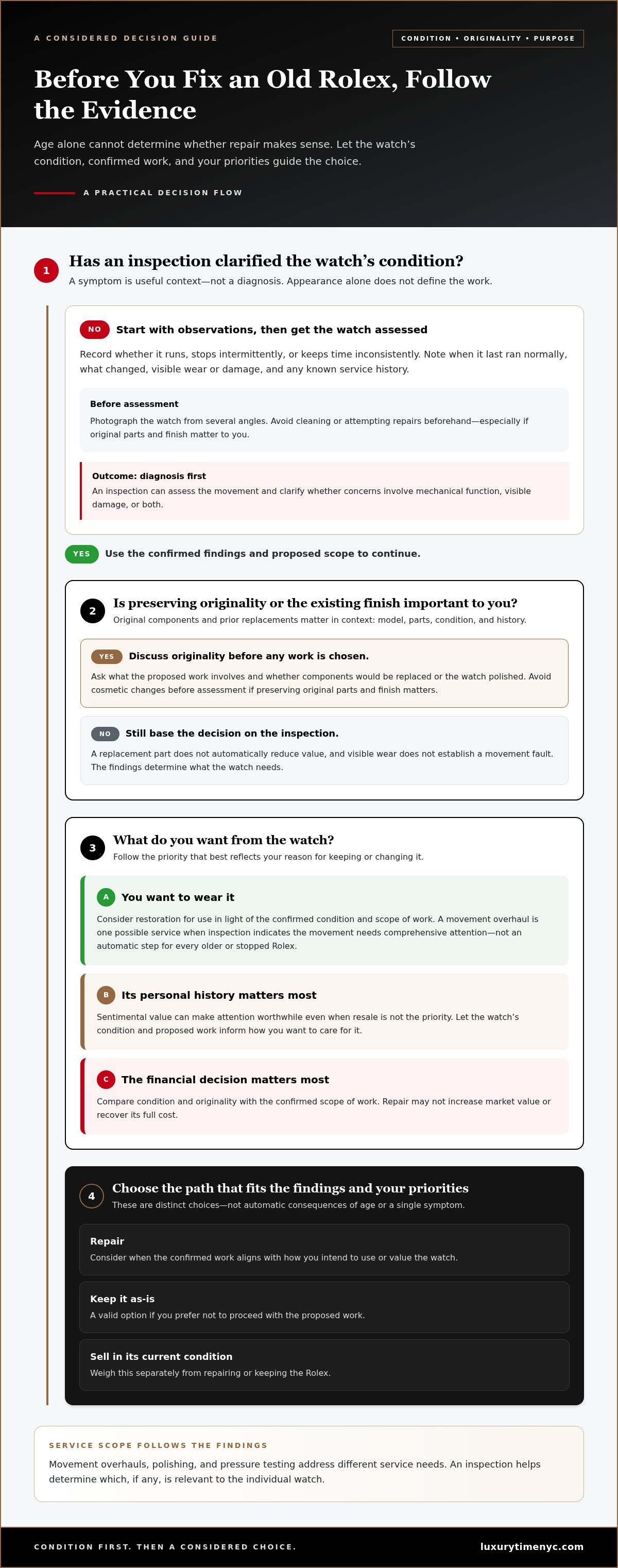
Deciding to Fix Your Old Rolex: A Practical Checklist
A little preparation can make an assessment more useful and the decision that follows more considered. If you’re weighing whether to repair, retain, or sell your Rolex, use this sequence to organize what you know before authorizing work.
- Document its present condition. Photograph the watch from several angles, including the dial, case, bracelet, crown, and any visible damage. Record whether it runs and whether any component appears missing. Don’t polish it, open the case, or attempt a repair before an assessment. Preserve its current state for comparison.
- Gather its records. Collect service receipts, purchase records, prior assessments, and any original documentation you have, including the box and papers. Note known replacement components or past work. These details provide context about the watch’s history, but don’t establish its current condition or guarantee a particular valuation.
- Describe the symptoms. Write down when the watch last ran, whether it stopped all at once or intermittently, and what changed before the problem began. Include any recent impact or exposure you know about. Stick to observations instead of guessing at the cause.
- Get a professional assessment. An inspection can assess the movement’s condition and clarify which work may be needed. A useful assessment explains the proposed work and its purpose, so you can distinguish a confirmed need from an optional recommendation.
- Compare the paths. Consider the proposed scope alongside your goal: wearing the watch, keeping it as-is, passing it on, or selling it. Decide only after you understand the work being proposed and how it relates to that goal.
What to prepare before an assessment
Bring the watch’s available history and your notes together. A service receipt may show what was addressed previously; the box and papers can add provenance context; photographs preserve a record of visible condition. None of these details alone proves what is wrong today. Together, they help the watchmaker consider the timepiece as an individual piece rather than relying on age or appearance.
How to evaluate a proposed repair
Before approving work, compare the proposed scope with what you want from the Rolex. Ask what each item addresses. Separate movement work intended to address function from optional cosmetic refinishing, such as polishing, particularly if preserving the existing finish matters to you. If the watch is mainly sentimental or you’re considering a sale, your priorities may differ from those of someone who plans to wear it regularly.
This process gives a more grounded answer to “is my old rolex worth fixing”: one based on the watch’s assessed needs and your intended outcome, not an assumption that every older Rolex should be restored. For an overview of professional services and assessment, explore NYC luxury-watch repair with Luxury Time NYC’s certified watchmakers.
Professional Rolex Repair in NYC: From Diagnosis to a Considered Decision
A careful assessment turns uncertainty into a clearer choice. Luxury Time NYC’s certified watchmakers inspect and service luxury watches, including Rolex timepieces. Their findings can explain the watch’s condition and the work under consideration. They don’t, by themselves, dictate that repair is the right decision. Your plans matter just as much.
What a professional assessment can clarify
An inspection helps distinguish a movement concern from visible wear or damage and define the possible scope of work. A movement overhaul addresses the movement; polishing is a separate cosmetic service, and pressure testing is another distinct service. These are not interchangeable, and none should be assumed necessary simply because a watch is old or has stopped. The appropriate discussion starts with the individual watch’s condition.
Share your intended use and preservation priorities during the assessment. A Rolex you hope to wear regularly may call for a different conversation from a vintage piece you want to retain with its original finish. If keeping original components is important, make that clear as the work is considered. A defined scope helps you weigh the proposed service against your goals without assuming a repair will increase resale value or recover its cost.
A discreet next step in New York’s Diamond District
Luxury Time NYC is located in Manhattan’s Diamond District at 15 W 47th St Suite 302, Third Floor, New York, NY 10036. The showroom brings together luxury-watch repair expertise and buying, selling, and trading options. That makes it possible to consider service alongside other paths, with the watch’s condition and your priorities guiding the decision.
If you’re still asking, “is my old rolex worth fixing,” begin with what an inspection establishes, then compare the proposed work with whether you intend to wear, retain, or sell the watch. Repair is one considered option, not an automatic conclusion. Keeping the piece as-is or selling it in its current condition may also fit your circumstances.
For a professional assessment in New York, explore professional luxury watch repair at Luxury Time NYC.
Choose the Future You Want for Your Rolex
The next decision isn’t only about the watch’s mechanism. It’s about the place you want this timepiece to hold in your life. Perhaps you hope to wear it again, preserve it for someone close to you, or release it to a new owner. Each intention gives the assessment a different purpose.
That perspective can make the question “is my old rolex worth fixing” easier to approach. You don’t need to decide based on age, uncertainty, or pressure to act quickly. Let the watch’s condition and your priorities guide the choice, and give yourself room to consider the findings before authorizing work. A thoughtful decision can honor both the watch’s history and what you want next.
For a considered next step, explore professional luxury watch repair with Luxury Time NYC. A clearer understanding of your options can help you move forward, whether repair, retention, or sale feels right.
Frequently Asked Questions
Can I wind an old Rolex that has stopped?
Only try gentle, normal winding if the crown moves as expected. Stop if you feel resistance or notice unusual behavior, and don’t force the crown or repeatedly try to restart the watch. A stopped Rolex may have several causes, and the symptom alone won’t identify one. Note how the crown feels and what the watch does, then arrange a professional inspection rather than opening or attempting to repair it at home.
Can magnetism make an older Rolex run incorrectly?
Yes, magnetism can affect some mechanical watches, but inaccurate or irregular timekeeping doesn’t prove magnetism is the cause. A watchmaker can assess whether magnetism is likely and distinguish it from other movement issues. Avoid improvised demagnetizing devices, which may not be suitable for your watch. Even if magnetism is involved, demagnetization won’t necessarily resolve a separate fault, so an assessment is more useful than guessing from the symptom.
Does a Rolex need a service if it has been unworn for years?
Not necessarily. Years without wear don’t establish the watch’s condition or prove that service is required. If you’re wondering, “is my old rolex worth fixing,” its behavior, maintenance history, and inspection findings are more useful than time in storage alone. Before regular wear, note whether it runs and share any previous service records with a watchmaker. Don’t assume a fixed interval applies without model-specific and manufacturer guidance.
Can I wear my old Rolex while it is losing time?
Inaccurate timekeeping can have several causes, so losing time isn’t a diagnosis. Consider limiting use if the watch makes an unusual noise, shows visible damage, or behaves erratically, and arrange an assessment. Continued wear can’t be assumed harmless, particularly when the watch’s condition is unknown. Note how much its timekeeping varies and under what circumstances, if you can do so without repeatedly testing or disturbing the watch.
Should I polish an old Rolex before getting it assessed?
Document the watch’s current appearance before arranging any cosmetic work. Polishing changes the exterior finish, which may matter if you value the original condition or want a clear record of existing wear. That doesn’t mean polishing is always harmful or beneficial. An assessment can help distinguish cosmetic concerns from mechanical needs, allowing you to consider each separately before deciding whether refinishing suits your priorities.
Can an old Rolex be assessed if it has no box or papers?
Yes. A watch can still be examined without its original box or papers, though service receipts, purchase records, or other available documentation may add useful history. Luxury Time NYC includes original serial numbers with every watch it sells; this doesn’t establish the paperwork status of your own Rolex. Bring any records you do have, and don’t delay an assessment solely because documents are missing.


