


A vintage case can look brighter after polishing yet lose the contours that give it character. The cost of professional watch case restoration for vintage pieces depends on the work required: light refinishing differs from correcting dents, rebuilding softened lines, or addressing mechanical needs at the same time. Because polishing removes metal, restraint matters as much as the visible result.
It’s understandable to want a clear estimate before entrusting a treasured watch to restoration. This guide explains what shapes the cost, how specialists approach scratches, dents, contour work, and refinishing, and when movement restoration belongs in the scope. You’ll also learn how owner approval guides the work and what information helps a professional assess the case. Each decision balances a cleaner finish with preserving original detail and heritage.
Key Takeaways
- Restoration cost depends on the condition of the watch and the scope of work, from restrained refinishing to more involved case correction.
- Owner approval helps keep refinishing aligned with the desired finish while preserving meaningful signs of age and original detail.
- Contour restoration calls for careful attention to the case’s original lines, not simply a brighter surface.
- Separating cosmetic work from movement needs clarifies what a complete restoration involves and which decisions shape the result.
Case and bracelet refinishing with owner approval
Refinishing should respond to the case’s condition, not a preference for maximum shine. Before work begins, agree with the owner on the finish, areas to treat, and acceptable changes.
Case and Bracelet Refinishing
Case and bracelet refinishing addresses scratches, worn surfaces, and differences in sheen across adjoining parts. Replating can renew a worn plated surface, while polishing changes the surface finish itself. A professional assesses each component separately, including the bracelet links and case lugs. That distinction matters: aggressive polishing can remove precious metal, soften lug lines, and damage historic hallmarks.
Polishing Versus Full Refinishing
A polish is a limited surface treatment intended to reduce visible marks and restore lustre. Full refinishing may involve treating multiple surfaces and recreating their original finishes, such as contrasting polished and brushed areas. For example, a watch with a bright bezel and satin-finished case sides needs different treatment on each surface. The owner’s approval should define which areas are included and which signs of age will remain.
A qualified watchmaker should be able to explain the proposed finish, identify vulnerable details, and describe how the work will preserve the case’s original lines. For a vintage Patek Philippe or Rolex, relevant experience includes handling historic hallmarks and distinct case profiles. Ask for a clear scope before approving the work.
Yes, case restoration can affect water resistance if the work involves opening the watch or disturbing its seals. Water resistance depends on the seals’ condition and correct fit, so refinishing alone shouldn’t be treated as proof that resistance is unchanged. Ask whether testing is included in the agreed work.
Before approving the work, ask which surfaces will be polished, refinished, or replated, and which original details may change. Also ask how the estimate and turnaround depend on the scope, case material, and bracelet condition. These factors determine the labor involved: a limited polish differs from replating and refinishing several components. Have the agreed treatment and any exclusions recorded before work starts.
Case re-profiling and restoration of original contours
Re-profiling addresses shape, not just surface shine. A watchmaker studies the case’s silhouette, lug angles, bevels, and transitions between planes before deciding whether reshaping is appropriate. On a vintage Rolex, for example, rounded lugs may indicate past material removal, while an uneven bevel can disrupt the case’s original geometry.
The aim is to recover a balanced profile without treating the factory shape as a blank template. Reference points include the symmetry of opposing lugs, the sharpness of surviving edges, and how the bezel meets the middle case. Photographs, model details, and intact surfaces can help guide the assessment. If too much metal has already been removed, further reshaping may reduce definition rather than restore it.
Careful preparation matters. The watchmaker documents existing wear, examines the case under magnification, and identifies areas to leave untouched. After disassembly, cleaning can reveal scratches or distortions hidden by dirt and residue. The professional then determines whether localized correction can improve the profile or whether abrasion would compromise hallmarks, edges, or the case’s proportions. The owner should approve the intended changes before material is removed.
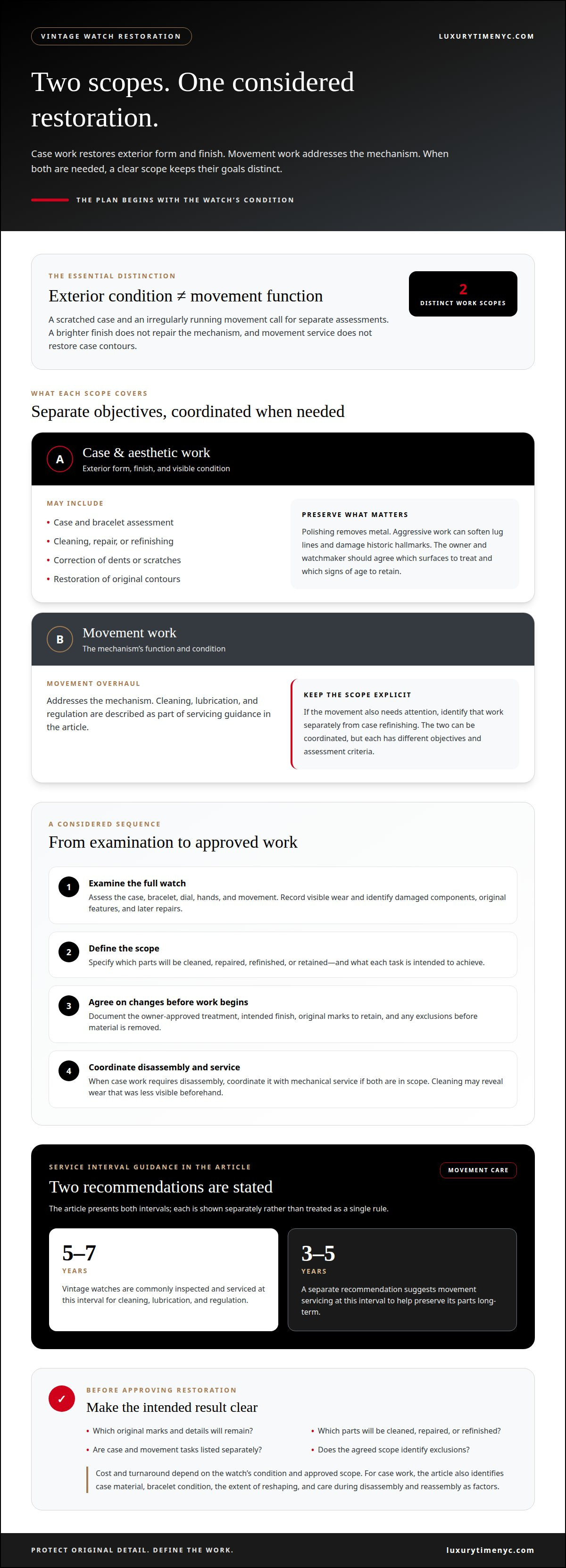
Re-profiling affects a watch’s visible architecture, but it doesn’t repair the movement. If both need attention, keeping the scopes distinct helps clarify the restoration plan. A movement overhaul concerns the mechanism; case work concerns exterior form and finish. The work may be coordinated, but each has separate objectives and assessment criteria.
Ask which contours the proposed work will address, what reference guides the intended shape, and which original details will be preserved. The estimate and turnaround depend on the case’s condition, the extent of reshaping, and the care required during disassembly and reassembly. For a broader restoration plan, a movement overhaul can be considered alongside the case work when the mechanism also needs service.
Complete mechanical and aesthetic restoration
Vintage watch case restoration involves assessing the exterior, documenting damage, and agreeing on appropriate refinishing. A complete restoration can also include movement service, but cosmetic and mechanical work address different needs.
The process begins with an examination of the case, bracelet, dial, hands, and movement. The watchmaker records visible wear, identifies damaged components, and distinguishes original features from later repairs. For example, a scratched case and an irregularly running movement require separate assessments. The proposed work should describe which parts will be cleaned, repaired, refinished, or retained, so the owner understands how each step may affect appearance and originality.
Mechanical work focuses on the movement’s function, while aesthetic restoration concerns the case and other visible surfaces. If both are required, the scope should make that distinction clear. A movement overhaul addresses the mechanism; refinishing addresses exterior condition. Vintage watches are commonly inspected and serviced every five to seven years for cleaning, lubrication, and regulation. A separate recommendation suggests movement servicing every 3-5 years to help preserve its parts long-term.
Sequence matters. The watchmaker assesses the full piece first, then identifies damaged areas and establishes the approved scope. If case work requires disassembly, coordinating it with mechanical service can keep the exterior and movement from being treated as unrelated projects. The owner should know which original marks will remain, which changes are proposed, and what each task is intended to achieve. Cleaning can also reveal wear that was less visible before assessment.
Cost and turnaround depend on the condition of the movement and case, the number of components needing attention, and whether parts require repair or replacement. A watch needing routine movement service and light case refinishing differs from one with damaged components and extensive exterior work. The estimate should separate those tasks and explain how they contribute to the complete restoration. That clarity lets the owner approve a defined result without confusing a cleaner appearance with restored mechanical performance.
Vintage watch case dent and scratch removal
A dent and a scratch call for different assessments. Careful watch case restoration for vintage pieces begins with examining the case under magnification and noting each mark’s location, depth, and effect on nearby edges. A shallow scratch across a flat case side differs from a dent at a lug, where the surrounding contour matters too. This assessment helps define which corrections can preserve the case’s form.
A dent may involve compressed or displaced metal, rather than a simple surface mark. The professional assesses whether reshaping can improve the area without making the case thinner or changing its profile. For example, an impact near a bezel seat needs particular care because the case must still fit its components correctly. If correction requires removing material, that trade-off should be included in the proposed scope.
Scratch removal also depends on depth and placement. Fine surface lines may respond to refinishing, while a deeper scratch can remain visible if removing it would erase an edge or soften a stamped detail. A mark crossing a polished bevel differs from one on a broad, brushed surface. Treatment should follow the finish and geometry of the area, rather than aim to make every surface uniformly bright.
Cost and timelines reflect the number and depth of marks, the metal involved, and whether dent correction requires additional case work. A single superficial scratch differs from several dents across the lugs and case flank. The watchmaker should explain which marks the estimate covers, what the process aims to remove, and which traces may remain to protect the original form.
A considered approach to watch case restoration for vintage pieces distinguishes correction from complete removal. Retaining a faint mark may be preferable to taking away more material than the case can spare. Clear documentation of affected areas gives the owner a defined basis for approval. Discuss vintage case dent and scratch correction as part of the restoration plan.
Luxury Time NYC
Luxury Time NYC offers a considered next step for owners weighing how to preserve a vintage watch. Its expertise with Rolex, Patek Philippe, Audemars Piguet, and Richard Mille timepieces provides relevant perspective when assessing a watch’s condition, originality, and restoration priorities.
Turn to Luxury Time NYC when you’re considering refinishing or need watch authentication to understand a piece’s provenance. A measured assessment can help clarify whether the priority is a restrained surface refresh or preserving original character. Contact Luxury Time NYC to discuss your vintage watch.
Choose a Restoration Path That Respects the Watch
The next step is to define what you want the watch to retain, not only what you want changed. For watch case restoration for vintage pieces, that means weighing appearance against originality and deciding which marks belong to the watch’s history. A clear restoration brief gives the work a considered direction.
Luxury Time NYC works with Rolex, Patek Philippe, and Audemars Piguet watches, bringing relevant familiarity with these marques to the conversation. Whether your question concerns a case’s condition or how restoration fits into the watch’s broader care, a focused discussion can help establish a practical next step without losing sight of the piece’s character.
Contact Luxury Time NYC about restoration to discuss the watch and the approach you have in mind. Preserve its distinction with care, and let its history remain part of its appeal.
Frequently Asked Questions
How Much Does Professional Watch Refinishing Cost?
Professional refinishing costs depend on the watch and the approved work, so there isn’t one dependable price for every piece. A written estimate should distinguish case work from bracelet or clasp treatment and list any replating separately. That itemization makes it easier to understand what the proposed charge covers and prioritize essential corrections over optional cosmetic work.
What Guarantee Is Provided for Refinishing Services?
A refinishing guarantee should specify which workmanship or finish concerns it covers and any limits. Luxury Time NYC’s two-year Global Luxury Time Warranty covers manufacturer defects; it is not a stated guarantee for refinishing results. Keep that distinction clear when reviewing restoration terms, especially if the work involves changes to a vintage case’s finish or surface details.
Will Refinishing Round Off My Watch Lugs or Erase Logos?
It can, if polishing removes too much metal or crosses delicate edges and markings. Lugs with narrow bevels and shallow stamped logos are particularly vulnerable to losing definition. A careful assessment should identify those features before work begins and specify how they’ll be protected. For a watch with faint hallmarks, preserving their legibility may matter more than removing every visible mark.
How much does vintage watch case restoration cost in the United States?
There is no single United States price for restoring a vintage case. A useful estimate reflects the metal, condition, affected components, and requested treatment rather than a generic national figure. Ask for separate descriptions of necessary case corrections and optional finish changes. This helps distinguish the cost of addressing structural or functional concerns from cosmetic work chosen primarily for appearance.
What factors affect the cost of restoring a vintage watch case?
The estimate is shaped by the case material, surface condition, and amount of correction needed. Bracelet work, replating, or restoring several distinct finishes can add separate tasks. Existing damage also matters: a light surface mark differs from a dent near a lug or a softened edge. A clearly itemized scope shows how each decision affects the overall work.
How do watchmakers restore scratches, dents, and corrosion on vintage cases?
Watchmakers first examine the affected area and determine whether the mark is superficial or has altered the case’s shape. They then choose a treatment that addresses the damage while preserving nearby edges, markings, and finish transitions. Corrosion requires particular care because the affected metal may be weakened or pitted. The appropriate correction depends on its location and depth, and some traces may remain to protect original details.


