


The standard bank wire transfer, long considered the undisputed benchmark of private horological commerce, is often the exact vulnerability modern fraud schemes exploit. Determining the safest payment methods for luxury watches requires looking well beyond traditional dealer customs. When acquiring an exceptional reference, assuming that standard commercial banking automatically protects your capital is an increasingly costly error.
Securing a rare Audemars Piguet or Rolex should evoke quiet pride, not the acute anxiety of irrevocable wire redirection, counterfeit escrow portals, or merchant surcharge confusion. You already recognize that provenance matters; how you settle the balance requires equal vigilance. In this guide, you'll master the precise risk-reward profiles of major settlement channels, discover how institutional Diamond District specialists execute high-value transactions, and gain the exact verification protocols needed to insulate your wealth.
From third-party escrow mechanics to credit card purchase protections, this analysis provides the definitive blueprint for acquiring high-value timepieces with complete peace of mind.
Key Takeaways
- Evaluate the distinct risk-reward profiles of bank wires, third-party escrow, and payment cards to identify the safest payment methods for luxury watches.
- Uncover why certified cashier's drafts and consumer digital wallets present acute capital risks when acquiring high-value timepieces.
- Master an institutional six-step execution protocol, including dual-channel voice verification of corporate banking details, to neutralize interception schemes.
- Discover how established Diamond District specialists eliminate settlement vulnerability through private showroom consultations and fully insured armored transit.
The Anatomy of High-End Watch Transactions: Hidden Risks and Capital Vulnerabilities
High-value horology commands immediate liquidity. Rare references change hands rapidly, drawing sophisticated financial adversaries toward high-ticket settlements. In secondary markets, evaluating the safest payment methods for luxury watches means dissecting the underlying settlement mechanics. Most collectors prioritize delivery speed over capital preservation. That balance is fragile. A single structural oversight can expose substantial liquid capital to irreversible loss.
Secondary watch trades traditionally favor irrevocable settlement mechanisms. Wire transfers and real-time bank settlements permanently eliminate merchant chargeback risks, but they instantly shift the entire transactional exposure to the buyer. If an issue arises post-settlement, your capital is gone. For technical card transactions, established institutions comply with the Payment Card Industry Data Security Standard (PCI DSS) to protect financial data, yet non-card rails require equally rigorous personal defenses.
Irreversible Losses: The Reality of Wire Fraud and Payment Diversion
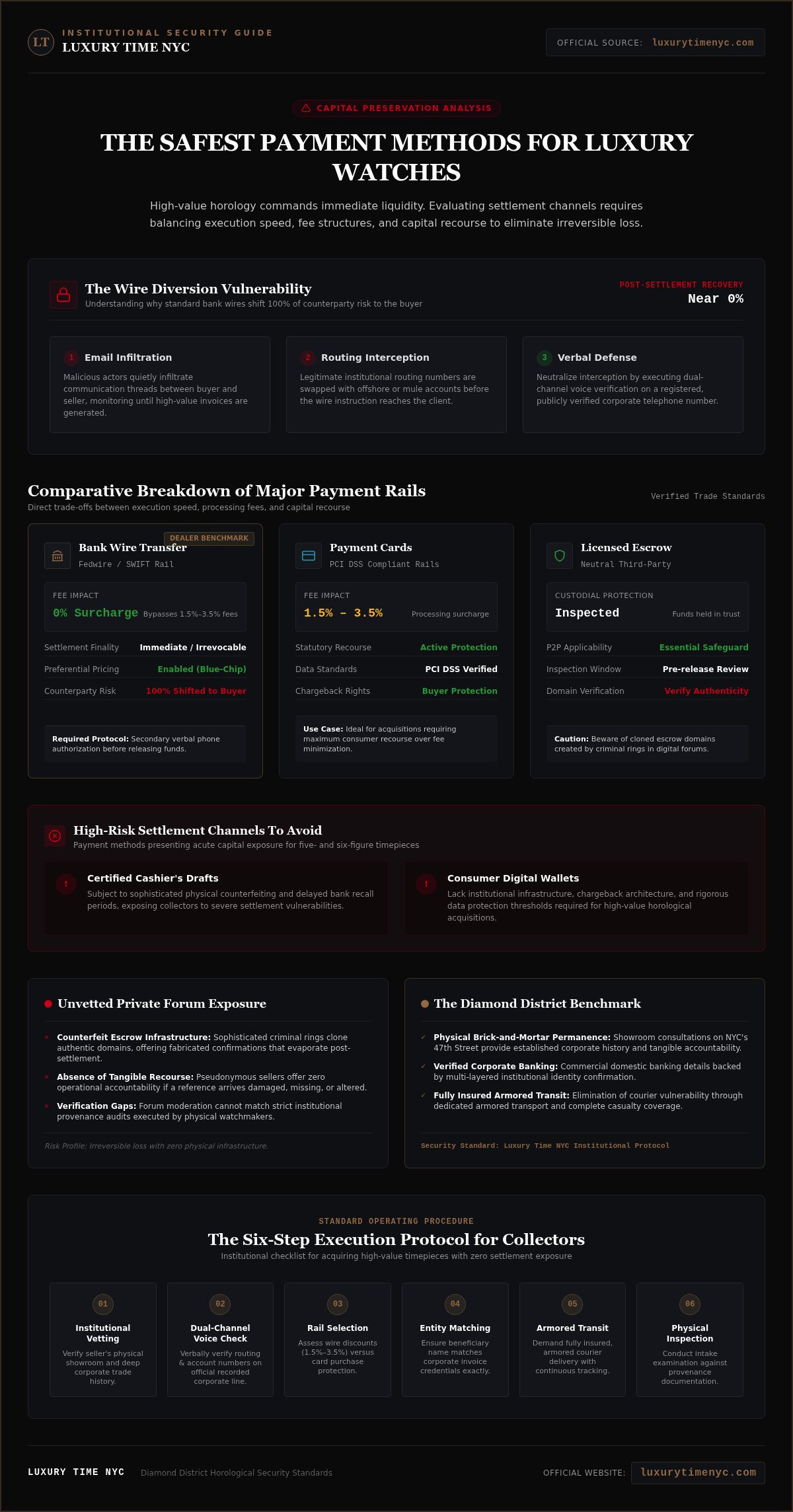
Business email compromise (BEC) remains an acute threat to private collectors. In these coordinated diversions, malicious actors quietly infiltrate a seller's email exchange, monitoring discussions until an invoice is generated. They intercept the transmission, swapping legitimate institutional routing numbers for offshore mule accounts. Once a domestic or international wire settles, recovery rates through retail banking channels plummet near zero. To preserve capital, always confirm settlement instructions via secondary verbal authorization, calling the seller's registered, publicly verified corporate telephone number before initiating payment.
Peer-to-Peer Pitfalls Versus Established Dealer Standards
Transacting with unvetted private sellers across open enthusiast forums introduces severe operational exposure. Independent digital listings lack institutional infrastructure, presenting distinct vulnerabilities:
- Counterfeit Escrow Infrastructure: Sophisticated criminal rings clone authentic escrow domains, providing fabricated balance confirmations that evaporate once funds clear.
- Absence of Tangible Recourse: Pseudonymous peer-to-peer sellers offer zero operational accountability if a piece arrives damaged, missing, or materially misrepresented.
- Verification Gaps: Forum moderation cannot match the strict provenance checks executed by vetted physical jewelers.
Authentic security requires established infrastructure. Discerning buyers understand that navigating 47th street provides a level of brick-and-mortar permanence that digital chat rooms cannot emulate. Physical presence, deep commercial history, and verified corporate banking represent the true foundation for securing five- and six-figure horological acquisitions, serving as the essential criteria for selecting the safest payment methods for luxury watches.
Evaluating the Safest Payment Methods for Luxury Watches: A Comparative Breakdown
Selecting between settlement mechanisms involves balancing execution speed, fee structures, and capital recourse. Each financial instrument distributes counterparty risk differently. When curating the safest payment methods for luxury watches, seasoned collectors evaluate whether immediate settlement discounts outweigh statutory safety nets.
Bank Wire Transfers: The Industry Standard for Premier Acquisitions
Fedwire and SWIFT settlements remain the undisputed benchmark for high-value horological acquisitions. Direct bank transfers clear with absolute finality, bypassing merchant processing fees that typically average between 1.5% and 3.5%. This efficiency enables dealers to offer preferential pricing on blue-chip references from Patek Philippe or Rolex. However, this channel places the burden of security entirely on the sender. Buyers must confirm corporate beneficiary details over recorded telephone lines prior to authorizing capital dispatch.
Licensed Horological Escrow Services: Neutral Third-Party Protection
For peer-to-peer transactions between unvetted private parties, licensed escrow provides essential custodial protection. Regulated escrow platforms hold liquid capital in neutral accounts while the buyer inspects the timepiece and conducts technical movement authentication. Funds disburse only after physical condition and serial integrity match the invoice. Standard fee structures apply, yet this neutral custody mitigates non-delivery risks when dealing outside established dealer networks.
Major Credit Cards and Regulated Consumer Finance
Premium credit cards deliver powerful buyer protections. Regulatory safeguards, such as the Fair Credit Billing Act, grant robust dispute mechanisms for goods that arrive damaged or counterfeit, reflecting standard FTC consumer advice on online shopping regarding payment safety. Despite this recourse, credit cards present distinct limitations for five-figure purchases:
- Transaction Limits: Daily card authorizations frequently decline high-ticket horological transactions without prior bank clearance.
- Interchange Surcharges: Merchant card surcharges often range from 2% to 4%, adding thousands in processing costs to rare timepieces.
- Settlement Friction: Card disputes can take months to resolve, freezing liquidity during formal reviews.
While paying merchant fees makes sense when acquiring a piece from an unproven digital seller, established relationships with reputable firms like Luxury Time NYC deliver complete authenticity guarantees without forcing collectors to absorb secondary transaction penalties.
High-Risk Payment Channels and Payment Pitfalls Every Collector Must Avoid
Acquiring fine horology demands an uncompromising filter. While identifying the safest payment methods for luxury watches safeguards acquisition capital, identifying predatory settlement traps is equally vital. In the secondary market, convenience often masks severe counterparty vulnerability. Serious collectors don't sacrifice transactional security for momentary operational ease.
The Perils of Peer-to-Peer Digital Wallets (Zelle, Venmo, and PayPal Friends & Family)
Consumer payment apps are engineered for casual personal transfers, not five-figure horological acquisitions. Their user agreements explicitly exclude commercial merchandise and physical collectibles from buyer or seller dispute mechanisms. When a transaction involves compromised bank profiles or identity theft, the platform provider issues an immediate clawback against the recipient. Legitimate dealers never conduct business through casual consumer apps, and collectors should never rely on them for rare assets.
Counterfeit Cashier’s Checks and Delayed Clearing Traps
Certified cashier's drafts project an illusion of institutional finality. That illusion is dangerous. Federal regulations mandate rapid funds availability, often crediting deposits within one to two business days. Definitive clearing, however, frequently takes weeks. Sophisticated counterfeiters exploit this gap, taking possession of an Audemars Piguet or Rolex reference before the bank discovers the forgery and claws back the temporary balance. Verifying a cashier's check requires calling the issuing branch directly using an independently verified routing number before releasing property.
Cash Hand-to-Hand and Cryptocurrency Considerations
Physical cash and digital tokens introduce unique operational liabilities. Evaluating these alternative channels reveals why institutional dealers enforce strict boundaries:
- Physical Currency Hazards: Carrying tens of thousands of dollars in physical currency invites severe personal safety liabilities. Beyond personal security, federal regulations require merchants to submit IRS Form 8300 for physical cash transactions exceeding $10,000.
- Cryptocurrency Finality: Public blockchain transfers are mathematically irrevocable once confirmed. If private keys leak, addresses mismatch, or the counterparty fails to ship, there is zero legal recourse. While investors who maintain digital holdings can discover Lumo Wallet to safeguard private keys on their own devices, using crypto for unvetted physical purchases introduces severe counterparty risk.
- Price Fluctuation: Token volatility during settlement windows creates unnecessary friction over asset valuation.
While formal frameworks like the FTC's security guide for businesses emphasize robust risk management across commercial environments, physical currency and anonymous digital ledgers remain fundamentally misaligned with the safest payment methods for luxury watches.
How to Securely Execute a Luxury Watch Transaction: A Six-Step Protocol
Precision execution protects capital. Even when utilizing the safest payment methods for luxury watches, mechanical discipline during settlement separates seasoned collectors from fraud victims. Follow this institutional protocol to execute acquisitions without vulnerability.
Pre-Payment Verification: Invoices, Banking Details, and Voice Authentication
Before routing any funds, establish absolute counterparty validity through three deliberate checks:
- Corporate Due Diligence: Demand an itemized commercial invoice displaying the seller's legal entity, state registration number, and verified physical premises.
- Out-of-Band Voice Confirmation: Initiate a direct telephone call to the merchant's registered switchboard. Verify the routing number, account name, and timepiece serial number verbally. Never use phone numbers printed solely on an emailed invoice.
- Micro-Deposit Validation: For high-value, six-figure acquisitions, transmit a nominal test transfer first. Once the dealer confirms receipt on their commercial ledger, release the remaining balance.
Settlement, Transit, and Intake Inspection
Once accounts align, initiate settlement via direct Fedwire or licensed escrow. Require the dealer to dispatch the timepiece through fully insured, armored transit with mandatory adult signature confirmation. Standard parcel post remains inadequate for fine horology.
Post-Payment Inspection and Provenance Documentation
Upon delivery, conduct a disciplined intake inspection in a controlled setting:
- Continuous Video Recording: Film the package intake from unbroken courier seals through unboxing. Document serial tags and condition in crisp detail without cutting the video feed.
- Provenance Matching: Cross-reference the case, rehaut, and movement serial numbers directly against the chronometer certificate, warranty card, and sales invoice.
- Technical Authentication: Inspect movement amplitude, water resistance, and mechanical tolerances as detailed in the guide to buy and sell watches.
Adhering to these sequential safeguards ensures you deploy the safest payment methods for luxury watches with complete operational security. When you are ready to expand your collection with absolute institutional confidence, schedule a private consultation with Luxury Time NYC to acquire fully authenticated references through our Manhattan showroom.
The Diamond District Benchmark: How Luxury Time NYC Ensures Flawless Transaction Security
Independent forums and peer-to-peer marketplaces cannot match the operational safeguards of an established physical institution. Established in New York's historic Diamond District in 2005, Luxury Time NYC sets the benchmark for capital preservation in high-value horology. Understanding the safest payment methods for luxury watches requires an environment where institutional financial rails integrate seamlessly with tangible, verified custody.
Institutional Banking and Fully Insured Global Transit
Remote acquisitions demand flawless execution. At Luxury Time NYC, corporate settlements execute exclusively through verified Tier-1 domestic banking institutions, eliminating the intermediary risks common to open digital exchanges. Every acquired timepiece undergoes rigorous in-house evaluation, pressure testing, and multi-point movement authentication backed by our certified authenticity guarantee.
For collectors receiving shipments remotely, outbound deliveries bypass conventional postal networks. Timepieces travel through specialized armored transit with complete replacement insurance coverage, requiring positive adult identification upon arrival. Collectors seeking exceptional references can review verified inventory through our curated insights in the guide to buying a Rolex in NYC.
Private Showroom Consultations in New York’s Diamond District
For discerning connoisseurs, the definitive settlement method remains an in-person exchange. Our private Manhattan showroom delivers an environment of quiet discretion and absolute security. Here, you examine pristine references from Rolex, Patek Philippe, Audemars Piguet, and Richard Mille firsthand, accompanied by complete provenance documentation.
Settling an acquisition within our showroom pairs direct physical inspection with real-time electronic banking confirmation. There is no transit delay and no ambiguity regarding mechanical integrity. This white-glove approach represents one of the safest payment methods for luxury watches available globally, merging institutional financial security with historic Diamond District provenance.
Schedule a private consultation at Luxury Time NYC to secure your next acquisition with total peace of mind.
Securing Your Next Acquisition with Institutional Certainty
Acquiring fine mechanical art should remain an exhilarating milestone, unburdened by financial exposure. As market tactics evolve, deploying the safest payment methods for luxury watches requires an uncompromising approach: pair institutional settlement channels with verified physical accountability. Dual-channel voice confirmations, disciplined commercial wire protocols, and neutral custody effectively insulate your liquid capital before any funds move.
Brick-and-mortar permanence remains the ultimate defense against digital diversion. Since 2005, Luxury Time NYC has provided discerning collectors with an enduring sanctuary in Manhattan's historic Diamond District. Every reference in our curated inventory is backed by a certified authenticity guarantee, validated through master horological inspection, and supported by secure institutional wire facilities alongside fully insured armored transit worldwide.
You don't have to leave settlement integrity to chance. When you demand uncompromising security and provenance, Explore Authenticated Timepieces at Luxury Time NYC and acquire your next masterpiece with complete confidence.
Frequently Asked Questions
Is a direct bank wire transfer safe when purchasing an expensive luxury watch online?
Direct bank wire transfers are safe only when transmitted to an established, physically verifiable dealer whose corporate credentials you have confirmed. Wires execute with finality and offer zero buyer recall if funds divert to a fraudulent account. To make it one of the safest payment methods for luxury watches, always verify the merchant's commercial banking details through a direct telephone call before transmission. Avoid sending wires to unvetted private individuals on open forums.
Can I pay for a Rolex or Patek Philippe with a credit card to earn travel rewards safely?
Yes, credit cards provide robust statutory fraud protection and reward accrual, though they often introduce merchant surcharges on high-value timepieces. Premium cards protect against non-delivery and counterfeit items under federal billing regulations. However, many dealers impose processing fees ranging between 2% and 4% or require daily spending limit pre-authorizations for five-figure assets. Balancing card perks against cash-wire dealer incentives is essential before completing settlement.
Why do luxury watch dealers avoid accepting PayPal or peer-to-peer mobile apps?
Premier dealers avoid peer-to-peer payment applications because their terms of service exclude high-value luxury merchandise and expose merchants to severe chargeback fraud. Platforms like Zelle or Venmo are built for casual personal transfers. If an account is compromised or funding sources are reported stolen, platforms trigger immediate clawbacks against the recipient. Commercial dealers refuse these apps entirely, relying instead on institutional banking infrastructure that guarantees genuine settlement finality.
What is third-party escrow and when is it recommended for watch transactions?
Third-party escrow is an arrangement where an independent, licensed financial intermediary holds purchase capital until the buyer receives and approves the timepiece. It is highly recommended for transactions between private parties who lack established reputations or physical storefronts. The buyer funds the neutral account, the seller ships the reference, and funds release only after mechanical inspection. For peer-to-peer exchanges, licensed escrow ranks among the safest payment methods for luxury watches.
How do established dealers verify cashier’s checks before releasing a luxury watch?
Established dealers verify cashier's drafts by holding physical inventory until the instrument clears definitively through the issuing bank, rather than relying on initial fund availability. Because banks often credit deposits provisionally within 48 hours, counterfeit drafts can take weeks to surface as forged. Dealers contact the issuing branch directly via independently sourced telephone directories to confirm routing and check issuance before releasing an Audemars Piguet or Rolex.
What recourse do I have if a purchased luxury watch arrives damaged or unauthenticated?
Your available recourse depends entirely on the payment channel utilized and whether the seller provides an explicit, legally binding authenticity guarantee. Credit card transactions permit formal billing disputes, while escrow services allow you to reject delivery during the agreed inspection window. With direct wires, legal recourse against unverified sellers is exceedingly difficult. Reputable institutions like Luxury Time NYC remove this risk entirely by providing certified authenticity guarantees backed by professional in-house watchmakers.
Is it safe to bring cash when buying a luxury watch in New York’s Diamond District?
Carrying substantial physical cash through Manhattan introduces significant personal security risks and operational complications for both parties. Transporting five-figure sums in currency invites unnecessary physical vulnerability. Federal law also mandates that merchants file IRS Form 8300 for cash transactions exceeding $10,000, requiring extensive personal reporting. Discerning clients prefer scheduling a private showroom appointment at Luxury Time NYC, concluding transactions via secure wire transfers or private bank arrangements in a protected, confidential environment.


