


The Cartier Santos is best understood as a design icon first, and a configuration choice second. Its square case, visible bezel screws, and Roman-numeral dial give the cartier santos watch a distinctive character, but choosing one involves more than recognizing its silhouette. Size, material, movement, and condition all shape how a particular example wears and fits a collection.
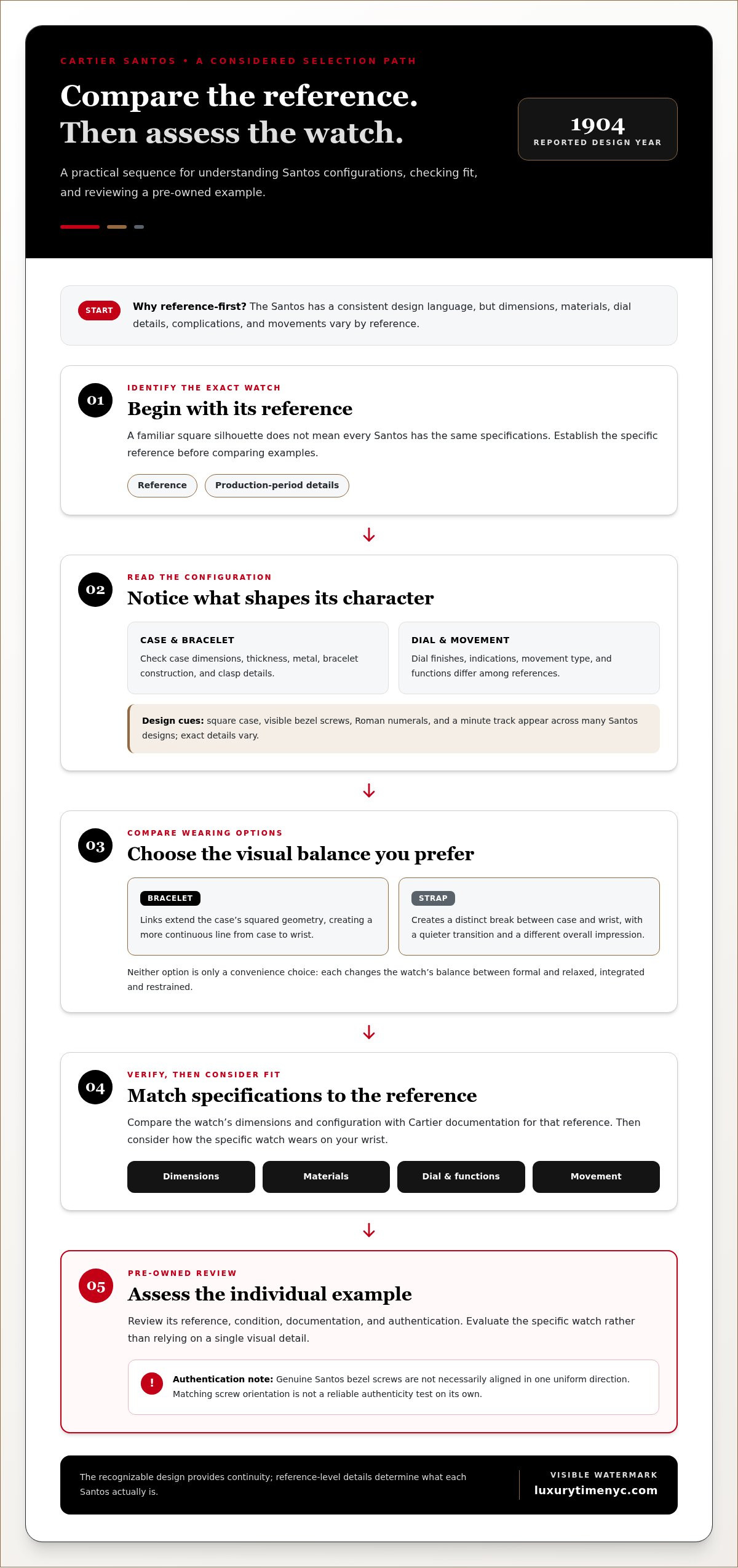
If you’re unsure where its place in Cartier’s watchmaking history begins, or how to compare versions without being swayed by hype, start with the details that can be checked. This guide covers the Santos heritage and defining design, practical fit and configuration preferences, and how to assess the authenticity and condition of a pre-owned watch.
We’ll examine the details that set the Santos apart, the practical considerations that distinguish one configuration from another, and the checks that matter when assessing a pre-owned example. Luxury Time NYC, an independent watch dealer founded in 2005 in New York’s Diamond District, offers authenticated Cartier watches and specialist experience. A considered choice begins with knowing what to compare.
Key Takeaways
- Understand the design and historical association that distinguish the Cartier Santos from other Cartier watches.
- See how case proportions, dial details, bracelet, and strap shape the character of a cartier santos watch.
- Compare verified dimensions and configurations to narrow your choice, then consider how the watch wears on your wrist.
- Assess a pre-owned example methodically by reviewing its reference, condition, documentation, and authentication.
- Follow a considered path from design research to provenance, with Luxury Time NYC’s specialist experience as a resource.
Why the Cartier Santos Watch Became a Design Icon
The Cartier Santos is a distinctive Cartier wristwatch, recognized by its square case, Roman-numeral dial, and exposed bezel screws. Its significance rests not only on a memorable outline, but also on the story of aviation and early wristwatch design associated with its creation. Understanding that history helps explain why the cartier santos watch feels purposeful rather than ornamental.
How the Santos story began
The familiar account connects Brazilian aviator Alberto Santos-Dumont with Louis Cartier. Santos-Dumont needed to read the time while flying, when taking a pocket watch from his clothing was impractical. Cartier’s solution, according to the house’s historical narrative, was a watch worn on the wrist. The design is commonly dated to 1904, and Cartier’s history is discussed in the broader account of Cartier (brand).
That date and personal connection are central to the Santos story, but claims about “the first wristwatch” require care. The watch is often described as one of the earliest purpose-designed men’s wristwatches, or as the first made specifically for aviation. Those formulations are more measured than treating it as the first wristwatch of any kind. Wrist-worn timepieces existed before the Santos, while its place in Cartier’s history is tied to a celebrated design created for a practical need.
The story’s lasting force lies in that meeting of utility and elegance. It links a watch to a specific wearer and task, then gives the resulting object a visual identity that remained legible across generations.
Design details that make the Santos recognizable
The Santos reads clearly from across a room. Its square case is softened by rounded corners, while the bezel follows the case’s geometry and is secured by visible screws. Rather than concealing construction, the design makes these fasteners part of the watch’s appearance. On genuine Santos bezels, the screws are not necessarily aligned in one uniform direction, so matching screw orientation is not a reliable authenticity test on its own.
The dial reinforces the formal character: Roman numerals, a minute track, and the Cartier name sit within a composed, highly recognizable layout. Exact dial details vary by reference, so no single version should be treated as the template for every Santos. The same is true of case dimensions and materials.
On bracelet-equipped versions, links continue the case’s squared geometry, creating a cohesive visual line from case to wrist. A strap, by contrast, gives the same watch a quieter transition and a different overall impression. These features are not exclusive to Cartier in isolation; it is their combination, proportions, and continuity that make the Santos identifiable.
In brief, the Santos grew from Cartier’s reported 1904 design for aviator Alberto Santos-Dumont into a landmark wristwatch whose square case, exposed screws, and coherent bracelet design remain its signature.
What Defines the Cartier Santos Watch Beyond Its Signature Shape?
The Santos has a recognizable design language, but it isn’t a single fixed specification. The square profile, composed dial, and relationship between case and bracelet create continuity across the family. Dimensions, materials, dial finishes, complications, and movements, however, belong to individual references. Recognizing that distinction helps collectors appreciate the design without assuming every example wears or functions the same way.
Case, bezel, and bracelet: reading the design language
Look at how the bezel frames the case, rather than treating its exposed screws as an isolated motif. Their placement emphasizes the geometry and gives the watch a measured, architectural presence. Details may vary by reference and period, so assess a specific watch on its own merits rather than expecting every bezel, corner, or finish to match exactly.
The bracelet changes the impression on the wrist. Its links visually extend the case, making the watch read as a continuous form; a strap creates a more distinct break between case and wrist and can soften the overall effect. Neither is simply a detail of convenience. Each shifts the balance between formal and relaxed, integrated and restrained. Sotheby’s Essential Guide to the Cartier Santos also places the square case and exposed screws among the design’s defining features.
For fit and condition assessments, distinguish what is visible from what requires documentation. Check case dimensions, thickness, metal, bracelet construction, and clasp details against the precise reference and reliable manufacturer information. A shared silhouette doesn’t establish identical specifications.
Dial, movement, and reference-level differences
Dial details shape the watch’s character at first glance. Roman numerals and a clear track give many Santos dials a formal, instrument-like order, while variations in color, texture, hands, or additional indications can change that impression. A skeletonized or chronograph version, for example, presents a different visual emphasis from a simpler time display; neither should be treated as representative of the entire family.
The same care applies beneath the dial. Movement type, functions, case materials, and dimensions differ among references and can also vary across production periods. Before comparing two watches, identify their references, then consult Cartier documentation for the corresponding specifications. Retail descriptions can help orient a search, but a listing for one configuration is not a specification sheet for every Santos.
The Santos shares a coherent design language; its dimensions, materials, dial, and mechanics are reference-specific. Recognize the family resemblance, then evaluate the individual watch. If you’re comparing examples, you can explore Cartier watches with reference details in view.
How to Choose a Cartier Santos Watch That Suits Your Wrist
Choosing a Santos is a matter of proportion and personal preference, not simply selecting a case with a familiar name. A square case can occupy the wrist differently from a round one with the same stated width. Case length, thickness, bracelet shape, and the way the corners extend toward the wrist all influence its presence. Compare the complete watch, not one measurement in isolation.
Which Santos size and proportions feel right?
Start by considering how much of your wrist you want the watch to occupy. Lug-to-lug length, where documented, helps indicate how far the case spans across the wrist; thickness affects how it sits under a cuff. The bracelet can also make the watch read as a broader, more continuous form. For a practical overview of case measurements and wrist fit, see this guide to choosing watch size.
Try a candidate on if possible. Notice whether its edges sit comfortably, whether it shifts as you move, and whether its scale feels balanced with your usual clothing. There’s no reliable gender or wrist-size rule that determines the right choice. Comfort and the visual balance you prefer are more useful guides.
Comparing verified Santos configurations
The verified details below illustrate why comparisons should be reference-specific. Dimensions and dial information are included only where documented; don’t infer missing details from another Santos.
| Reference or configuration | Dimensions | Material | Dial detail |
|---|---|---|---|
| Santos de Cartier Medium, WSSA0029 | Not specified in the verified details cited here | Steel | Not specified here |
| Santos Chronograph Large Model, introduced in 2026 | 37.7 × 47.5 mm; 11.6 mm thick | Steel, steel and yellow gold, or yellow gold | Not specified here |
| Santos-Dumont, WGSA0124 | 43.5 × 31.4 mm; 7.3 mm thick | Platinum | Silver satin-brushed |
| 2026 Santos-Dumont yellow-gold version | 43.5 × 31.4 mm; 7.3 mm thick | Yellow gold | Gilded obsidian |
Choosing materials, dial, and bracelet details
Material and dial affect the watch’s presence as much as its dimensions. Steel offers a restrained look; precious metal brings a warmer or more formal impression. A satin-brushed dial is quieter in effect than the gilded obsidian dial specified for the 2026 yellow-gold Santos-Dumont. These are aesthetic distinctions, not a universal ranking of quality or versatility.
Consider whether you prefer an integrated bracelet’s continuous line or the more distinct transition of a strap. Don’t assume a particular reference includes an additional strap or that components are interchangeable; verify what belongs to that exact configuration. For any cartier santos watch under consideration, compare the reference with Cartier’s documentation before relying on dimensions, movement, materials, or dial descriptions. Luxury Time NYC’s Cartier watch selection offers a starting point for a closer look.
How to Evaluate a Pre-Owned Cartier Santos Before Buying
A pre-owned Santos deserves a disciplined review. Appearance alone can’t establish authenticity, and an attractive set of accessories doesn’t tell the whole story. Assess the watch through its reference, components, condition, documentation, and specialist authentication. Each contributes useful evidence; none should be treated as a substitute for the others.
Check reference details, condition, and provenance
Begin with the reference and serial information on the watch, then compare them with reliable Cartier documentation for that model and period. Confirm that the case shape, dial layout, hands, material, and other visible features are consistent with the identified reference. Details differ across the Santos family, so judging by resemblance to a different version can lead to false conclusions.
Next, examine the watch in good light and consider the case, bezel, dial, bracelet, and clasp together. Look for dents, deep scratches, uneven wear, loose or damaged links, and signs that the case has been heavily polished. Polishing can soften edges and alter the crispness of the original contours. It isn’t automatically a reason to reject a watch, but the extent and quality of the work matter to collectors concerned with condition and originality.
Replacement parts also deserve context. A service replacement may be appropriate, yet it can affect originality or how closely the watch matches its initial configuration. Review service records where available, and compare stated repairs with the parts and condition you can see. Box and papers may support a watch’s history, but they don’t independently prove authenticity. Assess them alongside the watch, not instead of it.
Useful visual clues include the Roman numerals, the hidden “CARTIER” signature found on most modern Cartier watches, the crown cabochon, and the case-back engravings. Genuine Santos bezel screws are single-slot flat-head screws, and their alignment can vary. These observations are screening clues, not a complete test: convincing details on the outside don’t establish that every component is genuine or correct.
Why independent authentication matters
Specialist examination can assess whether the watch and its components are authentic and consistent with the reference. That matters because photographs and paperwork may not reveal issues that require closer inspection. A clear account of known service, replaced parts, and observed condition gives the buyer a more informed basis for a decision.
Authentication addresses identity and consistency. It doesn’t predict future performance, eliminate the possibility of later service, or promise resale value. Keep those questions separate. A sound purchase decision rests on what can be established about this watch today.
Luxury Time NYC, founded in 2005 in New York’s Diamond District, provides watch authentication and offers Cartier watches with a certified authenticity guarantee for its curated selection. For a pre-owned cartier santos watch, explore authenticated Cartier watches with reference and condition in mind.
Explore Cartier Santos Watches with Luxury Time NYC
A considered Santos purchase follows a clear sequence: understand the design, identify the configuration that suits your wrist and preferences, then assess the specific watch’s condition and provenance. The right choice isn’t determined by reputation alone. Reference details, authenticity, and the way a watch wears all matter.
What to expect when exploring the Cartier selection
Luxury Time NYC is an independent luxury-watch dealer founded in 2005 in New York’s Diamond District. The business buys, sells, and trades authenticated watches, including Cartier. Its curated watch selection carries a certified authenticity guarantee, giving buyers a clear point of confidence as they consider a timepiece.
For a Santos, keep the decision tied to the individual example. Compare its reference, configuration, condition, and documentation rather than assuming one listing represents the entire family. Evaluate the details of the specific watch in front of you, not assumptions drawn from another version.
Collectors can explore the retailer’s selection online or visit the showroom by appointment. Online purchases use secure payment and are supported by global shipping. For a sense of the local watch-trading context, Luxury Time NYC’s guide to New York’s 47th Street watch district offers further perspective on the Diamond District setting.
A New York showroom and global online experience
An in-person visit offers the opportunity to consider a watch at wrist level: its proportions, bracelet presence, dial, and condition are easier to evaluate when viewed directly. A showroom appointment in New York’s historic Diamond District provides that distinct experience. Online browsing makes it possible to review the retailer’s selection remotely, with secure payment and global shipping.
Ownership continues after the purchase. Service records and attentive care help preserve a watch’s condition, while professional watch repair is part of Luxury Time NYC’s broader expertise. The guide to luxury watch repair provides useful context for thinking about maintenance as part of long-term ownership.
The essential steps remain simple: recognize the Santos design, choose a reference and configuration that feel right, and give authenticity and provenance the attention they deserve. Luxury Time NYC brings specialist experience, a New York Diamond District presence, and an authenticated Cartier selection to that process. Explore the retailer’s Cartier watches at your own pace, with a considered choice in mind.
Choose the Santos That Feels Like Yours
The right cartier santos watch is not simply the one with the most familiar reference or the most striking specification. It’s the one whose presence feels considered on your wrist and whose character belongs naturally in your collection. Give yourself room to make that judgment. A watch chosen with patience can carry meaning beyond the moment of purchase.
Before taking the next step, decide what you want this piece to represent: a daily companion, a design landmark, or a considered addition to a broader collection. Let that purpose guide your final comparison, and give the individual watch’s condition and provenance the attention they deserve. The strongest choice is the one you can appreciate with clarity, today and over time.
When you’re ready to explore, Luxury Time NYC offers a considered setting for discovering Cartier watches. Explore Cartier watches at Luxury Time NYC and take the next step toward a piece that feels distinctly your own.
Frequently Asked Questions
What is special about the Cartier Santos watch?
The Cartier Santos watch is notable for pairing an aviation-linked origin story with a design that remains immediately recognizable. Its square form and visible fasteners make it a distinctive choice within Cartier’s watchmaking history, while the reported connection to Alberto Santos-Dumont gives the design a practical point of departure. For collectors, its appeal lies in that balance of purpose, enduring visual identity, and variations that let individual references express the design differently.
Is the Cartier Santos a good everyday watch?
It can suit everyday wear if its dimensions, configuration, and care requirements fit your routine. Consider how the watch sits during ordinary activities, whether its profile works with your usual cuffs, and whether you prefer a bracelet or a strap. Before choosing a specific example, review the manufacturer’s guidance for that reference, including its stated water resistance and maintenance recommendations. Daily suitability depends on the particular watch and how you plan to wear it.
How do I choose the right Cartier Santos size?
Compare the full case dimensions, especially length and thickness, rather than relying on width alone. If possible, try the watch on and check how the case sits across your wrist when your arm is relaxed and moving. A useful test is to wear it beneath a familiar shirt cuff and see whether the shape feels comfortable, not merely impressive in a display setting. Choose the scale you enjoy seeing and wearing.
Is a pre-owned Cartier Santos worth buying?
A pre-owned Cartier Santos can be a considered choice when the individual watch’s authenticity, condition, reference, and service history are clear. Review the case and bracelet for wear, and find out whether polishing or replacement components affect the configuration you want. Box and papers can add useful provenance, but they aren’t proof on their own. Base the decision on the specific example, not assumptions about future resale performance.
How can I tell if a Cartier Santos is authentic?
No single visible detail can establish authenticity with certainty. Examine the reference and serial engravings, dial printing, hands, crown, and bezel screws for consistency, but treat these as clues rather than a verdict. Counterfeits can imitate recognizable details, and photographs may not show every component clearly. For greater confidence, have the complete watch assessed through specialist watch authentication, including its components and their consistency with the identified reference.
Does every Cartier Santos watch have the same specifications?
No. Dimensions, materials, movements, dial details, and functions can differ between Santos references and production periods. For example, a chronograph and a simpler time display have different functions and dial layouts, so one model’s specifications can’t be applied to another. Identify the reference first, then compare its details with Cartier documentation. This prevents a retailer listing or a familiar-looking example from becoming an inaccurate guide to the entire family.
Can I buy a Cartier Santos online from New York?
Yes. Luxury Time NYC offers online shopping for its curated luxury-watch selection, with secure online payment and global shipping. The retailer is based in New York’s Diamond District, and its showroom can also be visited by appointment. Evaluate the details of the individual listing, including its reference and condition, as part of your purchase decision.


