


A watch can bring a home purchase closer, but its value on your wrist is not the same as the amount you’ll receive from a sale. Selling a watch to pay for a down payment calls for a clear calculation: estimate realistic proceeds, account for timing, and consider the personal cost of parting with it.
A Rolex, Patek Philippe, or inherited watch may mean more to you than its market value. Before deciding, consider what the funds would change and what you’d be giving up. The right choice depends on both.
This guide explains how condition, completeness, originality, and buyer demand affect resale proceeds. It also compares a direct sale with consignment, so you can weigh access to funds against the uncertainty of timing. Luxury Time NYC, an independent dealer in New York’s Diamond District, offers both routes. Consider each carefully before deciding whether to sell or keep your watch.
Key Takeaways
- Decide whether selling a watch to pay for a down payment makes sense by weighing your funding need against the watch’s financial and personal value.
- Assess brand, model, condition, originality, and buyer demand. An asking price is not the same as a purchase offer.
- Compare a direct sale, consignment, and keeping the watch by considering access to proceeds, timing, and how involved you wish to be.
- Gather watch details and coordinate your plans with the funding requirements and deadlines set by your lender or closing professional.
- Luxury Time NYC offers direct purchase and consignment through its New York Diamond District business.
Could Selling a Luxury Watch Help With a Down Payment?
A home may represent a long-considered next chapter. A fine watch may carry its own history: a family inheritance, a milestone, or years of collecting. Weighing one against the other is rarely a purely financial decision. Selling a watch to pay for a down payment may contribute useful funds, but the choice depends on what the sale could realistically provide and what parting with the watch would mean to you.
A watch’s resale value depends on the specific piece and the market. The amount an owner hopes to receive is only an expectation until there is an actual offer. An asking price or past purchase price does not establish what a buyer will pay today. Craftsmanship, heritage, scarcity, and demand can contribute to a luxury item’s value, but they do not make every resale outcome predictable. Understanding Luxury Goods offers broader context on how such items are viewed as a category.
A sale can add funds to your plans, but it cannot guarantee mortgage approval, satisfy a lender’s requirements, or ensure that a home purchase proceeds. Ask your lender or relevant professional about acceptable funds, documentation, and financing decisions.
Separate the down-payment target from the watch’s value
Start with the purchase need, not a guess at the watch’s worth. Identify the specific funding gap you’re trying to address. Is it the down payment itself, another purchase-related expense, or the amount you want to retain after closing? A defined target helps you judge whether a sale could make a meaningful contribution, rather than assuming the watch must cover the entire need.
Then assess the individual timepiece. Brand and model matter, but so do condition, originality, completeness, and current buyer demand. Two watches from the same maker can attract different levels of interest. Treat any estimate as a starting point, not money already available to spend.
Build your home budget around funds you can substantiate, not an unverified sale estimate. Consider the amount you may receive after applicable transaction costs or taxes, and consult a qualified tax professional about your circumstances. Avoid committing to a purchase on the assumption that a particular offer or sale outcome is certain.
Consider the watch’s personal significance
Ask yourself what the watch represents and whether it could be replaced. A piece bought for a personal milestone may feel different to part with than one you rarely wear. An inherited watch can hold memories and family meaning that no market assessment captures. Give those considerations space before deciding.
There’s a difference between a deliberate choice and a rushed response to a closing deadline. If timing feels urgent, clarify the actual funding need and compare sale options before accepting an outcome simply to move quickly. If ownership or family expectations are shared, discuss the decision with relevant family members.
The clearest choice balances the purchase need, a grounded view of potential proceeds, and your willingness to let the watch go. If those factors don’t align, keeping it may be the more considered decision.
What Determines a Luxury Watch’s Resale Proceeds?
A luxury watch’s resale proceeds reflect several details considered together, not simply the name on the dial. Brand and model can shape the pool of interested buyers. Condition, originality, configuration, completeness, and current demand help determine how a particular example is viewed. A sought-after reference in strong condition may attract different interest from a similar piece with replaced components or visible wear.
No single feature determines a watch’s resale value. The whole piece and the market’s interest in it matter. A general online estimate can offer context, but it cannot establish what a buyer will offer for your specific watch.
Keep three figures distinct. The original retail price is what the watch cost when sold new. An asking price is what an owner or seller hopes to receive. An actual purchase offer is a buyer’s assessment of the specific watch. These figures may differ substantially. Selling a watch to pay for a down payment requires a realistic offer, not a retail-price comparison or an unsold listing.
Condition, originality, and provenance
Visible wear, the state of the dial and case, and whether components remain original can influence an assessment. Service history can help explain how a watch has been maintained. Gather what you have, including warranty papers, purchase records, service documentation, the original box, and accessories. These materials provide useful context, but do not guarantee a particular offer.
Be candid about repairs or replaced parts. Don’t assume polishing or additional work will increase what a buyer is willing to pay. An intervention may affect originality, and the right course depends on the individual watch. Preserve existing documents and describe the piece accurately instead of making changes solely in the hope of improving its resale outcome.
Market interest and a realistic assessment
Demand can shift by model, configuration, condition, and market timing. Even within a celebrated marque, buyer interest may vary across references and variations. Online listings show what sellers are asking, but an advertised figure does not prove that a comparable watch sold for that amount or that it reflects an offer for yours.
For a grounded conversation, note the reference details, condition, known service history, and included materials. Compare like with like where possible, and treat broad price ranges as orientation rather than a promise. A more detailed explanation of the considerations involved appears in this guide to what determines a watch’s resale value.
Luxury Time NYC authenticates watches and offers direct purchase and consignment. An in-person conversation at its New York Diamond District showroom can put the details of your watch in context. Explore Luxury Time NYC as you consider your next step.
Sell, Consign, or Keep the Watch: Which Choice Fits?
A watch sale may narrow a funding gap, but it can also mean giving up a piece with personal or collection value. Compare the practical trade-offs before choosing a route. Luxury Time NYC offers direct purchases and consignment. The final result and timing depend on the watch and transaction.
Use this comparison as a starting point. Review the terms of any transaction before deciding.
| Option | Access to proceeds | Involvement and timing | Personal consideration |
|---|---|---|---|
| Direct sale | Proceeds depend on an accepted offer and completed sale. | A more direct route, though assessment and transaction timing can vary. | You part with the watch in exchange for the agreed proceeds. |
| Consignment | Proceeds depend on a sale to a buyer and the arrangement in place. | The watch is marketed to buyers; the sale date is uncertain. | You pursue a sale while accepting uncertainty about when it may happen. |
| Keep the watch | No sale proceeds are available for the purchase. | No selling process; you retain ownership. | You preserve the watch’s personal, family, or collection significance. |
When a direct sale may suit the decision
A direct sale may suit an owner who values a more straightforward transaction and has decided that letting the watch go is acceptable. The buyer assesses the specific timepiece, and any offer reflects that assessment. The offer may not meet your expectations or funding goal.
Compare the expected proceeds with the actual purchase-funding need. If the potential contribution would make only a modest difference, consider whether it justifies parting with the watch. If it addresses a defined gap, weigh that practical benefit against the personal cost of selling.
When consignment or keeping the watch may be preferable
With consignment, the watch is marketed to prospective buyers, and proceeds depend on a completed sale and the arrangement in place. This route may suit an owner willing to accept uncertainty about timing rather than pursue a direct sale. Review the commission and other terms, and don’t build a closing plan around assumed proceeds or a particular sale date.
Keeping the watch is equally valid. If it is irreplaceable, inherited, or closely tied to a milestone, its meaning may outweigh the financial benefit of selling. You don’t have to turn a valued possession into purchase funds simply because a home goal is approaching.
Luxury Time NYC’s New York Diamond District showroom offers an in-person setting to discuss a direct purchase or consignment. Explore Luxury Time NYC as you evaluate which choice fits your priorities.
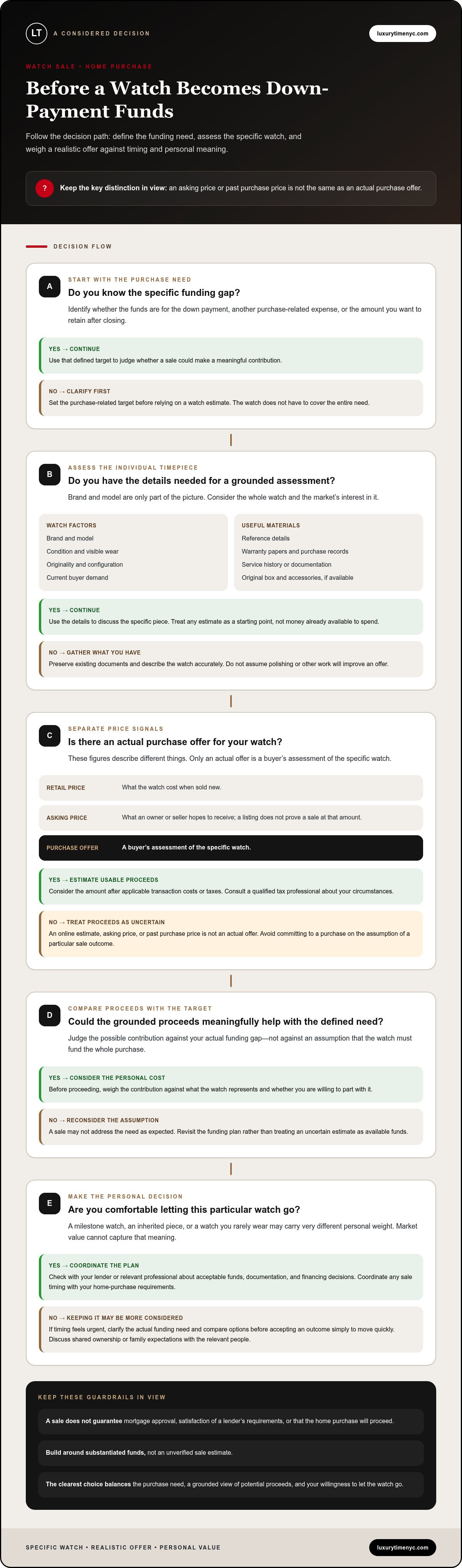
How to Prepare a Watch Sale Around a Home Purchase
A watch sale and a property purchase follow different timelines. Treat them as connected plans, but don’t assume one will automatically fit the other. Prepare the watch and the home-purchase timeline before relying on sale proceeds. A clear sequence helps you understand the funding need, present the watch accurately, and allow time for assessment and transaction steps without counting on an unconfirmed outcome.
- Confirm the funding need. Ask your lender or closing professional what funds are acceptable, what documentation they require, and when funds must be available. Clarify the specific gap you hope a sale will address.
- Gather information about the watch. Record its brand, model or reference details, visible condition, and known service history. Collect any box, papers, receipts, and service documents you have.
- Compare sale routes. A direct purchase and consignment differ in process and timing. Don’t assume either will produce a particular amount or meet a deadline.
- Plan around the purchase schedule. Allow time for assessment and transaction steps. Keep your lender or closing professional informed about your expected source of funds.
Gather the details that help assess the watch
Make a concise record of identifying details, condition, and known service work. Include original materials and documentation if available, but don’t alter the watch or arrange polishing or repairs solely to influence an assessment. A clear description is more useful than unsupported claims about rarity or investment potential. Note any uncertainty so the watch can be considered on its actual merits.
For broader context on preparing for a transaction, Luxury Time NYC’s guide to selling a watch discusses considerations for buying and selling in the luxury market.
Coordinate timing and documentation
Build a margin into your plan. An assessment, a decision between sale routes, and the transaction itself may each take time, and the schedule can vary. Don’t treat an anticipated amount as available until the transaction is complete. If your closing date is near, discuss your options with your lender or closing professional before making commitments that depend on watch proceeds.
Ask how proceeds from a personal-asset sale should be documented for your purchase. Retain relevant records, such as the sale agreement or other transaction paperwork and evidence of payment, and share them as directed by your professional. Keep copies with your home-purchase documents. For questions about tax obligations or reporting, consult a qualified tax professional familiar with your circumstances.
Luxury Time NYC offers direct purchase and consignment through its New York Diamond District business. Discuss a watch sale with Luxury Time NYC as part of a carefully coordinated purchase plan.
Explore a Discreet Luxury Watch Sale in New York
A considered sale begins with a clear understanding of the watch and your reason for selling. Luxury Time NYC is an independent luxury watch dealer founded in 2005, located in New York’s Diamond District. The business offers two routes for owners considering a sale: direct purchase and consignment. Professional watch authentication helps establish the identity and details of a timepiece.
The purpose of a conversation is to discuss your individual watch and priorities, then consider which option may fit. Selling a watch to pay for a down payment should work within your broader funding plan, not depend on an assumed result.
What a considered selling conversation can cover
Prepare the identifying details you know, such as the brand, model or reference, condition, and service history. Bring or describe available papers, receipts, box, and other original materials. Clear information keeps the discussion focused on your specific piece rather than broad comparisons that may not apply.
The conversation can also cover how a direct purchase differs from consignment and which route better reflects your priorities. Weigh the preference for a direct transaction against offering the watch to buyers through consignment. The assessment and next steps depend on the watch and arrangement, so don’t treat either route as a set offer or fixed schedule.
Take the next step when the numbers and priorities align
Proceed only when a potential sale fits your purchase-funding plan and your feelings about parting with the watch. If the funds would not address the need, or the piece carries meaning you’re not ready to relinquish, there is no reason to force a decision. A careful choice protects both the practical goal and the personal significance of the timepiece.
Luxury Time NYC’s New York Diamond District showroom is available by appointment for an in-person conversation. Bring the details and documentation you have, and discuss the watch with your priorities in view. You can consider the direct-purchase and consignment routes before deciding.
If your research and planning point toward a sale, Discuss selling your luxury watch with Luxury Time NYC. A thoughtful conversation is a measured next step, not a commitment to accept an offer or proceed before you’re ready.
Make the Next Step on Your Own Terms
A thoughtful decision doesn’t need to be made under pressure. Set a clear threshold for what would make a sale worthwhile, and decide in advance what you’ll do if the offer, timing, or emotional weight doesn’t meet it. That boundary can help keep a home purchase from turning a considered choice into a hurried one.
If selling a watch to pay for a down payment still feels right, make your next step an informed conversation, not a commitment. Bring the details you’ve gathered and the priorities you’ve defined. You can compare the available routes and take time to decide which, if any, fits your plans.
Start a conversation about your watch when you’re ready. A measured decision can honor both the home you hope to make your own and the timepiece that has mattered to you.
Frequently Asked Questions
Can I sell a luxury watch to help pay for a down payment?
Yes. Proceeds from a luxury watch sale can contribute to a down payment, but they don’t guarantee mortgage approval or complete a purchase. Selling a watch to pay for a down payment may be most useful when you’ve identified a specific funding gap and have a realistic sense of potential proceeds. Before relying on them, discuss the source and timing of funds with your lender or closing professional.
How much can I get for selling my luxury watch?
There’s no universal amount. A potential offer depends on the specific watch and current buyer interest. The reference, configuration, condition, originality, and completeness can all matter. An online listing can’t establish what a buyer will offer for your individual piece. For a more grounded view, provide accurate details and available documentation for a watch-specific assessment rather than budgeting from a hoped-for figure.
How long does it take to sell a luxury watch?
There’s no fixed timetable. A direct purchase and a consignment sale involve different steps, and consignment also depends on finding a buyer. Assessment, agreed transaction details, and payment arrangements can affect when proceeds become available. If your purchase has a firm deadline, build in a margin and don’t treat anticipated proceeds as ready funds until the sale is complete and your lender has addressed any documentation requirements.
Is it better to sell a watch outright or consign it?
Neither route is always better. The right fit depends on your priorities. An outright sale centers on a buyer’s offer for the watch, while consignment involves marketing it to potential buyers and depends on a completed sale. Compare the proposed terms, commission and other deductions, your desired level of involvement, and timing uncertainty. Don’t assume consignment will bring a higher result or meet a particular deadline.
What documents should I keep when selling a watch for home-purchase funds?
Keep a copy of the sale agreement or transaction record, evidence of payment, and communications that clarify what was sold and when. Preserve the watch’s identifying details and any available purchase, warranty, or service documents as well. Ask your lender or closing professional which records they require for funds from a personal-asset sale, and keep the paperwork together. A tax professional can advise on individual tax questions.
Will a watch sale affect my mortgage application?
A sale may raise questions about the source and documentation of funds, but its effect on your application depends on your circumstances and lender requirements. Tell your lender or mortgage professional that you’re considering a personal-asset sale before relying on its proceeds. Ask what records they need and whether the funds fit their requirements. A watch sale alone doesn’t establish mortgage eligibility or guarantee approval.
Should I sell an inherited watch to help buy a home?
Consider both the practical contribution and the family meaning before deciding. An inherited watch may carry history that its market assessment can’t reflect. If other relatives share ownership or an interest in the piece, discuss the decision with them before taking steps to sell. You might also pause if the choice feels driven mainly by deadline pressure. Proceed only when the sale aligns with your funding plan and personal priorities.


