


Traditional high horology reveres delicate hand-finishing; Richard Mille measures mechanical achievement in G-force thresholds and structural elasticity. For serious collectors, evaluating authentic richard mille technical specifications requires cutting through proprietary jargon to inspect the uncompromising micro-tolerances beneath the sapphire crystal. Too often, opaque nomenclature obscures genuine mechanical distinctions, leaving enthusiasts to guess at the physical differences between layered carbon composites and standard titanium alloys.
You already understand that these creations challenge conventional luxury, but verifying their true caliber architecture demands rigorous, objective analysis. This guide deconstructs the aerospace metallurgy, movement geometry, and shock-resistant engineering that define each reference. You will discover how variable-geometry rotors, free-sprung balances, and advanced skeletonized baseplates function under extreme mechanical stress, giving you the technical authority to evaluate every component with absolute precision.
Key Takeaways
- Explore how Formula 1 chassis principles dictate movement architecture, replacing conventional decorative plates with rigid, high-performance structural bridges.
- Examine advanced metallurgical composites, discovering how proprietary material layering produces distinct visual damascene striations and superior strength-to-weight ratios.
- Understand how in-house caliber engineering and free-sprung balances withstand severe physical impacts ranging from 5,000G to 12,000G.
- Master the mechanical benchmarks behind tripartite case geometry, calibrated titanium spline screws, and authentic richard mille technical specifications.
- Learn the professional multi-point inspection criteria required to verify genuine composite layering, movement beveling, and hermetic sealing before acquisition.
Horological Architecture: Deconstructing the Richard Mille Design Philosophy
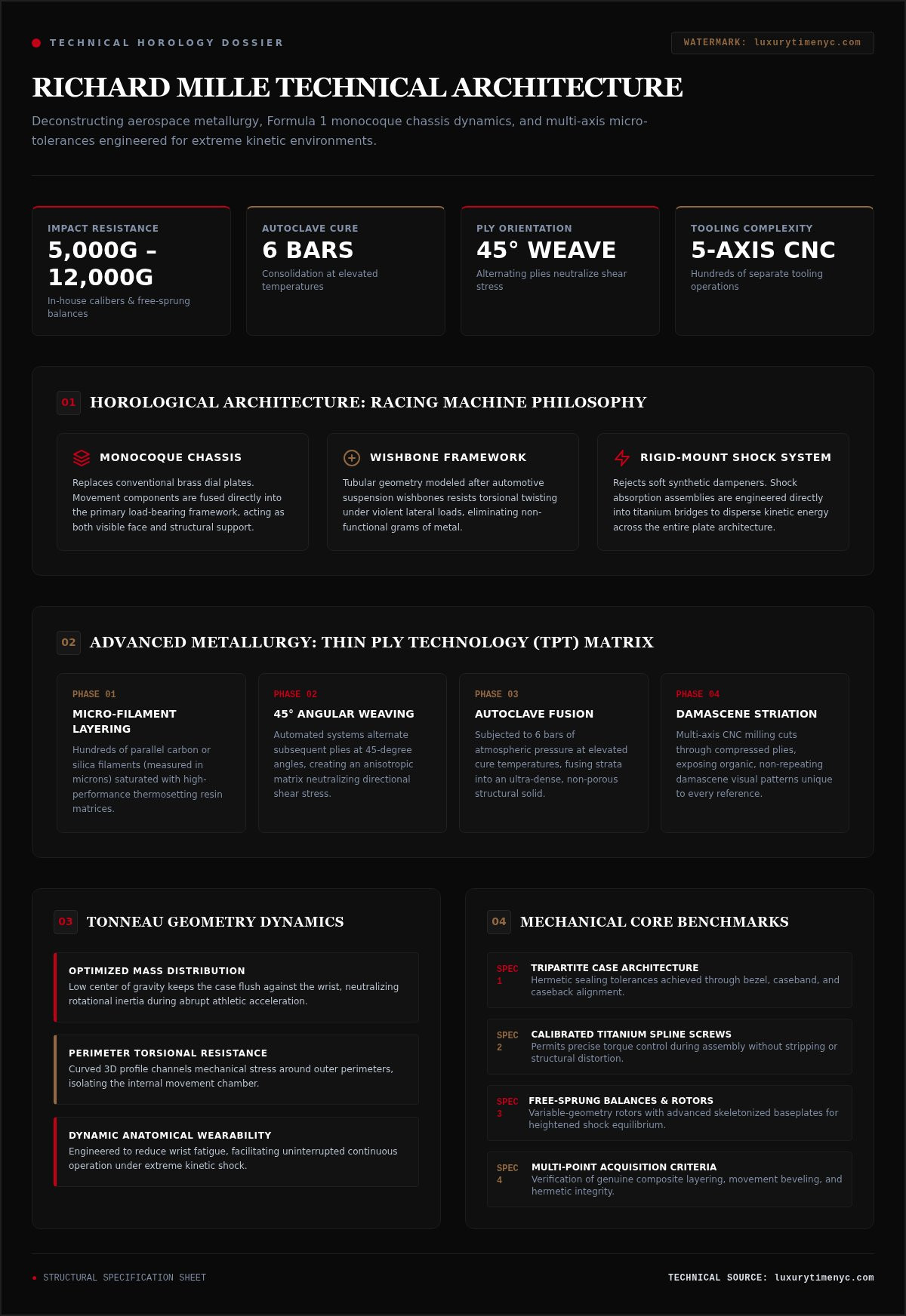
Richard Mille discarded classical Swiss conventions by treating the mechanical watch not as decorative jewelry, but as pure kinetic architecture. Movement components do not merely sit inside a container; they fuse directly into the load-bearing framework. By abandoning the traditional brass dial plate, the movement becomes the visible face and the primary structural support. Detailed study of the Richard Mille company history reveals this consistent engineering imperative: adapting Formula 1 monocoque chassis dynamics directly into wrist-worn platforms. In this design paradigm, richard mille technical specifications are defined by absolute structural efficiency and raw mechanical integrity.
The Racing Machine Concept: From Automotive Chassis to Escapement
Automotive suspension wishbones directly inspired the movement's tubular framework. High-stress racecars demand structures that resist torsional twisting under violent lateral loads; Richard Mille applies identical principles to micro-mechanics. The skeletonized baseplates, milled from advanced alloys, eliminate every non-functional gram of metal while preserving extreme structural stiffness. Rather than isolating the caliber through soft synthetic dampeners, functional shock absorption assemblies are engineered directly into the titanium bridges. This rigid-mount philosophy disperses kinetic energy across the entire plate architecture, securing delicate balance wheel pivots against severe external displacement.
Tonneau Geometry and Structural Ergonomics
Ergonomic form serves structural function. The signature tonneau silhouette is not merely a stylistic statement; it mirrors the complex anatomy of the human wrist. Achieving this seamless, three-dimensional curvature demands ruthless precision, requiring multi-axis computer numerical control (CNC) milling protocols that push machine tolerances to the micron level. A single curved case requires hundreds of separate tooling operations across five axes.
This calculated curve delivers practical collector advantages:
- Optimized Mass Distribution: The low center of gravity keeps the case planted flush against the wrist, neutralizing inertia during sudden athletic acceleration.
- Torsional Resistance: The curved profile channels structural stress around the perimeter rather than directly into the movement chamber.
- Dynamic Wearability: Reduced wrist fatigue enables continuous wear under extreme mechanical conditions.
When evaluating richard mille technical specifications, this sculptural geometry represents the definitive convergence of ergonomic comfort and uncompromising mechanical equilibrium.
Advanced Metallurgical Specifications: Proprietary Composites and Alloys
Traditional horology relies heavily on precious metals whose density adds substantial mass to the wrist. Richard Mille inverted this philosophy by introducing aerospace-grade composites that prioritize featherlight agility alongside structural resilience. This mastery of material science yields exceptional strength-to-weight ratios, ensuring that movement architecture remains uncompromised by thermal expansion or sudden atmospheric shocks. When examining richard mille technical specifications, the metallurgy is not decorative trim; it functions as an impenetrable structural armor.
Carbon TPT and Quartz TPT Material Matrix
Thin Ply Technology (TPT) separates these composites from standard chopped carbon fiber. The manufacturing process creates an anisotropic matrix engineered for omnidirectional resistance:
- Micro-Filament Layering: Hundreds of parallel carbon or silica filaments, each measuring mere microns in thickness, are saturated with high-performance thermosetting resin matrices.
- 45-Degree Angular Weaving: Automated systems alternate each subsequent ply at a 45-degree angle, neutralizing directional shear stress across all physical axes.
- Autoclave Consolidation: Subjected to six bars of pressure at elevated cure temperatures, the strata fuse into an ultra-dense, non-porous solid.
CNC machining through these compressed layers reveals the signature damascene striations unique to every individual watch case. Beyond its distinct visual presence, the matrix exhibits near-absolute electromagnetic neutrality and micro-surface hardness that resists everyday abrasion.
Grade 5 Titanium and Nanofiber Baseplates
Internal movement rigidity relies on biocompatible Grade 5 titanium, an aerospace alloy composed of ninety percent titanium, six percent aluminum, and four percent vanadium. Highly resistant to marine corrosion and chemical oxidation, this specific blend provides an exceptionally rigid foundation for high-speed gear trains. In select references, carbon nanofiber core matrices serve as the structural bed, eliminating micro-flexure across high-tension gear trains during physical impact.
Discerning collectors seeking verified composite architecture should partner with knowledgeable purveyors. When acquiring rare alloy references in the New York Diamond District, inspecting these intricate micro-structures with specialized horological experts guarantees every composite layer and finish aligns with factory standards.
Movement Mechanics: In-House Calibers, Tourbillons, and Shock Thresholds
High-complication watchmaking once demanded quiet contemplation and sheltered display cases. Richard Mille turned that convention on its head, engineering internal calibers to operate flawlessly under violent kinetic impact. Movement architectures are certified to survive acceleration forces ranging from 5,000G to beyond 12,000G in dedicated tourbillon references. This endurance stems from a fast-rotating mainspring barrel, which completes a revolution in six hours rather than the conventional seven and a half. This accelerated cycle minimizes internal friction, delivering a balanced torque curve that stabilizes amplitude across the entirety of the power reserve.
Chronometric precision relies on free-sprung balance wheels equipped with variable-inertia regulating weights. Because the balance spring lacks a traditional regulator curb, micro-adjustments are executed directly via small weights mounted on the balance wheel rim. This design prevents timing drift caused by sharp shocks. Bridges are meticulously wet-sapphire hand-polished and micro-blasted across Grade 5 titanium, proving that functional durability can coexist with rigorous hand finishing.
The Variable-Geometry Rotor Mechanism
Automatic winding systems often generate excessive stress during athletic play. Richard Mille resolves this issue through a proprietary variable-geometry rotor. Dual Grade 5 titanium wings feature adjustable heavy-metal fins that horologists reposition into multiple distinct slots.
This dynamic mechanism provides distinct operational benefits:
- Inertia Customization: Adjusting the fin radius alters the rotor's winding momentum to match the owner's physical movement patterns.
- High-Impact Protection: Moving the wings outward reduces winding efficiency during high-impact sports, protecting the barrel bridle from over-winding stress.
- Torque Stabilization: Maintaining an optimal mainspring tension band prevents isochronism errors during extended sedentary periods.
Tourbillon Construction and G-Force Resistance
Weight reduction remains the primary defense against shock displacement. Richard Mille tourbillon cages weigh fractions of a gram, dramatically reducing rotational inertia. In ultra-resilient executions, the entire escapement assembly hangs suspended from high-tensile braided steel micro-cables anchored to miniature tensioners. External kinetic energy is absorbed by cable flexure rather than driving sharp shear loads through the balance pivots.
Whether enduring a professional tennis serve or sudden racecar deceleration, these platforms preserve chronometric integrity under extreme physical duress. Maintaining such micro-mechanical tolerances requires periodic technical oversight. Preserving factory precision demands diagnostics via certified luxury watch repair specialists who understand complex caliber architectures and shock-absorption systems.
Evaluating these internal mechanisms reveals the rigorous truth behind authentic richard mille technical specifications: pure mechanical efficiency engineered for real-world resilience.
Case Construction and Hermetic Sealing Tolerances
A high-performance caliber requires an equally robust housing to survive extreme conditions. Richard Mille addresses this through an architectural tripartite case design consisting of three independent components: the front bezel, the central caseband, and the back bezel. Achieving a water-tight seal across these three curved elements demands absolute physical congruency. Even a fractional variance of a few microns between the mating surfaces could cause pressure loss or internal moisture ingress. These micro-tolerances are critical parameters within authentic richard mille technical specifications.
Hermetic integrity relies on precision seating rather than brute clamping force. Two transparent Nitrile O-ring gaskets rest inside milled perimeter channels situated between the case sections. The winding crown incorporates an integrated torque-limiting mechanism. This system disengages automatically when the mainspring reaches optimal tension, eliminating the risk of severed winding stems or broken mainspring bridles caused by excessive manual winding.
Grade 5 Titanium Spline Screws and Torque Security
Standard slotted screws often deform under high tightening loads. To eliminate this vulnerability, Richard Mille developed proprietary spline screws manufactured from Grade 5 titanium. Featuring distinct star-shaped heads, these fasteners allow precise application of rotational torque during assembly and scheduled servicing.
Their technical advantages serve both function and longevity:
- Thread Stripping Prevention: Calibrated engagement surfaces distribute torque evenly across the screw head, preventing driver slippage and mechanical deformation.
- Precise Torque Calibration: Watchmakers apply exact, factory-mandated torque thresholds using specialized calibrated screwdrivers.
- Structural Retention: Matched with abrasion-resistant titanium washers, these fasteners maintain constant tension across the tripartite case under heavy vibration.
Environmental Protection and Water Resistance Standards
Environmental sealing varies according to reference intent. Sport references feature water-resistance ratings from 30 meters up to 300 meters on specialized diving models. These aquatic references integrate unidirectional rotating bezels directly into the tripartite architecture, preventing timing shifts during underwater descents. Dial crystals are machined from sapphire crystal rated at nine on the Mohs hardness scale, treated with dual anti-reflective coatings to ensure optical clarity under intense ambient light.
Before entering any extreme environment, verifying that your timepiece maintains its environmental seals is essential. Collectors seeking complete peace of mind can schedule professional pressure testing to verify gasket resilience and tripartite tolerances with certified specialists.
Evaluating Richard Mille Specifications for Acquisition in New York City
Secondary market acquisitions demand uncompromising scrutiny. Intense global collector demand and the emergence of advanced counterfeit composites make superficial appraisals unacceptable. True technical evaluation requires a multi-point forensic audit of physical metallurgy, movement finishing, and assembly tolerances. Provenance documentation and complete box-and-papers records establish historical clarity, but physical caliber verification determines actual worth. Collectors exploring the curated 47th Street watch scene in Manhattan must look past exterior aesthetics, auditing the micro-tolerances that separate genuine high-horology calibers from sophisticated duplicates.
Technical Provenance and Inspection Protocols
A rigorous technical protocol examines every structural facet under high magnification:
- Microscopic Movement Auditing: Optical inspection verifies hand-drawn wet sapphire beveling on Grade 5 titanium bridges, pristine spline screw head geometry, and crisp, micro-engraved serial designations matching factory registries.
- TPT Composite Matrix Verification: Genuine Carbon TPT displays non-repeating, organic damascene striations created through high-pressure autoclave consolidation; illicit reproductions routinely show uniform surface wraps or molded synthetics.
- Diagnostic Timing Diagnostics: Electronic timing machines evaluate balance amplitude, beat error, and chronometric stability across multiple positions, confirming stable mainspring energy discharge.
- Atmospheric Pressure Testing: Specialized chambers assess nitrile gasket elasticity and case hermetic integrity, ensuring operational water resistance remains uncompromised.
Acquisition Strategy at Luxury Time NYC
Discreet, professional advisory remains the ultimate safeguard when acquiring high-value independent horology. Situated in the historic New York Diamond District, Luxury Time NYC conducts private consultations for discerning international collectors. Our multi-point in-house mechanical inspections authenticate caliber integrity, case tolerances, and functional resilience before any reference enters our showroom inventory. Every acquisition is supported by a certified authenticity guarantee, delivering complete peace of mind.
Mastering authentic richard mille technical specifications allows you to evaluate the microscopic architecture behind these racing machines with complete objectivity. When you're prepared to secure a verified reference, explore our curated selection of authenticated Richard Mille timepieces in our private showroom.
Securing Architectural Precision in Your Collection
True horological mastery resides in the complete synthesis of structural resilience and avant-garde metallurgy. From autoclave-cured composite matrices to suspended tourbillons engineered for extreme G-force resistance, richard mille technical specifications represent an uncompromising departure from static watchmaking traditions. These creations don't merely measure time. They harness kinetic energy through Formula 1 chassis geometry, Grade 5 titanium architecture, and hermetic tripartite case construction.
Navigating acquisitions at this caliber demands rigorous technical transparency and absolute verification. Backed by decades of Diamond District expertise curating investment-grade horology, Luxury Time NYC subjects every reference to comprehensive in-house multi-point mechanical inspections and performance evaluations. We invite you to schedule a private consultation in our discreet Manhattan showroom to examine authenticated Richard Mille timepieces and secure your next acquisition with enduring confidence.
Frequently Asked Questions
What makes Richard Mille technical specifications distinct from traditional watchmakers?
Richard Mille treats watch design as structural mechanical architecture rather than jewelry assembly. Movements eliminate conventional baseplates, integrating Grade 5 titanium bridges directly into the load-bearing framework. Instead of soft gold or heavy platinum, cases utilize aerospace-grade composites and high-pressure autoclave resins. Every component serves a specific mechanical purpose, maximizing shock resistance and structural rigidity under real-world athletic acceleration.
How does Carbon TPT differ from standard forged carbon in watchmaking?
Standard forged carbon consists of chopped carbon fibers cured randomly in resin. Carbon TPT (Thin Ply Technology) uses hundreds of parallel filament sheets stacked with alternating 45-degree orientations before autoclave consolidation. This systematic layering creates uniform omnidirectional tensile strength and unique damascene striations when milled, offering superior torsional resistance compared to standard molded carbon cases.
Can a Richard Mille watch withstand severe athletic shock and G-forces?
Richard Mille movements routinely endure kinetic impacts from 5,000G to beyond 12,000G. Suspended cable systems, free-sprung variable-inertia balances, and ultra-lightweight tourbillon cages neutralize sudden kinetic displacement. Athletes wear them during championship tennis matches and Formula 1 races because the calibers disperse sudden shocks across rigid bridges rather than transferring stress into delicate escapement pivots.
Why does Richard Mille utilize grade 5 titanium spline screws on watch cases?
Grade 5 titanium spline screws prevent head deformation and thread stripping during assembly and maintenance. Their specialized star pattern allows technicians to apply precise, factory-calibrated torque values using custom drivers. Paired with titanium washers, these fasteners maintain constant clamping pressure across the tripartite case, ensuring hermetic sealing against moisture and atmospheric pressure changes.
How does the variable-geometry rotor operate inside automatic Richard Mille calibers?
The variable-geometry rotor customizes automatic winding momentum to the wearer's physical activity profile. Certified horologists adjust movable heavy-metal fins along exterior wings into multiple configurations. Spreading the fins outward increases inertia for sedentary routines, while shifting them inward reduces winding speed during intense sports, preventing excessive strain on the mainspring bridle.
How does a collector verify the authenticity of Richard Mille technical specifications?
Authentication requires forensic inspection by certified horological specialists. Verifying genuine richard mille technical specifications involves auditing micro-beveled titanium bridges under high magnification, testing amplitude stability across multiple positions, and conducting pressure chamber diagnostics. Specialists also examine case striations to distinguish authentic multi-layer Carbon TPT from aftermarket cosmetic wraps, ensuring factory-standard micro-mechanical integrity.


