


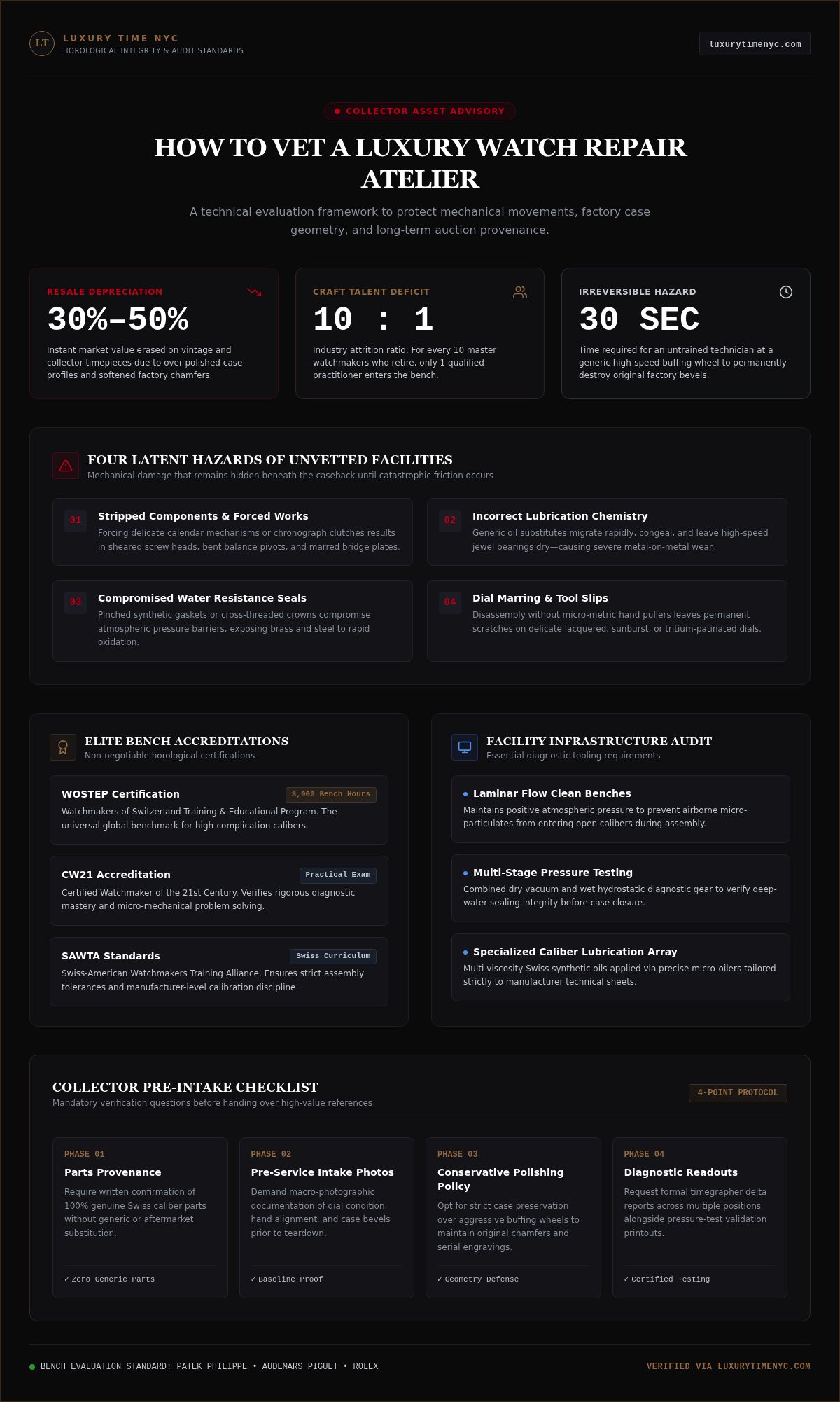
A single careless technician at a generic buffing wheel can destroy decades of horological provenance in thirty seconds. For serious collectors, handing over a Patek Philippe, Audemars Piguet, or vintage Rolex for servicing remains an exercise in quiet vulnerability. You rightfully fear softened lug bevels, damaged dials, stripped threads, and aftermarket components replacing genuine Swiss calibers. Knowing how to vet a watch repair shop is the only definitive safeguard against these irreversible mistakes.
Mechanical artistry demands unyielding technical precision and absolute transparency. You shouldn't have to wonder whether a facility possesses authentic manufacturer tooling or the discipline to preserve original factory finishes. In this guide, you will master the exact criteria required to evaluate an atelier, from auditing diagnostic pressure-testing gear and cleanroom standards to verifying master watchmaker credentials. Here is your evaluation framework for protecting your timepiece's mechanical integrity, aesthetic pedigree, and long-term auction value.
Key Takeaways
- Mastering how to vet a watch repair shop ensures your timepiece avoids the irreversible hazards of over-polishing, dial damage, and generic replacement parts.
- Identify elite horological credentials, including WOSTEP and CW21 certifications, to verify that your watchmaker possesses formal training in high-complication calibers.
- Audit workshop infrastructure to confirm essential diagnostic capabilities, from laminar flow clean benches to multi-stage dry and wet pressure testing equipment.
- Deploy a targeted pre-intake checklist to demand total transparency regarding parts provenance, photographic documentation, and movement overhaul procedures.
- Discover the distinct advantages of specialized independent ateliers that prioritize conservative restoration over mandatory factory component replacements.
The High Stakes of Entrusting Your Timepiece to a Repair Facility
Mechanical movements are marvels of kinetic architecture. Within an area barely wider than a coin, hundreds of components interact under relentless tension. Tolerances are measured in microns. Balance wheels oscillate hundreds of thousands of times per day. When you deliver such an instrument to an unvetted facility, you gamble with pure engineering. True horological preservation requires deep mastery. Without it, delicate gear trains fail, water seals degrade, and the physical integrity that defines high horology disappears.
Every serious collector understands that maintenance is an exercise in asset management. A single misstep during disassembly can compromise a caliber indefinitely. For luxury timepieces, learning how to vet a watch repair shop is the only reliable way to defend both physical precision and secondary market valuation.
The Hidden Hazards of Incompetent Horological Servicing
Disaster rarely announces itself immediately. Instead, it hides beneath closed casebacks until friction takes its toll. Incompetent handling damages fine calibers in predictable ways:
- Stripped Components and Forced Complications: Untrained hands often force delicate calendar works or chronograph clutches. Stripped screws, bent balance pivots, and marred bridge plates are common consequences.
- Incorrect Lubrication Chemistry: Modern Swiss calibers require multiple specialized synthetic oils. Generic alternatives migrate rapidly, congeal, and leave jewel bearings dry, accelerating metal-on-metal wear.
- Compromised Case Seals: Pinching a gasket or misthreading a screw-down crown destroys factory water resistance, exposing high-grade steel and brass to instant oxidation.
- Tool Slips and Dial Damage: Without micro-metric hand pullers and dial protectors, amateur technicians leave permanent gouges on lacquered, enamel, or sunburst surfaces.
Adhering to traditional master watchmaker craft and repair standards ensures that every bridge, jewel, and arbor is dismantled, evaluated, and reassembled with surgical discipline.
Preserving Original Provenance, Factory Geometry, and Resale Value
Collector demand hinges on case integrity. Factory bevels, crisp chamfers, and defined satin brushing reflect original manufacturing perfection. Unfortunately, generic repair shops frequently use high-speed polishing wheels to erase scratches. This destructive practice rounds sharp lug transitions, thins case profiles, and erases serial engravings. In the vintage and pre-owned sector, an over-polished case can instantly erase 30% to 50% of an asset's market value.
Dial preservation matters just as much. Original tritium or early luminova plots carry irreplaceable patina that discerning buyers prize above pristine modernity. Unscrupulous service centers often replace these historic components with modern service parts without consent, stripping a vintage reference of its historical story. Reviewing The Connoisseur’s Guide to Luxury Watch Repair in NYC (2026) provides essential local context for collectors seeking workshops dedicated to strict aesthetic conservation over hasty cosmetic overhauls. Mastering how to vet a watch repair shop ensures your heirloom remains entirely authentic.
Evaluating Watchmaker Credentials and Industry Certifications
Subjective online reviews cannot measure technical micro-mechanics. Anyone with a pair of tweezers can claim competence, yet true horology requires years of disciplined bench education. The American horological landscape faces an acute talent deficit; industry tracking indicates that for every ten master watchmakers who retire, only one qualified practitioner enters the bench. Consequently, discerning how to vet a watch repair shop begins by scrutinizing formal credentials rather than storefront claims.
Essential Horological Accreditations: CW21, WOSTEP, and SAWTA
Independent verification separates artisan watchmakers from retail jewelry technicians. When evaluating a specialist, demand proof of credentials that mandate intensive, real-world practical examinations:
- WOSTEP (Watchmakers of Switzerland Training and Educational Program): The universally recognized Swiss benchmark. The comprehensive curriculum demands 3,000 hours of intensive benchwork covering micromechanics, escapement regulation, and complex calibers.
- CW21 (Certified Watchmaker of the 21st Century): Administered by the AWCI, this credential validates elite skill. Securing an American Watchmakers-Clockmakers Institute certification requires passing demanding bench tests across written theory, high-tolerance timing, and automatic chronographs under tight tolerances.
- SAWTA (Swiss-American Watchmakers Training Alliance): Rigorous Swiss-partnered curriculums supported by brands like Rolex to produce technicians versed in modern high-precision architectures.
Independent Ateliers Versus Factory Brand Service Centers
Collectors face an ongoing dilemma between factory service centers and elite independent ateliers. Factory facilities possess proprietary brand tooling. However, their institutional policies often run counter to collector interests. Brand centers frequently enforce mandatory replacements of original dials, aged hands, and original bezels, erasing historical value in favor of pristine uniformity. They also routinely impose backlogs of twelve weeks to several months.
Conversely, premier independent workshops deliver tailored conservation. They respect unpolished cases, preserve aged luminous material, and operate with greater agility. The critical vetting criterion is verified parts procurement. Because Swiss conglomerates restrict component distribution through selective networks, an independent atelier must possess authenticated accounts or certified access to genuine calibers. Discerning collectors seeking conservative horological care often consult proven Diamond District curators like Luxury Time NYC to guarantee their acquisitions receive uncompromising mechanical stewardship without sacrificing historical authenticity.
Inspecting Workshop Infrastructure, Tooling, and Diagnostic Standards
Precision micro-mechanics cannot survive improvised workspaces. When evaluating an atelier, inspecting the physical environment tells you everything about their technical standards. Fine horology demands clinical cleanliness, strict climate control, and industrial-grade calibration tools. A workbench cluttered with generic hand tools reveals an operation unsuited for haute horlogerie. Knowing how to vet a watch repair shop requires looking past the polished walnut counters in the front showroom and auditing the diagnostic machinery operating in the back.
Master watchmakers rely on specialized apparatus to meet established standardized diagnostic and repair competencies. Without dedicated infrastructure, even trained hands cannot consistently achieve factory tolerances across complex mechanical calibers.
Cleanroom Environments and Micro-Mechanical Diagnostic Equipment
Microscopic airborne particulates are fatal to mechanical movements. A single speck of lint lodged between escape-wheel teeth creates instant drag, dropping balance amplitude and halting gear trains. Top-tier ateliers maintain cleanroom air quality standards, frequently deploying HEPA-filtered laminar flow hoods directly above assembly benches. Within these filtered micro-environments, master watchmakers disassemble and reconstruct delicate movements in near-particulate-free conditions.
Diagnostic equipment must match these environmental controls. Advanced digital timegraphers, such as Witschi timing units, analyze escapement health across five or six distinct resting positions. These devices generate concrete readouts tracking daily rate variance, balance amplitude (optimally 270° to 315°), and beat error below 0.3 milliseconds. Chemical cleaning requires equal sophistication. Automated multi-chamber ultrasonic machines cycle delicate plates and pinions through specialized water-free solvent baths, stripping aged oils without etching copper-beryllium alloys or rhodium plating.
Pressure Testing and Restoring Case Hermetic Integrity
Case water resistance is a dynamic seal system, not a permanent factory guarantee. Routine movement overhauls require rigorous testing to confirm that crystal gaskets, caseback O-rings, and crown stem packings maintain hermetic security:
- Dry Chamber Vacuum Testing: Advanced digital instruments evaluate case deflection under negative and positive air pressures down to nanometer tolerances. This dry step detects microscopic leakage without exposing valuable movements to water vapor.
- Hydrostatic Wet Pressure Chambers: Professional dive watches require wet testing chambers to verify structural integrity under extreme bar pressures according to ISO standards.
- Thermal Condensation Diagnostics: Warming a cased watch on a heated plate before applying a cold drop to the sapphire crystal exposes any trapped internal humidity. If internal condensation appears, the moisture seal has failed.
Demanding documentation of these multi-stage testing protocols remains an indispensable step when deciding how to vet a watch repair shop for high-value timepieces.
The Step-by-Step Vetting Checklist: Essential Questions to Ask Before Handover
Handing over a high-value timepiece requires an exacting protocol. An elite atelier welcomes deep scrutiny; hesitation signals substandard practices. When mastering how to vet a watch repair shop, do not rely on verbal reassurances across a counter. Conduct a structured intake interrogation to safeguard your mechanical investment.
- Can you document the watchmaker's active certifications? Request proof of CW21, WOSTEP, or direct manufacture accreditations for the technician physically handling your caliber.
- Do you perform all interventions on-site? Establish whether your watch stays within their secure facility or gets brokered to an anonymous third-party trade shop.
- What is your case finishing methodology? Demand confirmation that case refinishing utilizes specialized lapping machines to maintain flat factory planes and sharp chamfers rather than generic freehand buffing wheels.
- How do you verify water resistance? Require multi-stage testing documentation, encompassing dry vacuum testing and hydrostatic wet pressure testing to original factory bar ratings.
Direct Questions Regarding Component Authenticity and OEM Sourcing
Selective parts distribution makes component origin a critical friction point. Ask outright: "Are all replacement components genuine factory parts sourced through authenticated distribution channels?" Make your preservation parameters explicit in writing on the intake receipt. State unequivocally that the original dial, hands, date disc, and bezel insert must remain untouched. For collectors who cherish historic provenance, an unauthorized dial swap is catastrophic. Finally, demand that all replaced internal components, such as worn reverser wheels or mainspring barrels, be returned in sealed packaging upon service completion.
Estimate Transparency, Service Warranties, and Insurance Protocols
Ambiguity during intake leads to friction at pickup. Demand an itemized diagnostic report detailing timing readouts, amplitude, beat error, and an explicit scope of work before authorizing a complete movement overhaul. Confirm that the final handover includes a written warranty covering timing tolerances and water resistance. If you are comparing workshops in historic trading districts, consult Navigating 47th Street: The Connoisseur’s Guide to New York Watches in 2026 to evaluate workshop transparency and provenance protection.
Security protocols must be absolute. Interrogate the facility's physical vault standards and transit insurance limits. A professional institution holds blanket commercial insurance covering full secondary-market replacement value while your watch remains in their custody. If a facility hedges on these operational safeguards, look elsewhere. For peerless care and pristine standards, schedule an inspection with Luxury Time NYC to experience white-glove horological diagnostics firsthand.
Entrusting Your Timepiece to Manhattan’s Horological Authority
In Manhattan’s historic 47th Street Diamond District, mechanical excellence meets generational provenance. Established in 2005, Luxury Time NYC serves as a dedicated horological authority for collectors who demand absolute precision. Knowing how to vet a watch repair shop ultimately leads to choosing an atelier that treats fine timepieces as enduring mechanical assets rather than disposable accessories. Here, white-glove stewardship and technical discipline govern every intake.
Our workshop pairs rigorous diagnostic instrumentation with deep reverence for historical integrity. Discerning owners of Rolex, Patek Philippe, Audemars Piguet, Richard Mille, and Cartier timepieces require specialized expertise tailored to distinct caliber architectures. We provide that standard through transparent evaluations, on-site diagnostics, and unwavering preservation ethics.
Comprehensive Horological Capabilities: Overhaul, Refinishing, and Testing
Collector-grade care requires specialized services executed without compromise. Our bench capabilities focus on restoring mechanical health while defending aesthetic authenticity:
- Complete Movement Overhaul: Full caliber disassembly, multi-stage ultrasonic solvent cleaning, jewel inspection, correct synthetic lubrication, and micro-metric calibration to restore factory amplitude and timing tolerances.
- Conservative Watch Polishing: Specialized refinishing techniques that eliminate surface blemishes while strictly preserving crisp factory chamfers, satin brushing, and uncompromised lug geometry.
- Advanced Pressure Testing: Multi-step dry vacuum and hydrostatic pressure testing to verify case hermeticity and ensure dependable water resistance across diverse environments.
- Watch Authentication: Exhaustive multi-point technical inspections examining movement caliber execution, dial typography, case hallmarks, and serial engravings to verify provenance.
Establishing a Trusted Maintenance Relationship at Luxury Time NYC
Entrusting a rare reference to an atelier should never feel uncertain. Real security comes from a direct relationship with dedicated specialists who understand the secondary market implications of every intervention. Our historic 47th Street showroom provides private consultations, giving high-net-worth collectors and vintage enthusiasts direct access to transparent horological advice. We discuss diagnostic readouts openly, define conservation boundaries clearly, and document every step of the restoration process.
Mastering how to vet a watch repair shop protects your timepiece from permanent aesthetic erosion and mechanical compromise. When you demand uncompromising craftsmanship and respect for original design, schedule a consultation with Luxury Time NYC to secure the dedicated maintenance your collection deserves.
Safeguarding Your Horological Legacy
Mechanical timepieces are enduring assets, not temporary accessories. Preserving their micro-mechanical accuracy and original case architecture requires surgical bench discipline. When you know how to vet a watch repair shop, you eliminate the risks of rounded bevels, ruined dials, and compromised factory water resistance. You secure verified watchmaker credentials, validate clinical cleanroom diagnostic tooling, and demand unyielding provenance protection before parting with your timepiece.
Since 2005, Luxury Time NYC has served as a trusted horological anchor in Manhattan's historic 47th Street Diamond District. Specializing in Rolex, Patek Philippe, Audemars Piguet, and Richard Mille timepieces, our atelier unites master-level technical mastery with transparent collector care. From delicate movement overhauls and conservative watch polishing to advanced dry pressure testing and multi-point watch authentication, every intervention respects factory tolerances.
Your collection deserves rigorous, collector-grade stewardship. Schedule a private horological consultation with Luxury Time NYC today to experience uncompromising care and preserve your timepiece's provenance for generations to come.
Frequently Asked Questions
How often does a luxury mechanical watch require a complete movement overhaul?
Most premier manufactures recommend an overhaul every five to ten years. Modern synthetic lubricants resist drying longer than vintage oils, yet microscopic friction eventually degrades balance amplitude. You shouldn't wait for complete mechanical failure. Warning indicators like daily timing variance exceeding factory tolerances, reduced power reserve, or stiff manual winding signal that a movement overhaul is immediately necessary to prevent internal gear-train wear.
Can an independent watch repair shop obtain genuine OEM factory parts?
Yes, established independent ateliers can obtain genuine OEM parts, provided they maintain active brand accounts or verified component networks. Swiss luxury houses restrict distribution to workshops meeting strict tooling and cleanroom benchmarks. When evaluating how to vet a watch repair shop, always ask the technician to confirm their component sourcing directly. Vetted specialists secure original parts, ensuring your caliber retains authentic mechanical integrity.
What is the difference between movement servicing and simple case polishing?
Movement servicing addresses internal mechanical performance, while case polishing is strictly cosmetic exterior refinishing. A complete movement overhaul entails full caliber disassembly, ultrasonic cleaning, synthetic lubrication, and micro-regulation across multiple positions. Polishing restores surface metal finishes using lapidary wheels or buffing compounds. Discerning collectors often request movement servicing while explicitly declining case polishing to preserve original factory chamfers and vintage case geometry.
Why is pressure testing mandatory following any watch repair or battery replacement?
Pressure testing confirms that opening the case hasn't compromised hermetic seals against moisture and dust. Whenever a caseback unscrews or a crown stem disengages, elastomeric O-rings and crystal gaskets deform or shift. Even microscopic breaches invite airborne humidity, which rapidly oxidizes steel balance springs and tarnishes dials. Professional pressure testing utilizes dry vacuum and hydrostatic chambers to verify case integrity to exact factory depth tolerances.
Will polishing my luxury watch decrease its market or auction value?
Aggressive or improper polishing will significantly decrease collector appeal and secondary market value. Serious collectors prioritize crisp factory lines, razor-sharp bevels, and defined satin graining over mirror-smooth perfection. Excessive buffing rounds sharp lug geometry, thins case profiles, and erases serial hallmarks. Conservative watch polishing executed on dedicated lapping equipment restores brilliance safely, but unmolested factory metal always commands the highest premium at major auction houses.
What certifications should I look for when evaluating a master watchmaker?
Look for rigorous, bench-tested credentials from recognized international and national horological institutions. The premier North American benchmark is the AWCI CW21 credential, which requires proven mastery in micromechanics and automatic chronographs. Globally, diplomas from WOSTEP represent the absolute standard of Swiss horological education. These formal qualifications guarantee your technician possesses verified competence rather than informal jewelry store experience.
What happens if a watchmaker uses generic aftermarket parts during a service?
Installing generic aftermarket components compromises chronometric precision and can permanently invalidate future factory service access. Non-OEM wheels, mainsprings, and winding components rarely match exact Swiss metallurgical tolerances, causing premature gear wear and erratic amplitude. Brand service centers also frequently refuse future work or mandate costly replacements upon detecting non-genuine parts. Knowing how to vet a watch repair shop protects your caliber from unauthorized substitutions.


