


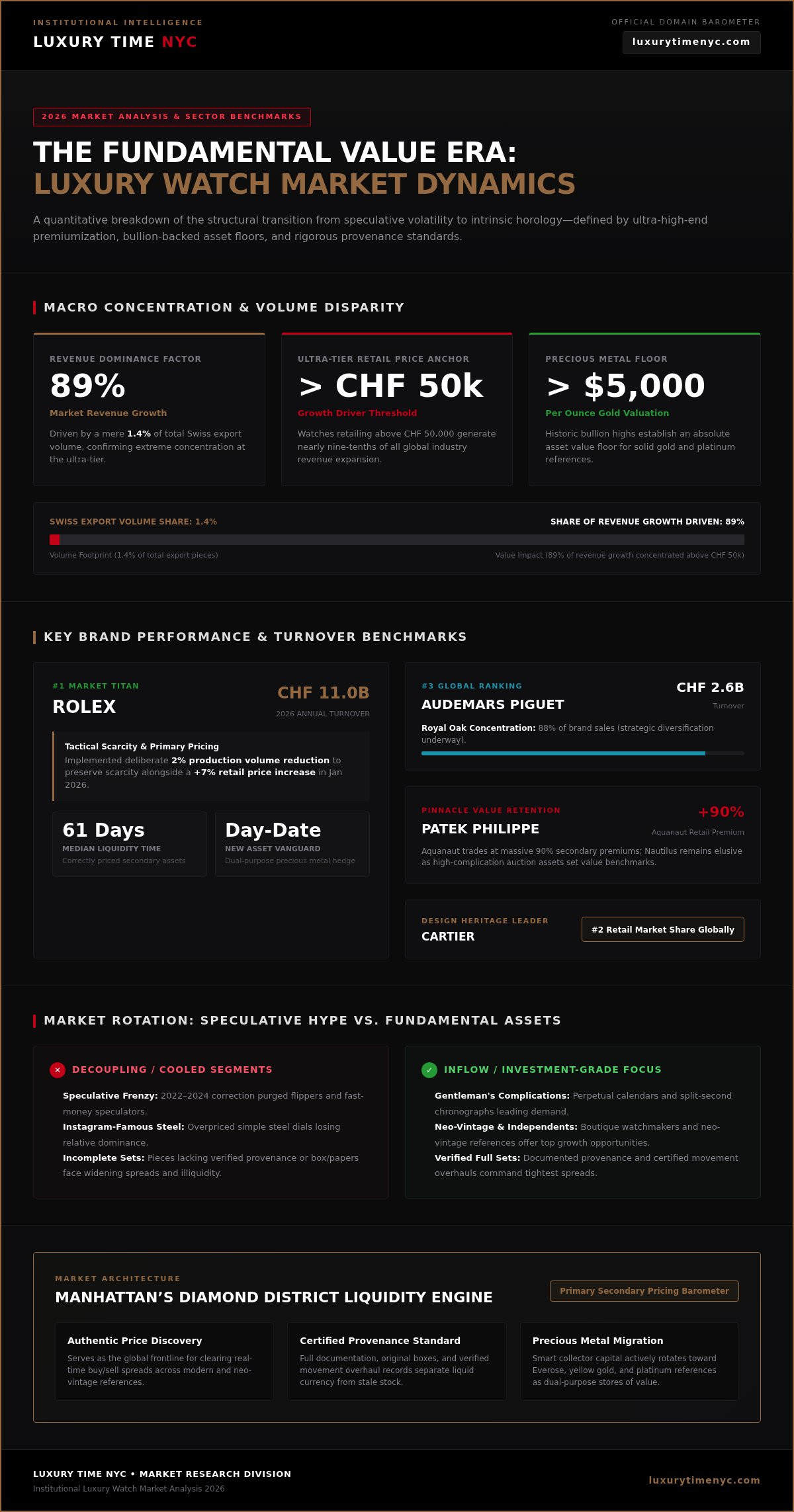
The era of the speculative bubble is over. In its place, a sophisticated, fundamental-driven market has emerged. Today, a mere 1.4% of Swiss export volume drives 89% of total market revenue growth. This luxury watch market analysis 2026 examines how serious collectors are pivoting from volatile hype to enduring horological assets. You've likely felt the tension of managing a collection where pre-owned prices no longer follow a predictable upward trajectory, making the risk of overpaying for a specific reference a very real concern.
We provide a definitive map of the current climate, identifying where genuine value resides and how to distinguish between fleeting trends and investment-grade pieces. You'll gain a clear understanding of the drivers shaping this year's performance, from the resilience of the Patek Philippe Aquanaut to the strategic rotation into neo-vintage Rolex references. We will explore the widening gap between correctly priced liquidity and stale inventory, offering the professional guidance necessary to curate a portfolio that stands the test of time.
Key Takeaways
- Discover how the 2026 landscape has transitioned from speculative volatility to a fundamental horology phase, where technical rarity and provenance dictate long-term value.
- Access a detailed luxury watch market analysis 2026 that highlights the shifting dominance of the Big Four and the resilient performance of high-complication references.
- Learn why the neo-vintage era and boutique independent watchmakers represent the most significant growth opportunities for the modern collector's portfolio.
- Understand the critical role of Manhattan’s Diamond District as a global liquidity engine and a primary barometer for authentic secondary market pricing.
- Master a sophisticated framework for acquisition and disposal, ensuring your collection remains a liquid asset through professional sourcing and strategic consignment.
The 2026 Luxury Watch Landscape: A Shift Toward Fundamental Value
The market has matured. The speculative frenzy of the early 2020s has vanished. In its place, we find a landscape defined by fundamental horology. This luxury watch market analysis 2026 reveals a sector where intrinsic value outweighs digital noise. Secondary market prices have finally stabilized. The correction of 2022 through 2024 purged the speculators; now, only the serious collectors remain. Following the 7% retail price increase implemented in January 2026, the primary market has signaled a permanent shift toward higher entry points, reinforcing the status of these pieces as enduring assets.
Interest rates have softened globally, yet bullion prices remain at historic highs. With gold surpassing $5,000 per ounce, an asset floor has formed for precious metal references. The Swiss watchmaking industry has responded with a flight to quality. While production volumes at houses like Rolex have seen deliberate 2% reductions to preserve scarcity, the focus on ultra-high-end premiumization has intensified. Watches retailing above CHF 50,000 now drive 89% of all market revenue growth. This isn't a volume game. It's a scarcity game played at the highest level of craftsmanship.
Defining Investment-Grade Timepieces in 2026
The Decoupling of Hype and Heritage
The era of "Instagram-famous" steel sports watches has cooled. Collectors are returning to historically significant references. We see the resurgence of the gentleman's complication. Perpetual calendars and split-second chronographs are favored over simple, hyped dials. Heritage carries weight. The market now values the quiet confidence of a Cartier Tank or the architectural brilliance of a Richard Mille. Intrinsic horological value in 2026 is defined as the intersection of documented provenance, artisanal rarity, and mechanical innovation that remains independent of transient social trends.
Brand Performance Benchmarks: Rolex, Patek Philippe, and AP
Rolex remains the titan. Absolute authority. Their CHF 11.0 billion turnover in 2026 confirms their market dominance. While the Professional line continues to anchor collections, we observe a pivot. Collectors now seek Classic elegance. The Day-Date is the new vanguard. Record-high gold prices have turned solid-gold references into a dual-purpose hedge. This shift reflects a broader trend toward refined aesthetics and enduring materials over purely utilitarian tool watches.
Audemars Piguet has climbed to the number three spot globally, generating CHF 2.6 billion in turnover. While the Royal Oak represents 88% of their sales, the brand is pushing for strategic diversification. Richard Mille and Cartier are challenging the traditional hierarchy. Cartier holds the number two position in retail market share, proving that design heritage can rival mechanical complexity. A BCG luxury pre-owned watch market study confirms that these brands function as alternative assets, maintaining value even as traditional markets fluctuate.
Rolex: The Standard of Liquidity
The secondary market treats the Daytona and GMT-Master II as currency. They clear quickly. Median selling time for correctly priced Rolex assets is just 61 days. If you're exploring the Manhattan market, The Essential Guide to Buying a Rolex in NYC provides the necessary tactical overview. The Day-Date 40, particularly in Everose or Platinum, has become the preferred choice for those valuing discreet authority. Steel sports models remain strong, but the smart capital is moving toward precious metals.
Patek Philippe and the Holy Trinity
Patek Philippe remains the pinnacle of value retention. Our luxury watch market analysis 2026 shows the Aquanaut line trading at a staggering 90% premium over retail. Scarcity is the engine. The Nautilus remains elusive, while high-complication auction pieces set new benchmarks for the industry. For those navigating the complexities of sourcing, Patek Philippe New York: The 2026 Collector’s Guide offers professional insight. Discontinued references from Vacheron Constantin and Audemars Piguet are also attracting significant premiums. Collectors value historical finality.
Our advisors are ready to help you source these rare models through our established Diamond District network.
Emerging Sectors: Neo-Vintage and Independent Horology
The horizon is widening. While established marques offer security, the luxury watch market analysis 2026 highlights a decisive shift toward sectors where technical rarity remains untainted by mass-market exposure. Collectors are looking beyond the current catalog. They seek the "pre-hype" era. This rotation into neo-vintage references and independent ateliers marks a return to fundamental horological appreciation. It's a search for the "maker's hand" in an increasingly automated world. Even beyond high-complication Swiss ateliers, independent watchmakers such as G.Gerlach showcase how focused design rooted in engineering and historical provenance resonates with modern collectors seeking distinct individuality.
The risk profile for these emerging sectors is distinct. Independents offer high reward but require deep industry knowledge. According to Federation of the Swiss Watch Industry export data, value is increasingly concentrated in low-volume, high-margin production. This institutionalization of the artisanal sector has created a protective floor for early adopters. The market is no longer just about what is new; it is about what is rare and historically significant.
The Neo-Vintage Goldmine
Defining the frontier. The neo-vintage era, spanning the late 1980s to the early 2000s, has become the new focus for strategic acquisition. These pieces offer the perfect equilibrium. Modern reliability meets classical proportions. Transitional references, such as the five-digit Rolex Submariner or GMT-Master II, are particularly prized. They feature sapphire crystals and reliable calibers, yet retain the charm of tritium dials and smaller 36mm to 39mm case sizes. Complications from the 1990s, especially perpetual calendars from the Holy Trinity, represent the current "sweet spot" for investors seeking technical innovation at a favorable price-to-quality ratio.
Independent Watchmaking: The Artisanal Alpha
Exclusivity redefined. Independent watchmakers like F.P. Journe and H. Moser & Cie have maintained resilient secondary demand throughout 2026. Their strength lies in their scarcity. Most of these ateliers produce fewer than 1,000 pieces annually, which serves as a built-in hedge against market saturation. The "maker's hand" is a tangible metric here. Every bevel and bridge reflects a level of hand-finishing that mass production cannot replicate. In this segment, limited supply in independent horology creates inelastic demand, ensuring that collectors compete for a fixed number of artisanal pieces regardless of broader economic shifts.
We specialize in sourcing these elusive references for our clients. If you're looking to diversify into independents, our advisors offer the discreet expertise required for such high-stakes acquisitions.
The NYC Diamond District: A Global Hub for Market Liquidity
Manhattan’s 47th Street is the beating heart of the global watch trade. It is a clearinghouse for excellence. With over 2,600 dealers concentrated between Fifth and Sixth Avenues, the Diamond District functions as the primary price-discovery engine for North American assets. This concentrated volume allows for rapid inventory turns and incredibly narrow spreads. For those conducting a luxury watch market analysis 2026, the District’s physical presence remains the most accurate barometer for active dealer wholesale benchmarks. It is where the world’s most significant horological transactions find their footing.
Liquidity is the defining advantage of this historic institution. High-value Patek Philippe or Rolex references clear faster here than in any other global corridor. While digital listings often linger for 199 days, correctly priced timepieces on 47th Street move in a median of 61 days. Dealers operate like commodities desks. They provide immediate capital. This speed is essential for collectors rotating significant capital between references. To understand this ecosystem, consult Navigating 47th Street: The Connoisseur’s Guide.
Physical Showrooms vs. Digital Marketplaces
Digital platforms offer reach, but physical showrooms offer security. Authentication is paramount. For six-figure assets, in-person verification remains the gold standard. NYC showrooms provide a level of transparency that pixels cannot replicate. They facilitate immediate trades. You walk in with a portfolio piece and walk out with liquid capital or a new acquisition. There is no waiting for escrow or shipping. If you're looking for The Best Place to Sell Watches in 2026, the Diamond District’s immediate buyback offers typically clear at 70% to 85% of wholesale secondary value.
The Sourcing Advantage
The true power of NYC lies in its network. Diamond District specialists can locate rare, non-catalog models that never reach public auction. It is about access. This network extends to the preservation of horological integrity. Local expert service is vital for value retention. Professional movement overhauls, polishing, and pressure testing ensure that investment-grade pieces remain in peak mechanical condition. Our Connoisseur’s Guide to Luxury Watch Repair in NYC outlines how to maintain these assets. Proper maintenance is not just a service; it is a value-preservation strategy.
Experience the Diamond District’s unparalleled liquidity by visiting our 47th Street showroom for a private consultation regarding your collection.
Strategic Portfolio Management: Acquisition and Disposal in 2026
A successful collection requires a disciplined framework. In the current climate, the "Buy, Hold, Trade" strategy has become the standard for serious collectors. You buy icons with proven track records. You hold rarities that show long-term promise. You trade liquidity to upgrade the overall quality of your holdings. This luxury watch market analysis 2026 suggests that portfolio agility is the key to navigating a landscape where value is concentrated in the top 1.4% of Swiss exports. Professional guidance is no longer a luxury; it's a necessity for market timing.
Disposal requires as much strategy as acquisition. Professional consignment remains the most effective method to maximize exit value on rare pieces. Private transactions often lack the security and trust required for six-figure horological assets. By leveraging an established 47th Street institution, you gain access to a global network of qualified buyers. We act as a discreet advisor, ensuring that every transaction is handled with the authority and exclusivity your collection deserves. Trust is the primary currency of the Diamond District.
Maximizing Resale Value
Condition dictates price. Mechanical integrity is the foundation of any investment-grade timepiece. Regular maintenance, including movement overhauls and pressure testing, preserves the long-term viability of the asset. While professional polishing can restore a piece to its former glory, the term "unpolished" remains a powerful premium keyword in 2026. It signals original case geometry and sharp edges that collectors prize above all else. A comprehensive service history from a specialist institution serves as a definitive catalyst for sustained asset appreciation and immediate liquidity.
The Future of the Market
The horizon for 2027 and beyond points toward bespoke horology. Artisanal scarcity will continue to drive the highest levels of demand. As traditional markets experience volatility, a diversified watch portfolio serves as a resilient hedge. It offers a tangible store of value that is independent of digital assets or fluctuating equities. The transition from speculative hype to fundamental value is complete. Collectors who prioritize craftsmanship, provenance, and technical excellence will find themselves well-positioned for the years ahead.
Your collection deserves professional stewardship. Consult with Luxury Time NYC for your next acquisition or trade-in to ensure your portfolio reflects the highest standards of the industry.
Navigating the New Standard of Horological Excellence
The 2026 landscape demands a return to fundamentals. We've explored how technical rarity and documented provenance have replaced transient hype as the true drivers of value. Whether you're rotating into neo-vintage references or securing a high-complication Patek Philippe, the market now rewards those who prioritize mechanical integrity. Our luxury watch market analysis 2026 underscores that liquidity remains highest for those who leverage established physical hubs like Manhattan's Diamond District.
Since 2005, Luxury Time NYC has served as a discreet advisor to the world's most discerning collectors. We provide expert sourcing for rare Rolex and Patek Philippe models, ensuring every piece meets our absolute standards for quality and heritage. From professional movement overhauls to certified authentication, our 47th Street institution is dedicated to the preservation of your horological assets. Your collection is an enduring legacy of fine engineering; it deserves professional stewardship.
Secure your next investment-grade timepiece at Luxury Time NYC and refine your portfolio with confidence. The pursuit of excellence is a timeless journey.
Frequently Asked Questions
What are the best luxury watches to invest in for 2026?
Investment-grade pieces in 2026 are defined by rarity and technical excellence. The Patek Philippe Aquanaut remains a leader, frequently commanding premiums of 90% over retail list price. Stainless steel Rolex sports models, specifically the Daytona and GMT-Master II, continue to offer high liquidity. Our luxury watch market analysis 2026 also highlights a rotation into neo-vintage references from the Holy Trinity. These pieces offer historical finality and classical proportions for the discerning collector.
How has the Rolex secondary market changed in the last year?
The Rolex secondary market has transitioned from speculative volatility to a period of rational value discovery. Following a 7% retail price increase in early 2026, we've observed a pivot toward precious metal references. The Day-Date 40 has seen a significant resurgence as collectors seek solid gold assets. While stainless steel models remain liquid, the market now prioritizes "full set" provenance and unpolished case geometry over transient social media trends.
Is the NYC Diamond District still the best place to buy a Patek Philippe?
Manhattan's Diamond District remains the global epicenter for high-value horological transactions. As an established 47th Street institution, we provide a level of immediate liquidity and price discovery that digital platforms can't replicate. Buying a Patek Philippe here ensures access to rare, non-catalog models and verified provenance. The physical proximity of over 2,600 dealers creates a competitive environment where spreads are narrow and authenticity is treated as an absolute fact.
What is neo-vintage horology and why is it trending?
Neo-vintage horology encompasses timepieces produced between the late 1980s and the early 2000s. This sector is trending because it's the perfect equilibrium between modern reliability and classical aesthetics. Collectors value the inclusion of sapphire crystals and reliable calibers paired with smaller, 36mm to 39mm case dimensions. These transitional references provide a sophisticated alternative to modern, oversized models. This shift represents a significant growth area within our luxury watch market analysis 2026.
How does professional watch repair affect the investment value of a timepiece?
Professional maintenance is a critical value-preservation strategy. A documented movement overhaul or pressure test ensures that a timepiece remains in peak mechanical condition. This is a prerequisite for high-value resale. While unpolished cases command a premium, sympathetic professional polishing can restore an asset's aesthetic appeal for the retail market. Regular horological service from a certified specialist institution provides the necessary assurance of precision that discerning collectors demand for their assets.
Can I trade-in my luxury watch for a newer model in NYC?
Trade-ins are a sophisticated method for managing a rotating collection. At our NYC showroom, we facilitate seamless transitions between references. This allows you to leverage the equity in your current timepiece toward a newer acquisition. The process provides immediate capital and avoids the long holding times associated with private sales. We specialize in high-ticket trades involving Rolex, Patek Philippe, and Audemars Piguet, providing professional valuations based on current Diamond District benchmarks.
Why are independent watchmakers outperforming legacy brands in 2026?
Independent watchmakers like F.P. Journe and H. Moser & Cie outperform legacy brands due to their extreme artisanal scarcity. Producing fewer than 1,000 pieces annually creates a built-in hedge against market saturation. Collectors are increasingly drawn to the "maker's hand" and the technical innovation found in these smaller boutiques. This limited supply creates inelastic demand, where the rarity of the craftsmanship ensures that value remains resilient even when broader luxury markets experience fluctuations.
What documents are required to prove the authenticity of a luxury watch?
A "full set" is the gold standard for proving authenticity and maximizing resale value. This includes the original manufacturer's warranty card or certificate, the presentation box, and all associated manuals. Documented service records from a professional horological institution also serve as a verified history of the watch's maintenance. At Luxury Time NYC, we provide a certified authenticity guarantee for every timepiece. This statement is an absolute fact, ensuring your high-value investment is fully secured.


