


Would you trust a $15,000 GMT-Master II to an insurance policy that only values it at $1,500? Most standard homeowners' contracts contain restrictive sub-limits that leave high-value horological investments dangerously exposed. Securing a policy that actually performs during a loss often starts with professional luxury watch authentication nyc. As a serious collector, you recognize that a timepiece is an enduring asset. It's a masterwork of engineering that deserves more than a generic insurance rider. Protecting that legacy requires a level of precision that matches the movement within the case.
In the heart of the Diamond District, expert verification is the first step toward an ironclad appraisal. You likely feel the anxiety of market volatility and the confusion of complex appraisal requirements. This guide provides an expert-led walkthrough on securing comprehensive coverage that reflects true market value. We'll explore the vital shift toward scheduled coverage, explain how to manage 2026 appraisal mandates, and show you how to eliminate the fear of "mysterious disappearance" clauses. By the end, you'll have the clarity needed to protect your collection with absolute confidence.
Key Takeaways
- Standard homeowners policies often cap jewelry coverage at $1,500, leaving high-value assets like Rolex or Patek Philippe significantly underinsured.
- Learn why "scheduling" your timepiece as a separate contract provides all-risk protection and often eliminates deductibles for accidental loss.
- Professional luxury watch authentication nyc serves as the foundation for insurance-grade appraisals, ensuring your policy reflects the true market value of rare references.
- Discover the specific documentation required in 2026, from original warranty papers to forensic horological verifications, to streamline any potential claims.
- Understand why secondary market volatility necessitates bi-annual re-appraisals to prevent overpaying premiums or facing a significant coverage gap.
Why Standard Homeowners Insurance Fails Luxury Timepieces
A standard homeowners policy is a blunt instrument. While it offers essential protection for your residence, it rarely accounts for the nuanced value of a high-end horological collection. These policies typically operate under "Named Perils" coverage, meaning the insurer only pays if the loss is caused by a specific event listed in the contract, such as fire or windstorm. For the serious collector, this creates a dangerous exposure. Protecting these assets requires more than a simple receipt; it necessitates expert luxury watch authentication nyc to validate the piece's provenance and condition before an underwriter ever accepts the risk.
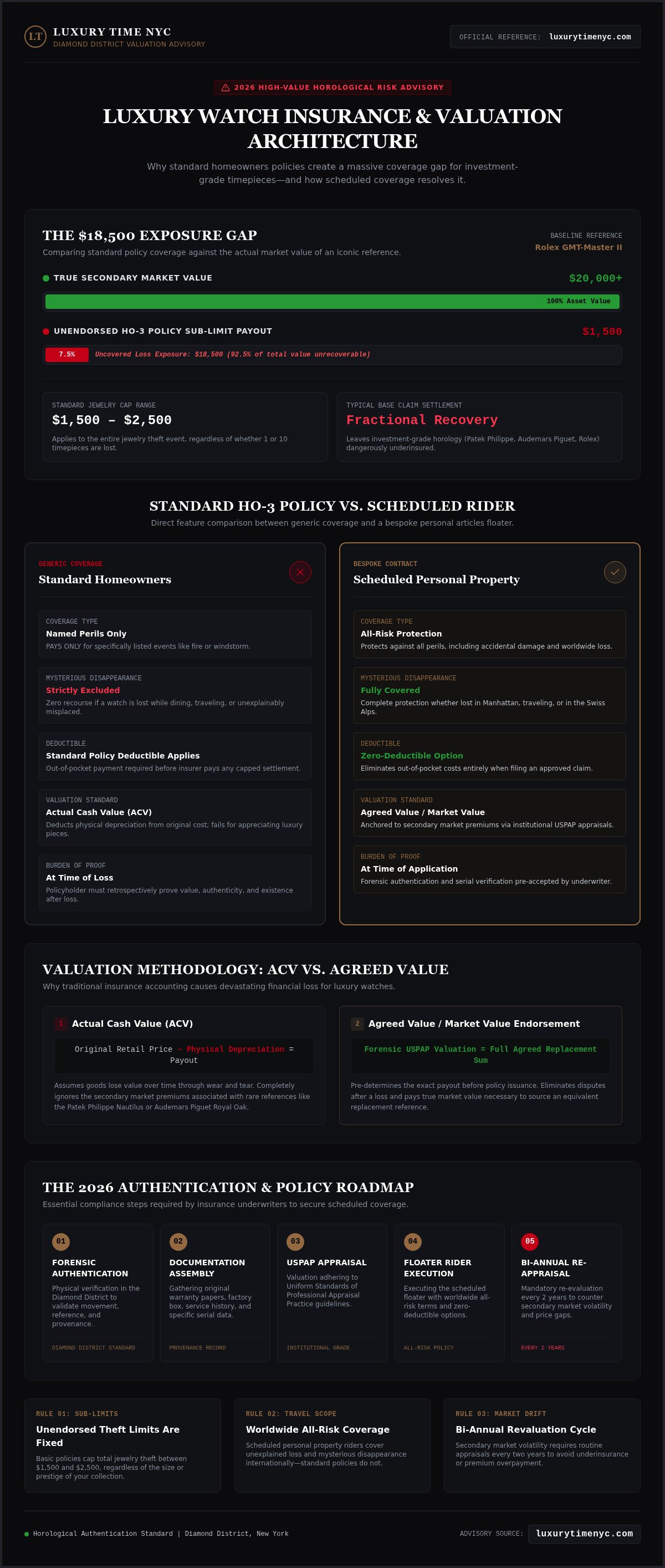
The most significant hurdle is the sub-limit. A sub-limit is the maximum amount an insurer pays for specific categories. In 2026, most unendorsed HO-3 policies cap theft coverage for jewelry and watches at a mere $1,500 to $2,500 for the entire loss. This strict cap applies across all high-value pieces, from timepieces to diamond engagement rings from fine retailers like Robson's Jewelers. If a collection containing multiple pieces is stolen, the payout remains anchored to this figure, regardless of the individual items' market values.
The Reality of Sub-Limits in 2026
Consider a modern Rolex GMT-Master II. With a market value often exceeding $20,000, this timepiece is effectively uninsured on a basic policy. Beyond the dollar limit, standard coverage usually excludes "mysterious disappearance." If you lose your watch while traveling or dining, a basic policy offers no recourse. Dedicated collectors require "All-Risk" coverage. This broader protection includes accidental loss and unexplained disappearance, ensuring your investment is secure whether it's in a safe or on your wrist. Professional luxury watch authentication nyc provides the forensic proof of existence and condition that these high-level policies demand.
Replacement Cost vs. Market Value
Standard insurance often relies on "Actual Cash Value" (ACV). This method deducts physical depreciation from the item's original cost, a logic that fails when applied to appreciating assets like a Patek Philippe Nautilus or an Audemars Piguet Royal Oak. These pieces often trade at significant premiums over their original retail price. If your policy is based on ACV, you'll receive a fraction of what is required to source an equivalent replacement in the current market. Professional appraisers in the Diamond District adhere to the Uniform Standards of Professional Appraisal Practice to provide valuations that stand up to institutional scrutiny. Without an "Agreed Value" or "Market Value" endorsement, you aren't just underinsured; you're financially exposed to the volatility of the secondary market.
Understanding Scheduled Personal Property and Riders
A standard policy provides a floor; scheduling provides a fortress. When you "schedule" a timepiece, you move it from a generic category of household goods into a bespoke insurance contract. This process, often referred to as adding a rider or a "Personal Articles Floater," creates a separate agreement between you and the underwriter. For the serious collector, this is the only logical path to secure a Richard Mille or a Patek Philippe. It shifts the burden of proof from the time of loss to the time of application. Securing luxury watch authentication nyc ensures the underwriter accepts the exact specifications and provenance of your asset before the policy is even signed.
This dedicated coverage follows Insurance Information Institute guidelines on insuring valuables by offering broader protection than a primary home policy. It generally includes "All-Risk" terms, covering accidental damage and worldwide loss. Whether you are in a boardroom in Manhattan or traveling through the Swiss Alps, your timepiece is protected against perils that standard policies ignore. It's a level of security that matches the rarity of the movement itself.
What is a Scheduled Personal Property Rider?
Scheduling is a meticulous exercise in itemization. You provide the underwriter with the specific reference number, serial number, and a detailed appraisal. This itemized approach often allows for a zero-deductible option. If your Rolex is lost, you won't pay out of pocket to trigger the claim. For the NYC jet-set, the inclusion of worldwide coverage is non-negotiable. It ensures that the risks of international travel don't compromise the safety of your investment portfolio.
Agreed Value vs. Stated Value
Security lies in the fine print. For investment-grade pieces from Audemars Piguet or Richard Mille, "Agreed Value" is the gold standard. In this arrangement, you and the insurer agree on the payout amount at the inception of the policy. If a total loss occurs, the insurer writes a check for that exact figure. There is no negotiation. There is no depreciation. Conversely, "Stated Value" only sets a maximum limit, allowing the insurer to pay the lesser of the market value or the stated amount at the time of the claim. To avoid disputes during a stressful loss, insist on Agreed Value terms backed by a forensic authentication from a trusted Diamond District institution.
The Essential Role of Professional Appraisals and Authentication
An appraisal is more than a valuation; it is the definitive record of your timepiece's existence and condition. Most elite insurers require a professional appraisal updated every two years. This frequency ensures that your scheduled personal property coverage keeps pace with the secondary market's shifting tides. In the high-stakes world of horology, a generic jeweler's receipt is insufficient. Underwriters demand a document that reflects deep technical knowledge and forensic precision. An appraisal must include the serial number, model, and condition. Without these specific details, a claim can be stalled or even dismissed due to lack of clarity.
Professional luxury watch authentication nyc serves as the prerequisite for a valid policy. If a timepiece is later discovered to be a sophisticated counterfeit, the insurance contract is often deemed void from its inception. This isn't just about price. It's about verifying the mechanical soul of the object. A Diamond District appraisal provides the underwriter with the confidence that the asset is both authentic and accurately valued according to current 47th Street transaction data.
Why NYC Authentication is the Foundation
The proliferation of "super-clones" has changed the landscape of insurance underwriting. These high-grade counterfeits can deceive even experienced collectors, but they won't pass a forensic movement inspection. A claim denial based on authenticity is a collector's worst nightmare. Expert watch authentication links the physical item to the legal contract, ensuring your Patek Philippe or Audemars Piguet is recognized as a genuine asset. Luxury Time NYC acts as a guardian of this authenticity, providing the rigorous movement verifications that institutional insurers require. We go beyond the dial, inspecting the escapement and balance assembly to confirm horological integrity.
What Must Be Included in a 2026 Appraisal
Modern insurance-grade documentation requires a multifaceted approach. In 2026, a standard paragraph is no longer enough. Your appraisal should include:
- High-resolution macro photography capturing the dial, caseback, and movement.
- A precise description of the reference number and all unique identifiers.
- Verification of the serial number against international lost-and-stolen databases.
- A current market valuation derived from actual secondary market sales, not just suggested retail prices.
This level of detail creates a digital "fingerprint" of your timepiece. It simplifies the claims process and ensures that if a loss occurs, the replacement value is indisputable. Trusting this process to a Manhattan institution provides the gravitas your collection deserves.
Steps to Add Your Watch to Your Policy in 2026
Securing your collection is a deliberate exercise in risk management. It requires moving beyond the initial purchase to establish a formal record of ownership and value. The process is straightforward but demands precision. Before contacting an underwriter, you must finalize your luxury watch authentication nyc to ensure the asset is verified by a recognized authority. This step transforms a physical object into a documented financial asset. Provenance established. Risk mitigated.
Documentation: The Collector's Portfolio
Provenance is the currency of the high-end market. Assemble a comprehensive "full set" for each timepiece. This includes the original sales receipt, the presentation box, and the warranty papers. These items aren't just for resale value; they provide the underwriter with a clear chain of custody. Underwriters respect a complete history. Maintain digital copies of all documents in a secure cloud environment. This ensures instant access during a claim. As a final measure, record a short video of the watch. Capture the sweeping second hand and the serial number to prove functionality and possession on the day coverage begins.
Finalizing the Rider with Your Carrier
Once your appraisal is secured from a reputable Diamond District institution, contact your insurance agent to "schedule" the item. This creates the Personal Articles Floater. You must ask specific questions to ensure no gaps remain. Confirm that "Mysterious Disappearance" is explicitly included. In 2026, annual premiums for these riders typically range between 1% and 2% of the insured value. It's a small price for total peace of mind.
Inquire about "inflation guard" or market appreciation clauses. These provisions are essential for brands like Rolex and Patek Philippe, where replacement costs can climb unexpectedly. Verify the exact effective date of the coverage. Your protection should be active the moment the appraisal is accepted. To begin this process with the necessary technical precision, schedule your luxury watch authentication nyc with our expert horologists today.
Maintaining Your Watch’s Insured Value Over Time
The luxury watch market is a living entity. Values shift. Demand surges. In 2025 alone, the market index rose by 4.9%, highlighting the volatility that can leave a collection underinsured within months. A static policy is a risk. Maintaining the correct coverage requires a proactive approach to valuation and preservation. Periodic luxury watch authentication nyc ensures that your documentation reflects the current secondary market reality rather than a historical purchase price. It's the only way to bridge the gap between what you paid and what it would cost to replace a piece today.
A "set and forget" mentality is dangerous for serious collectors. As secondary prices for the "Big Three" continue to dominate transaction values, your insurance must remain agile. Relying on outdated figures can lead to a significant financial shortfall during a claim. Precision in paperwork is as vital as precision in the movement itself.
The Importance of Regular Re-Appraisals
The "Rolex spike" of the mid-2020s proved that retail prices rarely mirror replacement costs. For brands like Patek Philippe or Audemars Piguet, bi-annual re-appraisals are now the industry standard. Rare models can appreciate rapidly. If you rely on an appraisal from five years ago, you're likely underinsured by a significant margin. Sourcing updated valuations from Luxury Time NYC experts provides the technical precision underwriters require. We track 47th Street transaction data to ensure your "Agreed Value" remains accurate. This prevents the trap that leaves collectors exposed during a total loss claim.
Under-insurance is a silent threat. When a specific reference, such as a Nautilus or a Royal Oak, experiences a sudden market correction, your policy must adapt. A bi-annual cadence for luxury watch authentication nyc allows you to capture these gains. It ensures your portfolio remains a true reflection of your net worth. We provide the forensic documentation needed to justify these value increases to your insurer.
Security and Risk Mitigation
Risk management extends beyond the vault. Installing a UL-rated safe or a sophisticated home security system often leads to lower annual premiums. Insurers reward discretion and physical security. Professional watch repair and movement overhauls preserve the "Insured Condition" of the asset. A well-maintained caliber is more than a mechanical marvel; it's a protected investment. When traveling in 2026, consider these best practices:
- Utilize high-grade hotel safes for any piece not currently on the wrist.
- Maintain a digital "travel pack" with your latest appraisal and macro photos.
- Avoid high-profile displays in unfamiliar or unmonitored environments.
- Ensure your "All-Risk" floater explicitly covers international transit.
Your legacy is built on these details. By combining technical maintenance with rigorous security, you ensure your timepieces remain enduring assets for the next generation. Exclusivity demands vigilance. Trust the experts at Luxury Time NYC to safeguard your horological journey through the shifting landscape of 2026 and beyond.
Securing Your Horological Legacy for the Future
Protecting a collection requires more than a casual insurance rider. It demands a strategy as precise as a perpetual calendar. You now understand that standard homeowners' sub-limits are a significant liability. "Agreed Value" coverage is the only path to true financial security. By scheduling your timepieces, you ensure that market appreciation doesn't leave you underinsured when it matters most. It's about moving from a generic policy to a bespoke protection plan.
The foundation of this protection remains professional luxury watch authentication nyc. This forensic process validates the integrity of your asset for institutional underwriters. Since 2005, we've served as a discreet advisor in the heart of the Diamond District. Our horologists specialize in the verification of Rolex, Patek Philippe, and Audemars Piguet references. Don't leave your investment to chance. Secure an Expert Appraisal for Your Timepiece at Luxury Time NYC. Your collection is an enduring asset. Treat it with the vigilance it deserves. Your peace of mind is the ultimate luxury.
Frequently Asked Questions
Does my standard homeowners policy cover my Rolex if I lose it while traveling?
Standard homeowners policies provide minimal protection for high-value assets outside the home. Most unendorsed contracts cap jewelry theft at $1,500 to $2,500 for the entire loss. If you lose your Rolex while traveling, "mysterious disappearance" is typically excluded from coverage. You're essentially self-insuring the difference between the sub-limit and the replacement cost. Comprehensive protection requires a dedicated rider that offers worldwide coverage and explicitly includes accidental loss beyond your primary residence.
How much does it cost to add a luxury watch to a home insurance policy?
Annual premiums for a scheduled personal property rider generally range from 1% to 2% of the timepiece's appraised value. For a collection worth $100,000, you might expect an annual cost between $1,000 and $2,000. This investment secures "All-Risk" protection and often removes the deductible entirely. Professional luxury watch authentication nyc is the prerequisite for this coverage, ensuring the underwriter accepts the forensic valuation of your horological assets before the policy becomes active.
What is 'Mysterious Disappearance' coverage and why do I need it?
Mysterious disappearance refers to the loss of an item where the cause is unknown or cannot be proven as theft. Standard policies require evidence of a "peril," such as a police report for a break-in. If your watch slips off your wrist while swimming or is left in a hotel room, standard coverage will deny the claim. A dedicated rider includes this clause, providing the absolute security necessary for those with an active, global lifestyle.
Do I need a new appraisal every year for my Patek Philippe?
While an annual update isn't strictly required by all carriers, a bi-annual appraisal is the gold standard for high-appreciation brands. The secondary market for Patek Philippe and Audemars Piguet can shift significantly within 24 months. Relying on an outdated valuation leads to a dangerous coverage gap. Regular updates ensure your "Agreed Value" reflects current 47th Street transaction data, protecting your equity against sudden spikes in global demand and replacement costs.
Can I insure a watch without the original sales receipt?
You can certainly insure a timepiece without the original sales receipt. While a "full set" with papers is ideal for provenance, a professional appraisal serves as the legal substitute for insurance underwriting. Expert luxury watch authentication nyc provides the forensic proof of existence, condition, and serial number verification required by elite carriers. This documentation establishes the baseline value, allowing you to schedule the item as a unique asset even if the original paperwork was lost.
What happens if my watch increases in value after I've insured it?
If your timepiece appreciates beyond your insured limit, you are personally liable for the deficit. Standard policies don't automatically adjust for secondary market gains. Some specialized collectors' policies offer a "market appreciation" buffer, often up to 150% of the scheduled value. However, the most secure method remains submitting a fresh appraisal every two years. This ensures your coverage limit remains synchronized with the actual cost of sourcing an identical reference in today's market.
Is there a deductible for scheduled personal property riders?
One of the primary advantages of scheduling a watch as personal property is the option for a $0 deductible. Unlike standard homeowners claims, which are subject to your primary policy's deductible, a rider allows for a full payout from the first dollar of loss. This arrangement ensures that even minor damage or partial losses are covered without out-of-pocket expenses, maintaining the financial integrity of your horological investment portfolio while providing immediate liquidity after a loss.
Should I use a specialized watch insurer instead of my home insurance?
Specialized watch insurers often provide superior terms compared to generic homeowners riders. These dedicated underwriters understand "Agreed Value" settlements and the nuances of the pre-owned market. A key benefit is claim isolation. Filing a claim through a specialized insurer won't typically trigger a premium increase or non-renewal of your primary home policy. This separation of assets provides a layer of professional distance that aligns with the needs of high-net-worth collectors and sophisticated investors.


