


In June 2026, a single F.P. Journe timepiece commanded $13.9 million at auction in New York. This figure redefines the boundaries of mechanical value. This isn't just about timekeeping; it's about the strategic acquisition of rare engineering. Understanding what makes a watch "investment grade" separates the casual enthusiast from the serious collector. While many luxury pieces are beautiful, only a fraction possess the rarity and market liquidity to serve as genuine capital assets.
You likely understand that price and value aren't always synonymous. Buying a retail model only to see its worth diminish by 30% the moment you leave the boutique is a risk every sophisticated buyer seeks to avoid. This guide provides the clarity needed to evaluate potential acquisitions with the precision of a Diamond District specialist. We'll examine the critical criteria of provenance, movement complexity, and the specific market dynamics that allow brands like Rolex and Patek Philippe to consistently outperform traditional markets. Whether you're eyeing a vintage Daytona or a modern Nautilus, you'll gain the confidence to secure pieces that represent enduring wealth rather than fleeting trends.
Key Takeaways
- Distinguish between luxury accessories and genuine horological assets by mastering the specific criteria of what makes a watch "investment grade".
- Identify the "Four Pillars" of value, where mechanical excellence and restricted production volumes create the supply-demand mismatch essential for capital growth.
- Prioritize the "Unpolished" premium and original provenance, ensuring every acquisition retains its historical integrity and maximum market desirability.
- Navigate the nuances of market cycles and industry events to optimize the timing of your entry and exit strategies with professional precision.
- Leverage professional authentication and elite sourcing networks to secure high-value timepieces from manufacturers like Patek Philippe and Rolex with absolute certainty.
Defining the Asset Class: What is an Investment-Grade Watch?
A luxury watch is often a statement of personal style or professional success. An investment-grade watch is fundamentally different. It is a vehicle for capital. While a standard luxury timepiece might lose value the moment it leaves the showroom, an investment asset maintains or increases its worth over time. The Watch has evolved from a simple mechanical tool into a sophisticated alternative asset class that demands a unique analytical framework. Understanding what makes a watch "investment grade" requires looking past the aesthetic appeal and focusing on market liquidity and historical resilience.
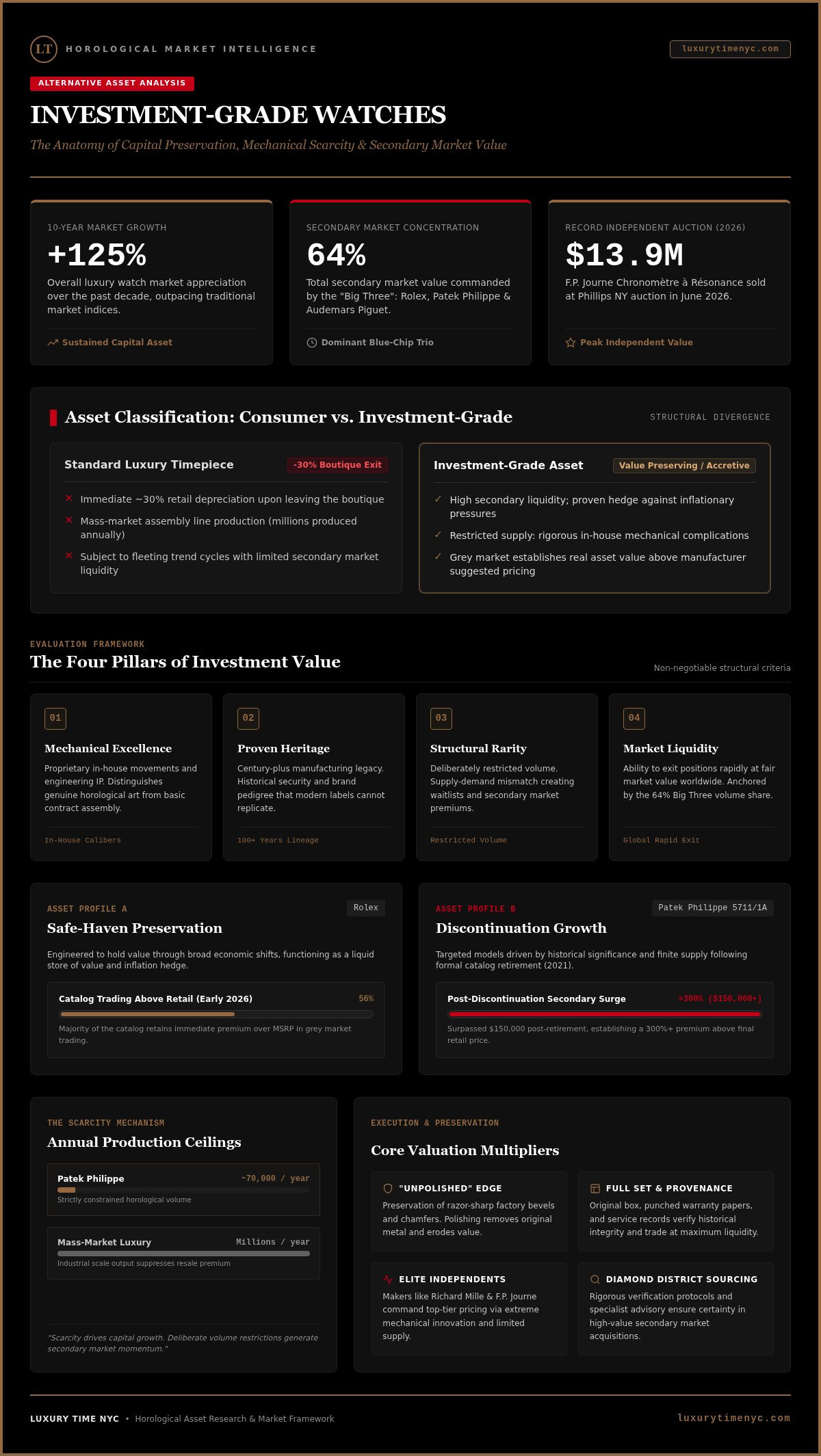
Investment-grade watches are pieces with proven secondary market demand and limited supply. Transitioning from a consumer to a collector-investor involves a psychological shift. You aren't just buying a product; you're acquiring a share in a brand's heritage and mechanical legacy. Data supports this perspective. The luxury watch market has seen an appreciation of approximately 125% over the past decade, frequently outperforming traditional market indices. This growth isn't accidental. It's the result of meticulous production and global desirability.
The 'Big Three' and Beyond
Rolex, Patek Philippe, and Audemars Piguet dominate the landscape. These manufacturers account for roughly 64% of the total value in the secondary market. Their dominance is rooted in consistency. However, the market is expanding. Emerging blue-chip brands like Richard Mille and F.P. Journe now command record-breaking prices at auction. In June 2026, a Phillips auction in New York saw an F.P. Journe Chronomètre à Résonance sell for $13.9 million. Independent watchmakers achieve this status by offering extreme rarity and uncompromising craftsmanship. They represent the pinnacle of horological exclusivity.
Value Retention vs. Appreciation
Some models serve as safe havens. They hold value through economic shifts, acting as a hedge against inflation. Rolex models are the primary example here, with 56% of their catalog trading above retail prices in early 2026. Growth pieces are different. These are models with high appreciation potential, often driven by discontinuation or historical significance. The Patek Philippe Nautilus 5711/1A, for instance, trades at more than 300% above its final retail price. The grey market serves as the ultimate arbiter of truth. It establishes the actual asset value, independent of manufacturer suggested pricing.
The Four Pillars of Horological Investment Value
Identifying what makes a watch investment-grade involves examining four distinct structural pillars. These aren't mere suggestions. They're the non-negotiable requirements of a high-performing asset. Mechanical excellence serves as the primary foundation. An in-house movement represents a manufacturer's unique intellectual property and engineering prowess, separating true horology from simple assembly. Heritage provides the necessary historical context. A brand with over a century of manufacturing excellence offers a level of security that modern labels rarely match. Rarity ensures the supply remains constrained while global demand continues to accelerate. Finally, secondary market liquidity allows a collector to exit a position quickly at a fair price, a trait pioneered by the "Big Three" manufacturers who currently command 64% of secondary market value.
Investment-grade status isn't just a label. It's a reflection of sustained market performance. When you evaluate a timepiece, you're looking for the intersection of technical mastery and cultural significance. High-net-worth individuals treat these acquisitions as a hedge against inflation. They're tangible assets with a global audience. If you're seeking to refine your portfolio with these specific criteria in mind, the advisors at Luxury Time NYC can help you identify pieces that meet these rigorous standards.
The Impact of Limited Production
Scarcity drives capital growth. Patek Philippe produces approximately 70,000 timepieces annually. In contrast, mass-market luxury brands produce millions. This deliberate restriction creates the legendary waiting list phenomenon that defines the modern market. When a production run ends, prices often surge instantly. The discontinuation of the Patek Philippe Nautilus 5711/1A in 2021 serves as a prime example, pushing secondary market prices over $150,000. This represents a 300% premium over its final retail price. Collectors value the finite. The end of a reference is often the beginning of its greatest appreciation.
Complications that Command Premiums
Engineering milestones like perpetual calendars, tourbillons, and minute repeaters represent the peak of mechanical achievement. These complications require hundreds of hours of manual labor and hand-finishing. They command significant premiums because they're remarkably difficult to manufacture. Yet, simplicity also has its place in a balanced portfolio. Staples like the Rolex Submariner remain essential investment assets. These models offer unmatched liquidity and universal appeal. They're the "gold standard" of the secondary market. Hand-finished dials and Metiers d’Art also add value, turning a functional tool into a unique masterpiece that resists market volatility.
Condition, Provenance, and the 'Full Set' Advantage
Acquiring a high-value timepiece is only the first step. Preserving its physical and historical integrity is what determines its eventual exit price. In the world of elite horology, condition is absolute. Serious collectors prioritize the "unpolished" premium, where the original case lines and sharp chamfers remain exactly as they left the manufacture. Every time a watch undergoes aggressive polishing, it loses metal mass and structural definition. Sharp edges become rounded. Original geometry vanishes. For those who understand what makes a watch "investment grade", these minute physical details are the difference between a standard luxury item and a blue-chip asset.
Provenance adds a layer of emotional and historical depth that translates directly into financial growth. A watch's history or previous ownership can significantly alter its value trajectory. Beyond the story, the physical "Full Set" serves as the ultimate checklist for security. This includes the original box, warranty papers, hangtags, and initial purchase receipts. These elements provide a tangible link to the watch's origin. It's a matter of significant capital; a missing warranty card can devalue a Patek Philippe by five figures. Completeness isn't a suggestion. It's a requirement for maximum liquidity.
The Paper Trail: Authentication and Documentation
Documentation is the bedrock of investment security. For vintage Patek Philippe acquisitions, an "Extract from the Archives" offers essential verification of the production date and original configuration. Matching serial numbers across the movement, case, and papers are mandatory. Any discrepancy here suggests a "franken-watch" composed of mismatched parts. Utilizing professional watch authentication protects your capital from sophisticated counterfeits and unauthorized modifications. It ensures that your investment is exactly what it claims to be.
Conservation vs. Restoration
Modern perfection is often the enemy of vintage value. "Service dials" and replacement hands might make a watch look newer, but they destroy the historical narrative and market desirability of the piece. Collectors value authenticity over aesthetics. Sympathetic servicing is always preferred over restoration. This approach maintains the mechanical movement's health without destroying the natural patina that develops over decades. A faded "ghost" bezel or a creamy Tritium dial are markers of age that command significant premiums. Don't let a standard service center erase the history that makes your timepiece unique.
Market Dynamics: Timing Your Acquisition and Exit
Timing is the ultimate luxury. In the high-stakes world of horology, understanding the distinction between a speculative hype cycle and sustained long-term growth is paramount. While recent years saw a cooling of the 2022 frenzy, 2026 has introduced a new era of stability. Rolex implemented its second price increase of the year on June 1, 2026, signaling robust brand confidence. This environment favors the patient collector who recognizes that what makes a watch "investment grade" is often its ability to withstand temporary market fluctuations. True value reveals itself over decades, not months.
Annual industry events, specifically Watches & Wonders, act as a primary catalyst for price movement. A single announcement regarding a discontinued reference can trigger an immediate supply-demand mismatch. When a manufacturer ceases production of a staple, the remaining inventory transitions from a retail product to a finite asset. In May 2026, a Patek Philippe Ref. 2523 world-timer sold for nearly CHF 8 million, proving that historical rarity remains the safest harbor. Navigating these shifts requires the insight of a trusted watch dealer who understands the historical patterns of these cycles.
The New York Diamond District Advantage
47th Street remains the global epicenter for watch liquidity. Our presence in this historic district provides a unique vantage point on the global luxury market. Physical proximity to the world's most skilled horologists ensures that every asset meets the highest standards of mechanical perfection. Specialized dealers here offer access to off-market investment pieces that never reach public platforms. This discreet network is essential for sourcing rare references from Patek Philippe or Audemars Piguet that carry significant appreciation potential.
Portfolio Diversification with Timepieces
Sophisticated investors typically allocate 5 to 10 percent of their portfolio to wearable assets. This strategy balances the security of blue-chip brands like Rolex with the high-reward potential of independents like Richard Mille. In 2026, the market has trended toward smaller case sizes, with 36mm to 39mm diameters seeing increased demand. While these assets offer portability and pleasure, collectors must be mindful of tax implications; consulting a professional is always recommended. To begin curating your collection with expert guidance, visit Luxury Time NYC.
Sourcing Your Investment with Luxury Time NYC
Luxury Time NYC operates at the heart of the global horological trade. Our presence in New York's historic Diamond District provides a strategic advantage that few can replicate. We act as a peer to the elite, offering a gateway into a world of timeless luxury and heritage. Understanding what makes a watch "investment grade" is only the beginning. Securing the asset with absolute certainty is the ultimate goal. We provide a certified authenticity guarantee that stands as an absolute fact. This no-nonsense delivery is essential when dealing with high-value mechanical assets. Every timepiece in our inventory undergoes rigorous inspection to ensure it meets our standards of mechanical perfection.
Our communication is defined by understated elegance and quiet confidence. We offer private consultations in our NYC showroom for high-net-worth collectors who value discretion and expertise. It's a space where time is treated as a luxury. You'll receive professional advice tailored to your specific portfolio needs. For our international clientele, we provide global secure shipping. This brings Diamond District expertise to a worldwide audience without compromising security. Every shipment is handled with the gravity such an investment deserves. We ensure the transition from our showroom to your collection is seamless and logical.
Expert Sourcing for Rare Models
Finding the "unfindable" requires a network built over twenty years of dedicated service. We specialize in locating rare Patek Philippe and Audemars Piguet pieces that remain hidden from public view. Our deep ties within the NYC Diamond District allow us to source off-market investment pieces with verified provenance. Whether you seek a specific birth-year Rolex or a discontinued Audemars Piguet reference, our custom sourcing requests deliver results. We leverage our reputation for excellence to find the exact model that completes your collection. This level of access is what separates a premier retailer from a standard boutique.
Preserving Value Through Professional Care
Maintaining a horological asset involves more than just storage. It requires professional stewardship to ensure long-term value retention. Our in-house services include meticulous movement overhauls and precision pressure testing. These procedures preserve the mechanical integrity of your investment for future generations. We don't just sell timepieces; we act as guardians of authenticity and curators of fine mechanical arts. Professional watch repair is the final pillar of asset protection. To begin your journey with an established metropolitan institution, we invite you to Schedule a private viewing at Luxury Time NYC.
Securing Your Horological Legacy
Mastering the nuances of what makes a watch "investment grade" is a prerequisite for any serious collector. It's a journey that balances technical appreciation with market discipline. You've seen how the intersection of mechanical rarity, unpolished condition, and impeccable provenance creates an asset that transcends simple timekeeping. These aren't just accessories; they're enduring stores of value. Success in this market requires more than just capital. It requires a partner who understands the gravity of every acquisition.
Located in the heart of NYC's Diamond District, Luxury Time NYC serves as a guardian of authenticity. We specialize in expert sourcing for rare Rolex and Patek Philippe models that rarely reach the public eye. Every timepiece we offer comes with a certified authenticity guarantee, ensuring your capital is protected by absolute facts. Whether you're refining an existing portfolio or making your first six-figure acquisition, our expertise provides the security you demand. The world of fine horology is waiting for those who value excellence above all else.
Explore our curated collection of investment-grade timepieces at Luxury Time NYC. Your next legacy piece is within reach.
Frequently Asked Questions
Is a Rolex always a good investment?
No, brand name alone does not guarantee financial returns. While 56% of Rolex models traded above retail in early 2026, others have seen corrections. The Rolex Oyster Perpetual 126000, for instance, experienced a price drop from $14,108 to $12,367 during the same period. You must focus on specific professional models like the Daytona or GMT-Master II, which consistently maintain high secondary market liquidity and demand.
How much should I spend on my first investment-grade watch?
No, modern references often provide superior liquidity compared to vintage pieces. The Patek Philippe Nautilus 5711/1A serves as a prime example, trading at more than 300% above its final retail price despite being a modern reference. Modern watches benefit from global recognition and greater ease of authentication. While vintage pieces offer extreme rarity, modern "hype" models currently drive significant volume in the secondary market.
What happens if I lose the original box and papers?
Losing the original documentation typically reduces a timepiece's market value by 15% to 30%. Collectors and dealers view the "Full Set" as the ultimate proof of provenance and authenticity. For high-value Patek Philippe models, a missing warranty card can result in a five-figure price reduction. Documentation is not just paper; it's a vital component of the asset's total value and exit potential.
Are modern Patek Philippe watches better investments than vintage ones?
Both sectors offer distinct strategic advantages. Vintage Patek Philippe models, such as the Ref. 2499, recently set records with sales exceeding $10 million, offering unmatched rarity. Modern models provide higher liquidity and are easier to trade quickly in the global market. A balanced portfolio often includes both, utilizing vintage pieces for long-term capital appreciation and modern references for their robust secondary market demand.
How often should an investment-grade watch be serviced?
Professional maintenance is recommended every five to ten years to preserve mechanical perfection. It's vital to use specialists who prioritize conservation over restoration. A professional movement overhaul ensures the piece remains functional without replacing original parts like dials or hands, which would destroy the investment value. Regular pressure testing is also essential for sport models to prevent internal moisture damage and preserve the movement.
Can I wear my investment watch, or will it lose value?
You can wear your timepiece, but you must do so with extreme discretion. Serious collectors pay a significant premium for "unpolished" cases with original factory lines. While light wear is generally accepted, significant scratches or dents that require aggressive polishing will diminish the asset's value. Treat the watch as a wearable asset, avoiding environments where the case or crystal could sustain permanent structural damage. For collectors who still want to enjoy their timepieces during upscale outings—such as a private coastal cruise with Happiest Ours—mindful wear in controlled settings allows you to appreciate the piece while preserving its pristine condition.
What brand is currently the fastest-growing in terms of investment value?
Independent watchmakers, specifically F.P. Journe, are currently experiencing the most significant growth in the auction market. In June 2026, an F.P. Journe Chronomètre à Résonance sold for $13.9 million in New York, shattering previous records. Collectors are shifting focus toward these independents because of their extremely low production volumes and uncompromising craftsmanship. This scarcity creates a supply-demand mismatch that mass-produced luxury brands cannot easily replicate.


