


What if the headline auction record tells you almost nothing about the Cartier Crash you’re considering? The cartier crash market value depends on the specific watch, not the model name alone. In April and May 2026, successive auction records drew fresh attention to the Crash, but a result for an exceptionally rare example isn’t a reliable valuation for every watch.
That distinction matters. Buyers and sellers may see asking prices alongside completed sales, while differences in origin, production era, condition, configuration, and provenance can make two examples difficult to compare. A celebrated design deserves more than a headline figure.
This guide explains what shapes a Crash’s market value and how to weigh relevant evidence without relying on a single result. It also covers the records and authenticity details to verify before a purchase, sale, or trade. Luxury Time NYC deals in authenticated luxury watches and approaches these decisions with care. The sections ahead examine comparable transactions, the details behind each example, and the checks that make a valuation more credible.
Key Takeaways
- Market value is an evidence-based estimate, not a universal figure. Separate asking prices, completed sales, dealer offers, and insurance valuations before drawing conclusions.
- To assess cartier crash market value, compare watches with closely matched origins, production details, condition, documentation, and provenance.
- Use dated, publicly verifiable completed sales as evidence. Note missing or incomparable details instead of treating every figure as equivalent.
- Before buying or selling, identify the watch, review its records, assess its condition, and arrange an in-person examination by a qualified watch professional for a high-value decision.
- Understand how private sales, dealer transactions, and consignment differ. Choose the route that best fits your priorities without assuming a particular outcome.
What Does Cartier Crash Market Value Actually Mean?
There is no single figure that represents every Cartier Crash. The cartier crash market value is an estimate based on relevant evidence, not a universal price attached to the model. Its usefulness depends on how closely the available comparisons match the specific watch and whether the underlying records can be verified.
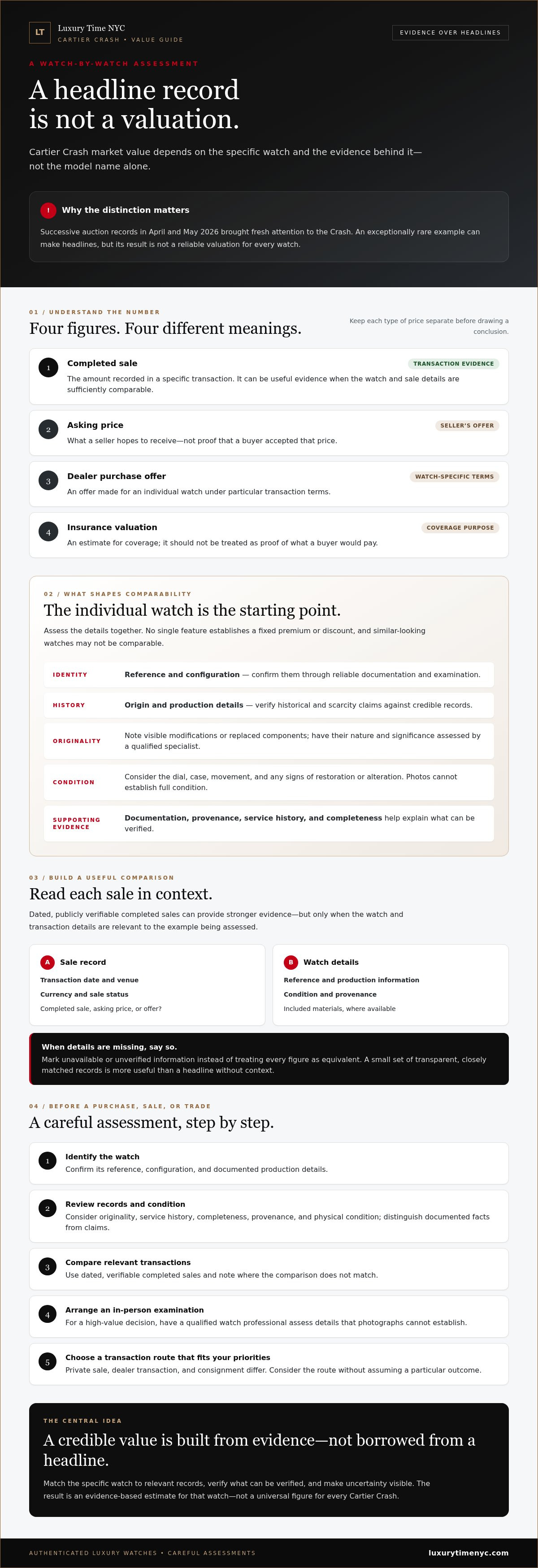
Market value is an evidence-based estimate for a particular watch; a completed-sale price is the amount recorded in a specific transaction. The terms are related, but they aren’t interchangeable. An asking price is what a seller hopes to receive. A dealer purchase offer applies to an individual watch under particular transaction terms. An insurance valuation serves a different purpose: it estimates a value for coverage and shouldn’t be treated as proof of what a buyer would pay.
Why one Cartier Crash market value cannot fit every example
A useful comparison considers the watch’s reference and documented production details, along with its condition and provenance. Originality, service history, and completeness can also affect buyer confidence and comparability. None of these details, by itself, establishes a fixed premium or discount.
Historical claims deserve particular care. Verify an example’s production history and provenance against reliable documentation rather than repeating an unconfirmed story. Even watches that look similar may not be comparable if their records or condition differ.
Asking prices versus completed sales
An advertised price is a seller’s offer, not evidence that a buyer accepted it. Completed transactions generally provide stronger market evidence because they show that a sale took place, but only when the watches and sale details are sufficiently comparable. Read a public auction result in context rather than treating it as a direct valuation for every Crash. For broader context, consult the list of record-setting watch auctions, while keeping individual transaction records central to your assessment.
For each comparison, record:
- Transaction date and venue: Note when and where the sale occurred.
- Currency and sale status: Distinguish a completed sale from an asking price or offer.
- Watch-specific details: Capture the reference, documented production information, condition, provenance, and included materials where available.
Mark unavailable or unverified details. A small set of transparent, closely matched records is more useful than a headline figure without context.
Which Factors Shape a Cartier Crash’s Market Value?
A credible assessment starts with the individual watch, not a headline figure. Reference and configuration, originality, physical condition, supporting records, and provenance all affect how confidently it can be compared with other examples. Consider cartier crash market value through these distinct details, weighing them together rather than reducing the assessment to a single feature.
Condition and documentation influence comparability, not a guaranteed sale outcome. They help explain how closely a watch resembles a recorded transaction and what a prospective buyer can verify. They can’t promise that a future offer or sale will match a prior result.
Reference, configuration, and originality
Start by confirming the exact reference and configuration through reliable documentation and examination. Record any visible modification or replaced component, then have its nature and significance assessed by a qualified specialist. Originality can inform buyer confidence, but its effect depends on the specific watch and the available evidence.
Be cautious with claims about production periods, historical origin, or reference-specific scarcity. Check these details against credible records instead of inferring them from appearance or repeating market lore. Sotheby’s account of the history of the Cartier Crash offers context for evaluating design narratives, but claims about an individual watch still require supporting evidence.
Condition, provenance, and completeness
Condition is specific to each watch. A careful assessment considers the dial and case, the movement, and any signs of restoration or alteration. Photographs can help document visible details, but they can’t establish the full condition of a high-value watch. If the decision depends on fine physical or mechanical details, arrange an in-person examination by a qualified watch professional.
Paperwork, service records, and provenance can help establish a documented history. Their presence may clarify what is known about the watch; describe gaps plainly rather than filling them with assumptions. Service history can also inform confidence in the watch’s care, but review records for relevance and consistency.
Note whether original accessories or other accompanying materials are present, absent, or unverified. Document what is included, but don’t apply a universal adjustment for missing items. Their significance depends on the example and the quality of the available comparisons.
For a discreet perspective on authentication and transaction considerations, readers can explore authenticated Cartier watch guidance from Luxury Time NYC, an independent dealer in New York’s Diamond District.
How to Compare Cartier Crash Market Evidence
A useful comparison is a record, not a collection of attractive figures. To assess cartier crash market value, separate completed transactions from current offers, then check whether each source identifies a watch closely enough to support comparison. Records from established auction houses such as Christie’s, Sotheby’s, and Phillips can provide dated sale evidence. A collector's guide to the Cartier Crash can also help readers understand the variations they may encounter.
| Evidence type | What it can show | What to verify |
|---|---|---|
| Completed auction sale | A publicly recorded transaction for a particular watch. | Sale date, venue, currency, reference or identifying details, condition, completeness, and whether the published result includes buyer’s premium. |
| Dealer asking price | A seller’s current advertised position. | Listing date, exact watch details, and whether the listing remains active. An asking price is not proof of a completed sale. |
| Direct dealer offer | An offer made for a specific watch under particular transaction terms. | Offer date, watch condition and documentation considered, and any terms that affect the amount offered. Offers may not be public or independently comparable. |
Which sources provide useful market evidence?
Start with original sale records from established auction houses. Confirm that the catalogue or result page identifies the watch and its relevant characteristics. A result with a limited description may be too weak to compare. Dealer listings can help you observe current asking positions, but treat them as offers, not confirmed transactions. Direct dealer offers may matter to an owner’s decision, yet private terms and limited disclosure can make them difficult to compare with public auction results.
How to read a comparison without false precision
Use a consistent record for each candidate comparison: date, venue or source, currency, transaction status, reference, condition, and completeness. Mark missing details as unavailable. If a watch differs materially or the evidence is too thin, exclude it rather than forcing it into an average.
Read auction terms carefully. Where disclosed, distinguish the hammer price or seller proceeds from a published result that includes a buyer’s premium, and note whether fees, taxes, or other terms are included. Don’t combine unlike figures without explaining the basis. If converting currencies, state the exchange-rate source and date used. A transparent set of comparable records is more informative than a precise-looking estimate based on mismatched evidence.
How to Assess a Cartier Crash Before Buying or Selling
A sound decision follows a clear sequence: identify the watch, review its documentation, assess its condition, and compare it with relevant market evidence. This process keeps cartier crash market value tied to the individual example rather than a headline, seller description, or broad estimate.
Photographs and written descriptions are useful starting points, not substitutes for authentication or physical inspection. For a high-value decision, arrange an in-person examination by a qualified watch professional. Pause if identifying details conflict or important questions remain unanswered.
A buyer’s due-diligence checklist
Before committing, check that the watch and its records tell a consistent story. Request clear information about condition and ask about service history, modifications, and any replaced or refinished components. Have authenticity assessed through an appropriate professional process before completing the transaction.
- Identify the example: Compare the watch’s identifying details with the accompanying documentation and investigate discrepancies.
- Review condition and work: Ask what is known about the dial, case, movement, restoration, and replacement parts. Seek a professional inspection instead of relying on photographs alone.
- Check the records: Review available provenance and service documents for consistency. For context on why service records matter, see this guide to professional luxury watch repair in NYC.
- Verify before purchase: Resolve material questions about authenticity and condition before proceeding.
A seller’s preparation and valuation checklist
Good preparation makes an assessment more transparent. Gather the papers, service records, provenance information, and accessories you have. Describe gaps as gaps. Don’t present an unverified history or claim originality without supporting evidence.
- Document the watch: Take clear photographs and prepare an accurate account of visible condition and known work. Images support the record but don’t replace an examination.
- Organize the file: Keep relevant documents and included materials together, noting what is missing or uncertain.
- Compare transaction routes: Consider more than one relevant channel, such as a private sale or dealer transaction, and compare the terms as well as the proposed amount. An offer and a completed sale are different forms of evidence.
For discreet guidance on a Cartier purchase, sale, or trade, contact Luxury Time NYC about your watch. Any assessment depends on the specific example and the information available; no estimate should be treated as a guaranteed outcome.
Where to Go Next When Considering a Cartier Crash
Comparable evidence provides context, but the watch itself remains central. Before acting, return to its reference, condition, documentation, provenance, and completeness. A credible view of cartier crash market value should explain which comparable records informed it and how those records differ from the example under consideration.
Your next decision is about the transaction route. Each option has different considerations, and none guarantees a particular sale price or timeline.
Choosing a transaction route
A private sale gives the owner direct control over presentation and negotiation, but also makes the owner responsible for finding a buyer, answering questions, and agreeing on authentication and payment terms. A dealer transaction may offer a more direct process, with an offer made for the specific watch. Consignment is different: the watch is offered for sale through an intermediary, and timing and terms depend on the arrangement. Review the written conditions carefully. For broader context, read this NYC guide to buying and selling watches.
Exposure, convenience, condition reporting, authentication procedures, fees, and payment terms may vary by channel. A direct purchase and consignment are different agreements and can involve different processes and timelines. If a sale is your priority, this guidance on selling luxury watches offers further considerations for assessing your options.
Questions to ask before proceeding
Before agreeing to buy, sell, or consign, ask what evidence supports the proposed assessment. Does it rely on dated completed transactions, current asking prices, or both? How closely do the comparisons match the watch’s reference, condition, and included materials? Ask how authenticity and condition will be documented, and clarify fees, payment arrangements, and other transaction terms in writing.
Luxury Time NYC, an independent luxury-watch dealer founded in 2005 and located in New York’s Diamond District, buys, sells, and trades Cartier watches, with consignment also available. To discuss a Cartier watch and the transaction route that may suit your priorities, contact Luxury Time NYC about buying, selling, or trading. Any assessment depends on the individual watch and the evidence available; it doesn’t imply that a Cartier Crash is currently available or that a particular valuation is guaranteed.
Make Your Next Cartier Decision with Confidence
A sound assessment begins with the individual watch, not a headline figure. Reference, condition, provenance, and documentation shape how meaningfully it can be compared with other examples. For a credible view of cartier crash market value, prioritize dated, verifiable completed transactions and distinguish them from asking prices and private offers.
Before proceeding, confirm the watch’s identity and records, seek an appropriate professional examination, and understand the terms of your chosen transaction route. Careful comparison won’t guarantee a particular outcome, but it can help you ask better questions and make a more informed decision.
Luxury Time NYC is an independent luxury-watch dealer founded in 2005 in New York’s Diamond District. The business buys, sells, and trades Cartier watches, and watches sold carry a certified authenticity guarantee. If you’re considering a Cartier purchase, sale, or trade, discuss your Cartier watch with Luxury Time NYC. Begin with clear records, thoughtful questions, and confidence in the evidence.
Frequently Asked Questions
What determines a Cartier Crash’s market value?
A Cartier Crash’s market value depends on the specific watch and the quality of evidence used to assess it. Relevant details include reference and configuration, production history, originality, condition, documentation, provenance, and completeness. Compare these characteristics with dated, completed transactions for similar examples. A record for a watch with different details may provide context, but it shouldn’t be treated as a direct valuation. Verify historical and production claims against reliable sources.
How can I find recent Cartier Crash sale results?
Look for completed-sale records published by established auction houses, including Christie’s, Sotheby’s, and Phillips. Review the original lot description and result, not just a headline or secondary summary. Note the sale date, venue, currency, identifying watch details, and whether the reported result includes a buyer’s premium. If condition or configuration details are missing, mark the comparison as incomplete instead of assuming it matches the watch you’re researching.
Are Cartier Crash asking prices the same as their market value?
No. An asking price is a seller’s offer, not proof that a buyer paid that amount. A completed sale provides stronger evidence of a transaction, though its relevance still depends on how closely the watch matches the example being assessed. A dealer’s purchase offer is another distinct figure, shaped by the specific watch and transaction terms. Keep these evidence types separate when judging a valuation or considering a sale.
Does the condition of a Cartier Crash affect its value?
Yes. Condition can affect buyer confidence and whether a watch is comparable with a documented sale. Assessment may consider the dial, case, movement, and evidence of restoration, alteration, or replaced parts. Photographs can reveal some visible details, but they can’t establish the complete physical or mechanical condition. For a high-value decision, have the watch examined in person by a qualified watch professional and record any known work accurately.
Does Cartier Crash paperwork increase its market value?
Paperwork can support identification, provenance, and confidence in a watch’s documented history, but it doesn’t guarantee a higher sale price. Review records for consistency with the watch, and distinguish original documents from later service records or other supporting material. Note what is present, missing, or unverified. The relevance of each document depends on the example and the available comparable evidence, so avoid applying a universal adjustment based on paperwork alone.
Is a Cartier Crash a good investment?
A Cartier Crash may appeal to collectors for its design and place in Cartier’s history, but no watch guarantees appreciation or a future return. Auction records show that particular examples can attract strong interest; they don’t predict what another watch will sell for later. Consider authenticity, condition, transaction costs, and personal collecting priorities. Treat market evidence as context for a decision, not as a promise of investment performance.
Should I get a Cartier Crash authenticated before buying or selling?
Yes. Authentication is an important step before a high-value purchase or sale. Ask an appropriate watch professional to examine the watch itself and review its identifying details and supporting records. Seller descriptions and photographs alone aren’t sufficient to confirm authenticity or condition. If you’re selling, organize available documentation and disclose known alterations or repairs. If you’re buying, resolve inconsistencies and clarify the authentication process before completing the transaction.


