


The clearest repair isn’t always a replacement. Watch crystal polishing in NYC can reduce fine, light, and some medium surface scratches when the damage is suitable for polishing; deeper scratches, chips, or cracks may require a different approach.
A visible mark can distract from an otherwise distinguished timepiece. The right treatment depends on the crystal material and the damage’s depth. Polishing works on the surface; it does not repair a fracture.
This guide explains how polishing addresses different levels of scratching, what exterior restoration may involve, and how crystal work fits into watch refinishing in New York City. You’ll also learn why the crystal should be assessed before choosing a treatment and when polishing may not be appropriate.
Key Takeaways
- Assess the crystal material and scratch depth before choosing a treatment; surface marks and deeper damage call for different approaches.
- Understand how crystal work fits into broader exterior restoration, including attention to the watch’s other finished surfaces.
- Learn why careful refinishing should respect the watch’s original lines and finish rather than remove more material than necessary.
- See when professional watch polishing in New York City may help restore a clearer, more cohesive appearance.
Polishing and restoring a watch’s exterior
Exterior restoration treats the case, bracelet, bezel, and crystal as distinct surfaces. A polished case can still look uneven if its brushed sections lose their directional grain. Work begins with inspection: the watchmaker identifies each finish, the location of scratches, and any sharp edges or softened contours. A controlled approach matters because polishing removes material. Excessive abrasion can round a bevel, flatten a chamfer, or weaken the contrast between polished and satin surfaces. The aim is to reduce visible marks while retaining the watch’s original profile and finish.
Fine surface wear may respond to polishing, while deep gouges need a different assessment. On a metal case, laser restoration can add material to a localized damaged area; profiling then shapes it to follow the original contour. These are separate steps, not a shortcut for every scratch. The watchmaker considers the metal, location, and surrounding finish before choosing a method. A dent near a lug, for example, requires attention to the lug’s shape as well as its surface.
Restoration can extend beyond visible casework. A movement overhaul involves dismantling, inspecting, and cleaning the watch and movement; damaged movement parts can be replaced. This addresses internal condition, not cosmetic marks, so it should not be confused with exterior polishing. The scope depends on the watch’s needs. A worn case finish alone does not mean the movement needs an overhaul.
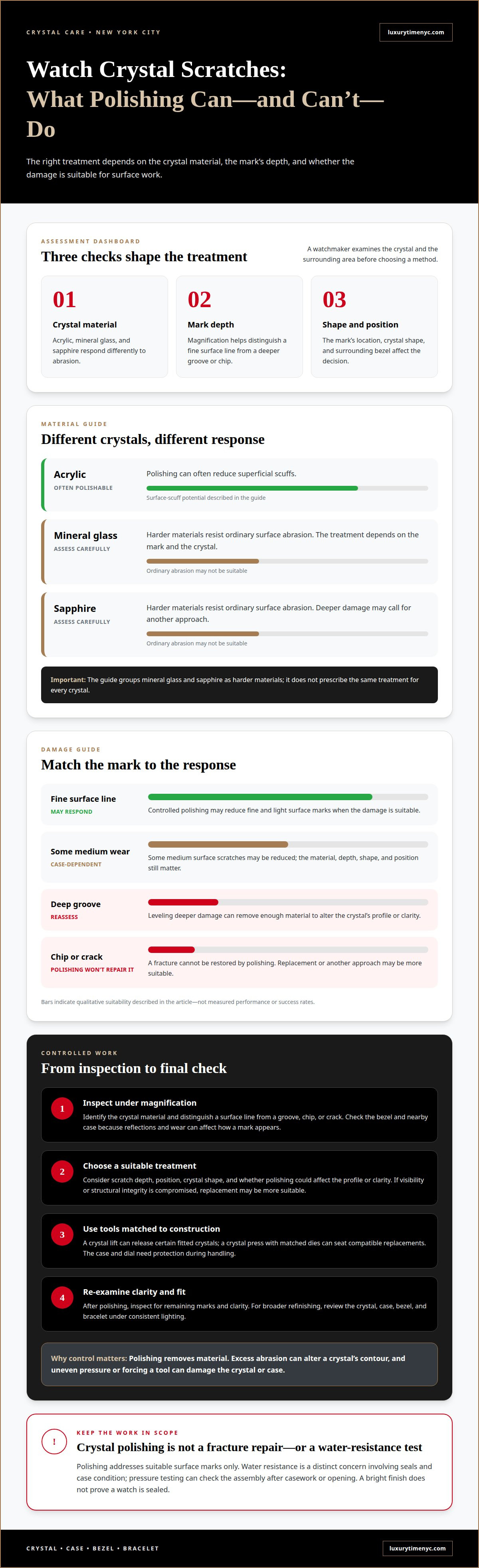
Water resistance is another distinct part of restoration. Case seals and the condition of the case affect how well the watch closes against moisture. After casework or opening, pressure testing can check the assembly. Polishing itself does not restore water resistance, and a bright finish is no evidence of a sealed case. Treating these as separate tasks helps preserve appearance and function. A careful service plan distinguishes surface refinishing, movement work, and water-resistance checks.
Removing fine, light, and medium scratches from glass crystals
Scratch treatment starts by identifying the crystal material and examining the mark. Under magnification, a watchmaker can distinguish a fine surface line from a deeper groove or chip. That distinction matters: polishing removes material, so the treatment must suit both the crystal and the damage. Controlled polishing may reduce a light mark. A crack or edge chip calls for a different decision because polishing cannot restore broken glass.
Plastic crystals need a different approach from mineral glass or sapphire. Acrylic can often be polished to reduce superficial scuffs, while harder materials resist ordinary surface abrasion. Removing enough material to level deeper damage can alter the crystal’s profile or clarity. The technician considers the mark’s depth and position, along with the crystal’s shape. If damage compromises visibility or structural integrity, replacement may be more suitable than continued abrasion.
Crystal removal and insertion require purpose-made tools. A crystal lift can release certain fitted crystals, while a crystal press with matched dies can seat compatible replacements. The watchmaker selects the tool to suit the construction and protects the case and dial during handling. Forcing a die or applying uneven pressure can damage the crystal or case. These tools support controlled work; they don’t make every crystal interchangeable.
Dents and wear around the bezel also affect how a scratch appears. A crystal may look marked when reflections from a worn bezel or case create visual distraction. The inspection therefore considers the full area, not only the line itself. After polishing, the surface is examined again for remaining marks and clarity. If you’re weighing treatment for a watch with crystal and case wear, a careful watch assessment can help clarify the appropriate restoration approach.
Refinishing watch parts, including the crystal
Refinishing considers how each visible component contributes to the watch’s appearance. The crystal frames the dial, while the bezel, case, and bracelet create its surrounding finish. A clean crystal cannot conceal worn metal, and refreshed metal cannot remove a mark from glass. Assess each part separately to determine whether the work involves surface treatment, component replacement, or both.
Case and bracelet finishes may combine polished planes with brushed surfaces. Their edges and transitions are part of the design, not incidental details. Refinishing should follow those existing lines rather than blur them. For example, polishing a satin-finished bracelet link can change how it reflects light beside untouched links. The clasp also deserves attention because its contact surfaces often show wear differently from the case.
The crystal needs its own assessment. Its material, shape, edge, and relationship to the bezel affect the available treatment. Polishing can reduce suitable surface marks, but it removes material and may alter the crystal’s contour. On a shaped crystal, changing an edge can affect how it sits against the case. A damaged or poorly fitting crystal may need replacement rather than further polishing.
A considered process begins by documenting visible wear and identifying the finishes and crystal condition. The watchmaker determines which components need treatment and protects areas that should retain their original texture. If the crystal is removed, handling and refitting are part of the work. If it stays in place, surrounding surfaces still need protection from polishing compounds and tools. Each decision depends on the component’s construction.
Final inspection compares the crystal, case, bezel, and bracelet under consistent lighting. Review the crystal for clarity and remaining marks, and check that the metal retains its intended contrast and contours. A cohesive result does not mean every surface looks newly polished. It means each component has been treated appropriately, guided by the watch’s design and original finish.
Watch polishing service in New York City
In New York City, a sound estimate starts with the crystal’s material, scratch depth, and the requested scope. These factors also shape the service timeline.
Crystal Polishing Costs
There isn’t one cost for every crystal-polishing job. The amount depends on the material, scratch depth, and whether treatment can be done in place. A plastic crystal with surface scuffs presents a different task from a shaped glass crystal with deeper damage. Ask for a proposed scope that distinguishes polishing from removal or replacement.
Polishing Timeframes
The time required depends on the crystal’s condition and the work it needs. Surface polishing differs from a job involving crystal removal, replacement, or inspection of the surrounding case. A watch needing broader exterior refinishing also requires a wider scope than crystal treatment alone. The estimate should describe the steps involved so you understand what affects completion.
Before work begins, ask the NYC watchmaker to identify the crystal material and explain the proposed treatment for its specific scratches. Ask whether the crystal will be removed and how the watch will be inspected after reassembly. These questions clarify the process and distinguish a surface polish from more extensive work.
A precise assessment considers how the crystal sits against the bezel. Polishing a crystal in place requires attention to the surrounding case finish; removal involves handling and refitting. The appropriate route depends on construction and damage, not simply on how visible a mark appears. Request a scope that names the affected component and describes the intended result.
For a watch with crystal marks and exterior wear, arrange a watch polishing assessment to discuss the appropriate scope.
Luxury Time NYC: Watch Polishing
Luxury Time NYC provides watch polishing for collectors considering exterior restoration. In New York’s historic Diamond District, the crystal’s material and scratch depth inform the appropriate approach. Fine surface marks differ from deeper damage, which may need another treatment rather than polishing alone.
Turn to Luxury Time NYC when crystal wear distracts from the dial or forms part of broader exterior wear. An assessment helps clarify whether polishing suits the condition and scope of the work. For Rolex, Patek Philippe, and Audemars Piguet watches, preserving the character of the piece remains central to a considered restoration.
Contact Luxury Time NYC to discuss watch polishing for your timepiece.
Choose a Considered Next Step
Decide what you want the watch to express after restoration. A discreet intervention may suit a timepiece whose age and character matter as much as its finish. For another owner, clearer presentation may be the priority. Being precise about your preference gives the conversation a useful starting point without assuming every mark should disappear.
For watch crystal polishing in NYC, frame the discussion around your watch and the result you value. Describe what draws your attention to the crystal and whether you’re considering work on the wider exterior. That context helps make the next decision deliberate, especially when preservation matters more than a uniform, newly polished appearance.
Discuss the right next step for your watch, and move forward with care and confidence.
Frequently Asked Questions
Where can I get a watch crystal polished in NYC?
Luxury Time NYC offers watch polishing in New York City. For watch crystal polishing in NYC, the assessment should account for the watch model and visible damage. The showroom is in the Diamond District at 15 W 47th St, Suite 302, Third Floor, New York, NY 10036. Describing whether the mark is a scratch, chip, or crack helps clarify the issue under consideration.
Which NYC watch repair shops polish watch crystals?
Luxury Time NYC offers watch polishing in NYC, including assessment of exterior wear. A shop’s general polishing service doesn’t establish that every crystal is suitable for the same treatment. For watch crystal polishing in NYC, the material and damage type matter. Identify the watch model and describe whether the mark is a surface scratch, chip, or crack to help define the work being considered.
Can scratches be polished out of sapphire watch crystals?
Some sapphire crystal scratches can be addressed, but sapphire’s hardness makes polishing a specialized procedure rather than a simple surface buff. The depth and location of the mark matter, especially near an edge or curved profile. A chip or crack differs from a shallow scratch and needs separate consideration. A watchmaker can distinguish surface treatment from crystal replacement.
Can acrylic watch crystals be polished, and how?
Yes, acrylic crystals can often be polished to reduce superficial scuffs. A watchmaker examines the surface, then uses a suitable polishing compound and controlled friction to refine the affected area. Deep grooves may require removing more material, which can change the crystal’s shape. A mark close to a domed edge, for example, requires care to preserve the original profile and fit.
Can mineral glass watch crystals be polished or do they need replacement?
Mineral glass is harder to polish than acrylic, so replacement may be the practical choice for noticeable scratches. The decision depends on scratch depth, crystal shape, and whether polishing would preserve clear visibility. A small surface mark and a deep groove are not equivalent. Inspection helps determine whether treatment or replacement better suits the crystal’s condition.
Does polishing a watch crystal affect water resistance or warranty?
Polishing alone doesn’t establish whether a watch remains water-resistant. If the crystal is removed or the case opened, seals and reassembly become relevant; pressure testing can assess the case’s resistance afterward. Warranty terms vary by watch and issuer, so polishing shouldn’t be assumed to preserve or void coverage. Review the applicable warranty wording before authorizing work that opens the case.


