


A rare watch can be a poor substitute for a stock portfolio. Learning how to invest in watches instead of stocks starts with recognising that a timepiece is a collectible asset, not an equivalent to shares. Its value depends on authenticity, condition, scarcity and buyer demand, and a return is never assured.
It’s easy to be drawn to watches: they offer mechanical craft, history and the pleasure of ownership, alongside the possibility of future value. But that appeal doesn’t remove the risks. A watch may take time to sell, and its market value can shift with collector interest.
This guide explains how watches compare with stocks, what to examine when assessing authenticity and condition, and how limited editions, discontinued models and market timing can influence desirability. It also shows how to approach a purchase with a collector’s discernment, keeping both the watch’s story and its investment potential in view.
Key Takeaways
- Treat a fine watch as a collectible, not a direct substitute for stocks; weigh heritage and demand alongside the risks of resale and uncertain returns.
- Assess authenticity, condition, originality and service history before judging a watch’s value.
- Consider why a limited edition or collaboration may attract collectors, while remembering that rarity alone does not establish lasting demand.
- Track discontinuations and shifts in collector interest to understand how supply and timing can influence desirability.
1. Are watches a better investment than stocks?
Not automatically. Stocks, bonds and ETFs are financial securities; a watch is a physical collectible whose resale depends on its reference, condition, authenticity and demand. Watch ownership is a different strategy, not a dependable replacement for a diversified portfolio.
Brand reputation and history can shape collector interest. The Audemars Piguet Royal Oak was introduced in 1972 as a luxury sports watch in stainless steel. Patek Philippe introduced the Nautilus in 1976, while Cartier created the Santos in 1904 for aviator Alberto Santos-Dumont. Such stories give specific models cultural context, but heritage alone does not establish future resale value.
Rolex, Patek Philippe, Audemars Piguet, and Richard Mille are widely recognized luxury brands often considered by collectors. Resale potential still belongs to individual models and examples, not every watch bearing a prestigious name. Pre-Moon OMEGA Speedmaster references 2915, 2998, and 105.003 are particularly prized; originality and condition matter when assessing one.
Some watchmakers sit within larger groups. Swatch Group acquired Blancpain, Breguet, and Glashütte Original in the 1990s. Group ownership can provide industry context, but it doesn’t by itself predict a model’s future performance.
Watches are generally less liquid than stocks, bonds and ETFs. Selling one means finding a buyer for that specific watch, while its condition and authenticity can affect negotiations and the time it takes to sell.
Investing in watches means choosing a piece for its maker, reference, originality, condition and collector demand, then holding it until a suitable resale opportunity arises. Track asking and completed-sale prices for the same reference, noting condition and included materials, and record your purchase and eventual sale prices.
In the United States, tax treatment depends on the transaction and your circumstances. Keep purchase, repair and sale records, and seek qualified tax guidance for filing. Also account for transaction charges, servicing, insurance, storage and any resale commission, all of which reduce the proceeds you retain.
2. Choosing a trusted seller and authenticating watches
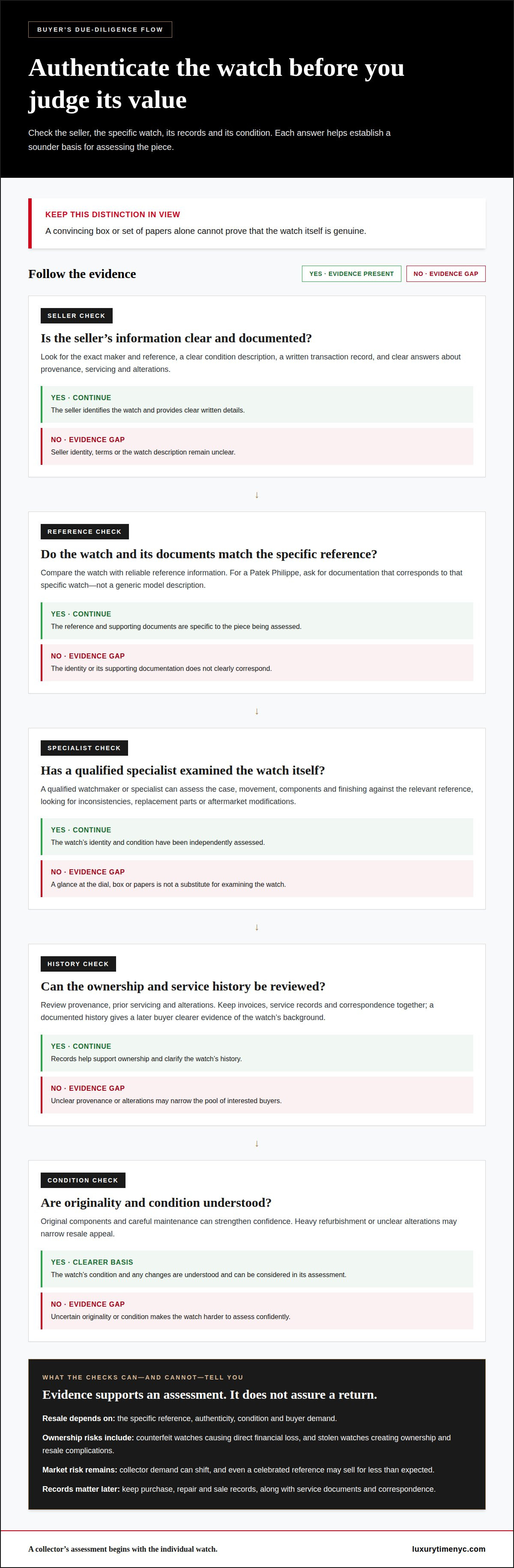
A credible seller should identify the exact maker and reference, describe the condition clearly and provide a written transaction record. For a Patek Philippe, ask for documentation that corresponds to the specific watch, not a generic model description. Clear answers about provenance, prior servicing and alterations help you assess the piece on a sound basis.
Authenticating a watch takes more than a glance at the dial. A qualified specialist examines the case, movement, components and finishing against the relevant reference, looking for inconsistencies, replacement parts or aftermarket modifications. Compare the watch with reliable reference information, and have its identity and condition assessed before purchase. A convincing box or set of papers alone cannot prove that the watch itself is genuine.
Condition, provenance, box and papers can all influence resale appeal. Original components, careful maintenance and a documented ownership history can strengthen confidence, while heavy refurbishment or unclear alterations may narrow the pool of interested buyers. Keeping the original box and papers can help when you resell the watch.
Counterfeits can cause direct financial loss, while stolen watches may create ownership and resale complications. Prices can also move with collector demand, so even a celebrated reference may sell for less than expected. Secure storage and appropriate insurance help address physical risks, but neither removes market volatility.
Before committing, follow a disciplined process: confirm the seller’s identity and written terms, establish the precise reference, review the watch and its records, then arrange an independent examination by a qualified watchmaker or specialist. Keep invoices, service records and correspondence together. These documents support your ownership and give a later buyer clearer evidence of the watch’s history.
3. Limited editions and celebrity collaborations
A limited edition can attract collectors because it is harder to find and acquire. But scarcity is only one part of its value. Buyers also consider the watchmaker’s reputation, the design, the collaboration’s significance and whether interest lasts beyond the initial release. A small production run matters most when collectors genuinely want that particular model.
Celebrity collaborations add another factor: a person’s cultural standing may draw attention, but that attention can fade. Assess the connection between the collaborator and the watch’s design. A meaningful creative role can give a model a clearer story than a name attached chiefly for promotion. Then compare its appeal with the maker’s standard models and other releases.
For a disciplined comparison, record the reference, edition details, release context, condition and recent sale evidence. Separate asking prices from completed sales, since an advertised figure doesn’t prove that a buyer paid that amount. Look for repeated interest across transactions rather than treating a single prominent sale as a reliable measure of lasting demand.
Vintage watches offer a useful contrast. Their appeal may rest on age, design history and surviving examples rather than a recent collaboration or stated production limit. Compare a vintage model’s documented history and condition with the edition’s release story. This helps clarify whether its rarity comes from scarcity, heritage or both.
Before buying, write down why the specific edition may remain desirable after its launch. Consider the maker’s standing, the collaborator’s relevance to collectors, the design’s distinction and evidence of secondary-market demand. If your case rests only on celebrity attention or limited availability, it’s weak. A measured assessment keeps collectability separate from investment judgment.
4. Market timing and discontinuations
A manufacturer’s decision to discontinue a model can focus collector attention. Patek Philippe discontinued the Nautilus 5711 in January 2021. If demand remains strong after production ends, fixed supply may support its appeal. Discontinuation alone, however, doesn’t ensure appreciation; buyer interest still determines whether scarcity translates into resale value.
The Rolex Submariner Hulk, Reference 116610LV, was discontinued in 2020. A status change gives collectors a clear point of reference, but it doesn’t make every example equally desirable. Condition, originality, and demand for that precise reference continue to shape interest. The key is distinguishing a genuine shift in availability from a temporary rise in attention.
Market sentiment can change quickly. The vintage watch market experienced a boom in spring 2020 as people sheltered during the COVID-19 pandemic. That episode shows how circumstances can influence buying interest, but a past surge doesn’t establish a pattern for future prices. A watch’s market can cool even while its heritage remains unchanged.
To assess timing, follow manufacturer announcements and compare them with actual collector activity. Note when production ends, then observe whether interest continues beyond the initial news cycle. Separate completed transactions from asking prices, and compare like-for-like references and condition. A sudden price increase without sustained buyer interest can signal excitement, not durable demand.
Consider your intended holding period and the cost of owning the watch while you wait for a suitable buyer. A discontinued model may still be difficult to sell if its audience is narrow. Don’t treat a launch, celebrity mention or discontinuation announcement as a deadline to buy. Patient assessment is more useful than reacting to headlines.
For a considered view of a specific reference, discuss a watch’s market position.
Luxury Time NYC
Luxury Time NYC can help you consider a fine watch as a collectible, focusing on its maker, reference, condition and market context. Its selection includes Rolex, Patek Philippe, Audemars Piguet and Richard Mille watches, giving collectors established names to explore as they weigh heritage against resale potential.
Turn to Luxury Time NYC when you’re assessing a particular timepiece or deciding whether a model suits your collecting goals. A considered discussion can bring the watch’s defining details into focus, from its identity and condition to the factors that influence collector interest. This perspective supports an informed decision without treating a watch as a guaranteed return or a substitute for financial planning.
For a considered conversation about a luxury watch, contact Luxury Time NYC.
Let Discernment Guide Your Next Acquisition
Deciding how to invest in watches instead of stocks calls for a clear purpose before you acquire a timepiece. Define what would make a watch worth owning for you, how long you’re prepared to hold it and what evidence might change your view. This discipline helps separate enthusiasm for a fine object from assumptions about future returns. No watch guarantees an investment gain.
Luxury Time NYC offers Rolex, Patek Philippe and Audemars Piguet watches for collectors considering a purchase. A thoughtful conversation can help you assess a timepiece in light of its craftsmanship, provenance and place in your collecting plans. Take the next step at your own pace, with the questions that matter to you in hand.
Contact Luxury Time NYC to discuss your next watch acquisition.
Frequently Asked Questions
Are watches a better investment than stocks?
No, watches aren’t inherently better investments than stocks. A watch gives you ownership of a tangible object and the pleasure of wearing or collecting it, while stocks are financial assets with different risks and liquidity. If you’re weighing how to invest in watches instead of stocks, consider whether collecting is an important goal, and don’t rely on a watch’s future resale value to meet financial needs.
Which watch brands and models hold or increase value?
No brand or model reliably increases in value. A strong name can attract attention, but appreciation depends on the specific reference and sustained buyer interest. Assess the individual watch rather than assuming every model from a prestigious maker will perform alike. Compare its identifying details with relevant resale records, and consider whether collectors continue to seek that precise version after the initial excitement fades.
What are typical prices and resale values for investment watches?
There’s no single typical price or resale value for investment watches. The amount depends on the specific reference, condition, completeness and demand when it’s offered for sale. For a realistic estimate, compare completed sales of closely matching watches, not just advertised prices. Account for selling expenses when estimating what you may retain; the final amount can differ from a listing or valuation.
How can I buy investment watches from authorized dealers, auctions, or the secondary market?
Choose a purchase route with clear terms, a precise watch description and documented condition. Dealer listings, auction catalogs and secondary-market offers may differ in the information and transaction terms they provide, so review each carefully before committing. Luxury Time NYC sells luxury watches and sources rare models. Explore its selection if you want to assess a pre-owned piece through a retailer.
How should I authenticate, store, insure, and maintain a valuable watch?
Have the watch authenticated, keep its purchase and service records, store it securely, and discuss appropriate coverage with your insurer. Luxury Time NYC offers watch authentication. For modern watches, manufacturer service intervals are typically every 5-7 years. Service needs depend on the watch and its condition; preserve records of any work, since they help document its care and ownership history.
What fees, taxes, and insurance costs apply when buying and selling watches in the United States?
Transaction charges, servicing, insurance, storage and any resale commission can reduce the proceeds you retain. Tax treatment depends on the transaction and your circumstances; keep purchase, repair and sale records, and seek qualified tax guidance.


