


The Richard Mille RM UP-01 Ferrari is 1.75 millimetres thick, but that measurement alone doesn’t establish that the watch will bend. This Richard Mille RM UP-01 Ferrari review looks beyond its remarkable profile to the case and movement construction behind the design.
A case this slim naturally raises questions about rigidity and handling. A considered Richard Mille RM UP-01 Ferrari review weighs those concerns against the watch’s engineering, rather than judging durability by thickness alone.
Here, you’ll learn how the case and movement are built, what the ultra-thin architecture means for bending concerns, and how the Ferrari partnership shapes the watch’s identity. Richard Mille and Ferrari began their long-term partnership in 2021, and the RM UP-01 project involved more than 6,000 hours of development and laboratory testing. Those details frame the watch as a technical collaboration as much as a display of extreme thinness.
Key Takeaways
- See how the compact case and movement architecture work together, including the details that distinguish this construction.
- Understand what the watch’s stated shock and water resistance mean, and where each measure has limits.
- Assess bending concerns through the design’s engineering, not thickness alone.
- Read the Ferrari partnership as a focused technical collaboration, not simply a name on the dial.
RM UP-01 case and movement construction
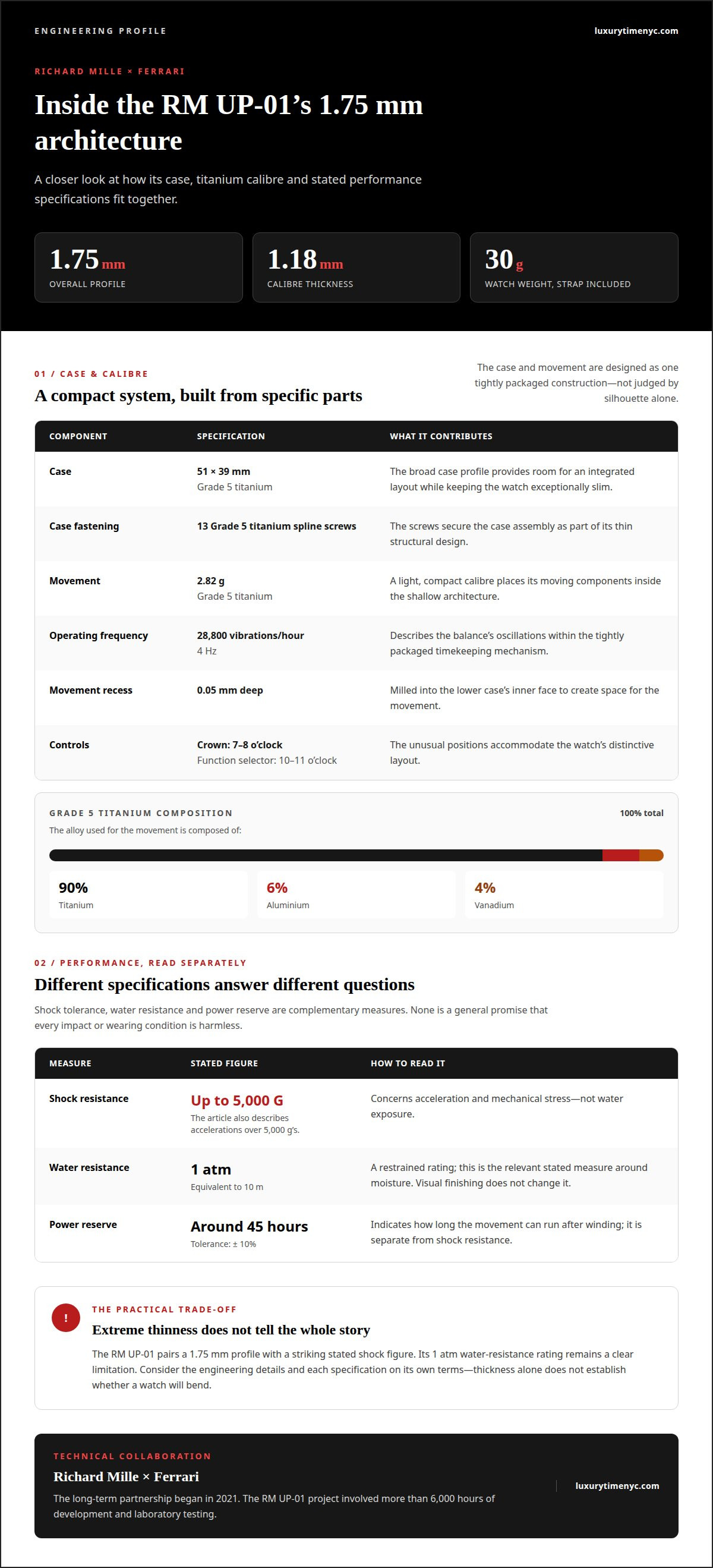
The RM UP-01’s titanium case measures 51mm by 39mm, giving its broad profile room for a highly integrated layout. Thirteen Grade 5 titanium spline screws secure the case assembly. Their count and placement matter: the fastening system holds the structure together while keeping the architecture exceptionally slim. The watch weighs 30 grams, including its strap, so the case and movement must deliver function without relying on substantial mass.
Grade 5 titanium is central to that construction. The alloy contains 90 percent titanium, 6 percent aluminium, and 4 percent vanadium. In the RM UP-01, the movement itself is made from this alloy and weighs 2.82 grams. Its compact footprint helps accommodate the mechanism’s moving components. These specifications show how the design balances a very light movement with a comparatively wide case.
The calibre operates at 28,800 vibrations per hour, or 4 Hz. That frequency describes the balance’s oscillations and places the movement’s timekeeping mechanism within a precise, tightly packaged system. Instead of treating the case and calibre as separate objects, the RM UP-01 integrates their dimensions into one thin construction.
Small details help explain the assembly. A 0.05mm-deep recess is milled into the lower case’s inner face, creating space for the movement. The sapphire crystals provide viewing surfaces for the movement. The winding and time-setting crown sits between 7 and 8 o’clock, an unusual position that accommodates the watch’s layout.
Together, the titanium alloy, spline screws, recessed case interior, and compact calibre form a deliberate engineering system. The Grade 5 construction is not merely a material choice; it connects lightness with structural assembly. For collectors assessing the RM UP-01, those specific details offer a more useful account of its build than its silhouette alone.
Is It a Game Changer?
The strongest case for the RM UP-01 is its unusual combination of thinness and stated shock resistance. Its principal limitation is the modest water-resistance rating, which narrows what that specification alone can support.
Shock and Water Resistance
Shock and water resistance describe different protections: the RM UP-01 calibre can withstand accelerations over 5,000 g’s, while the case is water-resistant to 1 atm (10 m). Both figures matter because they frame the conditions the watch is designed to tolerate, not a general promise of invulnerability.
The water rating is a restrained specification beside the shock figure. Case finishing may be judged visually, but appearance does not change the stated 1 atm rating. For a collector, the distinction is practical: the impressive acceleration figure concerns impact forces, while the water-resistance figure remains the relevant measure around moisture.
Power Reserve and Shock Resistance
Power reserve indicates how long the movement can run after winding; shock resistance describes its ability to withstand acceleration. The RM UP-01 offers around 45 hours of power reserve, with a stated tolerance of ± 10%, alongside a shock tolerance of up to 5,000 G.
These specifications describe different aspects of performance. Power reserve indicates how long the movement can run, while shock resistance concerns its ability to withstand mechanical stress. Neither replaces the other: read them as complementary measures, not as a guarantee that every impact or wearing condition is harmless.
Expert Review Praise and Criticism
The central praise is the technical ambition: the RM UP-01 combines a 1.75-millimetre profile with a calibre stated to tolerate over 5,000 g’s. The main criticism is the trade-off between that extreme construction and the case’s 1 atm water resistance.
That contrast gives the watch a distinctive, demanding brief. Its shock specification is striking, yet water resistance remains limited by its stated rating. The power reserve, around 45 hours with a ± 10% tolerance, adds practical context to the engineering achievement. The fairest assessment weighs these concrete strengths and constraints together, rather than treating thinness alone as proof of performance.
Ultra-thin case and movement design
The RM UP-01’s 1.75-millimetre profile reflects a movement designed around severe spatial constraints. Its architecture also gives the Ferrari collaboration a distinctly technical expression.
Ultra-Thin Mechanical Design
Ultra-thin mechanical design reduces the space occupied by the case, movement, and display while preserving essential functions. In the RM UP-01, the calibre measures 1.18mm thick within a watch measuring 1.75mm overall. That compact arrangement matters because the movement’s components must work inside an exceptionally shallow structure.
The winding system illustrates the challenge. A conventional winding stem with a minimum diameter of 1.5mm was too large for this watch, so the design replaced it. The balance and dial components illustrate the precision involved in fitting a movement into such a shallow case. These details show how each component’s placement and dimensions shape the finished profile.
Ferrari-Developed Design Features
The Ferrari partnership frames the RM UP-01 as a collaboration focused on a highly engineered, ultra-thin watch. Its distinctive layout places the winding and time-setting crown between 7 and 8 o’clock, with the function selector between 10 and 11 o’clock.
Sapphire also serves the design in carefully varied forms. The balance opening’s crystal measures 0.20mm at the centre and 0.30mm at the outer edges. Those specifications, alongside the slim sapphire hour dial, help explain the watch’s precise visual architecture. The project involved more than 6,000 hours of development and laboratory testing. The Ferrari connection is therefore expressed through a technical brief, not merely a name.
Comparisons with Other Ultra-Thin Watches
The Bulgari Octo Finissimo Ultra and Piaget Altiplano Ultimate Concept provide useful reference points for considering the ultra-thin category. The RM UP-01’s defining comparison is its 1.75-millimetre overall thickness combined with its Ferrari collaboration and distinctive display layout.
Its launch price is a separate commercial consideration from this design comparison. Production was limited to 150 pieces; that number describes the edition, not present availability. A specific example’s availability depends on the individual watch offered. The most useful comparison, then, is not thinness alone, but how each model’s architecture and identity shape its appeal to collectors.
Richard Mille and Ferrari collaboration
The Ferrari partnership gives the RM UP-01 a purpose beyond visual association. Its significance lies in how the collaboration frames a technical challenge: expressing a shared interest in performance through an unusually slim mechanical watch.
Richard Mille and Ferrari began their long-term partnership in 2021. The RM UP-01 project then required more than 6,000 hours of development and laboratory testing. Those figures establish the collaboration’s scale, but its meaning is clearest in the watch’s design decisions. The Ferrari name accompanies a concentrated engineering exercise, rather than serving only as a decorative signature.
The arrangement makes the watch’s functions part of its identity. Its winding and time-setting crown sits between 7 and 8 o’clock, while the function selector occupies the opposite side, between 10 and 11. These placements give the case a distinctive visual balance and reflect the demands of an unconventional format. The collaboration is expressed through the complete object, not just a logo.
Material and display choices reinforce that reading. Grade 5 titanium, carefully proportioned sapphire, and an integrated mechanical layout answer the challenge of making an ultra-thin watch coherent. The connection to Ferrari therefore reads as a design brief shaped around precision and performance, not as evidence that the watch reproduces a car component.
For collectors, that distinction clarifies the model’s appeal. The RM UP-01 brings together Richard Mille’s mechanical approach and Ferrari’s performance-led identity, while remaining a watch with its own proportions and functions. Its limited production adds exclusivity, but the more lasting point is the collaboration’s technical ambition. The result is most compelling to collectors who value engineering and partnership as much as recognizable branding.
Explore the RM UP-01’s collector context through the details that define its design and collaboration.
Luxury Time NYC: Richard Mille Watches
Luxury Time NYC offers Richard Mille watches for collectors considering the brand’s distinctive mechanical designs. If the RM UP-01’s proportions, movement, or Ferrari connection have sharpened your interest, the next step is to assess the specific timepiece and its authenticity.
Luxury Time NYC offers watch authentication, as well as Rolex, Patek Philippe, and Audemars Piguet watches. Authentication can help assess a watch’s provenance and originality, alongside a careful review of its condition and design. For collectors comparing Richard Mille models, understanding a watch’s details matters as much as recognizing its name.
Contact Luxury Time NYC to discuss Richard Mille watches or watch authentication.
Choose the Watch That Fits Your Collecting Priorities
A Richard Mille RM UP-01 Ferrari review can clarify the ideas behind this watch, but your own collecting priorities should guide what comes next. Consider whether you value experimental engineering, a strong design identity, or a timepiece that complements the character of your existing collection. That perspective can make a future acquisition feel considered rather than driven by a single headline feature.
Luxury Time NYC offers Richard Mille watches alongside Rolex, Patek Philippe, and Audemars Piguet watches. Comparing these makers can help you identify what matters most to you, from mechanical character and design language to how a watch fits your collection.
For a considered conversation about your next watch, contact Luxury Time NYC. Take the next step at your own pace, with your collecting vision in focus.
Frequently Asked Questions
Is It Going to Bend?
The RM UP-01’s slim profile does not, by itself, mean the case will bend during normal handling. Its construction is engineered around an exceptionally thin case and movement, but no bending tolerance is provided here. Treat it as a precision mechanical watch: avoid flexing the case, applying concentrated pressure, or using the thin profile as a reason to test its limits.
What Makes It “Ferrari”?
“Ferrari” identifies the RM UP-01’s collaboration, not a watch component made by the carmaker. Richard Mille and Ferrari began their partnership in 2021, and the project involved more than 6,000 hours of development and laboratory testing. The connection is visible in the watch’s performance-focused design language and unusual functional layout, giving the partnership a technical dimension beyond the name.
What are the Richard Mille RM UP-01 Ferrari’s key specifications and dimensions?
The case measures 51mm by 39mm, and the watch weighs 30 grams including its strap. Its movement measures 41.45 by 28.85mm, contains 23 jewels, and runs at 28,800 vibrations per hour, or 4 Hz. Grade 5 titanium forms the movement, while 13 titanium spline screws secure the case. These figures help distinguish the watch’s broad footprint from its exceptionally slim profile.
How thin and light is the RM UP-01 Ferrari?
The watch is 1.75mm thick and weighs 30 grams with its strap. Those two figures describe different aspects of wearing the watch: thickness gives its profile, while total weight indicates its lightness on the wrist. Its 51mm by 39mm case dimensions also matter, since a very slim watch can still have a broad presence across the wrist.
What movement does the RM UP-01 Ferrari use, and what is its power reserve?
The RM UP-01 Ferrari uses a manually wound mechanical movement, with a power reserve of around 45 hours and a stated tolerance of ±10%. That reserve describes approximate running time after winding, not a fixed guarantee for every circumstance. Its 4 Hz operating frequency and 23 jewels provide further context for collectors assessing the movement’s construction and daily winding requirements.
What should buyers know about servicing, durability, and water resistance?
The RM UP-01 Ferrari is water-resistant to 1 atm (10 m), so its rating should not be treated as broad protection from water exposure. Its calibre can withstand accelerations over 5,000 g, but that figure does not remove the need for careful handling or servicing. For maintenance, a movement overhaul addresses the mechanism; pressure testing evaluates water resistance, while authentication helps assess a watch’s identity.


