


What if the best way to negotiate a watch price is to say less and know more? If you’re wondering how to haggle at a diamond district watch store, start with the details that affect the specific watch: its reference, configuration, condition, and current market context. A posted price may leave room for discussion, but a credible offer is based on evidence, not a guess or a hard sell.
In New York’s Diamond District, a measured conversation can help you assess the watch and the value behind its asking price. Prepare relevant comparisons, ask focused questions about authenticity and condition, and make a calm counteroffer you can explain.
Before deciding, consider the full transaction, including documentation, payment terms, and applicable charges. Whether you’re considering a Rolex, Patek Philippe, Audemars Piguet, Richard Mille, or Cartier, proceed only when the watch’s value, authenticity, condition, and terms align with your priorities.
Key Takeaways
- Learn how to haggle at a diamond district watch store by discussing the specific timepiece rather than asking for a blanket discount.
- Use comparable listings as context, accounting for differences in reference, configuration, and condition.
- Weigh originality, completeness, and service documentation before deciding whether an offer represents value.
- Follow a composed negotiation sequence: inspect, ask focused questions, make a reasoned offer, and consider the response.
- Base your decision on the full picture: value, authenticity, condition, and transaction terms. Walking away is sensible when they don’t align.
How to Haggle at a Diamond District Watch Store Without Making It Adversarial
Negotiating over a high-value watch can feel unfamiliar, even if you’re an experienced shopper. A polished display and a confident asking price can make it hard to know where to begin. The answer to how to haggle at a diamond district watch store isn’t to push for a standard discount. It’s to discuss the particular watch in front of you and explain the reasons behind your offer.
The Diamond District, New York City is a distinctive setting for a watch conversation, but assumptions about the neighborhood won’t tell you whether a particular price is fair. The watch’s reference, condition, completeness, and market context matter more than an arbitrary percentage. Focused, courteous questions can clarify the details you need. Pressure tactics can distract from the real decision: whether the watch suits you at the terms offered.
What does haggling mean in a luxury watch store?
Haggling is a good-faith discussion of value and terms. It isn’t a demand for a discount, and it doesn’t guarantee the asking price will change. Flexibility depends on the particular watch and transaction. Start by asking about the timepiece and explaining what you’ve observed, then give the seller room to respond.
Keep separate parts of the transaction clear. The watch’s price is one discussion. A trade-in, service considerations, and payment terms are separate questions that can affect your overall decision. If you’re considering a trade, ask for its value independently so it doesn’t obscure the price of the watch you’re buying. That makes it easier to assess each part on its own.
What should you decide before opening the conversation?
Set a private maximum before negotiating. Base it on your budget and market information for the exact reference and condition, not a broad brand average or the most optimistic listing you find. Online asking prices provide context, but they don’t show what a comparable watch actually sold for. The The Essential Guide to Buying a Rolex in NYC can also help you clarify your priorities before an in-person conversation.
- Separate preference from evidence. A watch’s design or personal significance may make it especially appealing, but neither replaces an assessment of its condition and market context.
- Decide what matters most. Consider originality, completeness, documented service, and confidence in authenticity. A lower price may not make up for unanswered concerns.
- Set your boundary in advance. Decide what terms would make you comfortable proceeding, and be ready to pause if the discussion doesn’t meet them.
Arrive ready to listen as well as explain. A calm offer tied to a specific observation gives the seller something concrete to address. If the response doesn’t meet your expectations, ask a focused follow-up or take time to consider it. The aim isn’t to win an exchange. It’s to make a considered decision while keeping the conversation respectful.
Build a Defensible Offer Using Comparable Watches and the Exact Reference
A comparison is useful only if it describes a genuinely similar watch. Start with the exact reference, then note the configuration, including year, dial, materials, and original components where known. Watches from the same manufacturer can differ substantially in desirability and condition. A broad search for a brand name alone won’t give you a sound basis for an offer.
Compare condition and completeness, too. Look at visible wear, originality, service history, and provenance where available. Photographs can narrow your research, but they may not show every detail that affects an in-person assessment. Note whether each example includes its box, papers, accessories, or documented service. Differences in components or service history can make two watches poor comparisons, even when their references and dials appear similar.
Which details make a watch comparison genuinely comparable?
Keep a concise record for each relevant example: source, date checked, reference, known year, configuration, stated condition, service information, and included items. Mark details as unknown instead of filling gaps with assumptions. This makes it easier to see what matches and to explain why a particular listing informs your offer.
- Match the watch itself. Confirm the brand, reference, year where known, dial, materials, and configuration.
- Compare its history and state. Record condition, originality, provenance, and any documented service.
- Account for completeness. Note whether the box, papers, and accessories are included. Their presence alone doesn’t prove condition or authenticity.
How should you use online asking prices?
Use several current listings to understand the asking-price landscape, not to insist that a seller match one. An advertised figure reflects what a seller is seeking; it doesn’t establish what a buyer paid or what another watch is worth. If reliable confirmed-sale information is available, keep it separate from active listings and record its source and date. Market figures and platform data change, so compare them with the exact reference, condition, and date before relying on them.
For example, one listing may match the reference but provide little service information, while another includes documentation and has a different configuration. Don’t treat their prices as interchangeable. Identify what differs and use the closest comparison to frame a measured question: “I found examples with this reference, but the condition and included items vary. Could you help me understand how those differences are reflected in this watch’s asking price?” Specificity invites a useful answer. A screenshot without context usually doesn’t.
That preparation can make how to haggle at a diamond district watch store a more evidence-led conversation. For a wider view of the neighborhood and its watch-shopping context, see Navigating 47th Street. You can also explore Luxury Time NYC’s watch collection.
Assess the Watch’s Condition and Terms Before Discussing Your Counteroffer
The lowest figure isn’t automatically the strongest purchase. A watch with visible wear, altered or replaced components, incomplete accessories, or an unclear service history may not compare fairly with a more complete example. Before making a counteroffer, understand what the asking price represents and whether the watch’s condition and transaction terms fit your priorities.
Keep due diligence separate from bargaining. Questions about authenticity and condition help you establish what you’re considering. Once you understand the watch, decide whether a verified difference gives you a reason to discuss price. This keeps an unresolved concern from being mistaken for a simple request for a discount.
How do condition and documentation shape the discussion?
Inspect the watch calmly and ask for clear explanations of visible wear, replaced parts, and known service history. If documentation is missing, treat that as a question to clarify, not automatic evidence of a problem. Ask what records accompany the watch and what they establish. Authentication and service information answer different questions: authenticity concerns what the watch is, while service records describe known maintenance.
Consider originality and completeness separately. A watch can be authentic while including non-original components, or it may be offered without its box and papers. Don’t assume either detail. Note what is present, what is documented, and what remains unknown. If a particular detail matters to you, clarify it before using the watch as the basis for an offer.
Which terms deserve attention beyond the headline figure?
Compare the full transaction, not just the displayed price. Clarify which accessories are included and what any applicable warranty or authenticity guarantee covers. Ask for those terms in writing. Luxury Time NYC provides a certified authenticity guarantee. Read the specific written terms attached to your purchase so you understand what the guarantee covers.
- Final amount: Confirm applicable taxes and any disclosed payment-related charges before completing the transaction.
- Payment and delivery: Understand the accepted payment method, how the watch will be delivered or collected, and when it will be released to you.
- Returns or other protections: Review the written terms that apply rather than assuming different arrangements are equivalent.
These details can change how two offers compare, even when their headline figures are close. A documented authenticity commitment, clear transaction terms, and confidence in the watch itself matter alongside the negotiated amount. For broader transaction context, the luxury watch buying and selling guide offers related perspective.
Decide whether to make a counteroffer only after you understand the watch and the terms. When learning how to haggle at a diamond district watch store, follow this order: clarify first, assess second, negotiate third. If an answer is unclear, pause and seek clarification before committing. A composed decision is stronger than a rushed agreement based on one figure.
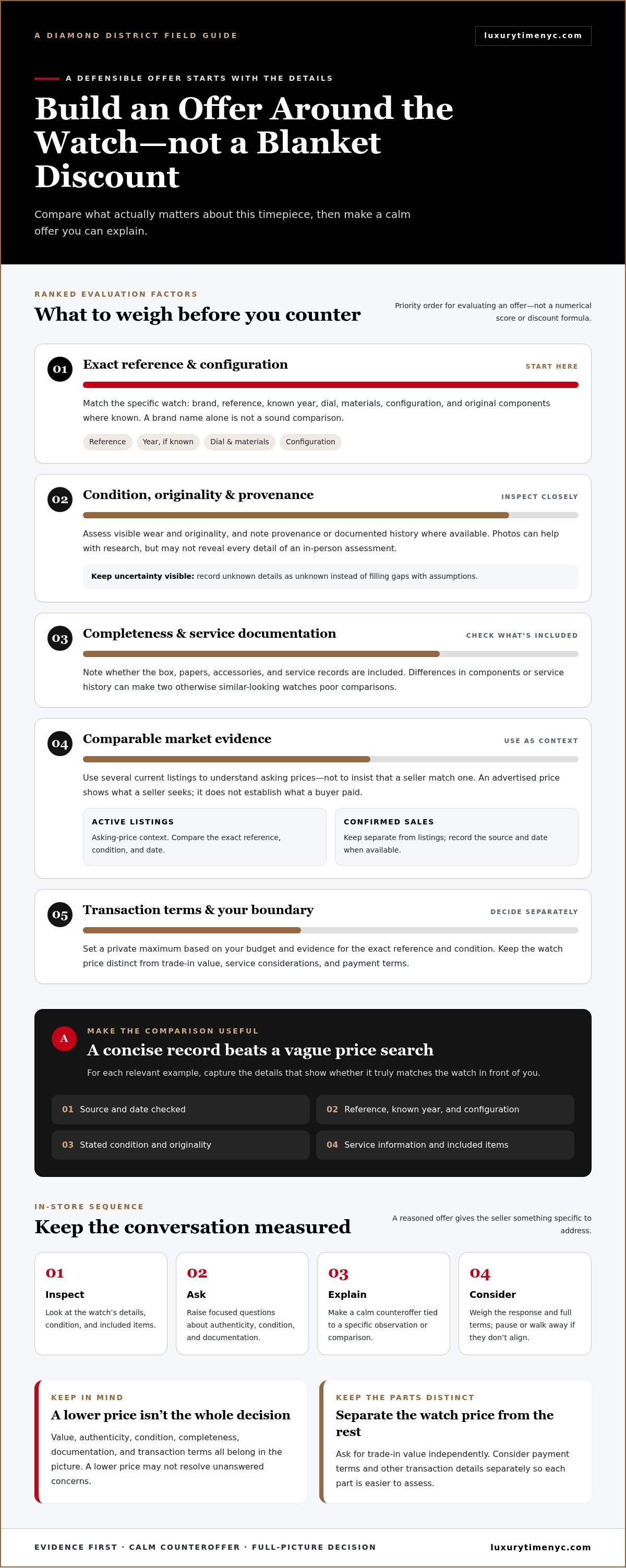
Use a Respectful, Step-by-Step Negotiation Script in the Store
A prepared conversation follows a simple sequence: inspect the watch, ask focused questions, make a reasoned offer, listen to the response, and decide without rushing. This is the practical heart of how to haggle at a diamond district watch store. You’re not trying to force agreement. You’re establishing whether the specific watch and its terms meet your expectations.
Keep your notes and comparable examples available, but let the timepiece lead the discussion. In a showroom conversation about an authenticated watch, attentive questions can clarify details a listing can’t show. Ask one question at a time, listen to the answer, and separate factual concerns from personal preferences. A strong request relates directly to the watch and has a clear reason behind it.
- Inspect. Look over the watch and note any condition details you want to understand.
- Ask. Clarify the reference, included items, known service history, and any other details that affect your assessment.
- Offer. State your proposed figure and briefly connect it to relevant comparisons or confirmed details.
- Listen. Give the seller room to explain the asking price or respond with different terms.
- Decide. Consider the complete offer, then accept, ask a focused follow-up, or take time to think.
What can you say when making your first offer?
Keep your language courteous and specific: “I’m interested in this reference. Could you discuss the figure based on these comparisons?” If you have a relevant observation, add it plainly: “I noticed this example differs in condition from the listings I reviewed. Would that be reflected in your asking price?” Don’t overstate what your research proves. Then pause and let the seller respond fully.
A pause gives the other person room to explain the watch’s condition, completeness, or market position. Resist the urge to fill the silence with a second offer or an unsupported claim. The goal is a clear exchange, not a performance.
How should you respond to a counteroffer?
Ask what informs the counteroffer: “Could you walk me through how the watch’s condition, included items, or service history factor into that figure?” If the price remains apart from your assessment, consider whether clarified terms change the overall value. You might say, “Thank you, I understand your position. I’ll take a moment to consider whether it fits my priorities.” This keeps the conversation courteous without implying agreement.
Keep price and trade-in discussions distinct. If a trade is relevant, ask for its value separately so you can assess both sides clearly. Confidence in authenticity and the seller’s knowledge also contribute to your decision alongside the negotiated figure. You can explore Luxury Time NYC’s authenticated watch selection.
Complete the Purchase with Confidence, or Walk Away Gracefully
A sound purchase rests on more than a negotiated figure. Before agreeing, consider whether the watch’s value, condition, authenticity, and written terms align with your priorities. If an important detail remains unclear or the terms don’t support your assessment, declining the deal is a valid outcome. A respectful conversation doesn’t obligate you to buy.
This is the final measure of how to haggle at a diamond district watch store: can you proceed with confidence, knowing what you’re buying and what the agreement includes? A decision made calmly is stronger than one made under pressure. Take the time you need to review the details.
What final checks belong before you agree?
Before payment, compare the transaction documents with the watch and your agreement. Look for the precise reference, the stated condition, and a clear record of included items. Review the agreed figure and applicable terms, including taxes or payment-related charges, before completing the purchase. Keep copies of the documents and records provided with the watch.
- Match the paperwork to the timepiece. Confirm that the reference and condition description correspond to the watch you inspected.
- Confirm what accompanies it. Make sure the listed accessories and documentation are included as agreed.
- Review the final terms. Read the written transaction details before payment and retain the records afterward.
These checks aren’t a sign of distrust. They’re part of a considered purchase. If a document differs from what you discussed, pause and ask for the discrepancy to be clarified before proceeding. A clear record supports the understanding reached by both parties.
How can Luxury Time NYC support a considered purchase?
Luxury Time NYC is an independent New York luxury-watch dealer established in 2005, with a Diamond District showroom and a certified authenticity guarantee. The company buys, sells, and trades luxury watches, so a trade-in can be handled as a separate part of your decision. Authentication and clear transaction terms matter alongside the watch’s condition and final price.
A well-negotiated purchase should feel considered, not extracted. If the evidence and terms align, proceed with confidence. If they don’t, thank the seller and leave the door open to reconsider. The right decision is one you can stand behind after the conversation ends.
To explore authenticated watches or arrange a showroom visit by appointment, visit Luxury Time NYC.
Let Your Next Watch Purchase Reflect Your Standards
The most rewarding purchase is one you can appreciate long after the negotiation ends. Let the conversation clarify what matters to you as a collector, whether that’s a particular reference, a meaningful addition to your collection, or confidence in a well-considered decision. Understanding how to haggle at a diamond district watch store is ultimately about preserving that confidence, not securing a concession at any cost.
There’s no need to force a decision. Take time to explore, compare, and choose a timepiece that feels right on its own merits. The next step may simply be a closer look at a watch that has caught your interest.
Explore Luxury Time NYC’s authenticated luxury watches, and approach your next conversation with quiet confidence.
Frequently Asked Questions
Is it normal to negotiate at a Diamond District watch store?
It’s reasonable to ask whether there’s flexibility, but negotiation isn’t assured. Each seller sets terms according to the particular watch and sale. A courteous question is enough to open the discussion: “Is there room to discuss the asking price?” If the answer is no, you can still clarify what’s included or take time to decide. A professional conversation doesn’t require either side to agree.
How much below the asking price should I offer for a watch?
There’s no reliable standard percentage for a first offer. The right figure depends on the exact watch, its condition, current market evidence, and your own limit. Rather than choosing an arbitrary reduction, decide what the watch is worth to you after researching comparable examples. Then make an offer you can explain. If your evidence is limited or the examples differ substantially, keep the offer measured and invite discussion.
Can I negotiate the price of a pre-owned Rolex?
You can ask, but a seller may accept, decline, or make a counteroffer. With a pre-owned Rolex, don’t rely on the brand name alone: a different reference, configuration, or condition can change how useful a comparison is. For example, a watch with documented service may not be directly comparable to one with no service information. Keep your request specific, and don’t treat a discount as a substitute for confidence in the watch.
Should I bring comparable watch listings to a store?
Yes, a small, well-organized set can make your reasoning easier to follow. Save the page or note the source and date, then mark the details that match or differ from the watch you’re considering. If a listing has disappeared, don’t present it as proof of a completed sale. Use comparisons to frame a question, not as an ultimatum or a claim that another seller’s terms must apply.
Can I negotiate a watch purchase and trade-in together?
You can discuss both in one visit, but ask for the purchase figure and trade-in valuation separately. That lets you see how each part contributes to the overall amount due instead of judging the transaction as one unexplained number. Share the trade-in’s reference and condition accurately, and review how its value is applied. If you’re unsure about trading, assess the watch purchase on its own first.
What should I do if the seller will not negotiate?
Accept the answer without escalating. You can clarify what documentation or accessories accompany the watch, then decide whether the full offer suits you. If it doesn’t, thank the seller and leave without committing. A firm price isn’t automatically unreasonable, just as a lower price isn’t automatically good value. You can reconsider later if the watch remains available and your assessment hasn’t changed.
Does paying in cash guarantee a better price on a luxury watch?
No. Cash doesn’t guarantee a lower price, and payment preferences vary by seller and transaction. Before deciding how to pay, ask for the complete amount due and clarify any payment-related terms. In New York, credit-card surcharges must be disclosed as part of the total price before the transaction is completed; debit and prepaid cards can’t be surcharged. Choose a payment method you’re comfortable using, not one based on an assumed discount.


