


A stopped luxury watch is a reason to pause, not to force it back to life. If you’re deciding what to do with a broken luxury watch, avoid repeated winding or operating the crown, especially after an impact or possible water exposure. Further handling could worsen a fault that a careful diagnosis might otherwise contain.
It’s natural to worry about more than the immediate problem. Repair can affect originality, condition, and provenance, while running a watch with a fault may put its movement at further risk. First protect the timepiece, then use its symptoms to guide your next step.
This guide explains how to respond to common signs of trouble, what to record before an assessment, and how to weigh repair choices in light of the watch’s history. Luxury Time NYC, an independent luxury-watch retailer in New York’s historic Diamond District, provides professional repair, including movement overhauls, polishing, and pressure testing. The right path begins with restraint, not assumption.
Key Takeaways
- When deciding what to do with a broken luxury watch, stop using it, note what happened, and protect it from further exposure or handling.
- Treat symptoms such as stopped running, inaccurate timekeeping, or difficulty winding as clues for inspection, not as a definitive diagnosis.
- Compare repair plans by diagnosis, proposed work, parts, documentation, and how well they align with your preservation priorities.
- Prepare the watch’s identifying details, symptom history, relevant events, and service records to support an informed assessment.
- Let the confirmed fault guide the repair scope. A stopped watch does not automatically need the same work as another damaged timepiece.
What to Do First When a Luxury Watch Breaks
A stopped or damaged watch needs a careful assessment, not an immediate assumption about the cause. A stalled movement, recent impact, and moisture beneath the crystal call for different responses. Until the watch has been examined, restraint is the best way to protect its condition.
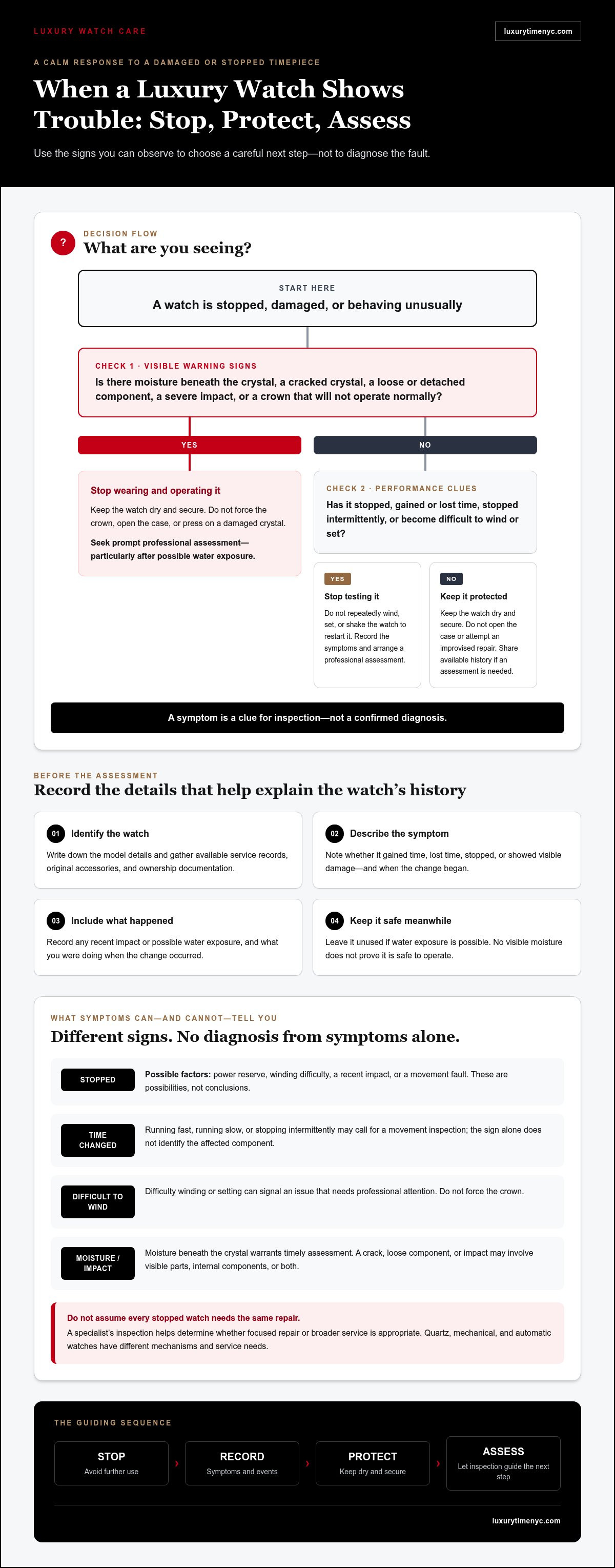
Stop wearing or operating the watch, protect it, and arrange a professional assessment.
Follow this sequence:
- 1. Stop use. Don’t wear, wind, set, or repeatedly test the watch if it has been struck, exposed to water, or is behaving unusually.
- 2. Note what happened. Record when the problem began and any recent impact, water exposure, or change in performance.
- 3. Protect the watch. Keep it dry and secure, away from unnecessary handling. Don’t open the case or attempt an improvised repair.
- 4. Arrange an assessment. Share your observations and available service history so a specialist can inspect the watch and determine the next step.
Which symptoms mean you should stop wearing the watch?
Stop wearing it if you see moisture beneath the crystal, a cracked crystal, a detached or loose component, or signs of a severe impact. A crown that won’t operate normally is another reason not to force it. These signs don’t confirm a specific fault, but continued wear or operation could expose a compromised watch to further harm. Seek prompt professional assessment, particularly after possible water exposure.
How should you protect and document a broken watch?
Keep the watch dry and secure. Don’t open the case, press on a damaged crystal, or try to correct the problem by repeatedly winding or setting it. If water exposure is possible, leave the watch unused and describe the circumstances during the assessment. No visible moisture doesn’t prove that the watch is safe to operate.
Write down the model details, exact symptoms, when they began, and whether the watch gained time, lost time, stopped, or sustained visible damage. Include what you were doing when the change occurred. Gather available service records, original accessories, and ownership documentation. These details can help establish the watch’s history and inform repair discussions.
A professional Watchmaker works with the mechanisms and construction that make a fine timepiece function. Luxury Time NYC provides professional repair, including movement overhauls and pressure testing. An assessment helps clarify what the watch needs before work is considered.
What Common Luxury-Watch Problems May Indicate
A watch’s behavior offers useful clues, but symptoms alone can’t establish what has failed. A stopped watch may have a different explanation from one that loses time or resists setting. Inspection helps distinguish a minor issue from a fault that needs more extensive work.
A symptom is a clue to investigate, not a confirmed diagnosis.
Why has a mechanical or automatic watch stopped?
Power reserve may be relevant if a watch stops after it hasn’t been worn or wound. Winding difficulty, a recent impact, or a movement fault may also be factors. These are possibilities, not conclusions. Don’t force the crown or repeatedly shake the watch to restart it. Those actions may add stress without revealing the cause. A specialist can assess the movement and determine whether a focused repair or broader service is appropriate.
What can timekeeping changes or difficult winding suggest?
A mechanical watch that runs fast, runs slow, or stops intermittently may need a movement inspection. Difficulty winding or setting can also signal an issue that needs professional attention, but it doesn’t identify the affected component. Quartz watches have different mechanisms and service needs from mechanical or automatic watches, so the watch type matters when symptoms are assessed.
A movement overhaul is a comprehensive service in which the movement is examined and serviced to address its condition and operation. It isn’t automatically the right response to every malfunction. Read more about what a movement overhaul involves to understand the scope of this work.
What do moisture, impact, or visible damage suggest?
Moisture beneath the crystal warrants timely assessment, even if the watch continues to run. A cracked crystal, loose component, or impact may involve visible parts, internal components, or both. The outward sign alone can’t establish the full extent of the damage. Avoid operating a watch after suspected water exposure or a hard impact until it has been assessed.
Pressure testing assesses a watch’s water resistance under test conditions. On its own, it doesn’t establish that every repair is complete or every possible issue has been addressed. Repair discussions also benefit from distinguishing between preserving original condition and restoring function. The National Archives’ discussion of preservation vs. restoration concerns film, but the distinction offers a useful way to frame priorities: maintenance and restoration aren’t always the same objective.
If symptoms point to a movement concern, explore professional luxury-watch repair. The appropriate scope starts with the watch’s condition, not an assumption that every stopped timepiece needs the same work.
How to Compare Repair Options Without Overlooking Preservation
Once an assessment identifies the likely fault, consider how the repair should be approached. Manufacturer service and independent specialist repair are distinct routes, not a universal ranking. The right choice depends on the watch, its condition, the proposed work, and your priorities for originality and documentation.
Compare repair plans using the same points:
- Diagnosis: What inspection findings support the recommendation?
- Proposed work: Which tasks are essential to address the identified issue, and which are optional?
- Parts: What parts are proposed, and how will changes be recorded?
- Documentation: What service details will be included in the watch’s repair history?
- Preservation priorities: How does the plan address your preferences for original components, finish, and long-term ownership?
These questions keep the decision specific to the watch instead of relying on broad claims about a particular service route. The Horological Society of New York offers educational resources on horology, the study and practice of watchmaking. A considered repair discussion should likewise make the proposed work and its purpose clear.
When might a focused repair differ from a movement overhaul?
The assessment findings determine whether the recommended work is focused or broader in scope. A movement overhaul addresses the internal movement, polishing treats exterior surfaces, and pressure testing evaluates water resistance. These services have different purposes and aren’t substitutes for one another. Before authorizing work, understand what each task is intended to address and whether it relates to the reported problem.
Cosmetic work deserves particular consideration on a collectible watch. Polishing may alter the appearance of exterior surfaces, so don’t assume it is necessary just because the watch is being repaired. Ask for the repair plan to distinguish functional work from optional refinishing.
How can a repair plan respect originality and provenance?
Collectors may value original condition and a clear service history, but no repair can guarantee a particular effect on value. Discuss your priorities before work begins. Where applicable, have the proposed work and parts recorded in the service documentation, then retain those records with the watch’s history. This creates a clearer account of what was done without promising that every component can remain unchanged.
If you’re weighing luxury watch repair in NYC, Luxury Time NYC provides repair and maintenance for established luxury-watch brands, including movement overhauls, polishing, and pressure testing. The question of what to do with a broken luxury watch isn’t simply how to restore operation. It’s which work best fits the watch’s condition and your preservation priorities.
How to Prepare for a Luxury-Watch Repair Assessment
A useful assessment starts with a clear account of the watch’s history and the change you’ve observed. You don’t need to identify the fault yourself. Precise details help separate what you’ve seen from what still needs inspection, giving the repair discussion a practical starting point.
What information should you bring to an assessment?
Gather what you have, even if some details are incomplete. Note the brand, model or reference details, purchase history, and previous service records. Describe when the problem began, what the watch was doing, and any recent impact, possible moisture exposure, or change in performance. Relevant accessories or ownership documents can help establish its history.
- Watch details: Brand, model, and reference information, if available.
- Symptoms: What changed, when it began, and whether it has continued or varied.
- Recent events: Any impact, water exposure, or other circumstance that may be relevant.
- History: Service records, purchase documentation, and relevant accessories.
Be specific rather than interpretive. “It stopped after a knock” is more useful than assuming the impact damaged the movement. If you’re deciding what to do with a broken luxury watch, this distinction helps keep the assessment grounded in observation.
What should a clear repair recommendation explain?
A useful recommendation should identify the observed issue, outline the proposed work, and explain whether further inspection could change its scope. Ask for clarity on parts and documentation, and state your desired outcome, such as restoring function while limiting unnecessary cosmetic work. Functional service and polishing address different needs, so discuss cosmetic work separately. If water resistance is relevant, pressure testing can assess it as part of the repair conversation.
Luxury Time NYC serves clients from its showroom in New York’s historic Diamond District and provides professional repair for established luxury-watch brands, including movement overhauls, polishing, and pressure testing. Bringing your notes and service history helps focus the discussion on the watch’s condition and your priorities.
Explore Luxury Time NYC’s watch repair services and prepare the details that will make your assessment more considered.
Choosing the Next Step for a Broken Luxury Watch
The next step depends on the warning signs and what an assessment reveals. Leave a watch unworn and unused if it has visible moisture, impact damage, loose components, or abnormal crown operation. If symptoms are less dramatic but persist or interfere with normal function, arrange an assessment rather than assuming the issue will resolve on its own.
Should you repair, continue wearing, or leave the watch untouched?
Use a simple decision path: urgent damage means stop use; unclear or persistent symptoms mean seek an assessment; confirmed findings help define the repair scope. A watch that has stopped doesn’t automatically need a complete movement overhaul. Depending on the cause and condition, it may need a focused repair, broader movement service, or another considered response. Repair can be a way to care for a fine timepiece, but it isn’t automatically the right ownership decision in every circumstance.
Until the watch has been assessed, avoid wearing or operating it if damage is visible or its behavior is abnormal. Record the symptoms and relevant events, then discuss the findings and proposed work before authorizing service. This keeps decisions tied to the watch’s actual condition rather than a general assumption about what a luxury watch needs.
How can Luxury Time NYC help with a repair decision?
Luxury Time NYC provides professional watch repair and maintenance in New York’s historic Diamond District, with specialist knowledge of established luxury brands. The appropriate service depends on the assessment: movement overhauls address internal movement needs, polishing addresses exterior surfaces, and pressure testing assesses water resistance. Each service has a distinct purpose, so the repair plan should match the watch’s condition and your priorities.
For owners considering what to do with a broken luxury watch, an assessment offers a sounder basis for deciding than continued use or an automatic overhaul. Discuss the symptoms, service history, desired outcome, and proposed scope before proceeding.
Protect its condition. Document its history. Choose the repair path with care. Arrange a conversation about your luxury watch.
Make Your Next Repair Decision with Confidence
Knowing what to do with a broken luxury watch begins with restraint. Stop using it if there’s visible damage or possible moisture, record what happened, and let an assessment distinguish symptoms from confirmed faults. The repair should follow the findings, not an assumption that every stopped watch needs a complete overhaul.
Keep preservation in the conversation. Clarify the proposed work, parts, and documentation, and be specific about whether your priority is restoring function, retaining original condition, or limiting cosmetic work. A considered repair can be a practical way to care for a fine timepiece, though the right decision depends on its condition and history.
Founded in 2005, Luxury Time NYC is an independent luxury-watch dealer with a showroom in New York’s historic Diamond District. Its professional repair services include movement overhauls, polishing, and pressure testing. Explore professional luxury watch repair at Luxury Time NYC and take the next step with a clearer understanding of your watch’s needs.
Frequently Asked Questions
Is it safe to keep wearing a luxury watch that has stopped?
Usually, stop wearing it until the cause is understood. A stopped watch doesn’t automatically have a serious fault, but continued operation may expose a compromised timepiece to additional stress. Be especially cautious after an impact or if you notice moisture, a damaged crystal, or unusual resistance when operating the crown. If you’re deciding what to do with a broken luxury watch, arrange an assessment before returning it to normal use.
What should I do if water gets inside my luxury watch?
Stop wearing or operating the watch and arrange a prompt professional assessment. Don’t open the case or try to dry it with heat, as improvised handling may create further risk. A watch that continues to keep time may still need inspection; running normally doesn’t establish that moisture hasn’t affected internal components. The appropriate assessment and service depend on the watch and the extent of its exposure.
Can I wind a luxury watch that is not running?
Don’t force the crown or continue winding if it feels rough, unusually resistant, or damaged. A stopped watch can have several possible causes, and winding won’t identify which one applies. Note when the watch stopped and what you felt as you operated the crown, then leave it unused until it has been assessed. This gives a professional useful information without subjecting the mechanism to repeated attempts.
How do I know whether my luxury watch needs a movement overhaul?
A movement overhaul should follow a professional assessment, not be assumed from a single symptom. Stopping, inconsistent timekeeping, and difficulty winding can each have different explanations. Inspection helps establish the fault and appropriate scope of work. Ask for a clear account of the observed condition, what the proposed overhaul includes, and how each part of the service relates to the watch’s needs.
Should I polish a scratched luxury watch during repair?
Not necessarily. Polishing addresses exterior surfaces. It’s distinct from servicing a movement or assessing water resistance. Collectors may value a watch’s original condition, so whether to polish depends on the timepiece and your priorities. Discuss proposed cosmetic work before authorizing it, including what it is intended to address. A scratch alone doesn’t mean polishing is essential to resolve a functional fault.
Does a broken luxury watch lose its value?
A fault alone doesn’t determine a watch’s market value. Brand, model, condition, originality, service history, and the nature of the damage may all be relevant. Avoid operating a watch with possible moisture or impact damage, and keep a record of the problem and any subsequent repair. No particular service can guarantee a resale outcome, so base decisions on the watch’s condition and documented history.
How long does luxury watch repair take?
Repair timing depends on the diagnosis, movement, scope of work, and any parts or testing required. A focused repair and a movement overhaul are different undertakings, so a generic timeframe may not reflect an individual watch’s needs. An assessment should clarify the proposed work and expected process for that timepiece. Until the scope is understood, avoid relying on a single estimate as a guide to every repair.


