


The realization that a centerpiece of your collection is a masterfully executed counterfeit is more than a financial oversight; it is a profound violation of trust. As "super clones" achieve a level of visual fidelity that challenges even the most discerning eye, many collectors face the unsettling question of what to do if you bought a fake watch. The loss of capital is significant, yet the blow to one's status as a connoisseur often stings more deeply. You deserve a path toward resolution that is as precise as the horology you admire.
We understand the urgency of reclaiming your investment and your peace of mind. This recovery guide outlines the exact legal and financial protocols required to secure restitution, from utilizing the 120 day credit card chargeback window to leveraging the 2026 INFORM Consumers Act against illicit sellers. You will learn how to obtain the definitive authentication necessary to transform a suspected forgery into an actionable legal claim. This is your blueprint for transitioning from a victim of fraud to a litigator of your own interests, ensuring your collection remains a sanctuary of absolute authenticity.
Key Takeaways
- Compile clinical evidence through macro-photography and immediate cessation of seller contact to protect your legal position.
- Understand exactly what to do if you bought a fake watch by obtaining a professional authentication report from an established metropolitan authority.
- Leverage the 'Significantly Not As Described' clause and platform-specific escrow protections to secure full financial recovery.
- Execute formal reporting through the FBI’s IC3 and brand-specific protection departments to establish a documented trail of fraud.
- Safeguard future acquisitions by partnering with institutions that offer absolute authenticity guarantees and deep horological expertise.
Immediate Steps: Securing Evidence and Professional Verification
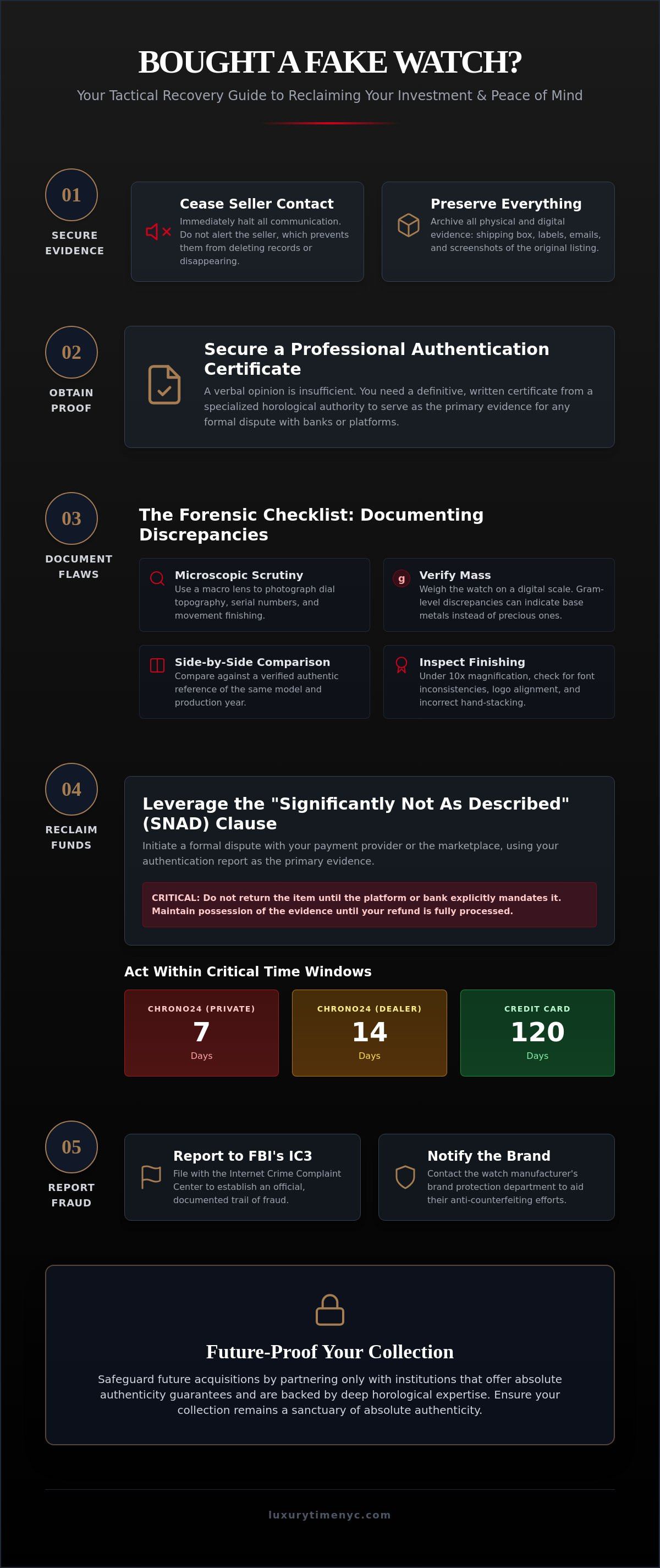
The discovery of a counterfeit in one's collection is a moment that demands a transition from passionate collector to clinical investigator. Your priority is no longer the item's beauty, but the integrity of your evidence. Silence is your first tactical advantage. Cease all dialogue with the seller immediately. Any premature accusation provides the vendor an opportunity to vanish or delete digital records. When determining what to do if you bought a fake watch, your first action must be to secure the chain of custody in a vacuum of professional detachment.
Preserve every physical artifact. The shipping carton, the courier’s thermal label, and the specific packing materials are essential forensic markers. Digital records are equally vital. Archive every email and screenshot every listing description before they are altered. These documents form the backbone of your legal position, proving exactly what was promised versus what was delivered. This measured approach mirrors the standards of a private consultation, where every detail is treated with the gravity it deserves.
The Importance of a Professional Authentication Certificate
Financial institutions and high-end marketplaces require more than a casual glance. A verbal opinion from a local jeweler is insufficient for a formal bank dispute. You need a definitive, written certificate from a specialized NYC institution. Expert horologists possess the technical tooling to expose 'franken-watches', items that pair genuine external components with counterfeit movements to deceive the eye. Recognizing the importance of professional watch authentication ensures your claim is backed by the authority of the Diamond District. This document is your primary weapon when demanding a full reversal of funds.
Documenting the Discrepancies
Technical analysis is the only path to restitution. Use a macro-lens to document the dial's topography, the serial numbers, and the movement’s finishing. A comprehensive overview of counterfeit watches shows that while 'super clones' are impressive, they inevitably falter under microscopic scrutiny. When documenting what to do if you bought a fake watch, follow these professional protocols:
- Perform a side-by-side comparison: Use a verified authentic reference of the same reference number and production year.
- Verify the mass: Measure the weight on a digital scale. Discrepancies of even a few grams can signal a base-metal movement instead of 18k gold or platinum.
- Inspect the finishing: Identify font inconsistencies, logo alignment, and hand-stacking order under 10x magnification.
This meticulous documentation transforms a suspicion into an undeniable fact. By approaching the problem with the precision of a master watchmaker, you position yourself to recover your investment with absolute certainty.
Financial Restitution: Navigating Disputes and Chargebacks
Securing financial restitution requires a shift from horological analysis to tactical litigation. When determining what to do if you bought a fake watch, the objective is the absolute reversal of funds. The process of navigating disputes and chargebacks demands precision and an understanding of platform-specific protocols. Speed is essential. Delay only serves the interest of the fraudulent party.
Initiate a formal dispute through the 'Significantly Not As Described' (SNAD) clause. This legal standard is the cornerstone of consumer protection in luxury transactions. It's a definitive statement: the item delivered is not the asset promised. When considering what to do if you bought a fake watch, your professional authentication report serves as the primary exhibit in this dispute. Do not return the timepiece until the platform or bank explicitly mandates it; maintaining possession of the evidence is paramount until the refund is processed.
Platform-Specific Recovery Strategies
Digital marketplaces operate on rigid timelines. On Chrono24, funds are held in an escrow account for a specific duration. For professional dealers, you have a 14 day window to initiate a return. If the seller is a private individual, this window narrows to 7 days. Act within this period to ensure the capital never reaches the seller’s hands. On eBay, the Money Back Guarantee overrides any 'no returns' policy if the item is found to be counterfeit. Even if a piece was vetted by an authentication hub, you retain the right to contest the findings if a master horologist identifies a sophisticated 'super clone' that bypassed their initial screening. For transactions via PayPal, you generally have a 180 day dispute window for counterfeit goods, providing an extended safety net for collectors.
Winning the Credit Card Chargeback
If platform-level resolution fails, your credit card issuer offers a final line of defense under the Fair Credit Billing Act. Most major networks, including Visa and Mastercard, provide a 120 day window from the transaction date to file a chargeback for counterfeit goods. This is not a mere customer service request. It's a formal protest. Your bank will evaluate the case based on 'expert testimony'. A certification from a recognized institution in the NYC Diamond District carries the weight required to silence a seller’s claims of 'buyer’s remorse'.
Securing this expert testimony is the first step toward a successful recovery. Engaging an authority for professional watch authentication provides the clinical proof banks require to rule in your favor. This level of verification transforms a complex dispute into a simple matter of fact.
Reporting the Fraud: Legal Recourse and Brand Protection
Reclaiming your capital is a priority, yet the pursuit of justice serves a broader purpose. It protects the sanctity of the horological market. Determining what to do if you bought a fake watch involves more than just a bank call; it requires engaging the formal mechanisms of justice. For the serious collector, this transition from victim to advocate is a clinical necessity. You must document the crime with the same precision used to verify a reference number.
The digital landscape of 2026 offers sophisticated avenues for reporting. Your first formal step should be filing a report with the FBI’s Internet Crime Complaint Center (IC3). This creates a federal record of the fraud. To effectively report counterfeit goods fraud, you must provide a detailed narrative of the transaction and the professional findings of your authentication. Under the Trademark Counterfeiting Act of 1984, the sale of these items is a federal offense. Your report contributes to a larger tapestry of enforcement that targets "super clone" manufacturers globally.
Engaging Brand Protection Departments
Prestigious manufacturers like Rolex and Patek Philippe are the guardians of their own heritage. They maintain aggressive intellectual property departments dedicated to tracking counterfeit trends. Contacting these "Brand Protection" units serves two purposes. First, it allows the manufacturer to flag the specific serial numbers used by counterfeiters. Second, a brand’s formal refusal to service the watch is the ultimate, undeniable proof of forgery. This refusal is a powerful piece of evidence in any legal proceeding. It confirms the item's exclusion from the lineage of fine mechanical arts.
Law Enforcement and Civil Action
If the transaction occurred through a physical hand-off in a metropolitan center like the NYC Diamond District, local law enforcement must be notified. A police report is often a prerequisite for high-value insurance claims. For losses exceeding $10,000, civil litigation becomes a viable path for restitution. Small claims court may be insufficient for investment-grade assets; superior court action allows for broader discovery. In complex cases involving large-scale scams, a private investigator specializing in luxury fraud can uncover the identities behind anonymous shell companies. This level of diligence ensures that your recovery is not just a hope, but a calculated legal outcome.
Your actions do more than recover lost funds. They reinforce the barriers against illicit trade. When you understand what to do if you bought a fake watch, you act as a guardian of authenticity for the entire community. This commitment to excellence is the hallmark of a true connoisseur.
Identifying the Threat: The Rise of the 'Super Clone' in 2026
The landscape of horological deception has undergone a radical transformation. In 2026, the term "counterfeit" no longer implies a crude imitation. It describes a sophisticated "super clone" that challenges the expertise of all but the most elite horologists. Understanding these advancements is vital when considering what to do if you bought a fake watch, as the indicators of forgery have moved from the surface to the microscopic. These items are engineered to deceive not just the novice, but the seasoned collector who relies on outdated benchmarks of authenticity.
Advanced Counterfeit Techniques
Modern forgery relies on industrial-grade technology. CNC machining now provides absolute parity in case geometry, ensuring every lug and crown guard matches the original to the tenth of a millimeter. High-end Rolex Super Clone watches utilize genuine 904L stainless steel. This ensures the tactile experience, corrosion resistance, and weight are indistinguishable from an authentic piece. The "rehaut" engraving and laser-etched crystals, once reliable benchmarks for verification, are now replicated with clinical accuracy. Most concerning is the 1:1 cloned movement. These calibers mimic the architecture of Patek Philippe and Audemars Piguet movements so closely that they often fool general dealers who lack specialized diagnostic tools and movement-specific knowledge.
The Red Flags of the Secondary Market
Psychological manipulation is a hallmark of the modern scammer. They often use aggressive timelines to bypass your due diligence. A price set "just below" the current market average is a deliberate tactic to trigger a "fear of missing out," prompting a rushed decision. If you're wondering what to do if you bought a fake watch, reflect on the seller's behavior during the acquisition. Did they insist on a "friends and family" payment? Did they provide blurry photography of the balance wheel or serial numbers? These are never accidents; they are calculated omissions designed to hide the lack of hand-finishing found in genuine horology.
The "Franken-watch" remains a persistent threat in the 2026 market. These pieces utilize a genuine dial, bezel, or crown to mask a counterfeit case and movement. This hybrid approach is designed to pass a cursory "naked eye" inspection. Scammers pair these items with meticulously forged "box and papers," creating a false sense of security through documentation that is as fraudulent as the timepiece itself. A reputable seller never avoids a third-party verification. Refusal to meet at an established NYC institution for a joint inspection is a definitive warning that the asset is compromised.
True security comes from a clinical, third-party assessment. If you suspect a piece in your collection is not what it seems, seek professional watch authentication to confirm its pedigree with absolute certainty and protect your capital from sophisticated fraud.
Future-Proofing Your Collection: The Path to Absolute Authenticity
The journey toward restitution is a demanding one. Once you've navigated the clinical steps of what to do if you bought a fake watch, your focus must shift from recovery to preservation. A collection of investment-grade timepieces should be a source of pride, not a source of anxiety. True security in the secondary market isn't found in personal expertise alone, but in the institutional protection of a trusted partner. Transitioning to a proactive strategy ensures that every future acquisition is a verified asset of enduring value.
The most effective defense against sophisticated forgery is the exclusion of high-risk sources. Serious collectors often limit their acquisitions to a "Connoisseur’s Circle," a network of established institutions that assume the burden of proof. By buying only from landmarks with a physical presence and a documented horological pedigree, you eliminate the variables that allow fraud to flourish. This professional distance from anonymous online forums is the hallmark of a mature collection strategy.
The Luxury Time NYC Standard
Authenticity is not a marketing claim. It's a technical fact established through clinical scrutiny. Our multi-point inspection process goes beyond the surface, involving a complete movement analysis to verify the caliber's finish and hand-stacking order. Pressure testing and serial number cross-referencing are standard protocols for every Rolex, Patek Philippe, and Audemars Piguet that enters our inventory. This rigorous methodology is why our showroom is considered the gold standard for secure transactions. For those seeking to expand their holdings with confidence, The Essential Guide to Buying a Rolex in NYC provides the necessary framework for navigating the 2026 market.
Building a Trusted Network
The New York Diamond District remains the global heart of the watch trade. It's a sanctuary of excellence where tradition meets modern engineering. Maintaining a relationship with a master horologist within this district provides ongoing verification for your entire portfolio. Whether you're utilizing professional sourcing services for a rare Richard Mille or considering the benefits of consignment through a vetted luxury platform, your network is your greatest asset. A lifetime authenticity guarantee from a metropolitan institution is the only documentation that truly matters in the world of fine mechanical arts.
You don't have to navigate the complexities of the global market alone. Whether you require a definitive report for a dispute or are ready to acquire your next investment piece, we invite you to schedule a professional authentication or browse our authenticated collection. Protect your capital and your legacy through the certainty of expert curation.
Reclaiming the Integrity of Your Collection
The journey from discovery to restitution is a clinical process. It requires the meticulous preservation of evidence and the authoritative verification only a professional institution can provide. By leveraging platform-specific protections and formal legal reporting, you transform a significant financial loss into a documented case for full restitution. Understanding exactly what to do if you bought a fake watch ensures that your pursuit of horological excellence remains uncompromised. You've transitioned from victim to advocate, securing your capital with the same precision found in a masterwork's movement.
The ultimate safeguard against the sophisticated "super clones" of 2026 is a partnership with a guardian of authenticity. Our NYC Diamond District showroom offers the security of expert authentication, a certified authenticity guarantee, and global secure shipping. Your passion for fine mechanical arts deserves a sanctuary of absolute trust. Every acquisition should be an enduring asset. Take the final step toward a verified future today.
Secure Your Investment with Luxury Time NYC’s Authenticated Collection
Frequently Asked Questions
Can I get my money back if I bought a fake watch on eBay in 2026?
Yes, you can secure a full refund under the eBay Money Back Guarantee. Buyers have 30 days from the confirmed delivery date to open a claim for an item that is not as described, which includes counterfeit goods. This platform protection overrides any seller's "no returns" policy. For watches priced over $2,000, the Authenticity Guarantee hub provides an additional layer of security, though professional third-party verification remains a vital step for your recovery.
How do I prove a watch is fake to my credit card company?
To prevail in a bank dispute, you must provide a formal authentication certificate from a recognized horological institution. Credit card issuers treat this document as expert testimony during their investigation. When determining what to do if you bought a fake watch, avoid making subjective claims. Instead, submit high-resolution macro photography alongside a technical report that identifies specific mechanical discrepancies, such as incorrect movement architecture or base-metal compositions.
Is it illegal to own or sell a counterfeit watch if I didn't know it was fake?
Selling counterfeit goods is a federal crime under the Trademark Counterfeiting Act of 1984. While the law primarily targets those with "knowledge" of the forgery, attempting to resell a fake watch, even unknowingly, exposes you to significant civil and criminal liability. If you discover a forgery in your collection, the most prudent course is to document the fraud and seek financial restitution from the original source rather than risk your reputation by passing the item to another collector.
Will a Rolex service center return my watch if they find out it’s counterfeit?
A Rolex service center will typically refuse to perform any maintenance on a counterfeit timepiece and return it unserviced. In certain jurisdictions, the manufacturer may be legally permitted to retain the watch or remove the fraudulent components to prevent the item from re-entering the global market. This formal refusal of service is a powerful asset. It serves as definitive, manufacturer-backed proof of forgery that can be used to win a financial dispute or legal claim.
What is a 'super clone' and can a professional dealer spot one?
A 'super clone' is a high-fidelity forgery that utilizes 1:1 cloned movements and genuine-grade materials like 904L stainless steel. While these sophisticated pieces often fool general jewelry dealers who lack specialized diagnostic tools, a master horologist in a specialized NYC institution can identify them. They look for microscopic finishing errors on the movement plates and deviations in the mechanical heartbeat that even advanced industrial CNC machines cannot yet replicate perfectly.
Should I confront the seller myself if I realize the watch is a forgery?
You should avoid direct confrontation until your evidence is fully compiled and your dispute is officially filed. Alerting a fraudulent seller prematurely provides them with an opportunity to delete digital records, alter listing descriptions, or vanish from the platform entirely. Secure your professional authentication first and initiate a formal dispute through the appropriate financial or marketplace channels. This clinical approach ensures that you maintain the tactical advantage throughout the recovery process.
Can I sue someone for selling me a fake luxury watch?
Yes, civil litigation is a viable path for restitution, particularly for losses exceeding $10,000. You may pursue action under the Lanham Act or through state superior courts to recover your investment. For high-value assets, a legal claim backed by a Diamond District authentication report often forces a settlement before a trial begins. It is a calculated and necessary step for the serious collector who has suffered a significant financial loss due to fraud.
Does 'box and papers' guarantee that a watch is authentic?
No, 'box and papers' are no longer a definitive guarantee of a watch's pedigree. Modern counterfeiters forge warranty cards, instruction booklets, and hangtags with the same clinical precision applied to the timepieces themselves. These accessories are frequently used as psychological tools to lower a buyer's guard during the due diligence process. Only a technical, movement-level inspection of the case geometry and internal caliber provides the absolute certainty required for an investment-grade acquisition.


