


A watch winder is not merely a display piece; it's a precision instrument designed to safeguard the mechanical lifeblood of your horological assets. For the elite collector, selecting the correct watch winder settings for automatic rolex movements is the difference between effortless accuracy and unnecessary mechanical wear. You've invested in a legacy of Swiss engineering. It's only natural to feel a sense of caution regarding over-winding or the invisible threat of magnetization from inferior equipment.
We understand that your timepieces represent both personal history and significant financial value. This guide provides the exact TPD data and directional requirements needed to maintain the new 2026 COSC Excellence Chronometer standards, which demand a daily rate of -2 to +4 seconds. You'll master the technical nuances of your specific caliber, ensuring your mainspring remains optimally tensioned without risk. From the high-torque demands of a Daytona to the bidirectional needs of a Datejust, we offer the clarity required to preserve your investment for the next generation.
Key Takeaways
- Preserve the mechanical integrity of your movement by ensuring consistent lubricant distribution through programmed rotation.
- Identify the precise watch winder settings for automatic rolex calibers to maintain the accuracy required for modern chronometer certification.
- Master the specific directional requirements for iconic references, including the specialized clockwise needs of the Daytona series.
- Protect your investment from mechanical fatigue by avoiding excessive turns per day that can lead to unnecessary component wear.
- Recognize the essential role of professional movement overhauls in supplementing even the most advanced winding technology.
The Role of Watch Winders in Rolex Preservation
A Rolex is a masterpiece of mechanical resilience. It is an asset designed for perpetual motion. For the serious collector, a watch winder serves as a silent guardian, ensuring the movement remains within its optimal operating parameters even when off the wrist. While many view these devices as mere conveniences, they are essential for preserving the long-term investment value of a high-grade collection. A documented history of consistent mechanical health, facilitated by proper storage, directly influences resale appraisals in the global secondary market.
When a movement sits idle for extended periods, the precision of the caliber is at risk. Understanding how automatic watches work reveals that these machines rely on a delicate balance of tension and lubrication. Correct watch winder settings for automatic rolex movements prevent the migration of lubricants and the settling of microscopic debris. This active preservation ensures that when you finally secure the clasp, the watch performs with the same chronometric excellence it possessed the day it left the showroom.
Mechanical Longevity and Lubricant Distribution
Modern Rolex calibers utilize advanced synthetic lubricants. These oils are engineered for stability, yet they are still subject to the laws of physics. If a watch remains stationary, these lubricants can pool in specific areas of the escapement or gear train. This uneven distribution leads to increased friction upon restart. For high-complication pieces like the Day-Date, keeping the movement active prevents the repeated stress of manual setting. Frequent crown adjustments can lead to premature wear on the winding stem and internal gasket seals. The Perpetual rotor, a definitive advancement introduced by Rolex in 1931, remains the cornerstone of self-winding technology in the modern era.
Why Rolex Movements Require Specific Motion
A winder does not simply spin; it mimics the sophisticated dynamics of an active lifestyle. Human wrist movement is erratic and multi-directional. A high-quality winder provides a controlled environment that replicates this kinetic energy without the risk of impact or environmental exposure. Most modern Rolex movements utilize a bi-directional winding system, meaning the rotor winds the mainspring regardless of which way it turns. By selecting the appropriate watch winder settings for automatic rolex, you ensure the mainspring is kept at its ideal torque. This prevents the slip-clutch from engaging too frequently, which occurs when a watch is over-wound, thereby extending the service interval of the entire assembly.
Decoding Rolex Winding Requirements: TPD and Directionality
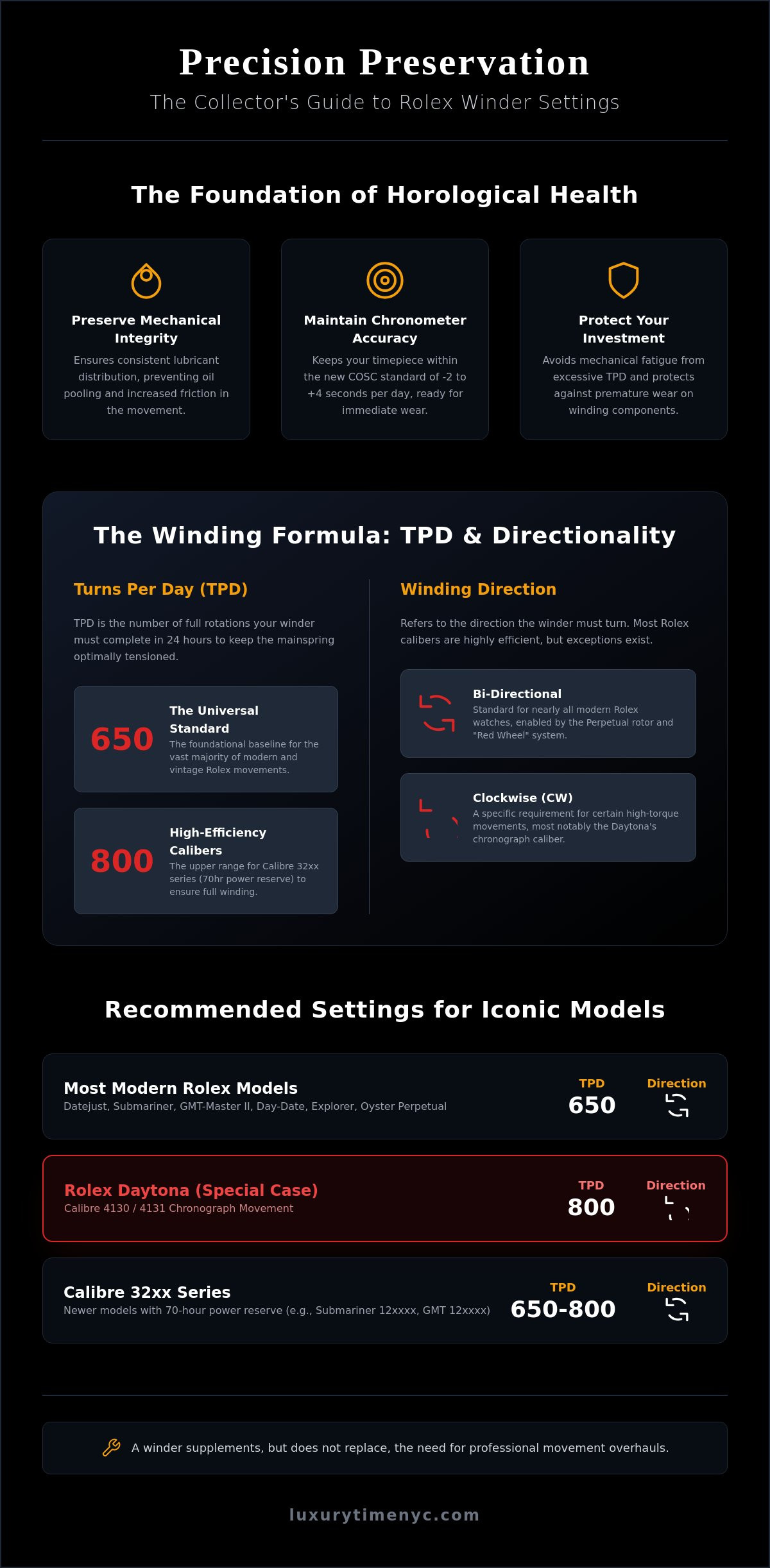
Selecting the correct watch winder settings for automatic rolex movements requires an appreciation for the specific energy requirements of the caliber. Turns Per Day, or TPD, represents the precise number of full rotations required to maintain the mainspring’s tension without inducing mechanical fatigue. While 650 TPD serves as the foundational baseline for the majority of the Rolex catalog, nuanced adjustments are necessary to account for the evolution of movement architecture. Precision is paramount. An under-wound watch will eventually lose its chronometric accuracy, while excessive rotation leads to unnecessary engagement of the internal safety mechanisms.
Modern Rolex engineering ensures that these timepieces are robust. However, the goal of a connoisseur is not merely to keep the watch running, but to keep it running at peak performance. This involves matching the winder’s output to the movement’s design. If your collection includes a variety of calibers, understanding these technical thresholds is the only way to ensure each piece remains ready for the wrist at a moment's notice.
Understanding TPD for Modern Calibers
The introduction of the Chronergy escapement in the Calibre 3235 has redefined winding efficiency. These modern movements boast an impressive 70-hour power reserve. They demand a winder that offers programmable rest periods. This prevents the slip-clutch from over-engaging. For the 2026 collection, a range of 650 to 800 TPD remains the optimal threshold for maintaining peak performance. While the slip-clutch prevents damage from over-winding, staying within this range minimizes friction on the mainspring barrel. This attention to detail is a hallmark of Rolex professional maintenance standards.
The Bi-Directional Winding Advantage
Rolex movements are celebrated for their bi-directional winding capability. This is facilitated by the signature Teflon-coated "Red Wheels" or reversing wheels. Unlike calibers that only wind in a single direction, the Oyster Perpetual line captures energy from every oscillation of the rotor. Selecting the "Bi-directional" or "Both" setting on your device is essential. It mimics the natural, varied motion of the wrist and ensures the movement stays within the new COSC Excellence Chronometer standards of -2 to +4 seconds per day. The only notable exception in the current catalog remains the Cosmograph Daytona, which typically requires a clockwise setting at 800 to 950 TPD. If you are uncertain about your specific caliber's requirements, a professional movement assessment can provide the technical clarity you need.
Model-Specific Settings for Iconic Rolex References
A sophisticated collection often spans decades of horological lineage. While the aesthetic of an Oyster Perpetual case remains timeless, the mechanical architecture within has evolved significantly across generations. Categorizing your watch winder settings for automatic rolex timepieces by movement family, rather than just the name on the dial, is the mark of a true connoisseur. A modern Submariner with a 32xx series caliber possesses different kinetic requirements than a vintage reference from the 1970s. Precision winding respects these boundaries.
Every caliber has a specific torque threshold. Maintaining this balance ensures that complications like the Saros annual calendar or the instantaneous date jump remain crisp and reliable. By tailoring the rotation to the specific movement, you avoid the mechanical fatigue associated with generic, high-frequency settings.
Professional and Sport Models: The 31xx and 32xx Era
The Professional series represents the pinnacle of tool-watch engineering. Modern iterations of the Submariner, GMT-Master II, and Sea-Dweller are built for resilience. For the modern Submariner (Ref. 126610), the industry-standard setting is 650 TPD with bi-directional rotation. This keeps the Calibre 3235 optimally tensioned without over-taxing the slip-spring mechanism. The GMT-Master II (Ref. 126710) follows a similar profile, benefiting from the efficiency of the Chronergy escapement.
- Submariner and GMT-Master II: 650 to 800 TPD, Bi-directional.
- Sea-Dweller and Deepsea: 650 TPD, Bi-directional.
- The Daytona Exception: The Cosmograph Daytona, powered by the Calibre 4130 or 4131, requires a clockwise-only setting at 800 to 950 TPD for optimal performance.
Classic and High-Complication Models
Classic models like the Datejust and Day-Date are the backbone of many elite collections. The Day-Date "President" requires consistent motion to ensure the day and date discs advance with perfect synchronicity at midnight. For the Sky-Dweller, the challenge is managing the Saros annual calendar. This movement is among the most complex Rolex has ever produced. It requires a steady 650 to 800 TPD Bi-directional cycle to keep the month and date indicators aligned. Dress models, including the older Cellini line, often feature thinner movements that favor the lower end of the TPD spectrum to preserve the delicate winding gears.
Vintage Rolex Considerations
Vintage references require a more measured approach. Older calibers, such as the legendary 1570 found in early Submariners and Explorers, were engineered before the era of modern synthetic oils and high-efficiency alloys. These movements benefit from gentler cycles. Setting a vintage piece to 650 TPD is often sufficient. Avoid high-frequency settings exceeding 800 TPD on watches produced before 1990. This prevents unnecessary wear on the reversing wheels and the mainspring barrel, which may have become more brittle over the decades. A heritage timepiece is a survivor. Treat its mechanical heart with the deference it has earned.
Avoiding Common Winder Mistakes and Over-Winding Risks
Mechanical preservation is a discipline of balance. While a Rolex movement is engineered for the rigors of daily life, it is not immune to the cumulative effects of poor storage practices. Many collectors fall into the trap of over-taxing their timepieces with aggressive watch winder settings for automatic rolex movements. More is not better. When a winder exceeds 1000 TPD, it forces the caliber into a state of constant exertion that offers no benefit to timekeeping. Rest cycles are non-negotiable. A winder should replicate the rhythm of human life, which includes periods of stillness. Without these pauses, the mechanical components are denied the opportunity for tension to stabilize.
The choice of hardware is as critical as the configuration. A winder is a tool. Use it with care. High-value investments deserve more than a budget solution with an unshielded motor. Precision requires an environment free from external interference. If you treat your winder as a secondary thought, you risk the very horological integrity you seek to protect.
The Slip-Spring Mechanism and Mainspring Health
A common misconception among enthusiasts is the fear of snapping the mainspring. This is a myth. Every modern Rolex features a slip-spring mechanism. Once the watch is fully wound, the end of the mainspring simply slides along the inside of the barrel. However, constant slipping is not harmless. It creates unnecessary friction and localized heat. Over time, this degrades the synthetic lubricants within the barrel. Finding the "sweet spot" typically between 650 and 800 TPD allows the watch to maintain a full power reserve without forcing the slip-clutch into perpetual use. This preserves the internal components for the long term.
Magnetization and Electronic Interference
A silent threat lurks within low-quality winders: magnetism. Cheap electronic motors often lack proper shielding. This creates a magnetic field that can compromise the Parachrom hairspring. While modern Rolex hairsprings are paramagnetic, they are not entirely invincible to high-intensity fields. If your watch suddenly gains several seconds or minutes per day, magnetization is the likely culprit. Elite winders utilize shielded Japanese or Swiss motors to eliminate this risk. Protecting the balance spring is essential for maintaining the new 2026 COSC Excellence Chronometer standards. If you suspect your timepiece has been compromised by magnetic interference, our specialists offer professional movement overhauls to restore its chronometric precision.
Beyond the Winder: Professional Maintenance for Your Collection
A watch winder is a sophisticated supplement to a collector's lifestyle, ensuring your timepiece is always ready for the next high-profile event or celebration where Goodtime DJ provides the entertainment. It's not a substitute for the meticulous hands of a master watchmaker. While the correct watch winder settings for automatic rolex calibers ensure the movement remains active, they can't address the inevitable chemical breakdown of internal lubricants. A timepiece is a mechanical ecosystem. It requires periodic physical intervention to maintain the chronometric standards expected of a world-class asset. Relying solely on automation without expert oversight is a risk to the mechanical integrity of your investment.
In the heart of the Diamond District, we see the consequences of neglected maintenance. A watch that remains on a winder for years without a professional assessment may appear to function perfectly, yet its internal components could be suffering from microscopic wear. True horological care involves a synthesis of proper daily storage and disciplined service intervals. Precision isn't just about rotation. It's about the preservation of engineering.
The Necessity of the Movement Overhaul
Placing a vintage or pre-owned timepiece with aging lubricants on a winder can accelerate internal damage. When oils dry or migrate, the increased friction between pivots and jewels acts like an abrasive. This is why a professional watch repair nyc assessment is essential before committing a watch to long-term automated winding. Modern Rolex timepieces typically require a service interval of five to ten years. During this process, the movement is entirely disassembled, cleaned, and re-lubricated to ensure it meets the 2026 COSC Excellence Chronometer standards. This preventative measure is the only way to guarantee that your watch winder settings for automatic rolex movements are actually preserving the caliber rather than taxing it.
Concierge Sourcing and Servicing in the Diamond District
Luxury Time NYC operates as a guardian of authenticity and mechanical excellence. Our showroom serves as a sanctuary for collectors who demand absolute precision. Whether you're looking to buy and sell watches or require a health check for your current portfolio, our expertise provides the security necessary for high-value acquisitions. We invite you to experience a level of service that mirrors the engineering of the timepieces we carry. To ensure your collection remains in peak condition, schedule a private consultation at our NYC showroom today. Our specialists will provide a comprehensive evaluation of your movement's performance and offer tailored recommendations for your winding and maintenance protocols.
Securing the Future of Your Horological Legacy
Mastering the technical nuances of your collection is a journey of refinement. By implementing the precise watch winder settings for automatic rolex movements, you ensure your timepieces remain in a state of perpetual readiness. You've learned that consistent motion preserves lubricant distribution while avoiding the mechanical fatigue of excessive turns. These protocols are essential for maintaining the new COSC Excellence standards and protecting the long-term value of your assets. Yet, even the most advanced winder is merely a bridge between professional services. True preservation requires the discerning eye of an expert.
Luxury Time NYC stands as a beacon for the serious collector. Our NYC Diamond District facility provides expert movement overhauls to restore chronometric perfection. Every piece in our inventory carries a certified authenticity guarantee, ensuring absolute security for your investment. We invite you to explore our curated collection of investment-grade Rolex watches or schedule a private showroom appointment for a bespoke consultation. Your collection is more than a series of instruments. It's an enduring legacy of excellence that deserves nothing less than perfection.
Frequently Asked Questions
Can a watch winder damage my Rolex mainspring?
A watch winder cannot break a modern Rolex mainspring due to the internal slip-clutch safety mechanism. This feature allows the spring to slide safely once full tension is reached. Constant engagement of this clutch creates unnecessary friction and heat. This can degrade the synthetic oils over time. Using the correct watch winder settings for automatic rolex models prevents this mechanical fatigue and preserves the caliber’s health.
What is the best TPD setting for a Rolex Submariner?
The optimal setting for a modern Rolex Submariner is 650 Turns Per Day (TPD) with bi-directional rotation. This configuration ensures the Calibre 3235 remains fully powered without over-taxing the movement. Some collectors prefer 800 TPD for watches with higher activity needs. Both settings fall within the recommended factory threshold for the Oyster Perpetual line and maintain peak chronometric performance.
Does a Rolex wind clockwise or counter-clockwise?
Most modern Rolex movements wind bi-directionally, meaning they gain energy from both clockwise and counter-clockwise rotations. This efficiency is a hallmark of the Perpetual rotor system found in the Datejust, Submariner, and GMT-Master II. The Cosmograph Daytona is the primary exception. It typically requires a clockwise-only setting. Always verify your specific caliber requirements to ensure the mainspring is being tensioned correctly by your device.
Is it okay to leave my Rolex on a winder all the time?
It's acceptable to use a winder continuously if the device includes programmable rest cycles. These pauses are essential to mimic natural wear and prevent the movement from being under constant stress. High-quality winders are designed to rotate for a set period and then remain stationary. This cycle allows the mainspring tension to stabilize. A winder that spins 24/7 without interruption is not recommended for fine horology.
How do I know if my watch winder is magnetizing my watch?
Magnetization typically manifests as a sudden, significant gain in time, often several seconds or even minutes per day. If your watch is gaining time rapidly, it may have been exposed to an unshielded motor in a budget winder. You can test this with a digital magnetism sensor or a traditional compass. Professional demagnetization and a movement overhaul are required to restore the precision of the balance spring.
Do vintage Rolexes need different winder settings than modern ones?
Vintage Rolex timepieces require a more conservative approach compared to modern references. Older movements, such as the Calibre 1570, were built with different alloy tolerances and traditional lubricants. Setting these watches to a gentle 650 TPD Bi-directional cycle is often best. High-torque watch winder settings for automatic rolex models can place excessive strain on heritage components that have become more delicate over the decades.
What happens if I set the TPD too low for my Rolex?
Setting the TPD too low will result in the watch eventually losing its power reserve and stopping. The movement won't be damaged, but it won't maintain the accuracy required for chronometer standards. If the mainspring isn't kept at an optimal tension, the amplitude of the balance wheel drops. This causes the watch to run inconsistently before it finally winds down and requires a manual restart.


