


True horological rarity is no longer defined by the number of complications, but by the architectural purity of a single silhouette. For the elite connoisseur, rare and collectible cartier watches represent the pinnacle of this shift toward design-led investment. While some still dismiss the Maison as primarily a jeweler, the global market is rapidly correcting this perception, rewarding those who recognize the mechanical integrity hidden within Cartier's most iconic shapes.
It's natural to feel skepticism when faced with the sheer volume of Tank variations or the fear of overpaying for a common retail model. This guide provides the necessary framework to distinguish between mass-market luxury and genuine investment-grade assets. You'll discover the mechanical excellence of the CPCP collection, the historical weight of specific global workshops, and the precise checklist for identifying true grail models. Locate a trusted partner in New York City and move beyond the boutique to secure a piece of enduring heritage.
Key Takeaways
- Distinguish between limited editions and genuine low-production vintage pieces to ensure your acquisition holds long-term investment value.
- Explore the historical significance of the London, Paris, and New York workshops and how regional provenance dictates the rarity of specific designs.
- Master the technical nuances of the Collection Privée Cartier Paris (CPCP) era, a decade defined by manual-wind excellence and the coveted 'Paris' signature.
- Learn to evaluate rare and collectible cartier watches using a specific checklist for 'grail' models, from the radical geometry of the Crash to the scarcity of the Pebble.
- Understand the critical importance of provenance and expert NYC-based authentication when securing high-ticket horological assets.
The Resurgence of Rare Cartier: Shifting from Jewelry to Horology
Since 2020, the global market for rare and collectible cartier watches has experienced a profound structural re-evaluation. Hammer prices for specific geometric shapes have tripled at major auction houses, signaling a departure from the era when the Maison was viewed solely through a decorative lens. This Cartier Renaissance isn't merely a spike in demand. It's a fundamental shift in how the elite collector views horological value. Serious investors are pivoting away from traditional round complications toward the architectural purity of Cartier's most daring silhouettes.
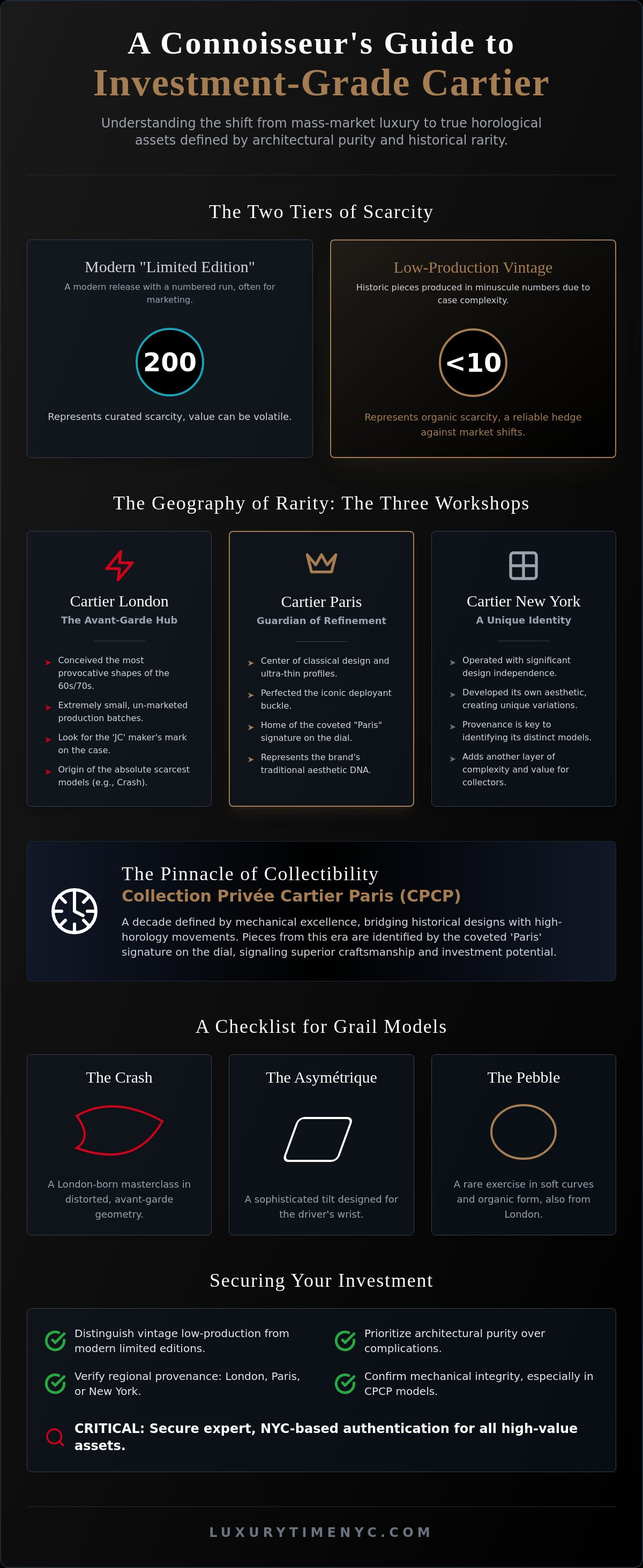
True rarity in this sector requires a nuanced understanding of production history. There's a vital distinction between a modern "limited edition" and a "low production" vintage piece. While a modern release might have a numbered run of 200, certain mid-century models were produced in single digits due to the sheer complexity of their cases. This organic scarcity provides a reliable hedge against broader market volatility. Horological Cartier is the uncompromising fusion of avant-garde design and mechanical integrity.
Breaking the 'Jeweler' Stigma
The perception of Cartier is shifting rapidly among the world's most disciplined collectors. While Cartier's history is rooted in its status as a premier jeweler, its early 20th-century dominance in shaped watches established the blueprint for modern horology. The modern move toward sophisticated in-house manufacture movements has solidified this reputation. Collectors now view the Tank and Santos as foundational assets rather than fashion statements. These pieces offer a level of historical depth that few other manufacturers can match. They represent a legacy of engineering that values form as much as function.
The Market for 'Shaped' Watches
Cartier's rejection of the round watch standard is the cornerstone of its collectibility. This design philosophy creates a unique barrier to entry. Fitting a high-performance mechanical movement into an irregular case is a significant engineering challenge. The difficulty of this process has historically kept production numbers low. This technical constraint is why models like the Crash and the Asymétrique remain so elusive.
- The Crash: A masterclass in distorted geometry.
- The Asymétrique: A sophisticated tilt for the driver's wrist.
- The Pebble: A rare London-born exercise in soft curves.
The allure of the asymmetric is undeniable. It's a statement of exclusivity that commands respect in any private consultation or high-stakes trade. In the world of high-ticket horology, these shapes aren't just watches. They are enduring assets with a proven track record of appreciation. Understanding these nuances is the first step toward building a portfolio that transcends the common.
The Geography of Rarity: London, Paris, and New York Workshops
For much of the 20th century, Cartier operated as three sovereign entities. The London, Paris, and New York branches, managed by the founding brothers and their successors, functioned with surprising independence. This decentralization is the primary driver of value for rare and collectible cartier watches. A collector isn't just buying a brand; they're acquiring the specific design philosophy of a historic workshop. These regional distinctions define the rarity and the ultimate market trajectory of a piece. Each city developed its own aesthetic DNA, creating a fragmented history that rewards the diligent researcher.
Cartier London: The Avant-Garde Hub
Under the leadership of Jean-Jacques Cartier, the London workshop became the epicenter of radical horology. It was here that the most provocative shapes of the 1960s and 70s were conceived, often produced in extremely small batches. The London Crash remains the most famous example, but the workshop's significance extends to its unique case construction and movement sourcing. Identifying these pieces requires a keen eye for London hallmarks and the 'JC' maker's mark on the case. Because London production was notoriously limited, these watches often represent the most expensive Cartier watches found at modern auctions. Their scarcity is absolute, not curated.
Paris vs. New York: Aesthetic Distinctions
Cartier Paris remained the guardian of classical refinement. The Parisian workshop focused on ultra-thin profiles and the perfection of the deployant buckle. Many of these pieces adhered to the Poinçon de Genève standards, representing the pinnacle of Swiss-French collaboration. In contrast, Cartier New York catered to a bold American sensibility. New York pieces often utilized 14k gold, a preference unique to the U.S. market at the time. They featured larger case proportions and unique bracelet designs that weren't available in Europe. These variations were often sold as boutique exclusives, making them difficult to find in the modern secondary market.
The 1970s marked the end of this creative fragmentation as the workshops began to unify. This transition makes 'pre-unification' pieces particularly significant to a portfolio. Sourcing these specific regional variations requires access to a deep network of private collections. For those looking to secure a piece of this fragmented history, consulting with a specialist who understands these workshop nuances at Luxury Time NYC is a vital step in the acquisition process. The distinction between a Paris-signed dial and a London-signed case can represent a difference of hundreds of thousands of dollars in valuation. It's a level of detail that defines the true connoisseur.
The Pinnacle of Collectibility: Collection Privée Cartier Paris (CPCP)
The Collection Privée Cartier Paris (CPCP) represents a decade of unparalleled mechanical ambition. Produced between 1998 and 2008, this era effectively silenced the skepticism surrounding Cartier's horological depth. These are not mere aesthetic tributes or simple re-issues. They are sophisticated instruments powered by calibers from the most prestigious Swiss manufacturers. For the intermediate collector, CPCP is the current 'smart money' sector. It offers a bridge between modern reliability and the extreme rarity of mid-century pieces discussed earlier.
Identifying rare and collectible cartier watches within the CPCP range requires a focus on movement provenance as much as case geometry. Cartier utilized high-end calibers from Piaget, Jaeger-LeCoultre, and Girard-Perregaux to ensure these watches met the highest standards of fine watchmaking. This era transformed the brand's reputation from a master of shapes to a serious mechanical contender. The limited production runs and manual-wind movements make these pieces enduring assets for any serious portfolio.
Signature CPCP Design Language
The visual identity of CPCP is instantly recognizable to the trained eye. The guilloché dial is a hallmark of the series, featuring a central rosette motif that radiates with a rhythmic stillness. Breguet-style hands in blued steel provide a classic contrast against the precious metal cases. The anatomy of the most valuable Cartier watches from this period always includes the sapphire cabochon crown and, most importantly, the 'Paris' signature positioned just below the 6 o'clock marker. This label is a definitive indicator of the collection's exclusivity and limited nature.
Top CPCP Models to Source
Certain models within the CPCP era stand out as essential acquisitions for the discerning connoisseur. These pieces represent the perfect intersection of heritage and engineering. They are often difficult to locate outside of private consultations or elite auction circles.
- The Tortue Monopoussoir: A high-complication masterpiece. It utilizes a sophisticated single-button chronograph movement, blending early 20th-century aesthetics with modern precision.
- The Tank Cintrée: The ultimate expression of the elongated case. Its curved profile follows the wrist with an elegance that few other designs can achieve.
- The Tank Basculante: A rare mechanical alternative to the Reverso. The unique vertical flipping mechanism protects the dial, showcasing Cartier's ability to innovate within its own historical framework.
The CPCP collection remains a gateway into a world of timeless luxury. It respects the past while embracing the technical rigor of the modern era. For those seeking a timepiece with both historical weight and mechanical integrity, these models are foundational.
Identifying the Icons: A Checklist for Rare Cartier Models
While the Maison's catalog is vast, only a select few references achieve the status of a true "grail." Identifying rare and collectible cartier watches requires moving beyond the mass-market success of the modern Santos or Ballon Bleu. It involves a disciplined focus on specific production windows and material rarities, a philosophy shared by those who visit AfricaGems to source rare loose stones. These icons represent the pinnacle of horological investment. They are the pieces that define a collection's authority and command the highest respect in private circles.
The 'Crash' Phenomenon
The Cartier Crash is the undisputed sovereign of 20th-century watch design. Despite the persistent myths of a melted Baignoire salvaged from a fiery car accident, the reality is more deliberate. It was a product of 1967 London, a radical exercise in distorted geometry. The gap between a vintage London original and a modern Privé re-issue is vast, both in scarcity and valuation. While modern editions are highly desirable, the early London pieces remain the ultimate status symbol among the New York elite. They represent a moment of pure, unadulterated creative defiance.
Beyond the Crash, the Pebble, often referred to as the "Baseball," stands as a testament to London's avant-garde era. With fewer than 10 original examples known to exist from the initial production, it's a model defined by absolute scarcity. Similarly, while the Tank Cintrée is a staple of the brand's history, the platinum versions are the most coveted by serious connoisseurs. The weight of the metal paired with the elongated, curved case creates a presence on the wrist that's both substantial and understated. For those seeking a bridge between jewelry and horology, the Bamboo Coussin from the 1970s offers a relic of gold craftsmanship—a quality of artisanal work reflected in the designs of KaMila Fine Jewellery—that's increasingly difficult to source in pristine condition.
Rare Complications: Beyond Time-Only
Cartier's mastery extends into the realm of high complications, a sector often overlooked by those who focus solely on shapes. The Pasha de Cartier Perpetual Calendar in solid gold is a 1980s rarity that combines sporty architecture with grand complication rigor. For a more contemporary expression of high-art horology, the Rotonde de Cartier Mysterious Hours showcases the brand's ability to create "floating" movements that defy visual logic. These pieces are more than watches; they are mechanical illusions.
Sourcing these specific icons requires more than just capital. It demands a partner with the reach to navigate the global secondary market and the technical expertise to verify internal integrity. If you're ready to add a definitive icon to your portfolio, you can begin the process of sourcing rare complications through Luxury Time NYC. Our Diamond District vault serves as a gateway to the world's most elusive references. Contact our advisors today to discuss your specific acquisition targets and secure a piece of horological history.
Securing Your Investment: Sourcing and Maintenance in NYC
Acquiring rare and collectible cartier watches is a pursuit that demands both patience and a secure logistical framework. In the high-stakes environment of the secondary market, provenance is the ultimate currency. While the watch itself is the prize, the presence of original "Box and Papers" acts as a definitive safeguard for its future valuation. For a London Crash or a CPCP Tortue, these documents transform a beautiful object into a documented historical asset. They provide the necessary link between the item's origin and its current standing in your portfolio.
At Luxury Time NYC, we act as a guardian of authenticity. Our process involves a forensic examination of vintage movements and regional hallmarks. We verify the specific signatures of the London, Paris, and New York workshops that define the brand's fragmented history. This no-nonsense approach ensures that every piece in our vault meets the absolute standards required for investment-grade horology. It's about providing security in an industry where details matter most.
Sourcing Rare Models on 47th Street
The Diamond District is a unique global hub where the most elusive references often surface before reaching the auction block. Aligning with an NYC watch partner provides a significant advantage in global sourcing. We offer private showroom appointments that provide a discreet environment for high-value acquisitions. This professional distance allows for a measured, high-end consultation where time is treated as a luxury. Many collectors also utilize trade-in opportunities, leveraging their current holdings to secure a more significant Cartier rarity. It's a sophisticated way to evolve a collection without unnecessary friction.
Preserving Horological Integrity
Once a piece is secured, the focus shifts to long-term preservation. Original dials are mandatory for value retention. A refinished dial can diminish the market price of a vintage Cartier by more than fifty percent. Professional watch repair nyc is essential for maintaining these delicate mechanical systems. Regular movement overhauls protect the asset from internal wear while ensuring accuracy. For precious metal cases, we provide specialized care including pressure testing and careful cleaning. This meticulous attention to detail ensures that your rare and collectible cartier watches remain in pristine, investment-ready condition. Protecting the mechanical integrity is as vital as the initial acquisition.
Securing Your Horological Legacy
The transition from a casual collector to a sophisticated connoisseur begins with a deep appreciation for Cartier's geometric defiance. True value in rare and collectible cartier watches is found at the intersection of historical workshop provenance and mechanical integrity. Whether you seek the radical lines of a London-born Crash or the manual-wind excellence of the CPCP era, your focus must remain on absolute authenticity. These timepieces are not merely accessories. They are enduring assets that reward the disciplined eye and the patient investor.
Success in this high-ticket market requires a partner with deep industry knowledge and a presence in the world's premier commerce centers. Luxury Time NYC provides this essential security through expert sourcing in the NYC Diamond District and a definitive authenticity guarantee. Our professional horological repair services ensure your investment is protected and maintained to the highest standards. We invite you to explore our curated collection of investment-grade Cartier watches at Luxury Time NYC. Your next definitive acquisition is waiting in our Manhattan showroom.
Frequently Asked Questions
Are Cartier watches a good investment compared to Rolex?
Cartier watches offer a distinct investment profile characterized by geometric scarcity rather than the mass-market volume typical of Rolex. While Rolex provides high liquidity, rare Cartier shapes have shown superior appreciation in recent auction cycles. The record-breaking sales of early 2026 prove that the market now values architectural rarity as highly as traditional mechanical complications. It's a shift from tool watches to horological art.
What makes a Cartier watch 'rare' rather than just expensive?
True rarity is a function of production volume and regional provenance rather than retail price. An expensive modern watch might be produced in the thousands; a truly rare piece was often handcrafted in batches of fewer than 100. Identifying rare and collectible cartier watches requires a focus on these low-production windows and unique workshop hallmarks. These factors create a barrier to entry that sustains long-term value.
Why is the Cartier Crash so expensive?
High demand for the Cartier Crash stems from its status as a radical design icon and its extreme scarcity. Original London workshop pieces from the late 1960s are exceptionally difficult to locate in the global market. The April 2026 auction record of $2 million confirms its position as the ultimate horological trophy. Its value is rooted in its creative defiance and limited historical footprint. Absolute exclusivity.
What should I look for when buying a vintage Cartier Tank?
Originality is the most critical factor when evaluating a vintage Tank for your portfolio. You must examine the dial for any signs of refinishing and verify the movement's mechanical integrity. Look for specific workshop hallmarks or the "Paris" signature at 6 o'clock. These details define the historical weight of rare and collectible cartier watches and are essential for securing future appreciation. Subtle nuances dictate value.
Does Luxury Time NYC offer authentication for rare Cartier watches?
Luxury Time NYC provides a definitive watch authentication service for all high-ticket Cartier references. Our Diamond District experts conduct a forensic analysis of movements, hallmarks, and case geometry to ensure absolute integrity. We treat every consultation with the discretion and professionalism required for high-value assets. This process provides the security needed when dealing with the complexities of the vintage market. Absolute transparency is our standard.
Regional distinctions: What is the difference between Cartier Paris and Cartier London watches?
Regional differences lie in the creative independence of the two workshops during the mid-20th century. Paris remained the guardian of classical Swiss-French refinement and ultra-thin mechanical calibers. London acted as an avant-garde hub, producing the brand's most daring and low-production shapes. These London-signed pieces were made in significantly smaller quantities, which is why they command a substantial premium today. A hierarchy of rarity exists.
How do I sell a rare Cartier watch in NYC for the best price?
Achieving the best price for a rare timepiece requires a discreet, professional consultation with a specialized advisor. Avoid the volatility of public platforms and instead leverage the deep network of a Diamond District institution. Luxury Time NYC offers the security and market knowledge needed to manage high-value trades. We provide a professional gateway for elite collectors looking to liquidate or evolve their holdings. Expertise matters.
Is the CPCP collection still undervalued in 2026?
Many industry professionals consider the Collection Privée Cartier Paris (CPCP) to be a high-growth sector in 2026. While interest has intensified since 2020, these models still offer exceptional value compared to the six-figure vintage shapes of the 1960s. They represent a smart money acquisition for those who value manual-wind movements, precious metal cases, and strictly limited production runs. Timeless engineering meets sophisticated investment.


