


Your current Rolex is not merely a timepiece. In 2026, it is a high-performing asset that requires precise management. You likely recognize that holding a specific reference should be a deliberate choice; however, the complexities of trading in a rolex for an upgrade often create unnecessary hesitation. The fear of an undervalued offer or the logistical risks of shipping a five-figure asset can stall the natural evolution of a curated collection.
We understand that your time is as valuable as your inventory. As a firm rooted in the tradition of Geneva-grade excellence, we reveal how to leverage the 2026 market shifts, such as the January price increases and the surging 68.42% appreciation of mid-size classics, to your financial advantage. You'll learn to identify which models retain the most equity and how to execute a transition that is both secure and sophisticated. We provide the expert validation needed to move from your current reference to a higher-tier timepiece with absolute confidence and professional discretion.
Key Takeaways
- Learn to treat your timepiece as a liquid asset by navigating the 2026 market for professional steel models.
- Discover why the "Full Set" remains the gold standard for retaining value during a high-tier exchange.
- Identify the strategic shift from stainless steel references to the refined world of precious metal complications.
- Master the professional process of trading in a rolex for an upgrade through secure digital consultations and insured transit.
- Understand the unique advantages of executing your trade within the epicenter of the global luxury watch market.
The Logic of Trading in a Rolex for an Upgrade in 2026
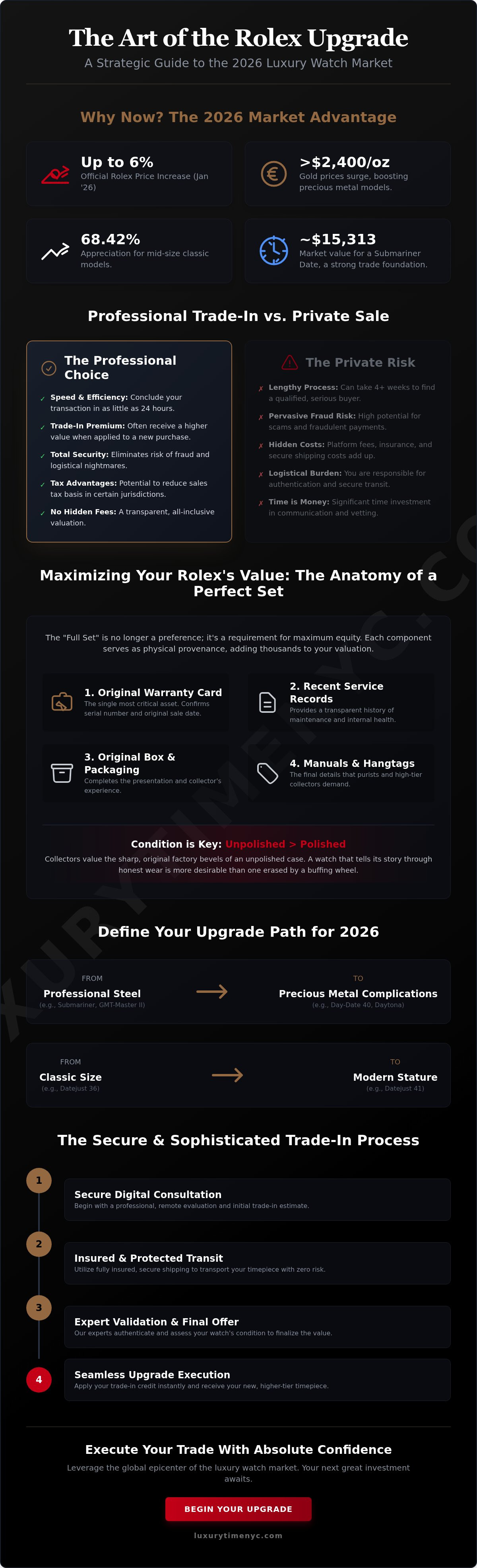
The 2026 market has fundamentally redefined how sophisticated collectors view liquidity. With Rolex implementing price increases of up to 6% in January and gold surpassing $2,400 an ounce, your current timepiece represents significant horological capital. Trading in a rolex for an upgrade is no longer a simple transaction; it's a capital-efficient maneuver to access higher-tier complications without the friction of a total cash outlay. Professional steel models, such as the Submariner Date, currently command secondary prices near $15,313. This provides a robust foundation for those looking to move into precious metals or discontinued icons like the "Pepsi" GMT-Master II. For many, trading in a rolex for an upgrade represents the most direct path to a Daytona or a Day-Date 40 in the new 18ct Jubilee gold alloy.
This strategy allows you to retain maximum equity while enjoying the instant gratification of a new reference on your wrist. By applying the value of your current watch directly to the next, you often benefit from a reduced sales tax basis, depending on your jurisdiction. It's a calculated move for the fiscally disciplined enthusiast who values both time and financial efficiency. The process ensures that your capital remains active within your collection rather than sitting idle in a bank account.
Trade-In vs. Private Sale: The Real Value Exchange
The allure of a private sale often fades when confronted with reality. Hidden costs are pervasive. Third-party platforms frequently extract substantial fees, while secure, fully insured transit for a high-value asset adds further expense. There's also the persistent risk of fraudulent buyers and the complexity of authenticating a sale to a stranger. A professional trade-in offers a "Trade-In Premium." Dealers frequently provide a higher valuation when that credit is applied toward an inventory piece. While the open market may take four weeks to find a qualified buyer, a trade-in concludes within 24 hours. It's a seamless exchange of value that protects your time and your capital.
The Psychology of the First Rolex: To Keep or To Trade?
Collectors often struggle with the sentiment of their first acquisition. The history of the Rolex brand is built on the idea of an enduring legacy, yet not every watch is a destined heirloom. If a piece no longer commands your attention, it has fulfilled its purpose as a stepping stone. You might consider "upgrading within the family." Moving from a Datejust 36 to a Datejust 41, for instance, retains the aesthetic DNA of your first watch while reflecting your current stature. It's a logical evolution of taste. Decide if the watch is a permanent fixture of your heritage or a vehicle for your next great investment. High-net-worth individuals recognize that a collection must breathe to grow.
Evaluating Your Rolex: How to Maximize Your Trade-In Value
Precision is the hallmark of the Rolex brand, and it's the standard by which your timepiece is judged during a trade-in. In the 2026 market, the "Full Set" has transitioned from a preference to a requirement for those seeking maximum equity. Collectors and institutions now place an unprecedented premium on the original box, warranty cards, and even the green chronometer hangtags. These elements serve as a physical provenance, anchoring the watch's history. When you're trading in a rolex for an upgrade, the presence of these accessories can swing the valuation by thousands of dollars. This documentation provides the ultimate assurance of authenticity in an increasingly complex global market.
Physical condition remains a primary driver of value. We distinguish between "desk diving" marks, which are superficial scuffs on a clasp, and structural damage that requires invasive restoration. The integrity of the Oystersteel and the crispness of the Cerachrom bezel are paramount. A Cerachrom bezel is virtually scratch-proof. Therefore, any visible chips suggest a level of impact that may have affected the movement. Paradoxically, an unpolished case often fetches a higher premium than a refurbished one. Collectors value the sharp, original bevels and factory-finished lug edges. A watch that tells its own story through honest wear is often more desirable than one whose history has been erased by a buffing wheel.
The Documentation Hierarchy
Not all accessories carry equal weight. The original warranty card, featuring the serial number and date of sale, is the most critical asset in your possession. Following this, recent service records provide a transparent window into the watch's maintenance. If you've misplaced your original papers, obtaining Professional Watch Authentication is a vital step to restore buyer confidence. While modern trade-ins rely on digital records, vintage pieces demand "matching numbers" where the serials on the case, movement, and papers align perfectly. This synergy is essential for maintaining Rolex's secondary market performance within your personal portfolio.
Mechanical Health and Service History
The internal state of your watch is as significant as its exterior. A recent movement overhaul can significantly increase your trade-in quote. It removes the immediate need for the dealer to perform maintenance. However, one must be cautious with "Service Dials." In the world of high-end horology, an original dial with a natural patina is almost always more valuable than a pristine, modern replacement. Horological Integrity is the precise alignment of original components with verified mechanical accuracy. If you're unsure of your watch's current standing, a discreet watch authentication can provide the clarity needed before trading in a rolex for an upgrade.
Defining Your Upgrade Path: Strategic Moves for 2026
Strategic collection management requires a vision for upward mobility. In 2026, the transition from "Hype Steel" to "Precious Metals" has become the hallmark of the mature collector. With gold prices exceeding $2,400 an ounce, the inherent value of an 18ct gold reference provides a sophisticated hedge against market volatility. Trading in a rolex for an upgrade often involves moving from the utilitarian charm of a Submariner to the complicated elegance of a Sky-Dweller or the timeless authority of a Day-Date 40. Current market dynamics also show a pronounced shift toward refined silhouettes. The demand for 36mm models is surging, making these classic sizes a strategic leverage point for those consolidating their holdings into higher-tier assets.
The "Complication Upgrade" is another primary driver this year. Moving from a time-only reference or a simple Datejust to a GMT-Master II or a Yacht-Master II represents a significant leap in horological sophistication. These pieces don't just tell time; they reflect a mastery of global travel and nautical precision. When you're trading in a rolex for an upgrade, you aren't just changing a dial color. You're acquiring a more complex mechanical engine that commands respect in any boardroom or private club.
From Tool Watch to Executive Statement
The progression from a tool watch to an executive statement is a rite of passage for the elite. Many collectors begin their journey with a stainless steel Submariner before pursuing a Patek Philippe New York acquisition. This leap represents a move into the absolute pinnacle of horology. Within the Rolex ecosystem, the natural path often leads from an Oyster Perpetual to the "Presidential" Day-Date. For those seeking maximum leverage in the New York market, the GMT-Master II "Pepsi" remains a formidable power trade. Its discontinuation in April 2026 has solidified its status as a high-liquidity asset that commands immediate attention on 47th Street.
Vintage to Modern: The Reliability Trade
The choice between vintage soul and modern precision is a central theme for the 2026 collector. Trading a 5-digit reference for a modern 6-digit model offers tangible engineering benefits. The Cerachrom bezel provides a level of scratch resistance that vintage aluminum cannot match. The Glidelock clasp offers ergonomic perfection that's essential for daily wear. However, "Neo-Vintage" pieces from the 1990s and early 2000s are currently prime trade-in bait. These watches bridge the gap between heritage aesthetics and modern reliability. While a tritium dial offers a romantic patina, a modern caliber provides the 70-hour power reserve required by a fast-paced lifestyle. It's an exchange of historical charm for contemporary performance.
The Luxury Time NYC Trade-In Process: Step-by-Step
Execution requires the same precision as the movements we curate. While the strategy of trading in a rolex for an upgrade relies on market timing, the transaction itself demands a white-glove approach. We've refined a four-stage protocol designed for the global elite. This process transforms a high-value asset into a liquid credit, allowing for a seamless transition between references. Every step is defined by transparency, security, and professional discretion.
The journey begins with an initial digital consultation. By providing high-resolution imagery and serial data, you receive a preliminary valuation based on the latest 2026 data. With the Rolex brand seeing a 7.92% growth in average value as of May 2026, your quote reflects real-time liquidity. Once the initial terms are established, we facilitate insured transit. We handle the complexities of global logistics with absolute security, ensuring your timepiece is protected from the moment it leaves your possession until it reaches our Manhattan laboratory. Our expert horologists then perform a meticulous physical inspection, verifying movement integrity and component authenticity before finalizing the equity exchange.
Securing Your Preliminary Quote
Accuracy in remote appraisal depends on visual data. To secure a definitive quote, we require five essential perspectives: the dial, the case back, the crown, the lugs, and the bracelet buckle. Using industry-standard terminology like "Mint" or "Excellent" helps align expectations. Understanding the "Buy-Sell Spread" is vital in the 2026 luxury market. This spread accounts for the professional authentication and servicing required to maintain our inventory's peerless standards. A clear, honest assessment of your watch's condition ensures the most efficient path to your next acquisition.
Finalizing the Transaction in the Diamond District
The Manhattan showroom offers an experience that digital platforms cannot replicate. An in-person appointment at our 47th Street institution provides immediate authentication and "Same-Day Upgrade" capabilities. You can witness the verification of your watch's movement and walk out with your new masterpiece in a single afternoon. For our international clientele, we provide a secure global shipping experience that mirrors the safety of an in-person visit. Whether you are in New York or London, the transition is handled with the quiet confidence of an established metropolitan authority. If you are ready to elevate your collection, begin your consultation at Luxury Time NYC today.
Why the Diamond District is the Ultimate Trade-In Destination
Success in the secondary market is as much about location as it is about timing. Manhattan's 47th Street remains the undisputed epicenter of global watch trading, a historic corridor where the world's most significant references change hands. For the serious collector, trading in a rolex for an upgrade within this district offers an level of liquidity that suburban dealers simply cannot match. It's a high-velocity environment where expertise is concentrated and market values are set in real time. At Luxury Time NYC, we operate with an aura of understated authority, providing a discreet sanctuary for individuals who value professional excellence and absolute privacy.
Our position within this metropolitan institution allows us to offer more than just a transaction. We provide access to "Off-Market" inventory, featuring rare Patek Philippe or Richard Mille pieces that never reach our public digital catalog. These items are reserved for our inner circle of clients who view their collection as a dynamic portfolio. We move beyond the singular trade-in to offer long-term horological management, ensuring your assets continue to appreciate in both aesthetic and financial value. This peer-to-peer relationship is the foundation of a sophisticated collection.
The Advantage of 47th Street Liquidity
Navigating 47th Street provides a distinct competitive edge. Because of the sheer volume of trade, we maintain a narrower buy-sell spread than isolated dealers, translating to better pricing for your current timepiece. The density of expertise here is peerless. Our horologists inspect more rare Rolex references in a single week than most professionals see in a calendar year. This experience allows us to recognize the subtle nuances of a "Neo-Vintage" dial or a rare bezel variant instantly. We leverage this "NYC Premium" to find a new home for your trade-in with exceptional speed, which allows us to offer you more equity toward your next masterpiece.
The Luxury Time NYC Guarantee
Trust is the most valuable currency in the Diamond District. Our promise of "Absolute Authenticity" is not a marketing claim; it's a definitive fact backed by our reputation as a premier Manhattan institution. We understand that trading in a rolex for an upgrade is a deeply personal evolution of your style. Our bespoke sourcing service ensures that if your desired upgrade isn't currently in our vault, we will utilize our global network to secure it. Every watch we carry undergoes rigorous movement validation and pressure testing to ensure it meets our exacting standards of mechanical perfection. Schedule your private trade-in consultation in our NYC showroom today.
Securing the Next Chapter of Your Horological Legacy
Managing a world-class collection requires more than passive appreciation; it demands strategic movement. You now understand that your current reference is a powerful instrument of liquidity in a 2026 market defined by rising values and refined tastes. By trading in a rolex for an upgrade, you secure your position within the horological elite. This transition is protected by our certified horological authentication lab, ensuring that every exchange maintains absolute integrity and mechanical precision.
Since 2005, Luxury Time NYC has served as a cornerstone of the New York Diamond District, providing discreet advisory and exclusive access to rare, off-market inventory. Your journey toward a higher-tier complication or a precious metal masterpiece deserves the oversight of an established metropolitan institution. Trust in a process that values your time as much as your investment. It's a path to your next masterpiece defined by quiet confidence and expert validation.
Elevate your collection: Start your Rolex trade-in consultation now.
Expert Perspectives on Rolex Trade-Ins
Will I get more money if I sell my Rolex privately instead of trading it in?
Private sales often present a higher gross listing price, but the net return is frequently lower. Platform fees, high-value shipping insurance, and the risk of fraudulent buyers create significant friction. A professional trade-in provides a "Trade-In Premium" and potential tax advantages that maximize your horological capital. It's a seamless exchange of value that protects your time and your investment.
Can I trade in a Rolex that doesn't have the original box and papers?
We accept timepieces without original documentation, although a "Full Set" commands the highest market premium. Our on-site horological lab performs a definitive watch authentication to verify every internal component. This professional validation ensures that your asset retains its maximum possible equity even in the absence of its original provenance. We treat every watch with the respect its engineering deserves.
How long does the Rolex trade-in process take at Luxury Time NYC?
The process is designed for the fast-paced life of the global elite. Preliminary digital quotes are typically delivered within one business day of your inquiry. For those visiting our Manhattan showroom, the physical inspection and final equity transfer often conclude in a single afternoon. It is an efficient, same-day transition to your next investment-grade reference.
Is my watch insured during the shipping process for a trade-in?
Every timepiece is protected by comprehensive, high-value insurance during transit. We facilitate secure global logistics to ensure your asset is covered from the moment it leaves your possession until it reaches our vault. This absolute security is foundational to our relationship with international collectors who require a safe, discreet gateway for their high-value assets.
What are the most popular Rolex models to upgrade to in 2026?
Current trends favor precious metal complications and discontinued icons. The Daytona remains a primary target, while the Day-Date 40 in 18ct gold has seen increased demand following the January 2026 price adjustments. Many collectors are currently trading in a rolex for an upgrade to the GMT-Master II "Pepsi" following its April 2026 discontinuation to capture its rising secondary value.
Do you accept trades for other brands like Patek Philippe or Audemars Piguet?
Our curation extends to the absolute pinnacle of Swiss engineering. We actively facilitate trades involving Patek Philippe, Audemars Piguet, Richard Mille, and Cartier. This allows you to reallocate capital across the world's most prestigious manufacturers within a single, professional environment. We act as a guardian of authenticity for all high-tier mechanical arts.
How do you determine the market value of my pre-owned Rolex?
Valuation is determined by real-time secondary market liquidity and physical horological integrity. We analyze the specific reference's performance, such as the 7.92% brand growth seen in early 2026, alongside the watch's condition. Our experts evaluate case sharpness, movement health, and the presence of original factory components to ensure a definitive, market-leading offer.
Can I trade in a vintage Rolex for a brand-new model?
Vintage references are exceptional vehicles for acquiring modern precision. Given the surging demand for "Neo-Vintage" models from the 1990s and early 2000s, your older timepiece may hold significant leverage. We frequently assist collectors who are trading in a rolex for an upgrade, moving from the charm of a tritium dial to the robust reliability of a brand-new 2026 reference.


