


The Patek Philippe Calatrava is not a mere accessory. It is a horological discipline. While many collectors chase the fleeting noise of steel sports models, the true connoisseur understands that this timepiece represents the silent, enduring core of a serious collection. Since 1932, it has defined the dress watch category. Today, the sheer variety of references demands a discerning eye.
Selecting the right reference shouldn't be a gamble. It's common to feel uncertain when faced with an oversupply of varying models or the risks of the secondary market. You deserve a timepiece that's authentic, historically significant, and perfectly suited to your lifestyle. This guide helps you master the nuances of the world’s most emblematic dress watch. You'll discover how to distinguish between the Bauhaus roots of vintage pieces and the modern technical prowess of the latest 2026 releases. From our Manhattan showroom, we provide the expertise needed to secure a piece that holds its value. We'll explore the evolution of the collection, from the classic hobnail bezel of the 6119 to the 192-hour power reserve of the 5328G, ensuring your next acquisition is a definitive asset.
Key Takeaways
- Discover the Bauhaus lineage of the Reference 96 and how its minimalist philosophy continues to shape the collection's identity.
- Distinguish between the textured elegance of the Clous de Paris bezel and the contemporary refinement of smooth-bezel models.
- Master the collector’s framework for assessing value, including the significant premium placed on original box and papers.
- Navigate the calatrava secondary market with confidence by prioritizing professional authentication and provenance.
- Learn how to select a reference that serves as both a personal statement and a stable addition to a high-value portfolio.
Defining the Quintessential Dress Watch: What is a Patek Philippe Calatrava?
The Patek Philippe Calatrava is the definitive expression of the round wristwatch. Launched in 1932, it remains the manufacturer's flagship collection. It is the gold standard against which all other dress watches are measured. The name itself carries a weight of history. It derives from the Calatrava Cross, the ornate symbol of the 12th-century Spanish Order of Calatrava. While the name is shared with the famed architect Santiago Calatrava, the watch collection predates his fame by nearly half a century. It is a product of a specific horological era where survival depended on innovation and absolute purity of design.
The Bauhaus Influence and Minimalist Design
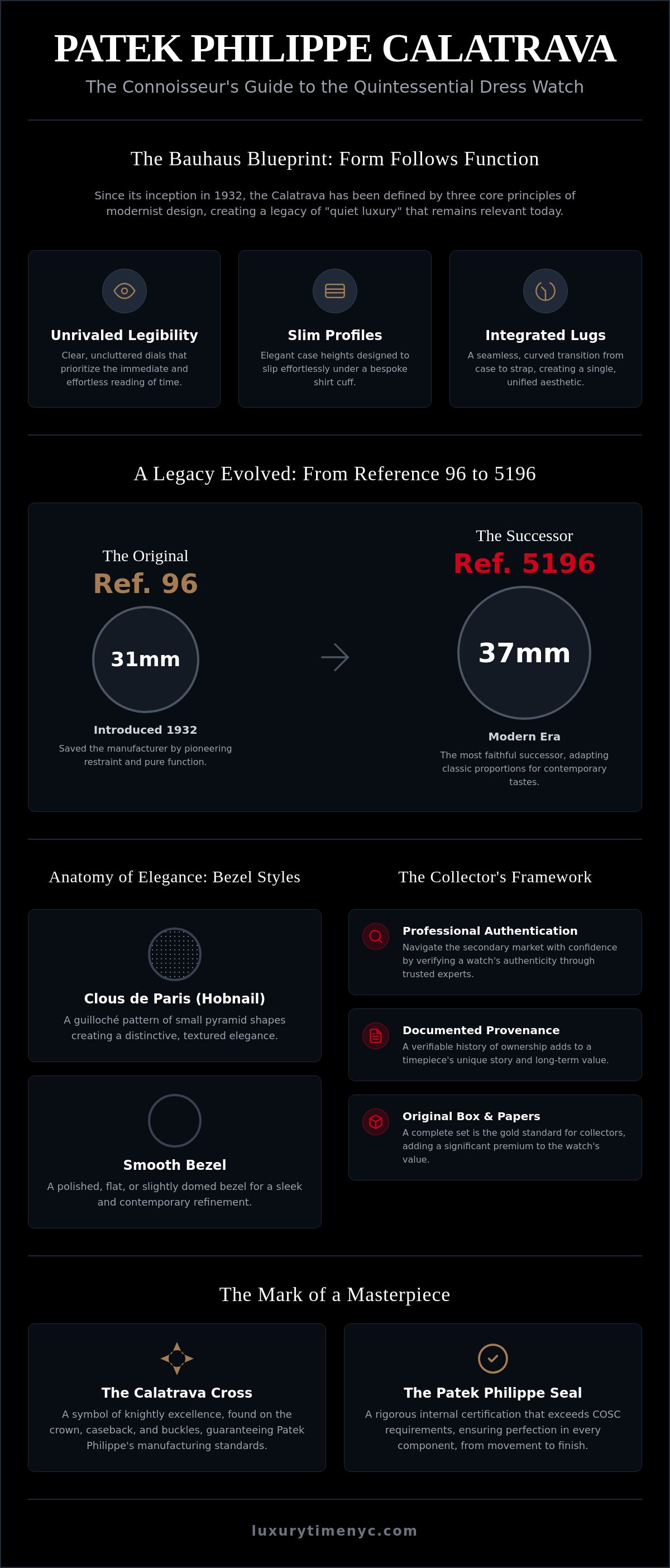
The 1930s marked a global shift toward modernism. The Patek Philippe Calatrava history begins with the Reference 96, a piece that embraced the Bauhaus principle of "form follows function." This philosophy stripped away unnecessary ornamentation. Designers focused on three core elements:
- Unrivaled Legibility: Clear, uncluttered dials that prioritize the immediate reading of time.
- Slim Profiles: Elegant case heights designed to slip effortlessly under a bespoke shirt cuff.
- Integrated Lugs: A seamless, curved transition from the case to the strap for a unified aesthetic.
In 2026, this "quiet luxury" aesthetic is more relevant than ever. Collectors are moving away from aggressive, oversized pieces toward the understated confidence found in the refined proportions of a modern calatrava. It's a statement of taste that requires no explanation.
The Symbolic Calatrava Cross
The Calatrava Cross is more than a logo. It is a mark of knightly excellence and a fact-based guarantee of Patek Philippe’s manufacturing standards. The emblem appears with intentionality across the collection. You'll find it etched onto the crown, embossed on the caseback of specific references, and forming the silhouette of the tang buckles. This symbol confirms that the watch meets the brand's rigorous internal certification.
Every modern calatrava carries the Patek Philippe Seal. This standard exceeds traditional COSC requirements, ensuring that every component, from the movement to the exterior finishing, is executed to perfection. At Luxury Time NYC, we view the cross as a signature of absolute authenticity. It represents a commitment to heritage that few other houses can match. Whether you're admiring the hobnail bezel of a 6119 or the sleek, polished lines of a 5227, the cross remains the ultimate symbol of horological authority in the heart of Manhattan's Diamond District.
Bauhaus Heritage and the Evolution of Reference 96
Reference 96 is more than a vintage watch. It is the savior of Patek Philippe. Introduced in 1932 during the Great Depression, its 31mm case proved that restraint could be a revolutionary force. It established the blueprint for every calatrava that followed. The design was purely functional. It featured flat bezels and integrated lugs that felt modern then and feel timeless now. This original reference saved the manufacturer by offering a product that prioritized essential timekeeping over the ornate excesses of the previous decade.
From Reference 96 to the Modern 5196
The transition from the original 31mm masterpiece to the modern 37mm Reference 5196 represents a careful calibration of heritage. While the case diameter grew to meet contemporary tastes, the soul of the watch remained intact. The original Caliber 12-120 eventually made way for the Caliber 215 PS, a manual-wind movement known for its reliability and remarkable slimness. To understand the Calatrava movement evolution is to appreciate how Patek Philippe balances tradition with mechanical progress. Many collectors view the 5196 as the most faithful successor to the 1932 original because it retains the same dauphine hands and baton markers that first defined the collection.
Technical milestones didn't stop with manual winding. The introduction of self-winding movements in the line allowed for greater daily wearability without sacrificing the signature thinness that defines the brand. If you're looking to compare these historic references in person, our advisors at Luxury Time NYC can guide you through the tactile differences between a vintage 96 and its modern counterparts. We specialize in sourcing pieces that maintain their structural integrity and historical value.
Reference 6119: The New Standard in 2026
The Reference 6119 has become the new benchmark for the modern collector. Its 39mm case size reflects a preference for a more commanding wrist presence in 2026. Inside beats the Caliber 30-255 PS. This movement features dual mainspring barrels, providing an impressive 65-hour power reserve. This is a significant increase from the 44-hour reserve found in the older 215 PS models. The 6119 serves as the definitive bridge between vintage aesthetics and modern engineering. It pairs the iconic "Clous de Paris" bezel with a movement designed for the rigors of the 21st century. This reference proves that a calatrava can be both a tribute to the past and a leader in technical innovation.
Navigating the Collection: Complications, Bezels, and Case Materials
The choice of a calatrava often begins with the bezel. This single design element dictates the watch's entire personality and historical context. Patek Philippe offers two distinct paths for the discerning collector: the legendary Clous de Paris and the understated smooth bezel. Each reflects a different facet of the brand's heritage, from artisanal guilloché work to the sleek lines of modern minimalism.
Clous de Paris vs. Smooth Bezel
The Clous de Paris, or hobnail pattern, is a masterpiece of geometric precision. Found on iconic references like the 3919 and the modern 6119, it features a series of small, pyramid-like structures created through a meticulous guilloché engraving process. This texture isn't just aesthetic. It's remarkably practical. In the secondary market, these bezels often appear in better condition because the pattern effectively masks the micro-scratches that plague high-polish surfaces. While a hobnail bezel is the ultimate companion for a formal tuxedo, the smooth bezels found on the 5227 or 5196 offer a sleek, contemporary look. They transition seamlessly into a business casual environment, providing a more versatile option for daily wear.
Complications in the Calatrava Line
Complications within the collection range from minimalist time-only dials to highly functional instruments. Purists often debate the merits of dial symmetry. The 5196 maintains the classic small seconds sub-dial at 6 o'clock, while the 5227 utilizes a central sweep seconds hand. Many collectors prefer the "time-only" references because they lack a date aperture, preserving the dial's original Bauhaus balance. However, for the modern professional, the collection has expanded into high-utility territory:
- Ref. 5212A Weekly Calendar: A rare stainless steel model that tracks the week number and month.
- Ref. 5524G Travel Time: A pilot-style aesthetic featuring a dual time zone mechanism.
- Ref. 5328G 8-Day: A manual-wind calibre with a staggering 192-hour power reserve.
Material choice further defines the collection's hierarchy. Yellow gold remains a traditionalist's favorite, while rose gold and white gold offer modern warmth and discretion. However, platinum remains the apex of the calatrava family. The platinum 6196P-001 is a prime example of value retention. While many in-production references trade at an average 32% discount on the secondary market, platinum models hold their value better. Data shows the 6196P trades at only an 8.3% discount to its retail price. Stainless steel is an outlier, making models like the 5212A particularly interesting for those seeking rarity in a less precious metal.
One can't discuss the 5227 without mentioning its Officer’s caseback. This hinged dust cover is a subtle nod to vintage pocket watches. It protects the sapphire display back while offering a private moment of horological appreciation. It's a detail that exemplifies the brand's commitment to traditional craftsmanship, allowing the owner to view the movement only when they choose, maintaining an aura of quiet exclusivity.
The Collector’s Framework: Assessing Value and Provenance in 2026
Assessing a calatrava requires more than an appreciation for Bauhaus lines. It demands a clinical evaluation of condition and documentation. In the 2026 market, the gap between a "naked" watch and a complete set has widened significantly. A timepiece accompanied by its original box and papers commands a 15% to 20% premium at Luxury Time NYC. This documentation isn't just paper. It's a verified lineage. It provides the security necessary for a high-value investment.
Dial integrity remains the most critical factor for vintage and neo-vintage pieces. Collectors prize "tropical" dials, where natural UV exposure has shifted the original pigment into unique, warm hues. These are viewed as honest aging. Conversely, a refinished or "redone" dial is a catastrophic failure in value. Authenticity is the only currency that matters in the Diamond District. This is why we insist on professional watch authentication for every pre-owned acquisition. We leave nothing to chance.
The platinum tier represents the apex of this framework. Beyond the weight of the metal, look for the single Top Wesselton diamond set between the lugs at 6 o'clock. This subtle marker distinguishes the most prestigious metal from white gold. It's an "if you know, you know" detail that defines the highest level of collecting. It signals a piece that is both a tool for timekeeping and a concentrated store of wealth.
Investment Potential of Discontinued References
The discontinuation of the 5196 has fundamentally altered the secondary market landscape. Since it left the catalog, prices have surged as collectors realize the 37mm manual-wind reference was the last of its specific lineage. While the 6119 has successfully taken its place, the 5196 is now a "sleeper" reference moving into blue-chip territory. Scarcity drives value. Limited editions, such as those released for specific anniversaries or regional markets, offer the most significant upside for long-term holders. Identifying these undervalued assets requires a partner with deep market access.
The Importance of Service History
A documented service history is a non-negotiable asset for the serious collector. A Patek Philippe service seal acts as a secondary guarantee of excellence. Neglecting movement overhauls on vintage pieces leads to irreversible wear on delicate calibres. Provenance matters. A calatrava sourced from a Manhattan institution like Luxury Time NYC carries the security of a clear ownership history. It ensures the movement is performing to the manufacturer’s original specifications.
Secure your next horological asset with a partner who understands the gravity of heritage and the nuances of the global market at Luxury Time NYC.
Acquiring Excellence: The Luxury Time NYC Experience
The journey to owning a Patek Philippe is as significant as the watch itself. While the digital market offers convenience, it often lacks the gravity required for a high-value investment. Our showroom sits at the heart of Manhattan’s Diamond District. This is the global center of horological commerce. Here, 47th Street provides an unparalleled density of expertise and inventory. Luxury Time NYC operates as a discreet advisor in this fast-paced environment. We prioritize absolute transparency. Authenticity is not a marketing claim; it is a verified fact delivered with the confidence of an established institution.
Sourcing Rare Calatravas in the Heart of Manhattan
Finding a specific reference requires more than a standard search. Our private network of global collectors and dealers allows us to access timepieces that never reach public listings. Whether you seek a discontinued 5196 or the latest 2026 releases, we bridge the gap between desire and acquisition. Understanding the nuances of navigating the 47th Street watch scene is essential for any serious collector looking to avoid the pitfalls of a crowded market.
The tactile experience remains irreplaceable. Under our professional showroom lighting, the subtle differences between various gold alloys become clear. You can feel the weight of a platinum case. You can hear the precise, mechanical click of an Officer’s caseback. This physical consultation ensures the calatrava you select aligns perfectly with your personal style and wrist proportions. It's a level of service that anonymous online platforms simply can't replicate.
Trade-In and Upgrade Services
Many collectors reach a point where they wish to refine their portfolio. Transitioning from stainless steel sports models to the refined elegance of a dress watch is a natural evolution for the sophisticated connoisseur. We offer a seamless, professional process to trade-in for a Calatrava. Leveraging the value of a current Rolex or Audemars Piguet allows you to fund a Patek Philippe acquisition with minimal friction.
Our experts provide fair, market-driven valuations based on real-time data from the global luxury market. We treat every trade-in as a private consultation, ensuring you receive the maximum value for your assets. Once your selection is made, we offer secure, global shipping to provide absolute peace of mind. Your acquisition journey begins with a conversation. Browse our current Patek Philippe Calatrava collection and secure your next heirloom today. We invite you to experience the quiet confidence that only an authenticated calatrava can provide.
Defining the Future of Your Collection
The calatrava remains the ultimate expression of horological restraint. It's a timepiece that transcends seasonal trends, rooted in a century of Bauhaus excellence and mechanical precision. Whether you're drawn to the vintage proportions of a Reference 96 or the technical mastery of the newest 2026 releases, your choice reflects a commitment to enduring value. You've mastered the nuances of hobnail bezels, the critical importance of original documentation, and the security found in documented provenance.
At Luxury Time NYC, we offer more than just inventory. We provide a gateway to rarity through our expert horological sourcing and a physical showroom in the heart of Manhattan’s Diamond District. Every acquisition is backed by our absolute, certified authenticity guarantee. It's time to move beyond the ordinary and invest in a legacy. We invite you to view our curated selection of Patek Philippe Calatrava watches and speak with our advisors. Secure a masterpiece that defines your collection today.
Frequently Asked Questions
Is the Patek Philippe Calatrava a good investment watch?
The Calatrava is a stable horological asset, though its performance varies by metal and reference. In the 2026 secondary market, in-production models trade at an average 32% discount below retail. However, rare platinum references like the 6196P-001 show exceptional resilience, trading at only an 8.3% discount. It is a foundational piece that offers predictable value compared to more speculative sports models.
What is the difference between a Calatrava 5196 and a 6119?
The primary differences are case size and mechanical capability. The discontinued 5196 features a 37mm case and the Calibre 215 PS with a 44-hour power reserve. The modern 6119 increases the diameter to 39mm and utilizes the Calibre 30-255 PS. This newer movement employs dual mainspring barrels to achieve a 65-hour power reserve, offering significantly better performance for the modern collector.
Why is the Calatrava called the "Bauhaus" watch?
This designation stems from the original Reference 96 introduced in 1932. The design followed the Bauhaus principle of "form follows function," which prioritized minimalist aesthetics and absolute legibility. By removing unnecessary ornamentation and integrating the lugs into the case, Patek Philippe created a calatrava blueprint that remains the industry standard for pure, functional elegance nearly a century later.
What does "Clous de Paris" mean on a Calatrava bezel?
Clous de Paris, or "hobnail," refers to a decorative guilloché pattern consisting of small, pyramid-like squares. This geometric texture is a signature of references like the 3919 and 6119. Beyond its sophisticated appearance, the pattern is highly practical for daily wear. The textured surface effectively masks micro-scratches and minor abrasions that would be immediately visible on a high-polish smooth bezel.
Does the Patek Philippe Calatrava hold its value better than the Nautilus?
The Nautilus typically commands higher speculative premiums, but the Calatrava offers a more stable and accessible entry point for long-term wealth preservation. While sports models experience volatile market swings, the dress watch collection maintains a consistent floor. For collectors prioritizing horological heritage over social media trends, the calatrava remains the more disciplined choice for a permanent portfolio.
What should I look for when buying a vintage Calatrava Ref. 96?
Prioritize dial authenticity and case integrity. Many vintage examples from the 1930s and 40s have refinished dials, which catastrophically reduces their value. Look for "tropical" aging or honest patina rather than a suspiciously perfect surface. Ensure the 31mm case has not been over-polished, as this rounds the sharp Bauhaus edges. Professional authentication is mandatory to verify the movement's original components.
Can I wear a Calatrava with casual attire?
Modern iterations are increasingly designed for versatility. Models like the 5226G, with its textured charcoal dial and beige numerals, pair effortlessly with denim or cashmere. The 6007G also offers a more contemporary aesthetic through its "carbon-motif" center dial. While traditionally a formal timepiece, the shift toward larger case sizes and casual materials makes the collection suitable for a sophisticated weekend wardrobe.
How often should a Patek Philippe Calatrava be serviced?
You should schedule a professional service every 3 to 5 years. Regular maintenance is essential for a movement overhaul to replace aged lubricants and check the integrity of the Patek Philippe Seal standards. For manual-wind models, this prevents unnecessary wear on the winding gears and mainspring. Proper care at a specialized NYC institution ensures the watch remains an enduring asset for future generations.


