


A single deep gouge across a high-polished center link does more than catch the light; it disrupts the deliberate harmony of a masterpiece. For the serious collector, the first mark is often the deepest. You recognize that your timepiece is a high-value asset, yet you fear the aggressive wheel of an unskilled technician might soften the very lines that make it iconic. Seeking a professional rolex bracelet scratch removal service is not merely about aesthetics. It's an act of preservation.
We understand the anxiety that accompanies restoration. You demand the return of that factory-fresh brilliance without the loss of precious metal or the rounding of sharp lug edges. This guide reveals the precision techniques used by Manhattan's elite horologists to restore original finishes while maintaining the integrity of your watch's geometry. We'll examine the distinction between brushed and mirror surfaces, the conservation of case shape, and the methods used to ensure your Rolex remains a pristine reflection of its heritage.
Key Takeaways
- Understand why professional restoration is a strategic investment in preserving the architectural integrity of your timepiece.
- Discover the surgical precision of high-torque lathes and specialized wheels required to achieve factory-grade finishes.
- Learn how a premier rolex bracelet scratch removal service in Manhattan protects your asset through rigorous metal conservation.
- Explore the "less is more" philosophy that safeguards the sharp lug edges critical for long-term resale value.
- Gain insight into the multi-stage refinishing process that distinguishes master horology from standard cosmetic cleaning.
The Art of Rolex Bracelet Restoration: Understanding Surface Wear
Ownership begins with a pristine clasp. It ends with a story told in steel. For many, that story includes the inevitable contact with the physical world. A Rolex is engineered for resilience, but it isn't immune to the friction of a life well-lived. Seeking a rolex bracelet scratch removal service marks a pivotal moment for a collector. It's the transition from accepting wear to demanding the restoration of factory-correct standards. This isn't a mere cleaning. It's a strategic preservation of the watch’s financial and aesthetic value.
Every Rolex bracelet is a masterpiece of metallurgy. Whether your piece is crafted from 904L Oystersteel, the warm hue of 18ct Everose gold, or classic yellow gold, the finish is intentional. These surfaces are designed to catch light in specific ways. When scratches mar that surface, they do more than look unsightly; they disrupt the watch's silhouette. Professional restoration returns the metal to the exact specifications set in Geneva, ensuring the piece remains an enduring asset.
Identifying Scratches: Hairlines vs. Deep Gouges
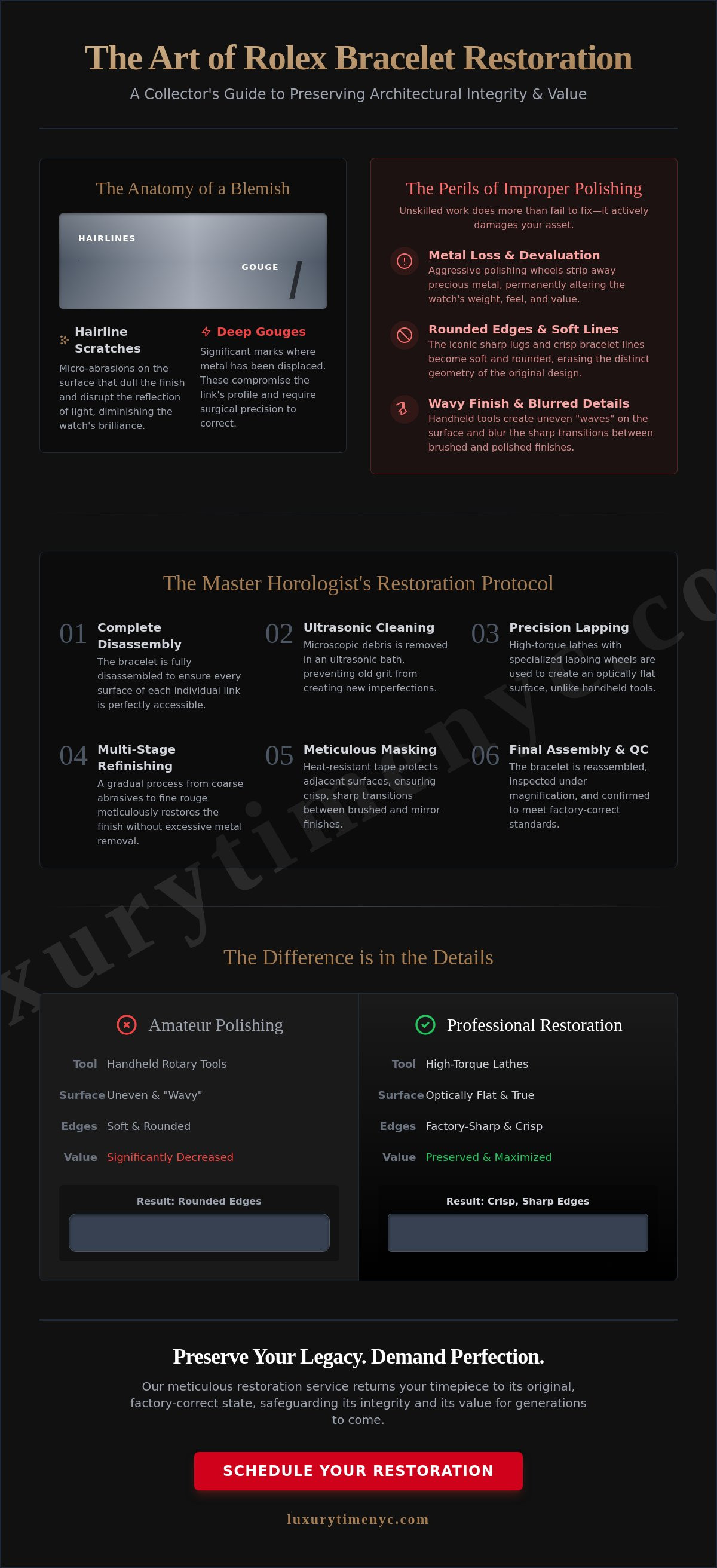
Surface wear exists on a spectrum. Hairline scratches are the most frequent intruders. They are micro-abrasions that affect how light reflects off the brushed or mirror-polished surfaces. While they don't compromise the metal's structure, they dull the watch's brilliance. Deep gouges are more concerning. These marks penetrate the grain of the metal. If your fingernail catches in the groove, the metal has been displaced. Professional restoration at this level is surgical. It requires the skilled hand of an NYC horologist to level the surrounding area without causing a dip in the link's profile.
The Patina Debate: To Polish or Not to Polish?
Collectors often agonize over the unpolished status. In the vintage market, original edges are sacred. For a modern piece, however, deep scratches can lead to metal fatigue or uncomfortable snags on fine cashmere. The Art of Polishing, when executed correctly, is an act of conservation rather than alteration. The goal is never to make the watch look different. The goal is to make it look exactly as it did when it first sat in the jeweler's tray. A conservative approach ensures the lugs remain sharp and the bracelet remains robust.
A professional rolex bracelet scratch removal service understands these metallurgical nuances. They treat each link as an individual component of a larger mechanical sculpture. By utilizing the correct speeds on a high-torque lathe, a master polisher can remove the damage while respecting the original geometry that defines the Rolex brand.
Professional Rolex Polishing Techniques and Horological Standards
True horological restoration is a surgical discipline. It requires more than a steady hand; it demands an adherence to Professional Metal Finishing Standards that generic jewelers simply cannot replicate. A professional rolex bracelet scratch removal service begins with a complete disassembly. The bracelet is detached and stripped of its spring bars. This ensures every surface is accessible. Before any abrasive touches the metal, the components undergo ultrasonic cleaning. Removing microscopic debris prevents "swirling," where old grit creates new imperfections during the refinishing process.
We utilize high-torque lathes equipped with specialized lapping wheels. Unlike handheld tools that create "waves" or uneven surfaces, these stationary machines provide the absolute flatness required for Oyster links. The process is multi-staged. It moves from coarse abrasives to fine rouge, each step refining the light's path across the steel or gold. The goal is a surface that is not just shiny, but optically flat. If your timepiece requires this level of care, a professional watch polishing consultation can help determine the best path for your specific model.
The hallmark of a master horologist is the crispness of the transition. We use specialized heat-resistant tapes to mask off alternating links. This allows us to apply a directional satin finish to the outer links while maintaining a flawless mirror polish on the center links. The result is a sharp, defined contrast that mimics the watch's original assembly. This meticulous masking protects the integrity of the different finishes, ensuring they don't bleed into one another.
Restoring the Oyster and Jubilee Finishes
The Oyster bracelet requires a directional satin finish. It's a linear grain that must be perfectly parallel across every link. The Jubilee, conversely, demands a high-gloss finish on its smaller, rounded center links. Achieving this without rounding the edges is a matter of millisecond timing on the wheel. We maintain the distinct contrast lines that define the Rolex aesthetic. It's a balance of pressure and speed that preserves the architectural strength of the bracelet.
Laser Welding: The Solution for Deep Dents
When a gouge is too deep for traditional refinishing, we don't grind the metal down. That would ruin the case geometry and thin the links. Instead, we employ laser welding. This process involves adding microscopic amounts of matching 904L steel or proprietary gold alloy directly into the void. The laser fuses the new metal to the old at a molecular level. Once leveled and polished, the repair is invisible. It’s the ultimate expression of metal conservation, ensuring no original material is lost to the wheel.
Preserving Investment Value During Scratch Removal
In the high-stakes world of horological collecting, the guiding principle is simple: less is more. Every pass of an abrasive wheel, however slight, removes microscopic layers of material. A premier rolex bracelet scratch removal service prioritizes metal conservation above all else. While a pristine finish is desirable, it must never come at the expense of the watch's silhouette. A Rolex that has been "buffed" into a rounded, shiny pebble loses its architectural soul and its market appeal. Serious collectors look for the crisp lines and substantial weight that signify a well-maintained, rather than an over-processed, timepiece.
The clasp is often the most vulnerable point of contact, yet it carries the most significant branding: the coronet. Amateur refinishing often blurs this relief, turning a sharp emblem into a ghost of its former self. Protecting this detail is paramount. Documented service history from a reputable source can increase a watch's market price by 10% to 20% compared to unserviced counterparts. This premium reflects the buyer's confidence that the metal's integrity remains intact. True value lies in the balance between aesthetic perfection and structural honesty.
The Dangers of Over-Polishing and Rounded Edges
Improper technique leads to "softened" lugs and rounded link edges. When a technician uses a soft buffing wheel without a fixed rest, the edges of the links are inevitably rolled. This creates a convex surface where there should be a flat plane. Over time, aggressive polishing thins the links, leading to premature "bracelet stretch" and compromised structural integrity. A master polisher maintains the sharp, defined transitions that separate the brushed surfaces from the mirror-polished flanks, ensuring the watch feels as substantial as it did on day one.
Maintaining Original Factory Geometry
Maintaining original factory geometry requires the use of a lapping machine. Unlike a standard buffing wheel, a lapping machine uses a flat, rotating disk that ensures surfaces remain perfectly planar. This equipment respects the original chamfers and bevels that define the Oyster and Jubilee designs. Horological geometry is the preservation of factory-intended angles. By adhering to these strict geometric standards, a professional restoration ensures the watch retains its intended light-play and balance. Every angle is a deliberate choice made by the manufacturer; our task is to honor those choices through disciplined conservation.
Selecting a Rolex Bracelet Scratch Removal Service in NYC
Manhattan’s 47th Street is not merely a destination; it is an institution. For the global elite, this dense cluster of expertise represents the definitive standard for horological maintenance. Choosing a rolex bracelet scratch removal service in this environment ensures access to a lineage of craftsmanship that spans generations. It's a world where discretion meets technical mastery. Here, the preservation of your timepiece is treated with the same gravity as the acquisition of a rare stone.
A facility must house its master horologists on-site. Outsourcing a high-value asset like a platinum Daytona or an Audemars Piguet Royal Oak introduces unnecessary risk and a lack of accountability. Specialists who handle the "Holy Trinity" alongside Rolex daily possess a refined horological eye. They understand that the finishing on a Cartier Tank requires a different pressure than the Oystersteel of a Submariner. Security is equally paramount in a metropolitan center. A reputable institution maintains high-level insurance and advanced vaulted storage. They treat your timepiece with the reverence a high-value investment deserves, ensuring peace of mind from drop-off to final reveal.
The Diamond District Advantage
The historical context of 47th Street as a hub for rare parts and expert labor is unparalleled. It's the global epicenter for watch restoration. Proximity matters. Being located in the heart of this district allows for immediate access to specialized tools and authentic Rolex components that other regions struggle to source. For those visiting the city, Navigating 47th Street: The Connoisseur’s Guide provides essential insight into this exclusive landscape. This concentration of talent ensures that even the most complex bracelets are restored to factory specifications without compromise.
Red Flags in Watch Refinishing
Avoid the temptation of "while-you-wait" polishing. High-caliber restoration is a slow, deliberate process. Quick-fix kiosks often skip the critical disassembly phase. This leads to uneven finishes and the dreaded softening of case edges. A professional quote should always be holistic. It must include a movement health check and a mandatory pressure test. Polishing involves heat and vibration; ensuring the seals remain intact is non-negotiable. Shops that bypass ultrasonic cleaning pose a significant danger. Leaving abrasive grit within the link junctions causes internal friction and accelerated wear. For a truly professional result, entrust your timepiece to a specialist in bespoke watch restoration.
The Luxury Time NYC Restoration Experience
Luxury Time NYC represents the pinnacle of horological stewardship. We don't merely repair; we curate. Our approach to bracelet and case refinishing is defined by an uncompromising commitment to conservative restoration. For the modern collector, a timepiece is a legacy asset. It requires a hand that understands the delicate balance between removing a blemish and preserving provenance. Every rolex bracelet scratch removal service we perform is guided by this philosophy of minimal intervention for maximum impact. We protect the edges that others might round. We honor the metal that others might waste.
Our concierge-level experience begins with a private consultation. We analyze the specific needs of your inventory with the discretion you expect. Whether your collection resides in Manhattan or requires secure global shipping, our logistics are as precise as our horological tools. We specialize in the acquisition and maintenance of rare models, ensuring even the most elusive references remain in showroom condition. This is a partnership in preservation. Your watch is treated as an enduring asset, not a temporary accessory.
Bespoke Refinishing for Serious Collectors
We recognize that every collector has distinct objectives. A daily-wear GMT-Master II demands a different intensity of restoration than a museum-grade reference destined for the auction block. We tailor our polishing intensity to your specific goals. Using state-of-the-art equipment, we replicate the original Rolex factory grain with microscopic accuracy. For those seeking deeper insight into our standards, The Connoisseur’s Guide to Luxury Watch Repair in NYC offers a comprehensive look at our methodology. We don't just restore surfaces; we restore the watch's intended aesthetic identity.
Integrated Maintenance and Authentication
Aesthetics are nothing without functional integrity. At Luxury Time NYC, our rolex bracelet scratch removal service is never an isolated procedure. It's an entry point into a comprehensive multi-point inspection. We examine the movement's beat error, verify water resistance through rigorous pressure testing, and inspect the clasp's safety mechanisms. This holistic view ensures your watch performs as flawlessly as it looks. Additionally, our certified authenticity guarantees provide the absolute peace of mind essential for high-value investments. We act as the final word in horological truth. Precision. Uncompromised.
Inquire about our professional restoration services at Luxury Time NYC to experience the standard that Manhattan's elite collectors demand.
Honoring the Heritage of Your Timepiece
Restoring a Rolex bracelet is a meticulous balance of metallurgical science and aesthetic discipline. True preservation requires maintaining factory geometry and avoiding the softened, rounded edges common in amateur work. Every pass of the wheel must be intentional. Every link must be respected. Safeguarding the architectural integrity of your watch ensures it remains a pristine reflection of its heritage and a robust financial asset. Aesthetic perfection should never come at the cost of structural honesty.
Choosing a professional rolex bracelet scratch removal service in Manhattan ensures your timepiece is handled by those who understand high-stakes horology. Located in the heart of NYC’s Diamond District, Luxury Time NYC specializes in the restoration of investment-grade Rolex and Patek Philippe pieces. Our process is defined by master horologist oversight and absolute authenticity guarantees. We don't just remove surface wear; we protect the soul of the machine. Your collection represents a lifetime of achievement, and it deserves the quiet confidence of expert hands.
Restore your timepiece to its original brilliance at Luxury Time NYC. Experience the standard that New York's most discerning collectors demand.
Expert Guidance on Rolex Restoration
Can all scratches be removed from a Rolex bracelet?
Most surface abrasions and hairlines can be eliminated through professional refinishing. However, the depth of the damage dictates the methodology. While standard polishing resolves light wear, deep gouges that penetrate the metal's grain may require additive techniques like laser welding to avoid excessive metal loss. A master horologist assesses each link to determine the threshold between aesthetic restoration and structural preservation.
How much metal is actually removed during a professional Rolex polish?
A disciplined refinishing process removes a microscopic layer of material, typically measured in microns. The objective is to level the surrounding surface to the depth of the abrasion. By utilizing high-torque lathes and specialized wheels, experts ensure that the material loss is negligible. This precision allows the bracelet to retain its original weight and robust feel even after multiple services over several decades.
Does polishing my Rolex bracelet lower its resale value?
Professional refinishing often enhances the market appeal of modern timepieces. For contemporary models, a factory-fresh appearance is a significant selling point. A documented rolex bracelet scratch removal service from a reputable Manhattan institution can increase the selling price by 10% to 20%. While vintage collectors may prefer an unpolished state, modern buyers prioritize the brilliance and crispness of a well-maintained asset.
What is the difference between polishing and laser welding?
Polishing is a subtractive process that smooths the surface by leveling the metal, while laser welding is an additive restoration technique. Laser welding involves fusing microscopic amounts of matching 904L steel or gold alloys directly into deep dents. This allows us to fill a gouge without grinding down the surrounding area. It is the ultimate solution for preserving the original factory geometry of the watch.
How often should I have my Rolex bracelet refinished?
Refinishing is best reserved for major service intervals, typically every five to ten years. Frequent polishing can lead to the "softening" of sharp edges and the thinning of links over time. By aligning cosmetic restoration with a full movement overhaul, you ensure the watch remains in peak condition without compromising its architectural integrity. Accept minor hairlines as the natural patina of a life well-lived between these intervals.
Can I remove scratches from a gold Rolex bracelet at home?
Attempting home restoration on precious metals is high-risk and often results in permanent aesthetic damage. Gold is significantly softer than Oystersteel and requires precise torque control to maintain flat surfaces. DIY polishing cloths and abrasive pastes frequently create "waves" in the metal and round off the crisp transitions of the links. Professional intervention is required to achieve the optically flat mirror finish intended by the manufacturer.
How long does a professional Rolex scratch removal service take in NYC?
A standard restoration typically requires several business days to complete the multi-stage refinishing process. This timeline allows for complete disassembly, ultrasonic cleaning, and the meticulous masking of alternating brushed and polished links. In the heart of the Diamond District, the pace of work reflects a commitment to artisanal quality rather than the hurried output of high-volume repair kiosks. Quality restoration is a slow, deliberate discipline.
Will scratch removal affect the water resistance of my Rolex?
Refinishing the bracelet does not impact the watch's seals, but case restoration requires a mandatory pressure test. Any professional rolex bracelet scratch removal service should include a comprehensive multi-point inspection. This ensures that the heat and vibrations from the polishing wheel haven't compromised the gaskets. Verifying water resistance is a non-negotiable step in maintaining the functional integrity of a high-value timepiece.


