


For the discerning collector, the distinction between a watch that knows the month and one that understands the century is the difference between a fine tool and a permanent legacy. You recognize that both complications represent the zenith of horological engineering. However, selecting the right perpetual calendar vs annual calendar watch often brings a unique set of anxieties regarding mechanical fragility and the true cost of ownership in 2026. It's a choice that defines how you interact with time itself.
We understand that at this level of acquisition, clarity is as valuable as the movement. This guide explores the mechanical nuances, investment potential, and lifestyle fit of horology’s most prestigious calendar complications. You'll gain a technical understanding of why a Patek Philippe perpetual calendar remains an undisputed sovereign of the secondary market, while modern annual calendars offer a robust, daily elegance. We provide the expert insight needed to secure an investment-grade timepiece that aligns with your personal heritage. From the NYC Diamond District to the auction houses of Geneva, we examine the path to a confident, authoritative purchase.
Key Takeaways
- Understand the leap year wheel, the mechanical heart that allows a perpetual calendar to remain accurate until the year 2100.
- Compare the perpetual calendar vs annual calendar watch through the lens of modern utility, weighing the ease of annual adjustments against the prestige of century-spanning engineering.
- Identify why specific Patek Philippe references, such as the 5327G and 5205G, continue to command a significant premium in the 2026 secondary market.
- Evaluate long-term ownership requirements, including the specialized movement overhaul services essential for maintaining these intricate mechanical computers.
- Discover how to navigate the NYC Diamond District to secure a legacy timepiece that functions as a stable, high-value asset.
Mastering the Horological Calendar: An Introduction to Complications
The distinction between a simple date window and a high-complication calendar is profound. A standard date wheel requires manual correction five times a year to account for months with fewer than 31 days. High-complication models offer a more seamless, elevated experience. Understanding the nuances of a perpetual calendar vs annual calendar watch is essential for any collector entering the 2026 market. These two titans represent different philosophies of engineering, utility, and prestige.
The Evolution of Timekeeping Mastery
Calendar complications first appeared in pocket watches, where generous cases accommodated complex gearing. The transition to the wrist required radical miniaturization, a feat perfected by masters like Patek Philippe. Today, the calendar is arguably the most useful high complication for daily wear. It provides immediate, functional data that bridges the gap between mechanical art and daily life. In our digital age, owning a mechanical calendar is a definitive statement of exclusivity. It signals an appreciation for heritage that requires no software or battery. It's a quiet authority on the wrist.
Defining the Perpetual vs. Annual Distinction
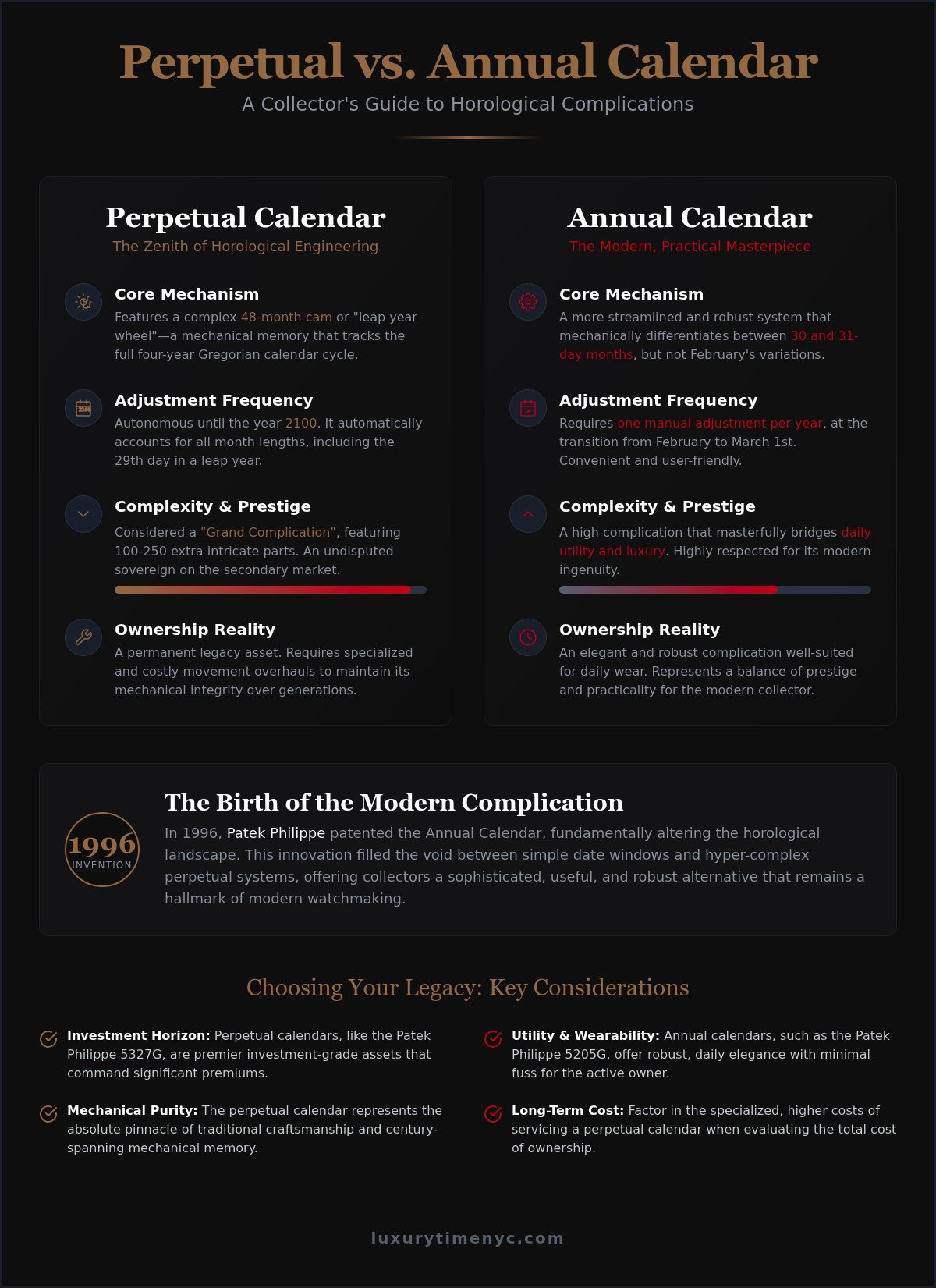
The Perpetual calendar is an autonomous mechanism designed to track the date accurately for over a century without manual intervention. It accounts for the varying lengths of months and the intricacies of leap years. By contrast, the Annual Calendar is a 20th-century innovation that expertly bridges utility and luxury. This complication requires only one manual adjustment each year, specifically at the transition from February to March. In 2026, the baseline expectation for these timepieces remains absolute mechanical integrity. At Luxury Time NYC, we view these items not merely as accessories, but as enduring assets that maintain their value within the heart of the Diamond District.
The Mechanical Divide: Perpetual vs. Annual Architectures
The architecture of a high complication is a study in mechanical logic. To truly grasp the nuances of a perpetual calendar vs annual calendar watch, one must look beneath the dial. Here, wheels and levers perform a silent, relentless dance of calculation. Precise logic. Relentless engineering. The perpetual calendar is a master of memory. It accounts for 28, 30, and 31-day months with effortless precision. It even anticipates the leap year. Conversely, the annual calendar operates on a more streamlined logic. It recognizes the transition between 30 and 31-day months but requires human intervention for the shortest month of the year. For the serious collector, these differences are not merely technical; they dictate the rhythm of ownership.
Patek Philippe fundamentally altered the horological landscape in 1996. Their patent of the Annual Calendar mechanism introduced an entirely new category of complication. It effectively filled the vast void between simple date displays and the dense, complex perpetual systems. This innovation offered collectors a sophisticated alternative that prioritized both daily utility and mechanical ingenuity. It remains a hallmark of the brand's commitment to evolving the art of watchmaking. For many, this patent represents the birth of the "modern" complication. It's a bridge between tradition and contemporary life.
Inside the Perpetual Calendar Mechanism
The heart of the perpetual complication is the 48-month cam. This intricate component tracks the full four-year cycle of the Gregorian calendar. It's a mechanical program etched in steel. Because of this mechanical memory, a Perpetual Calendar requires no manual adjustment until the year 2100. This is the specific year when the Gregorian calendar omits a leap year that would otherwise occur. Such movements frequently earn the "Grand Complication" designation. They represent the absolute peak of traditional craftsmanship. A perpetual movement typically contains between 100 and 150 more components than its annual counterpart. Every part is hand-finished. Every gear is essential.
The Ingenuity of the Annual Calendar
The Annual Calendar uses a simplified gear train to achieve its high utility. By utilizing wheels rather than the traditional levers found in perpetual movements, it offers increased robustness. The "February Exception" is its only limitation. Because the mechanism doesn't account for February's 28 or 29 days, a single manual adjustment is necessary every March 1st. This Guide to Calendar Watches highlights how this reduction in component count often results in a more durable timepiece. It's a masterclass in efficient engineering. If you're considering adding one of these masterworks to your collection, our experts can guide you through a movement overhaul to ensure your calendar remains perfectly synchronized.
Practical Realities: Setting, Servicing, and Daily Wear
Owning a grand complication is a profound commitment. It is a relationship between the collector and the machine. The "dreaded adjustment" occurs when a perpetual calendar exhausts its power reserve. Resetting the intricate sequence of day, date, month, and leap year is a meticulous task. It requires patience. For many, this is where the perpetual calendar vs annual calendar watch debate becomes a matter of lifestyle. An annual calendar is far more forgiving. It allows for a swifter return to accuracy after a period of rest. It's a practical choice for the collector who rotates their pieces frequently.
Serious collectors often rely on high-end watch winders to maintain the mechanical pulse of their timepieces. This ensures the calendar remains synchronized. In the demanding environment of New York City, a watch winder provides peace of mind. It protects the delicate gears from the strain of frequent manual resetting. While a Patek Philippe is engineered for longevity, its calendar mechanism remains a sensitive instrument. It demands respect. It requires a steady, rhythmic energy to function at its peak.
The Ritual of Setting Your Timepiece
Understanding the "danger zone" is essential for the preservation of your movement. You should never adjust the calendar functions between 10 PM and 2 AM. During these hours, the gears are already engaged in the changeover process. Forcing an adjustment can lead to mechanical failure. Modern 2026 calibers have introduced more user-friendly innovations, such as recessed pushers and crown-based settings that offer greater security. For those seeking professional assistance with these delicate operations, we recommend consulting The Connoisseur’s Guide to Luxury Watch Repair in NYC (2026) for expert guidance.
Maintenance and Longevity
Servicing costs reflect the mechanical density of the movement. A perpetual calendar movement contains significantly more components than an annual calendar. This complexity requires specialized expertise. Regular pressure testing is vital to ensure the case remains sealed against the elements. We believe that professional movement overhauls are non-negotiable for investment-grade pieces. These intervals ensure that lubricants remain fresh and parts show minimal wear. A well-maintained perpetual calendar vs annual calendar watch will not only hold its value but will appreciate as a functional work of art for generations.
Curated Excellence: Standout Calendar Timepieces at Luxury Time NYC
The selection of a high-complication timepiece is an exercise in personal style. At Luxury Time NYC, we curate only the most significant examples of mechanical artistry. The Patek Philippe 5327G stands as the quintessential Perpetual Calendar. Its recessed sub-dials and Breguet numerals evoke a classical heritage. In contrast, the Patek Philippe 5205G offers a masterclass in Annual Calendar design. It utilizes three sweeping apertures at the top of the dial to display the day, date, and month. This layout provides immediate legibility. Choosing between a perpetual calendar vs annual calendar watch often depends on whether you prefer these clean windows or the intricate depth of traditional sub-dials.
For the modern collector, the Audemars Piguet Royal Oak Perpetual Calendar offers a different perspective. It combines the legendary octagonal silhouette with a movement of incredible thinness. The dial layout is a study in balance. It manages to present a wealth of information without sacrificing the bold, architectural identity of the Royal Oak. Whether you seek the classicism of Patek or the avant-garde spirit of AP, the choice reflects your unique approach to horology. The perpetual calendar vs annual calendar watch distinction is most visible in how the manufacturer chooses to balance this information with negative space.
The Patek Philippe Calendar Collection
Patek Philippe remains the undisputed sovereign of the calendar complication. Their movements are celebrated for more than just their mathematical precision. The moon phase accuracy is legendary. It deviates by only one day every 122 years. Note the leaf-shaped hands. They glide over sunburst dials with a quiet grace. This level of detail is why serious investors focus their attention here. We invite you to explore the current inventory in our Patek Philippe Calendar collection to find your next legacy piece. Every item is verified by our in-house experts for absolute authenticity.
Alternative Icons: Audemars Piguet and Beyond
The landscape of high horology extends beyond Geneva. Audemars Piguet has mastered the ultra-thin perpetual movement, a technical feat that allows for a more wearable, discreet profile. Richard Mille approaches the calendar with a futuristic lens. They utilize grade 5 titanium and carbon TPT to house their complications. These pieces are designed for the collector who values extreme performance alongside mechanical tradition. Our expert network in the Diamond District allows us to source even the rarest references. If you are searching for a specific grand complication, contact our professional advisors for a private, high-end consultation.
Strategic Acquisition: Choosing Your Legacy in the Diamond District
Acquiring a high complication in the heart of the NYC Diamond District is a rite of passage for the serious collector. It is an exercise in strategic foresight. When evaluating the perpetual calendar vs annual calendar watch through the lens of investment, the distinction is clear. Perpetual calendars are frequently viewed as the ultimate "grail" watches. Their mechanical complexity translates directly to market scarcity. In 2026, these pieces function as stable, high-value assets that often outperform traditional financial instruments. They are not merely purchases. They are legacies.
The "Patek Premium" remains a dominant force in the global luxury market. Certain references, particularly those with rare dial configurations or limited production runs, tend to appreciate with surgical precision. This appreciation is driven by a global community of connoisseurs who value the technical mastery required to build a 48-month cam system. While the annual calendar offers a robust and stable entry point, the perpetual complication remains the preferred choice for those seeking a long-term hold with significant historical weight. Understanding these market dynamics is essential for any modern collector. Knowledge is power.
Investment Value and Resale Potential
Scarcity dictates value. A perpetual calendar movement is produced in far fewer numbers than an annual calendar, creating a natural ceiling on supply. This makes the perpetual calendar a more resilient asset during periods of market volatility. It is the cornerstone of any serious horological portfolio. For a deeper analysis of the current market, we invite you to consult our Patek Philippe New York: The 2026 Collector’s Guide to Acquisition. This resource provides the data-driven insights needed to navigate the complexities of high-end acquisition with confidence. It is your roadmap to value.
Your Private Consultation in NYC
The "on-wrist" experience is non-negotiable. A watch of this caliber must be felt. Its weight and balance are as important as its movement. At Luxury Time NYC, we provide a discreet, professional environment for these critical evaluations. We offer expert guidance for those buying and selling watches to upgrade or diversify their collections. Every timepiece in our inventory comes with a definitive authenticity guarantee. This is an absolute fact. We act as guardians of authenticity. We invite you to Explore our curated selection of Patek Philippe Calendar watches and begin your next chapter in horological history. Private appointments are available. Global shipping is standard.
Securing Your Horological Legacy
The choice between a perpetual calendar vs annual calendar watch is a defining moment for any serious collector. It's a balance of mechanical ambition and modern utility. You've explored the intricate 48-month cams that power the perpetual's century-spanning autonomy. You've seen how the annual calendar's streamlined logic offers a robust, daily elegance. Both complications represent the zenith of engineering. They aren't merely accessories; they're enduring assets that command respect in any global center of commerce.
At Luxury Time NYC, we provide the expertise required to navigate these high-value investments. Our showroom in the NYC Diamond District serves as a gateway to the world's most prestigious manufacturers. Every timepiece in our curated inventory comes with an absolute authenticity guarantee. This is a fact. From expert sourcing to professional movement overhauls, we ensure your timepiece remains a precise record of your legacy. We invite you to acquire a piece of history that speaks with quiet confidence. Your next acquisition awaits.
Browse the Patek Philippe Calendar Collection at Luxury Time NYC
Frequently Asked Questions
What is the main difference between an annual and a perpetual calendar?
The primary difference is the mechanical memory regarding month lengths and the leap year cycle. A perpetual calendar accounts for every month length and the four-year leap year cycle, requiring no correction until the year 2100. An annual calendar recognizes 30 and 31-day months but fails to account for February. Consequently, an annual calendar requires a manual adjustment once per year on March 1st. This distinction is the core of the perpetual calendar vs annual calendar watch comparison for most collectors.
Do I need a watch winder for a perpetual calendar watch?
A watch winder is highly recommended for any perpetual calendar to maintain the complex synchronization of its displays. Because resetting these movements after they stop is a meticulous and time-consuming process, keeping the mainspring wound ensures the date, month, and leap year indicators remain accurate. For collectors with multiple high-complication timepieces, a winder preserves the mechanical memory of the watch and prevents the need for professional intervention to resync the delicate calendar sequence.
How often does a perpetual calendar need to be adjusted?
A perpetual calendar requires no manual adjustment until the year 2100, provided the movement remains wound and running. This specific year is an exception in the Gregorian calendar where a leap year is omitted. In contrast, an annual calendar must be adjusted once every year at the end of February. While the perpetual offers "set it and forget it" convenience for a century, the annual calendar requires a brief ritual of manual correction every March 1st to remain accurate.
Why are perpetual calendar watches so much more expensive?
Perpetual calendar watches command a higher premium due to the extreme mechanical density and labor-intensive finishing required. These movements typically contain 100 to 150 more components than an annual calendar, including the complex 48-month cam and leap year wheel. Each part must be hand-finished to exacting standards to ensure the friction-heavy mechanism operates reliably over decades. The rarity of the expertise needed to assemble these Grand Complications further drives their significant market value.
Can an annual calendar watch handle leap years?
No, the annual calendar mechanism is not designed to account for the variable length of February or the quadrennial leap year. It treats February as a 30-day month in its internal logic, which is why it requires a manual advance on March 1st. This limitation is the primary mechanical trade-off when choosing a perpetual calendar vs annual calendar watch. The perpetual calendar remains the only mechanical solution that autonomously tracks the 29th of February without human intervention.
Is a perpetual calendar watch a good investment for 2026?
High-complication watches from prestigious manufacturers like Patek Philippe remain exceptionally stable assets in the 2026 market. Perpetual calendars benefit from extreme scarcity and a "grail" status among global collectors. These pieces often appreciate as functional art, provided they have a documented service history and verified provenance. Investing in a grand complication from a reputable NYC Diamond District specialist ensures you are acquiring a timepiece with enduring liquidity and historical significance that transcends simple fashion trends.
What happens if I set my perpetual calendar at the wrong time of day?
Adjusting a calendar complication during the "danger zone", typically between 10 PM and 2 AM, can cause severe mechanical damage. During this window, the gears are already engaged in the automatic changeover process. Forcing a manual adjustment can bend levers or break teeth on delicate wheels. If your watch has stopped during these hours, it's safer to advance the time past 2 AM before attempting to change any calendar indicators or seeking a professional movement overhaul for safety.
Does Patek Philippe still make the best annual calendars?
Patek Philippe remains the definitive authority on the annual calendar, having invented and patented the complication in 1996. Their movements, such as those found in the 5205G or 5396R, are celebrated for their elegant aperture-based layouts and mechanical reliability. While other prestigious brands have since introduced their own versions, the Patek Philippe execution continues to set the industry standard for legibility, finishing, and long-term value retention in the global secondary market. It is the gold standard.


