


In the rarefied world of high-stakes horology, metal that is removed can never be replaced. Every stroke of an abrasive wheel alters the original geometry intended by the artisans in Geneva. Sharp edges. Precise bevels. Pristine geometry. These are the hallmarks of a masterpiece. For the discerning collector, the difference between a factory finish and a compromised case represents more than just aesthetics. It represents a significant delta in investment value. Understanding how to tell if a Rolex has been overpolished is the essential skill that separates the casual buyer from the true connoisseur.
You likely recognize the anxiety that comes with inspecting a vintage Submariner or a classic Datejust. One wrong move can lead to overpaying for a watch that has lost its structural integrity and historical soul. We will master the art of identifying these subtle shifts in form. This guide delivers a precise checklist of physical signs, ranging from soft lugs to faint engravings, designed to give you absolute confidence during your next acquisition. We explore why unpolished pieces command such a staggering premium in the 2026 market and how you can spot a professional refinish that respects the heritage of the crown.
Key Takeaways
- Protect your investment potential by understanding why original factory geometry remains the ultimate marker of provenance in the 2026 market.
- Identify the visual cues of excessive metal loss, such as the "melted soap" effect, to master how to tell if a Rolex has been overpolished before you buy.
- Evaluate the integrity of chamfers and crown guards to ensure the timepiece retains the sharp, intentional lines of its original Swiss engineering.
- Adopt a professional inspection protocol using a 10x loupe to scrutinize grain patterns and verify the centering of lug holes against factory standards.
- Recognize the value of expert evaluation in the NYC Diamond District to distinguish between destructive third-party work and professional refinishing.
The Impact of Polishing on Rolex Heritage and Resale Value
A Rolex is a sculpture in steel or gold. Its value resides in its lines. In the 2026 collector market, the philosophy of the "unpolished" watch has reached a zenith. Collectors no longer seek perfection; they seek honesty. Every abrasive touch removes metal that can never be recovered. This is the irreversible loss of horological history. Sharp edges. Precise bevels. Understanding how to tell if a Rolex has been overpolished is the first step in sophisticated asset management. Case lines are not merely aesthetic. They are the primary drivers of long-term investment yield.
Distinguishing between a sympathetic service polish and a destructive amateur effort is crucial. A factory-spec refinish performed by a skilled watchmaker respects the original architecture. It uses specialized laps to maintain flat surfaces. An amateur "hack job" uses a soft buffing wheel. This rounds every corner. It blurs the transitions. Mastering how to tell if a Rolex has been overpolished allows a collector to bypass these compromised assets. Pristine geometry is the ultimate luxury.
Why Collectors Pay a Premium for Original Geometry
In high-end trading, "honest" condition refers to a watch that shows its age without losing its shape. It's the presence of original factory brushing. This texture is incredibly rare in vintage pieces. Most have seen decades of service cycles. An overpolished case often signals a hidden history. It suggests the seller tried to mask heavy impact damage or deep corrosion. For the elite collector, a few "honest" scratches are preferable to a watch that has been "melted" into a characterless pebble.
The Economics of Metal: Why Weight and Shape Matter
Metal has mass. Every polishing cycle removes microns of material. In gold models, this loss is literal wealth disappearing from the case. Over time, lugs become thin and asymmetrical. This affects the structural integrity of the bracelet fit. A thinned lug can no longer support the spring bar with factory precision. This leads to excessive "stretch" and potential failure. Provenance, in the context of case finishing, serves as the indelible record of a timepiece's physical journey and the respect shown to its original form.
Identifying the Physical Markers of an Overpolished Rolex Case
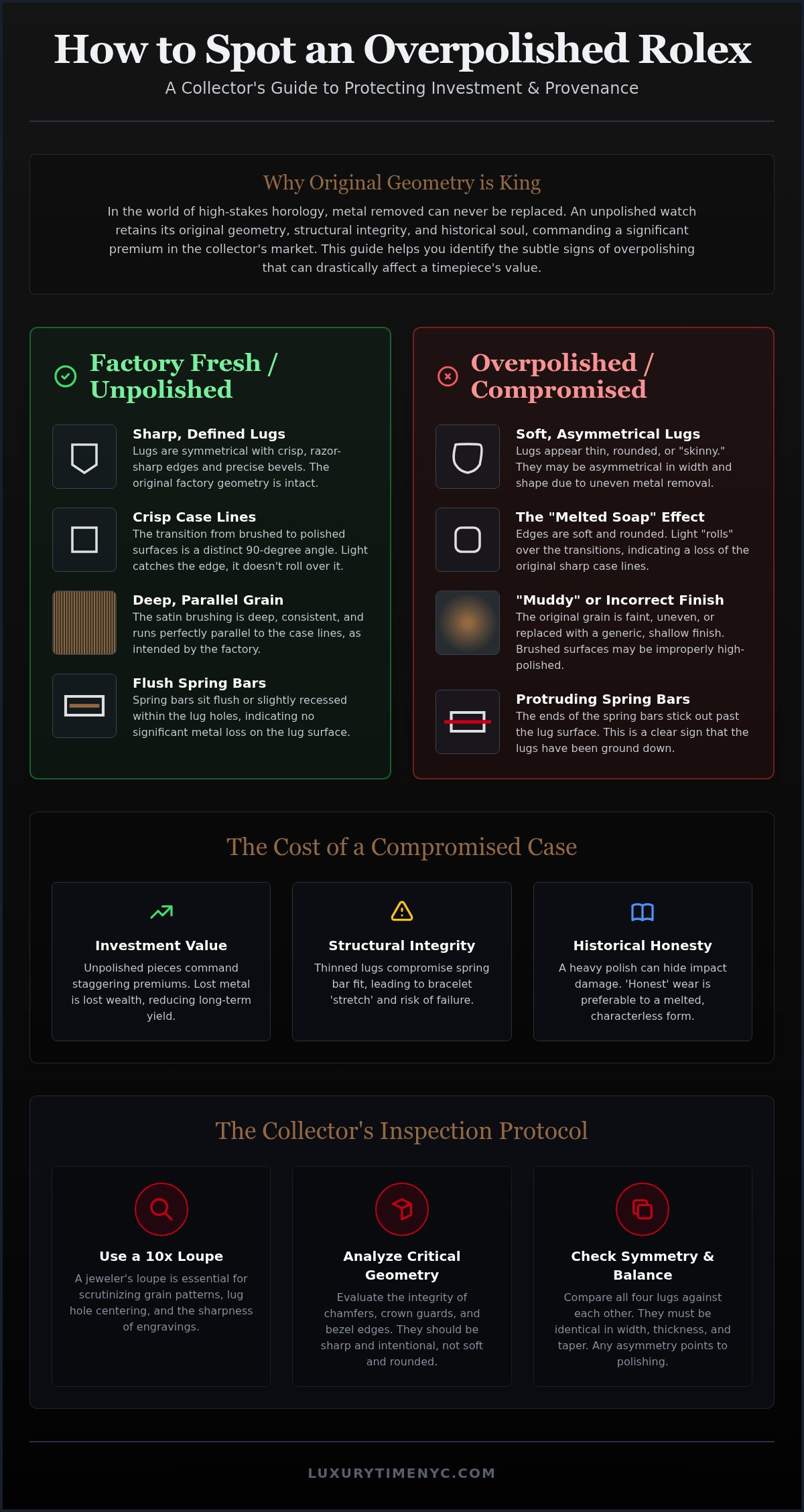
Inspection is a sensory experience. A factory-fresh Rolex case is a study in sharp angles and deliberate textures. When these details blur, the watch begins to lose its horological identity. Learning how to tell if a Rolex has been overpolished involves training your eye to see what's missing, rather than what's present. One of the most immediate indicators is the spring bar fit. On a crisp, untouched case, the spring bars remain flush or slightly recessed within the lug holes. If the ends of the bars protrude beyond the edge of the metal, it's a definitive sign that the lug surface has been ground down through repeated or aggressive polishing cycles.
Texture provides another vital clue. Rolex utilizes a specific, directional satin brushing on the tops of the lugs. This grain should be deep, consistent, and perfectly parallel to the case lines. Overpolishing often leaves this surface "muddy" or replaces the intentional grain with a generic, shallow finish. In extreme cases, a polisher might even attempt to hide damage by turning a brushed surface into a high-polish one, a direct violation of the original design architecture. Adhering to strict industry standards requires a level of restraint that many third-party polishers simply lack.
The 'Melted Soap' Aesthetic: Softened Profiles
Light is your most valuable tool during an inspection. Hold the watch so light catches the edge where the polished side meets the brushed top. On an original case, this transition is a razor-sharp, 90-degree angle. It should be crisp enough to almost feel sharp to the touch. Overpolished watches exhibit the "melted soap" effect. The edges look soft, rounded, and fluid. Instead of a distinct line, the light will "roll" over the edge in a curved reflection. This softening fundamentally alters the watch's topographical profile and silhouette.
Asymmetry and Proportions: The Visual Balance Test
Balance is the hallmark of Swiss engineering. When evaluating a timepiece, compare the four lugs against one another. They should be identical in width and taper. It's common to find a "skinny" lug on a watch that's suffered a deep dent; a technician may have ground that specific area down to remove the mark, leaving it visibly thinner than its counterparts. This asymmetry ruins the watch's wrist presence and balance. If you're unsure about a potential acquisition, consulting experts in watch authentication ensures you aren't inheriting someone else's mistake. A compromised lug is a permanent alteration to the watch's structural integrity.
Critical Geometry: Analyzing Lugs, Crown Guards, and Bezel Sharpness
Geometry is the soul of a Rolex. It represents the original intent of the Swiss engineers who designed these icons to withstand the rigors of professional use. When metal is lost, the architecture collapses. This loss of form is central to learning how to tell if a Rolex has been overpolished. A watch with preserved geometry feels substantial. It reflects light with military precision. Every angle serves a purpose. When those angles are compromised, the watch loses its "wrist presence" and its historical value.
The relationship between different case components is delicate. On a tool watch, the transitions should be intentional and clear. Overpolishing blurs these boundaries. It turns a precision instrument into a soft, characterless object. Discerning collectors prioritize the "skeleton" of the watch over a superficial shine. They understand that a few scratches on a thick, sharp case are far more desirable than a "mint" watch that has been ground down to a shadow of its former self.
The Art of the Chamfer: Factory vs. Aftermarket
On vintage sports models, the chamfer is the wide, angled bevel between the brushed top and the polished side of the lug. A factory chamfer has a specific width and a consistent, matte-to-polished transition. Aftermarket "re-cuts" are increasingly common. These attempts to mimic factory finishes often fail under close scrutiny. They are often too wide, lack the correct angle, or show inconsistent depth. Discerning collectors look for the "ghost" of the original line. If the bevel looks too fresh or artificial compared to the rest of the watch, it's likely a modern intervention. Understanding these nuances is part of The Connoisseur’s Guide to Luxury Watch Repair in NYC (2026), where original specifications remain the only acceptable standard.
Crown Guards: The First Line of Defense
Crown guards are often the first victims of aggressive polishing. They are small and exposed, making them easy targets for a buffing wheel. On a Submariner or GMT-Master, the guards should be symmetrical. They should cradle the winding crown with authority. Overpolishing leads to "needle-point" guards that look dangerously thin. Some guards become "stubby," losing their elegant taper. Symmetry is essential. Comparing the top guard to the bottom guard often reveals the truth. Thickness serves as a historical record of every service cycle the watch has endured. Mastering how to tell if a Rolex has been overpolished requires a deep analysis of these protective shoulders.
A serious acquisition demands a rigorous methodology. Mastering how to tell if a Rolex has been overpolished requires more than a cursory glance; it demands a disciplined, multi-point inspection. Professional collectors rely on a 10x loupe to scrutinize the micro-details that the naked eye misses. This protocol is designed to strip away the distractions of a superficial shine to reveal the true state of the metal beneath. Always compare your findings against high-resolution "New Old Stock" (NOS) reference photos to establish a baseline of factory perfection.
Step 1: The Profile and Silhouette Check
Viewing the watch at eye level is the quickest way to assess lug height consistency. The four lugs must be uniform in their vertical profile. If one lug appears "dipped" or significantly lower than its counterpart, a deep scratch was likely buffed out with excessive force. A 10x loupe reveals the "funnel" effect of overpolished lug holes, where the once-sharp aperture becomes soft and cavernous. Holes should be perfectly centered. If they appear to "drift" toward the edge of the lug, the surrounding metal has been dangerously thinned.
Step 2: Brushing and Finish Analysis
Observe the direction and consistency of the satin finish on the lug tops. Factory brushing is linear, deep, and perfectly parallel. High-speed buffing wheels used by amateurs often leave tell-tale "swirl marks" or a shallow, inconsistent grain. Look for the transition point where the brushed surface meets the polished side. On an original case, this boundary is a distinct, unblurred line. Circular or haphazard brushing patterns are immediate red flags that suggest an aftermarket intervention rather than a factory-spec service.
Step 3: Hardware Integration
The "Spring Bar Test" is a definitive marker of case health. In a crisp case, the spring bars remain flush or slightly recessed. Protruding ends indicate that the lug surface has been ground down. Check the fitment of the bracelet end-links against the case. They should sit flush with the metal. If you notice an "overhang" where the lug has become narrower than the bracelet itself, the watch has lost its original proportions. This systematic approach is the only definitive way to know how to tell if a Rolex has been overpolished before the transaction is finalized. For those seeking absolute certainty, The Essential Guide to Buying a Rolex in NYC: 2026 Collector’s Edition provides further context on navigating the local market.
If you have any doubts about the structural integrity of a potential investment, our team provides expert watch authentication to ensure your timepiece meets the highest standards of originality.
Ensuring Authenticity and Integrity with Luxury Time NYC
Excellence is never an accident. It is the result of a disciplined, exclusionary curation process. In the heart of the historic NYC Diamond District, Luxury Time NYC serves as a guardian of horological history. We understand that a timepiece is an asset, a legacy, and a masterpiece of engineering. Our specialists have spent decades refining their eyes. Identifying how to tell if a Rolex has been overpolished is a core competency of our authentication team. We don't merely look at a watch. We scrutinize its soul. Every lug, every bevel, and every grain of brushing must meet the original factory specifications before it earns a place in our inventory.
Transparency is our primary currency. We provide collectors with the tools they need to make informed, high-value decisions. This includes high-resolution macro photography that captures every microscopic detail of the case geometry. Our condition reports are not marketing descriptions; they are definitive technical audits. We highlight the sharpness of the crown guards and the integrity of the lug holes. This level of detail provides the security necessary when dealing with investment-grade assets. We speak the language of the elite collector, offering a gateway to watches that remain "honest" and "sharp."
Curation Over Collection: Our Quality Standard
We reject the majority of timepieces that cross our desks. A Rolex with "melted" profiles or asymmetrical lugs fails our geometric integrity tests immediately. We believe that metal removed is value lost. Our showroom is a sanctuary for pieces that have been preserved with respect. For those looking to build a world-class portfolio, professional consultation is essential. Our expertise allows us to source the rare, untouched examples that the 2026 market demands. You can explore our philosophy further in The Connoisseur’s Guide to Buy and Sell Watches: Navigating the 2026 Luxury Market.
Professional Refinishing Done Right
There are moments when a sympathetic polish is appropriate to restore a watch’s luster. However, this must be executed with absolute restraint. Our professional watch polishing services utilize specialized laps and abrasive wheels to maintain flat surfaces. We don't use soft buffing wheels that round off the edges. We respect the crown. We preserve the architectural lines of your Rolex to ensure its value endures for future generations. If you're concerned about the state of your current collection, visit our NYC showroom for an expert evaluation of your timepiece. Our team provides the definitive word on how to tell if a Rolex has been overpolished or if it retains its factory-delivered glory.
Preserving the Architecture of Time
The pursuit of a perfect timepiece is a journey of discernment. We have explored the critical markers of case health, from the razor-sharp chamfers of a vintage Submariner to the symmetrical profiles of modern crown guards. Mastering how to tell if a Rolex has been overpolished is the definitive skill for any serious collector looking to protect their capital and horological legacy. Metal that is lost is gone forever. Originality remains the only standard that withstands the test of time.
At Luxury Time NYC, we act as guardians of this excellence. Our specialists in the historic NYC Diamond District curate a collection where rare and vintage geometry is preserved with absolute reverence. Every acquisition is backed by our certified authenticity guarantees and made accessible through secure global shipping. Whether you are adding a cornerstone piece to your portfolio or seeking your first masterpiece, the integrity of the metal must be beyond reproach. Trust in the expertise of a metropolitan institution dedicated to the craft.
Secure an investment-grade Rolex from Luxury Time NYC and invest with the confidence that only true expertise provides. Your collection deserves nothing less than perfection.
Frequently Asked Questions
Does polishing a Rolex always decrease its value?
Polishing doesn't always damage value; it depends on the watch's era and the quality of the work. For modern pieces, a light, professional refinishing is often expected by buyers to ensure a "like-new" appearance. For vintage models, however, any metal removal can reduce resale value by 20% to 50%. The market increasingly prioritizes original factory lines over a superficial, scratch-free shine.
Can an overpolished Rolex be fixed or 'restored'?
Once metal is removed, the loss is traditionally permanent. Some high-end restorers use laser welding to add material back to thinned lugs or crown guards, followed by precise re-cutting. While technically impressive, many elite collectors view this as a loss of originality. It's often more prudent to invest in a piece that retains its factory geometry than to attempt a costly and controversial restoration.
What does 'unpolished' actually mean in a dealer's description?
In a professional dealer's description, "unpolished" signifies that the case retains its original factory finish and architecture. The metal has never encountered an abrasive wheel or buffing compound. These watches exhibit the exact grain patterns and razor-sharp transitions intended by the manufacturer. Such pieces are increasingly rare and represent the pinnacle of investment-grade horology in the 2026 market.
How many times can a Rolex be polished before it is ruined?
Every polishing cycle removes a layer of metal. While a light, sympathetic touch might be performed several times, three to five aggressive polishes can fundamentally ruin a watch's proportions. Lugs become thin, crown guards become "needle-pointed," and the overall silhouette is compromised. Our specialists at Luxury Time NYC advocate for minimal intervention to ensure the watch remains an enduring asset.
Is it better to have a scratched original case or a polished clean case?
A scratched original case is almost universally preferred by serious connoisseurs. These marks are viewed as "honest" wear that preserves the watch's history and provenance. A polished case may look cleaner at a distance, but the loss of sharp edges and original geometry is a permanent devaluation. In the world of luxury investments, original metal is always more valuable than a forced, artificial luster.
What are 'chamfers' and why are they so important on a Rolex?
Chamfers are the deliberate, angled bevels found on the edges of the lugs, particularly on vintage sports models. They are vital because they serve as a primary indicator of a watch's structural history. A wide, crisp chamfer is difficult to replicate outside of a factory setting. If these bevels are missing or look "soft," it is a clear sign that the case has been overpolished.
How can I tell if the brushing on my Rolex is factory-original?
Factory-original brushing is characterized by its deep, linear, and perfectly parallel grain. It should look intentional and uniform across the lug tops. If the brushing appears shallow, inconsistent, or shows circular "swirl marks," it likely indicates a third-party refinish. Learning how to tell if a Rolex has been overpolished involves using a 10x loupe to scrutinize these micro-textures against known factory standards.
Why do the spring bars stick out on some vintage Rolex watches?
Protruding spring bars are a definitive red flag. In an untouched or lightly serviced case, the ends of the bars should be flush with or slightly recessed within the lug holes. When a case is repeatedly ground down, the metal thickness decreases. This causes the spring bars to "drift" or stick out beyond the surface. It's one of the most reliable ways for a collector to identify significant metal loss.


