


What if a diamond bezel looks flawless but isn’t factory original? A precise setting can be convincing, but appearance alone can’t establish who fitted it. If you’re weighing how to tell if a diamond bezel is factory original, look beyond the quality of the stones.
Alignment, spacing, and how the bezel fits against the case are useful details to inspect. They are clues, not proof. Even a well-executed aftermarket setting may look seamless to the unaided eye, while incomplete provenance can leave questions about a watch’s history and collector appeal.
This guide explains what visual inspection can reveal, what reference details and records may support, and where that evidence has limits. You’ll learn how to compare a watch’s configuration and provenance, and when a professional examination can help resolve conflicting details. The goal is a well-supported decision before you buy, insure, or value a watch. For a high-value timepiece, authentication can put its appearance, records, and craftsmanship into context.
Key Takeaways
- Factory original means the bezel matches the watch’s original manufacturer configuration. An authentic watch may still have a replacement bezel fitted later.
- Use alignment, stone spacing, setting consistency, and the bezel’s fit as clues, not proof of factory origin.
- To understand how to tell if a diamond bezel is factory original, compare the watch’s exact reference and available records with its current configuration and service history.
- Before buying or valuing the watch, save the seller’s description and photographs. Seek professional assessment if the evidence is incomplete or conflicting.
- A careful authentication considers the watch, its documentation, and its condition together.
What Does “Factory-Original Diamond Bezel” Mean?
A factory-original diamond bezel belongs to the manufacturer’s original configuration for that particular watch. The distinction is historical, not simply visual. A bezel can be beautifully made and precisely set without having been fitted by the manufacturer when the watch was assembled.
No single photograph or visual detail conclusively establishes factory origin. Even a genuine watch can later receive a replacement bezel or a custom diamond setting. The watch itself may be authentic while its current bezel no longer reflects its original configuration. That’s why how to tell if a diamond bezel is factory original starts with the watch’s history, not the sparkle of its stones.
Factory-set, replacement, and aftermarket: the distinction
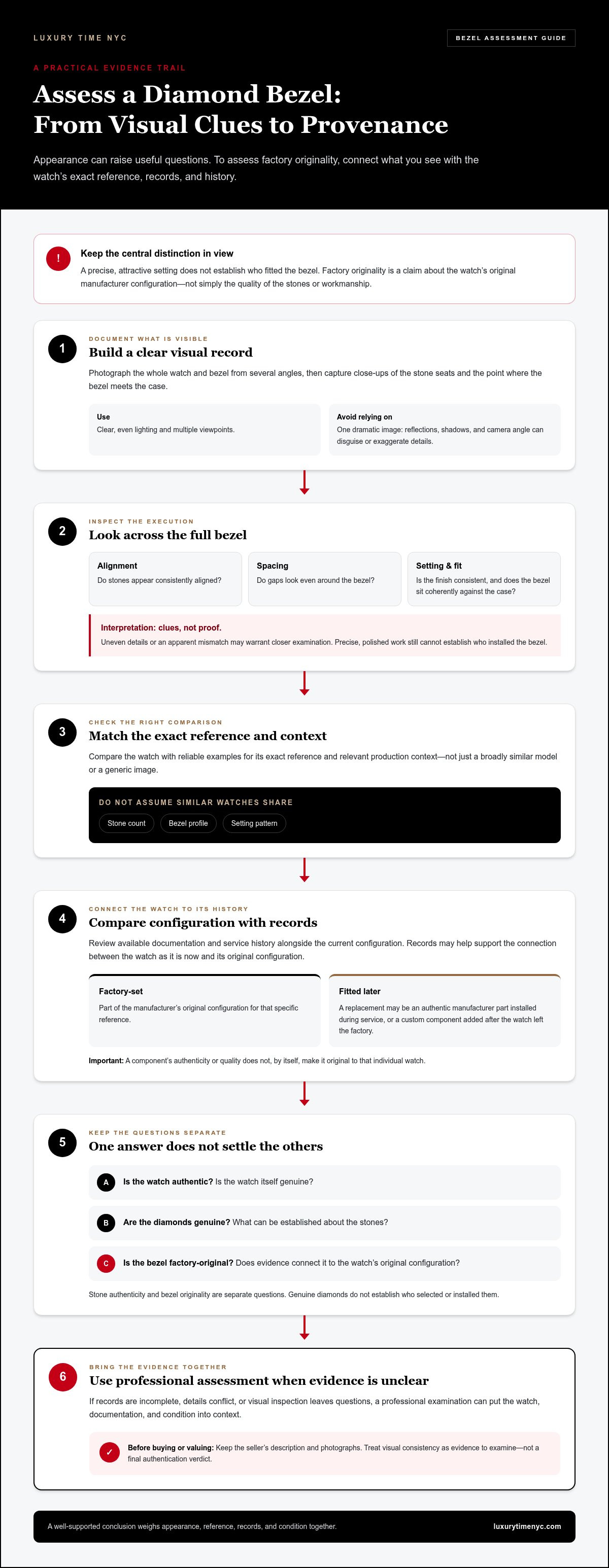
A factory-set bezel is part of the manufacturer’s original configuration for the specific reference. A replacement bezel is fitted later. It may be an authentic manufacturer part installed during service, or a custom component added after the watch left the factory. A component’s authenticity or quality doesn’t, by itself, make it original to that individual watch.
An aftermarket bezel is a non-factory modification, often created or set by a third party. The term describes its origin, not a fixed standard of workmanship: quality and execution can vary. The diamonds themselves may also be genuine, but that answers a different question. As Understanding Diamond Cuts explains, cut affects a diamond’s appearance and interaction with light; it can’t show who selected or installed the stone.
Keep these questions separate:
- Is the watch authentic? Is the watch itself genuine?
- Are the diamonds genuine? What can be established about the stones?
- Is the bezel factory-original? Does the evidence connect this bezel to the watch’s original configuration?
One answer doesn’t automatically settle the others. A convincing setting may merit closer examination, but it can’t establish the bezel’s provenance on its own.
Why originality matters to collectors
For collectors, originality supports confidence in a watch’s represented history. A bezel that matches the original configuration tells a different story from one fitted later, even if both look refined. Clear provenance helps a prospective owner understand what the watch has retained, what may have changed, and how confidently its history can be described.
That distinction can shape collector preference, but it doesn’t guarantee a particular resale result or value. Condition matters: wear, previous repairs, and the state of the watch as a whole belong in the assessment. Documentation matters, too, because records can help connect the watch’s current configuration with its past.
Treat “factory original” as a claim about configuration and history, not as a synonym for authentic, attractive, or expertly finished. The strongest conclusion weighs the bezel alongside the watch’s reference, records, and condition.
Which Visual Clues Can Help Assess a Factory Diamond Bezel?
A close inspection can reveal details worth investigating, including uneven stone placement, inconsistent gaps, irregular setting work, or a bezel that appears poorly integrated with the case. These observations can help you form questions, but they don’t identify who installed the bezel. Visual consistency is evidence to examine, not proof of factory origin.
For a useful first review, photograph the whole watch and bezel from several angles. Use clear, even lighting, and take close-ups of the stone seats and the point where the bezel meets the case. Don’t rely on a single dramatic image: reflections, shadows, and camera angle can make even spacing look irregular or hide small inconsistencies.
Setting, spacing, and overall execution
Look across the bezel rather than judging one stone in isolation. Are the stones aligned consistently? Do the gaps between them appear even? Is the setting finished consistently around the full circumference, or do particular sections look noticeably different? Record what you see without treating it as an authentication verdict. Precise work is a positive observation, not a record of who performed it.
Where possible, compare the watch with reliable examples for its exact reference and production context. Generic images of a similar Rolex or another watch from the same family may show a different configuration. Even excellent custom work can look polished and orderly, so visual resemblance alone can’t establish original installation.
Case fit and reference-specific context
Study how the bezel sits against the case. Check whether its proportions look coherent with the case and dial, and whether the transition between components appears consistent from different viewpoints. A visible gap, uneven edge, or apparent mismatch may warrant further examination, but its significance depends on the specific watch and its condition. Images can’t reveal every detail of how the parts fit together.
Reference matters. Compare like with like: the exact reference and relevant production context, not simply a broadly similar model or generic Rolex photograph. Don’t assume a stone count, bezel profile, or setting pattern should match across watches that look alike. For additional context on evaluating whether stones are diamonds, consult the GIA Guide to Diamond Authenticity. Stone authenticity and bezel originality are separate questions.
When considering how to tell if a diamond bezel is factory original, treat photographs as a record of visible details, not a final answer. Keep unedited images of the full watch and close-ups together, and note differences you observe between angles. If the details raise questions, professional watch authentication can assess the bezel in the context of the watch as a whole.
Factory Original vs. Aftermarket: How to Weigh the Evidence
A diamond bezel may look entirely plausible on a genuine watch and still have been fitted later. Real diamonds, refined workmanship, and a close visual match can support further inquiry, but none independently connects the bezel to the watch’s original configuration. The question is not only whether the watch and stones are genuine, but what the combined evidence says about this particular watch’s history.
Use the comparison below to distinguish observations from evidence of provenance. No single row is a verdict.
| Evidence area | What it may support | What it can’t establish alone |
|---|---|---|
| Configuration | The reference and bezel details appear consistent with reliable information about that model and production context. | A visual match doesn’t prove this bezel was originally fitted to this watch. |
| Provenance | Purchase records, dated photographs, or other records may document the watch’s earlier appearance or configuration. | A document’s relevance and connection to the specific watch still need consideration. |
| Service history | Service paperwork may record work performed or components replaced, helping explain the current configuration. | A later manufacturer service part isn’t necessarily original to the watch as first sold. |
| Visual assessment | Setting, spacing, and case integration can raise useful questions for closer examination. | Craftsmanship, diamond authenticity, and appearance don’t identify who installed the bezel. |
What documentation can support the original configuration?
Start with the watch’s reference and compare its recorded configuration with dependable manufacturer information or specialist records. Then review purchase documents, service paperwork, and photographs created around the time of purchase or service. A dated image showing the same bezel can support a timeline; a service record may explain a later replacement. Neither automatically proves original installation unless it clearly relates to the watch and the question being assessed.
Consider provenance, too. Does a document identify this particular watch, or does it describe a similar model? Is its date consistent with the watch’s known history? Papers can strengthen a conclusion, but their value depends on their relevance and reliable connection to the piece.
How to interpret conflicting clues
Conflicting evidence calls for closer review, not an instant declaration that the watch has been altered. A bezel that appears consistent with the reference may come with service paperwork describing a replacement. Conversely, incomplete paperwork doesn’t prove the bezel is aftermarket. It leaves a question unanswered.
For a disciplined assessment of how to tell if a diamond bezel is factory original, separate findings into three categories:
- Confirmed facts: details directly supported by relevant records or examination.
- Plausible indicators: observations that fit the expected configuration but don’t establish provenance.
- Open questions: gaps, discrepancies, or claims that still need examination.
This approach avoids turning one clue into a verdict. It also gives an authenticator a clearer basis for assessing the watch, its documentation, and its service history together.
How to Check a Diamond Bezel Before You Buy or Value the Watch
A measured review is more useful than a quick visual verdict. Before you commit to a purchase or settle on a valuation, assemble the information that can connect the bezel to the specific watch. For broader acquisition considerations, the Rolex buying guide offers additional context for approaching a pre-owned watch purchase with care.
A practical evidence checklist
Work through the evidence in sequence. Keep a record of what is documented, what is only suggested, and what remains unknown.
- 1. Identify the exact reference. Record the model reference and available serial information for private review. Avoid publishing sensitive ownership details. Use the reference to focus your research on the watch’s specific configuration and production context, rather than relying on images of a broadly similar model.
- 2. Gather the records. Collect purchase documents, dated photographs, service paperwork, and any written description supplied by the seller. Save the original listing, including its wording and photographs, before it changes or disappears. These materials document the watch’s history and how its condition and bezel were represented to you.
- 3. Inspect and compare. Photograph the full watch and bezel from several angles, then note visible details such as stone alignment, spacing, setting consistency, and how the bezel meets the case. Compare those observations with reliable information for the exact reference. Record discrepancies without treating a difference as proof of alteration.
- 4. Seek professional assessment. If records conflict, the configuration appears unusual, or the purchase or valuation carries meaningful consequences, have the watch examined as a complete timepiece. The assessment should consider its reference, condition, bezel, available documentation, and known history.
This process makes the question of how to tell if a diamond bezel is factory original more manageable. A seller’s description is useful evidence of what was represented, not independent confirmation that the claim is correct. Keep it with dated photographs and records so a later review has a clear point of comparison.
When professional authentication is the sensible next step
Pause before finalizing a purchase or valuation if a key claim can’t be reconciled with the available records, or if the bezel raises questions that photographs can’t resolve. Incomplete paperwork doesn’t automatically mean a watch is altered, but it may leave the bezel’s history unestablished. A professional assessment can evaluate the evidence in context instead of relying on one feature alone.
Authentication and repair answer different questions. Repair concerns the watch’s condition and function; it doesn’t, by itself, establish whether the bezel was part of the original configuration. The luxury watch repair guide provides related service context, while authentication focuses on originality and evidence. For a review, arrange professional watch authentication before making a decision that depends on the bezel’s provenance.
A Professional Assessment Brings the Evidence Together
Visual inspection and records can narrow the questions, but a professional assessment considers how those clues relate. The bezel is examined in the context of the watch’s reference, case, dial, condition, and available service history. This broader view helps distinguish what can be observed directly from what can reasonably be concluded about configuration and provenance.
What a complete assessment should consider
A considered review looks beyond the stones. The examiner can compare the bezel and its fit with the watch’s reference and configuration, assess the overall condition, and review relevant purchase or service documents. Findings should distinguish physical observations from conclusions about the bezel’s origin. If records are incomplete or conflicting, that limitation belongs in the explanation rather than being replaced with certainty.
In practical terms, the assessment brings together:
- Configuration: whether the bezel appears consistent with the specific reference and its context.
- Condition: signs of wear, repair, or component changes that may help explain the watch’s present state.
- Documentation: what the available records support, and how closely they relate to the individual watch.
- Conclusion and limits: which details are established, which are indicators, and what remains unresolved.
This is a more reliable way to approach how to tell if a diamond bezel is factory original. An assessment based only on photographs can’t account for every physical detail or establish a complete history. A careful professional can explain how the evidence fits together without claiming more than the available material supports.
Make a confident next decision
A clear assessment can inform whether to proceed with a purchase, how to describe the watch in a collection record, or what to consider before future service. It doesn’t guarantee a particular valuation or resale outcome; it gives you a more grounded understanding of the watch’s configuration and the evidence behind it. For broader acquisition considerations, see this guide to buying a Rolex in NYC.
When the bezel’s history matters to your decision, Luxury Time NYC’s watch authentication service offers a resource for a considered review. Explore Luxury Time NYC for watch authentication and expertise in fine timepieces.
Make Your Next Watch Decision With Clarity
A careful decision doesn’t require certainty beyond the evidence. It requires knowing what has been established, what remains unresolved, and whether that distinction matters to your purchase, collection record, or plans for the watch. If the bezel’s history will influence your next step, a considered assessment can help you proceed with greater confidence.
For collectors asking how to tell if a diamond bezel is factory original, the most useful outcome is a clear understanding of the watch in front of them, not an assumption based on appearance. Luxury Time NYC provides watch authentication and professional repair services from its New York Diamond District showroom, available by appointment.
Bring your questions and the records you’ve gathered into a more informed review. Explore Luxury Time NYC’s watch expertise and take your next step with confidence.
Frequently Asked Questions
Can you tell if a diamond bezel is factory original just by looking at it?
No, appearance alone can’t reliably confirm factory origin. Even careful photography may hide changes in fit, setting, or finish, and excellent aftermarket work can look convincing. A close inspection is useful for identifying points to investigate, such as uneven stone height or a visible gap at the case. Treat these as observations, not a verdict, and compare them with reference-specific records before relying on the claim.
What is the difference between a factory diamond bezel and an aftermarket bezel?
A factory diamond bezel was part of the manufacturer’s configuration for that watch, while an aftermarket bezel was added outside that original production configuration. A later replacement can also be a genuine manufacturer part, such as one fitted during service, without being original to the watch as first sold. For example, a service record describing a bezel replacement may explain the current component, but doesn’t make it factory-original to that individual watch.
Do factory diamond bezels have a serial number or certificate?
Don’t assume the bezel has a separate serial number or that a standalone certificate proves it was originally fitted. A watch’s reference and serial information help identify the timepiece, while purchase or service documents may provide context about its configuration. Review whether any paperwork clearly refers to that specific watch and bezel. A document confirming the stones are diamonds addresses gem authenticity, not necessarily the bezel’s history.
Can an aftermarket diamond bezel be fitted to a genuine Rolex?
Yes. A genuine Rolex can later be fitted with a third-party diamond bezel, so confirming the watch itself is authentic doesn’t establish that every component is original. The modification may be carefully executed, and the stones may be genuine. If you’re considering such a watch, distinguish clearly between “genuine Rolex” and “factory-set diamond bezel” in any purchase description. They make different claims and require different supporting evidence.
Does a factory-original diamond bezel increase a watch’s value?
Not automatically. Original configuration may matter to collectors, but value also depends on the specific reference, condition, documentation, and current buyer demand. A factory bezel shouldn’t be treated as a guaranteed premium, and an aftermarket setting doesn’t produce a predictable discount in every circumstance. For valuation, establish what the watch is, how it’s configured, and how confidently that history can be documented.
What should I check before buying a pre-owned watch with a diamond bezel?
Before committing, confirm the exact reference and read the listing closely: does it claim the bezel is factory-set, describe it only as diamond-set, or disclose a later replacement? Save the description and images, then compare the seller’s claim with available papers and service records. If originality affects your decision, include an independent examination in your purchase process rather than relying on photographs or verbal assurances alone.
Can a watchmaker confirm whether a diamond bezel is factory original?
An experienced watchmaker or watch-authentication professional can examine the bezel, its fit, the watch’s components, and relevant records. That examination may identify signs of replacement or establish consistency with a known configuration. A physical inspection alone may not reconstruct the watch’s full history, particularly if documentation is missing. The most useful assessment states what was observed, what the records support, and where the evidence remains inconclusive.


