


In the quiet corners of the 2026 market, the most expensive error is often the one you cannot see. A flawless dial might hide a mismatched movement. Sharp lugs could be the result of deceptive laser welding. Understanding the specific mistakes to avoid when buying a vintage rolex is now a requirement for the serious collector, especially as secondary market prices for icons continue to fluctuate following the recent 7% industry price increase. You seek a timepiece that transcends mere fashion. You require an asset with historical integrity. Absolute authenticity.
It’s a sentiment we share. True luxury isn't found in a rushed transaction but in the meticulous verification of every serial number and bezel insert. This strategy will allow you to master the nuances of vintage acquisition, ensuring your next investment remains a pillar of your collection. We'll explore the dangers of over-polishing, the reality of modern documentation, and how to establish a secure partnership with an established NYC advisor. Your journey toward a secure, high-value acquisition begins with a commitment to due diligence.
Key Takeaways
- Prioritize technical precision over emotional attachment to preserve the historical and mechanical integrity of your collection.
- Identify the nuances of "Frankenwatches" and the significant value impact of non-period correct service components.
- Master the critical mistakes to avoid when buying a vintage rolex, specifically the irreversible loss of value caused by over-polishing.
- Recognize why the physical timepiece must serve as the primary evidence of authenticity regardless of accompanying documentation.
- Secure your investment by leveraging the expertise of a discreet, metropolitan institution dedicated to horological truth.
The Perils of Provenance: Why Vintage Rolex Acquisition Demands Precision
The acquisition of a vintage timepiece is a silent negotiation between history and condition. For the uninitiated, the primary mistakes to avoid when buying a vintage rolex often center on the fear of a complete counterfeit. However, the seasoned collector knows that the true danger lies in the "grey areas." These are watches that lack mechanical or historical integrity despite being composed of genuine components. In 2026, where market volatility remains a factor and recent price increases have set new baseline values, a single incorrect hand or a service dial can result in a valuation drop exceeding $10,000. Precision is your only defense.
Emotional resonance is the collector's greatest vulnerability. The desire to own a specific reference often clouds technical judgment. This "reference blindness" leads buyers to ignore subtle red flags in favor of completing a set. To avoid these pitfalls, one must adopt a mindset of clinical detachment. You aren't just buying a watch; you are acquiring a curated piece of Rolex history and models that must stand up to rigorous professional scrutiny. Patience is the hallmark of the elite collector. The market rewards those who wait for the right example rather than the first available one. Absolute authenticity. Historical integrity.
The financial stakes in 2026 have never been higher. With gold prices trading near all-time highs and the secondary market showing a 4.9% growth in the previous year, every component carries weight. A mismatched bezel or a bracelet from a later decade isn't just a cosmetic flaw; it's a structural failure in the watch's investment potential. Professional verification isn't an optional step. It's the foundation of a secure purchase. Adopting a rigorous vetting process is the most effective way to address the common mistakes to avoid when buying a vintage rolex before capital is committed. Without it, you're merely gambling with a high-value asset.
The Myth of the "Perfect" Vintage Find
Skepticism is a virtue in high-value horology. If a 50-year-old tool watch appears immaculate, it likely isn't original. Authentic vintage pieces carry the "honest wear" of decades. They show the patina of time. A dial that looks like it left the factory yesterday is often a service replacement or, worse, a modern refinish. In a transparent global market, "too good to be true" pricing is a flashing warning sign. Value is always found in the details that prove a watch has lived, not in a suspicious lack of age. Originality is often imperfect. It's aged. It's real.
The Cost of Impatience in Horology
Impatience is expensive. The most significant, investment-grade examples rarely reach public auction or open marketplaces. They move through private networks of trust. Vetting the dealer is as critical as inspecting the movement. At Luxury Time NYC, we act as a guardian of authenticity for our clients. We understand that time is the ultimate luxury. Our showroom serves as a sanctuary where every piece is verified for period-correctness before it's ever presented. This deliberate pace ensures that your legacy is secured by a timepiece of absolute truth. We provide the expertise that turns a purchase into a lasting legacy.
The "Frankenwatch" Phenomenon: Identifying Non-Period Correct Components
A genuine Rolex is more than the sum of its mechanical parts. It's a chronological record. When those components originate from different production years or mismatched references, the timepiece becomes a "Frankenwatch." This isn't a counterfeit in the traditional sense; every piece may be authentic Rolex. However, for the serious collector, it represents a significant failure in provenance and investment value. The 'Frankenwatch' Phenomenon has historically ensnared even the most high-profile collectors. It proves that deep pockets cannot replace deep industry knowledge. Understanding these structural inconsistencies is among the most critical mistakes to avoid when buying a vintage rolex.
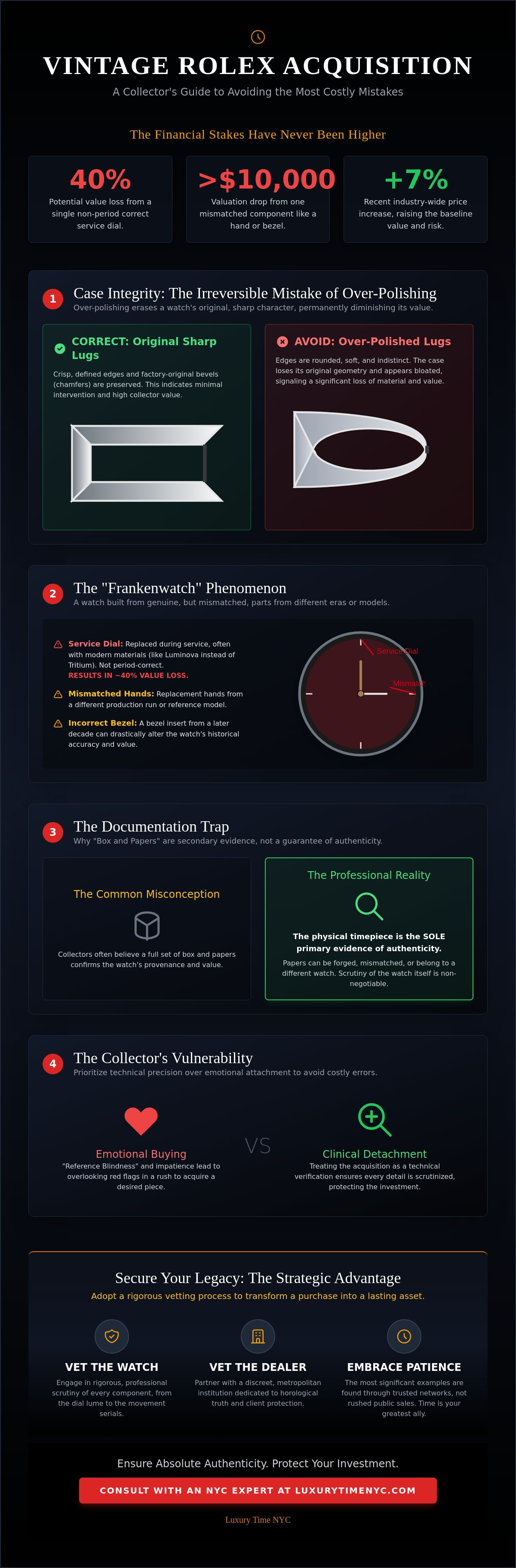
The "Service Dial" trap is perhaps the most common pitfall. During a standard overhaul in decades past, Rolex service centers frequently replaced original, aged dials with modern equivalents to improve legibility. While these are genuine Rolex parts, they aren't period-correct. For a rare reference, a service dial can slash the collector value by 40%. The watch loses its soul. It loses its history. A 1960s Submariner must have a dial that reflects 1960s production techniques, not a luminova replacement from the 1990s.
Technical verification extends to the bracelet and movement. Bracelets carry date codes on the clasp that should align with the case serial number. A 1972 GMT-Master on a 1985 Oyster bracelet is a red flag. It suggests a piece that's been pieced together rather than preserved. Similarly, movement calibers must match the specific reference and era. A caliber swap can turn an investment-grade asset into a mere daily wearer. Discerning buyers often seek professional watch authentication to navigate these complexities with absolute certainty.
Dial Integrity and Lume Consistency
Luminous material tells a story. Tritium or radium should age consistently across the dial, hands, and hour markers. If the hands glow brighter than the markers, they've likely been replaced or relumed. The "Relumed" mistake is irreversible. Aftermarket glow destroys the historical value of the piece. Under high magnification, the "re-printed" dial reveals its secrets. Uneven serifs. Incorrect spacing. These are the markers of a compromised asset. Historical truth is found in the details.
Bezels and Inserts: The Details Matter
Bezel inserts are the face of a tool watch. Collectors obsess over "fat font" versus "thin font" because they denote specific production windows for GMTs and Submariners. Accepting a newer service bezel on a 1960s piece is a common error. It's too clean. It lacks the correct typography. The market is flooded with "ghost" bezels that have been chemically faded to mimic decades of salt-water exposure. A genuine ghost bezel has a soft, metallic sheen. A fake often looks chalky and forced. Rare components. Absolute precision.
Case Integrity: The Irreversible Mistake of Over-Polishing
Shine is often a mask for structural loss. In the pursuit of a pristine aesthetic, many novice buyers inadvertently commit one of the most expensive mistakes to avoid when buying a vintage rolex: accepting a watch that's been over-polished. For the serious connoisseur, the unpolished case is the ultimate acquisition. It represents a timepiece that's retained its original factory geometry. Every instance of machine buffing removes a layer of metal. Over decades, this process thins the lugs and rounds the once-sharp edges, permanently altering the watch's silhouette and investment value.
The geometric profile of a Rolex case is a masterpiece of industrial design. Collectors look for the chamfers, those precise, factory-cut bevels that transition between the brushed top of the lug and the polished side. When these lines are blurred, the watch loses its architectural integrity. Similarly, the crown guards on a tool watch should remain robust and symmetrical. A soft case, where the guards have been thinned to mere slivers, indicates a history of aggressive maintenance that prioritizes temporary brilliance over long-term viability. In the current 2026 market, a vintage GMT with thick, unpolished lugs can command a premium of $10,000 or more compared to a thinned counterpart. Metal is value.
Reading the Lugs
Verification begins with the lugs. Aggressive buffing often results in uneven widths, where one lug appears noticeably slimmer than its partner. You must also inspect the spring bar holes. On an unpolished example, these holes remain crisp and deep. If the spring bar itself protrudes from the side of the case, or if the hole looks like a shallow, rounded crater, the case has been compromised. Connoisseurs distinguish between "sleeve polish," the gentle, natural smoothing caused by years of contact with fabric, and "wheel polish," the destructive force of a high-speed buffing motor. The former is a mark of history. The latter is a mark of neglect.
The Role of Professional Restoration
There's a narrow window where intervention is acceptable, provided it's handled as conservation rather than mere cleaning. This level of professional watch repair is fundamentally different from the standard buffing offered by a neighborhood jeweler. True restoration involves preserving the original brushed finish on the lug tops while using specialized laps to maintain the razor-sharp transition to the polished sides. It's a delicate balance of metallurgy and art. At Luxury Time NYC, we advocate for the preservation of original metal above all else. A scratch is a story; a thinned lug is a tragedy.
The Documentation Trap: Why "Box and Papers" Aren’t a Guarantee
In the world of high-value horology, paper is often more easily forged than steel. Many collectors fall into the trap of paying a 30% premium for "punched" papers or a stamped warranty card, assuming these documents provide an absolute shield against fraud. This is a fallacy. In 2026, sophisticated counterfeiters produce period-correct paperwork that can deceive even experienced eyes. One of the most significant mistakes to avoid when buying a vintage rolex is allowing a printed certificate to distract from the physical reality of the timepiece itself. The watch must always be the primary evidence of its own truth.
A "Full Set" carries a certain psychological allure. However, an obsession with accessories like anchors, tags, or booklets can lead to a compromised acquisition. These items are frequently "married" to a watch later in its life. A 1970s Submariner accompanied by a 1990s box or a period-incorrect booklet is a red flag. It suggests a curated set designed to inflate price rather than a genuine, single-owner history. Real value is found in a verifiable service history. Documentation from an authorized service center or an elite independent watchmaker provides far more security than a loose piece of paper from decades ago.
Verifying the Paperwork
Meticulous cross-referencing is required. Every Rolex warranty paper includes a country code, known as the Landescode (LC). If a watch claims a domestic US provenance but carries an LC 100 code for Germany, the narrative is fractured. Inconsistencies in ink aging or font styles on vintage certificates often reveal a modern forgery. This is why a certified authenticity guarantee from a reputable, established dealer is worth more than loose papers found on a public marketplace. True security comes from a relationship, not just a receipt.
The Value of Provenance
The human story adds a layer of complexity. Ignoring the "original owner" narrative is a missed opportunity for the discerning collector. Documented history, such as military service records or specific gift engravings, can significantly impact the watch’s desirability. While some fear engravings, a well-documented military provenance can double the value of certain references. This level of due diligence is essential for successful Rolex acquisition in NYC. Expert guidance ensures that every detail of the watch's past aligns with its physical condition.
Don't leave your legacy to chance. Ensure your next acquisition is backed by our rigorous standards of watch authentication and professional expertise.
Securing Your Legacy: The Strategic Advantage of an NYC Institution
The final hurdle in horological acquisition isn't technical; it's environmental. While the nuances of dials and cases are vital, the context of the transaction often dictates the security of the investment. One of the most pervasive mistakes to avoid when buying a vintage rolex is the allure of the unvetted private sale. In an era of high-resolution fakes and sophisticated Frankenwatches, the absence of a professional intermediary is a liability. A private seller offers no recourse. No institutional accountability. Securing a high-value asset requires more than a handshake; it requires a legacy of expertise.
Luxury Time NYC operates as a guardian of horological truth. Our appointment-only showroom provides a sanctuary of discretion, far removed from the frantic pace of the open market. By choosing an established institution, you bypass the risks associated with unverified provenance and hidden modifications. We don't just sell watches; we curate legacies. Our sourcing service is designed to eliminate the uncertainty that plagues the secondary market, ensuring that every piece in your collection is beyond reproach. Establishing a relationship with a trusted NYC watch partner is the ultimate strategy for the modern collector. Absolute exclusivity. Horological truth.
The Diamond District Advantage
The 47th Street corridor remains a global epicenter of commerce and expertise. Here, the concentration of master watchmakers and historians allows for rapid, multi-layered verification. However, the sheer volume of trade makes "buying the seller" the most critical rule of engagement. A physical, established Manhattan presence provides a level of security that digital platforms cannot replicate. It's about accountability. It's about a commitment to excellence that spans generations. In the Diamond District, reputation is the only currency that truly matters. Expert validation. Metropolitan prestige.
Your Next Steps in Collecting
Mastering the mistakes to avoid when buying a vintage rolex is a continuous process of refinement. To begin your journey with absolute confidence, we invite you to schedule a private consultation at Luxury Time NYC. Our process for vetting investment-grade pieces is exhaustive. It involves microscopic inspection, movement analysis, and historical cross-referencing. We act as your advocate in a complex market, ensuring that your capital is placed in assets of genuine rarity and integrity. Your legacy deserves nothing less.
"In the world of vintage Rolex, you don’t pay for the watch; you pay for the peace of mind that it is what it claims to be."
Mastering the Art of Acquisition
The pursuit of a vintage Rolex is a study of technical discernment. You now understand that historical truth resides in the minute details. The crispness of a lug. The consistency of tritium lume. The alignment of a caliber with its production era. By identifying the structural mistakes to avoid when buying a vintage rolex, you have transitioned from a speculative buyer to a considered collector. True luxury is found in this absolute certainty. It's a commitment to due diligence that ensures your asset remains as enduring as the heritage it represents.
Located in the heart of the NYC Diamond District, Luxury Time NYC provides a sanctuary for those who value transparency. Every timepiece carries a Certified Authenticity Guarantee, a definitive statement of our expertise in sourcing rare, investment-grade models. We invite you to explore our curated collection of authentic vintage Rolexes and secure your horological legacy with a partner who values excellence above all else. Your next acquisition should be a source of pride, not uncertainty. Build your collection with confidence.
Frequently Asked Questions
Is it a mistake to buy a vintage Rolex without original papers?
It is not necessarily a mistake to buy a vintage Rolex without original papers, as the physical timepiece remains the definitive record of its own authenticity. While a "full set" can command a premium, many investment-grade examples have lost their paperwork over decades of genuine use. The priority remains the integrity of the case, dial, and movement. A professional authentication is far more valuable than potentially forged documents.
How can I tell if a vintage Rolex dial has been refinished?
Refinished dials often reveal their secrets under high magnification through blurred serifs or incorrect font spacing. You should inspect the "SWISS" or "T SWISS T" markings at the six o'clock position for precise alignment. Genuine dials exhibit a crispness in the printing that modern refinishing cannot replicate. Inconsistent lume aging between the markers and hands is another signature of aftermarket intervention. Historical truth is found in the details.
What is the most common mistake first-time vintage Rolex buyers make?
The most common error is valuing a pristine, shiny appearance over original, unpolished condition. First-time buyers often equate scratches with a lack of value, leading them to purchase over-polished examples that have lost their factory geometry. Avoiding these mistakes to avoid when buying a vintage rolex requires a shift in perspective. True value lies in the preservation of original metal and period-correct components rather than artificial brilliance.
Does a "service dial" significantly affect the resale value of a Rolex?
A service dial can reduce the resale value of a vintage Rolex by approximately 40% depending on the rarity of the reference. While these are genuine Rolex parts, they are not period-correct for the watch's production year. Collectors seek the original dial that left the factory. A modern luminova replacement on a tritium-era watch is a significant detractor for those seeking investment-grade assets. Absolute authenticity is paramount.
Is it safe to buy a vintage Rolex from a dealer in the NYC Diamond District?
It is safe and often advantageous to buy from an established NYC institution that offers a physical showroom and a transparent authentication process. The Diamond District is a global center for horological expertise, but "buying the seller" remains the golden rule. Avoid the frantic atmosphere of open booths. Instead, seek out appointment-only curators who provide absolute guarantees of authenticity and professional accountability. Metropolitan prestige. Absolute security.
How do I know if a vintage Rolex case has been over-polished?
Over-polished cases are identified by thinned lugs and rounded edges where sharp factory bevels should exist. You must check the symmetry of the crown guards and the depth of the spring bar holes. If the spring bars protrude from the side of the case, the metal has been significantly reduced. An unpolished case retains its robust, geometric silhouette. It feels substantial. It remains architecturally correct. Metal is value.
Why is "period-correctness" more important than "originality" in some cases?
Period-correctness ensures that every component aligns with the specific production window of the serial number. While a part might be a "genuine Rolex" item, it is not correct if it belongs to a different decade. Collectors prioritize components that match the technical specifications of the era. This level of detail is essential when navigating the various mistakes to avoid when buying a vintage rolex, as mismatched parts compromise the watch's historical narrative.
Should I have a vintage Rolex pressure tested before buying?
You should request a pressure test if you intend to wear the watch near water, though many collectors treat vintage pieces as "dry" assets. It's a standard part of a professional movement overhaul or authentication. However, understand that aged gaskets and crystals may fail under extreme conditions. A successful test provides peace of mind for daily wear. It confirms the structural integrity of the oyster case without compromising the delicate vintage movement.


