


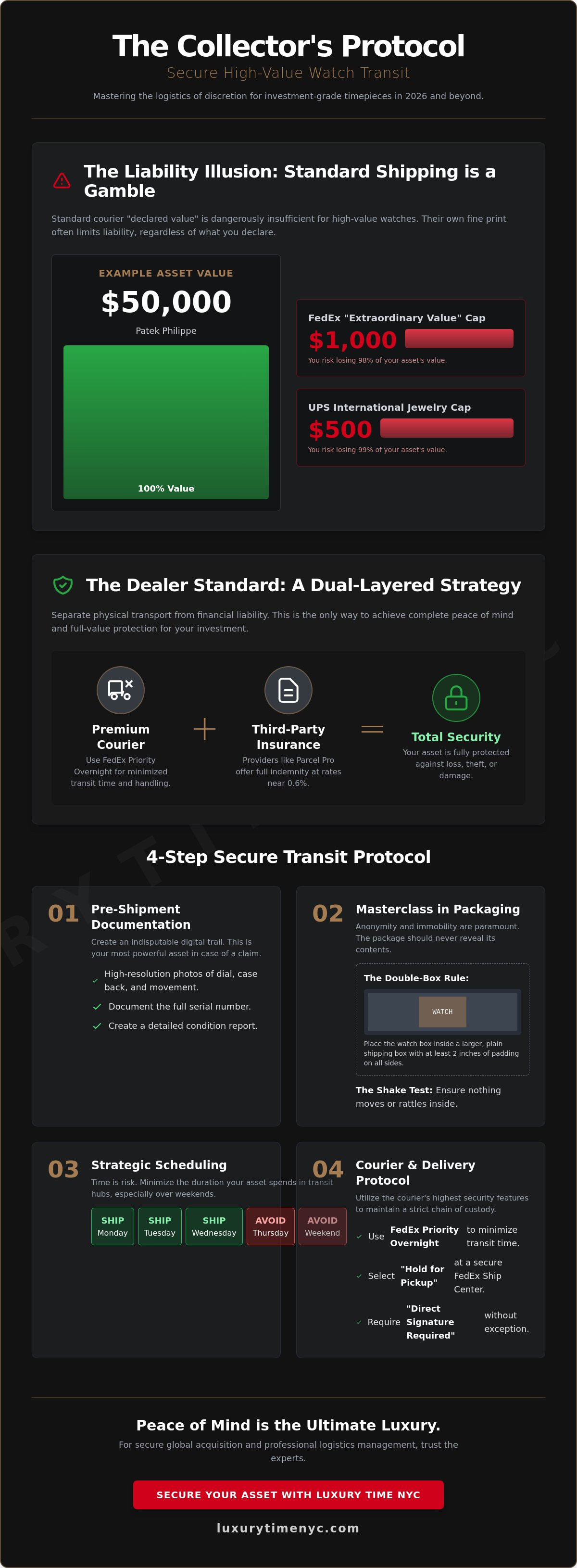
The standard "declared value" offered by major couriers is a dangerous illusion for the serious collector. While FedEx and UPS are global giants, their liability for items of extraordinary value is often capped at a mere $1,000; this leaves a $50,000 Patek Philippe or a rare Audemars Piguet dangerously exposed. You understand that the best way to ship an expensive watch isn't found at a retail shipping counter. It's a calculated exercise in anonymity and high-level indemnity. The anxiety of a potential empty box scam or a convoluted claims process is a burden no horological enthusiast should carry.
This guide masters the sophisticated logistics required for secure, high-value transit in 2026. You'll learn why third-party insurance providers, offering rates near 0.6 percent, outperform carrier-provided coverage in both cost and security. We'll detail the essential double-box packaging method and the discreet terminology that shields your assets from internal theft. From navigating the latest 15 percent import tariffs to selecting couriers with the highest security protocols, this protocol ensures your timepiece arrives with its heritage and value intact. Peace of mind is the ultimate luxury.
Key Takeaways
- Understand why standard courier liability is insufficient for investments exceeding $5,000 and how to transition to professional-grade logistics.
- Discover why the best way to ship an expensive watch involves pairing FedEx Priority Overnight with a specialized third-party indemnity provider.
- Master the "Double-Box Rule" and the "Shake Test" to ensure your timepiece remains immobile and protected against external pressure.
- Implement strategic scheduling by shipping only between Monday and Wednesday to avoid high-risk weekend delays in transit hubs.
- Learn how a rigorous authentication process serves as the foundation for secure global acquisition and absolute peace of mind.
The Logistics of Discretion: Defining High-Value Watch Transit
Within the world of fine horology, the moment of transit is the most vulnerable point in an asset’s lifecycle. For the discerning collector, high-value transit begins the moment a timepiece’s replacement value exceeds $5,000. This is not merely a logistical category; it's a fundamental shift in responsibility. You aren't simply mailing a package. You are managing a high-stakes asset transfer. The best way to ship an expensive watch requires moving beyond consumer-grade habits and adopting the protocols of an established metropolitan institution.
Standard shipping methods designed for high-volume e-commerce are fundamentally insufficient for investment-grade horology. A retail courier center is built for speed and efficiency, not the specialized care required for a Patek Philippe or a Richard Mille. To successfully navigate this process, you must cultivate a psychological shift. The package is no longer a parcel. It's a vessel for a significant portion of wealth. This mindset demands a rigorous focus on provenance and condition reporting before the first layer of padding is even considered. When determining the best way to ship an expensive watch, one must prioritize anonymity and documentation over convenience.
Why Standard Courier Insurance Often Fails
Standard couriers operate on volume, and their liability structures reflect that reality. Their fine print often reveals devastating limitations for watches and jewelry. FedEx, for instance, limits the maximum declared value for "items of extraordinary value" to $1,000. UPS international shipments containing jewelry are frequently capped at a $500 liability limit. Relying on basic shipping insurance from a retail counter is a dangerous gamble. These caps exist regardless of the value you declare at the kiosk. Professional horological indemnity is the only way to ensure the full market value is protected against loss or internal theft.
The Role of Provenance in Secure Shipping
Security begins with a meticulous record. Before the watch enters its transit casing, you must establish a definitive condition report. This document acts as a guardian of authenticity. High-resolution photography is essential. Capture the dial, the case back, and the movement's functionality. Documenting the serial number is a non-negotiable step. This creates an indisputable digital trail that protects both the sender and the recipient. If a claim is ever necessary, this evidence is your most powerful asset. It transforms a vague dispute into a factual certainty. A professional approach ensures that the history and integrity of the piece remain unquestioned throughout its journey.
Selecting a Courier and Professional Indemnity Providers
The "Dealer Standard" is the benchmark for secure horological logistics. It's a dual-layered strategy that separates physical transport from financial liability. Professional collectors never rely on a courier's basic liability. Instead, they utilize a premier courier for movement while securing a third-party indemnity overlay. This approach is the best way to ship an expensive watch, as it bypasses the restrictive $1,000 caps typical of standard carrier agreements. By decoupling these services, you ensure that your asset is protected by specialists who understand the true market value of a vintage Rolex or a modern Richard Mille.
FedEx Priority Overnight remains the industry's preferred transit speed. In the world of high-value assets, time is risk. Every hour a timepiece spends in a sorting facility increases the probability of a security breach. An overnight window minimizes handling points and ensures the package remains within a controlled, high-velocity stream. To further mitigate risk, always opt for "Hold for Pickup" at a secure FedEx Ship Center. Residential deliveries are vulnerable to porch piracy and courier error. Collecting your item from a secure facility, behind a counter with verified identification, is a non-negotiable protocol for the serious connoisseur.
Direct Signature Required (DSR) must be applied without exception. This ensures the chain of custody is never broken. When you are acquiring a Patek Philippe from a trusted metropolitan institution, the security of the journey is as vital as the authenticity of the movement itself. A professional advisor ensures these details are managed with absolute precision.
Third-Party Insurance: Parcel Pro and IFS Inforsure
Specialized providers like Parcel Pro and IFS Inforsure offer the robust coverage that standard carriers refuse. These entities provide indemnity for shipments valued at $100,000 or more per package. Their systems integrate directly with major couriers, providing a seamless logistical experience. To maintain a valid claim, these insurers mandate strict adherence to security requirements, such as double-boxing and the use of nondescript labeling. With third-party rates often hovering around 0.6 percent of the declared value, this specialized protection is both more comprehensive and more cost-effective than retail options.
Comparing Courier Tiers for Luxury Assets
While FedEx Priority Overnight is the standard for speed, USPS Registered Mail remains the most secure domestic option. It's a slow, methodical process where every person who touches the package must sign a ledger. USPS provides insurance up to $50,000 for these shipments, though the transit time can extend to several weeks. In contrast, UPS Next Day Air provides a reliable alternative to FedEx, but collectors must be wary of the $500 international jewelry limit. Regardless of the tier, always initiate your shipment at a staffed Customer Center. Retail kiosks and third-party drop-off points lack the surveillance and security infrastructure required for high-value horology.
Masterclass in Secure Packaging: The Double-Box Method
Excellence in horological transit is a matter of layered security. While previous protocols focused on indemnity and courier selection, the physical package remains your final line of defense. The best way to ship an expensive watch is to treat the container as a mobile vault. This requires a departure from standard retail habits. You must embrace a philosophy of anonymity. A package that advertises its contents is a liability. By employing the "Double-Box Rule," you create a redundant shield that protects the movement from both physical impact and unwanted attention.
The foundation of this method is the "Russian Doll" concept. The watch must be secured inside two nested, heavy-duty cardboard boxes. Never use the original manufacturer box as the outermost shipping container. High-end presentation cases from brands like Patek Philippe or Audemars Piguet are recognizable by their weight and dimensions. They should be treated as the internal treasure, protected by nondescript industrial materials. Once the inner box is placed within the outer shell, you must perform the "Shake Test." Agitate the package firmly. There should be zero movement or sound. If you feel even a slight shift, the internal integrity is compromised.
Sealing the package requires professional-grade materials. Use non-branded, tamper-evident reinforced tape on all seams. This creates a "H-seal" pattern on both the top and bottom of the box. Avoid clear office tape or standard masking tape, as these are easily bypassed or damaged. The goal is to make any attempt at unauthorized entry immediately obvious to the recipient upon arrival.
The Inner and Outer Box Protocol
The inner box should house the watch roll or travel case securely. Surround this inner vessel with at least 2 inches of padding on all sides. Use high-density foam or premium bubble wrap. Avoid loose-fill materials like packing peanuts, which can settle during transit and leave the item vulnerable. We recommend using new, high-crush-test boxes. Recycled cardboard has weakened fibers and may collapse under the weight of other parcels in a high-velocity sorting facility.
Discretionary Labeling and Documentation
Anonymity is your greatest ally against internal courier theft. A critical rule for the connoisseur: never use words like "Luxury," "Watch," "Rolex," or "Jewelry" on the shipping label. These terms are beacons for bad actors. Instead, utilize abbreviated business names. For example, use "L.T. NYC" rather than "Luxury Time NYC." This maintains professional records without disclosing the package's value. Inside the inner box, place a duplicate packing slip and a clear return address. This ensures that even if the outer label is damaged, the item can still be identified and routed correctly. If you are sending a timepiece for professional watch authentication, this internal documentation is essential for maintaining the chain of custody.
Strategic Scheduling and Risk Mitigation Protocols
Security is not merely a physical barrier; it's a strategic sequence. The best way to ship an expensive watch involves mastering the temporal and evidentiary aspects of the journey. Even the most robust packaging cannot offset a poorly timed departure. A sophisticated collector manages the schedule with the same precision found in a Swiss escapement. This ensures the asset never lingers in a vulnerable state. Precision timing. Absolute transparency. These are the hallmarks of professional horological transit.
The Uninterrupted Video Record
Fraud prevention requires indisputable visual evidence. You must record a single, unedited video of the entire packing sequence. Begin by showing the watch's serial number and its mechanical function. Place it into the inner casing. Continue filming as the inner box is nested into the outer container. The video must be a continuous take, concluding only after the shipping label is applied and the seams are sealed with tamper-evident tape. This unedited record is your definitive defense against "empty box" claims. It provides a level of security that paper trails cannot match. It is a factual statement of the package's contents at the moment of sealing.
Timing and Transit Environmental Control
Timing is a critical variable in risk mitigation. The "Monday-Wednesday" shipping window is the industry standard for a reason. Shipping on a Thursday or Friday invites the risk of the package sitting in an unsecured hub over the weekend. Transit hubs often operate with reduced staff on Sundays, creating a window of vulnerability. Similarly, you should postpone shipments during extreme weather events or peak holiday seasons. These periods increase the likelihood of logistical bottlenecks and handling errors. Before releasing the package, coordinate directly with the recipient. They must be physically present to receive the item at the designated Ship Center. The best way to ship an expensive watch is to ensure it remains in motion until it reaches a secure facility.
Transparency maintains the chain of custody. Provide the recipient with immediate tracking updates. This allows for real-time monitoring of the asset's progress. Upon arrival, a rigorous inspection protocol is required. Instruct the recipient to examine the outer box for any signs of tampering or structural damage before signing the delivery receipt. If the tamper-evident tape appears compromised, the delivery should be documented immediately with the courier. When you are exploring our Rolex or Patek Philippe inventory, these protocols ensure the investment's integrity is preserved from vault to vault.
The Luxury Time NYC Standard: Secure Global Acquisition
Luxury Time NYC operates at the intersection of mechanical excellence and absolute security. For the sophisticated collector, the best way to ship an expensive watch is to leverage the infrastructure of an established metropolitan institution. We don't merely facilitate transport; we orchestrate a secure passage for assets of significant historical and financial value. Our commitment to fully indemnified global transit ensures that every Rolex or Richard Mille is shielded by the highest levels of professional protection. This is the standard of the elite. It's a protocol designed to eliminate the vulnerabilities inherent in standard courier networks.
Every timepiece undergoes a rigorous professional watch authentication before it enters our logistics stream. This process is the bedrock of our security protocol, establishing a definitive record of condition and mechanical integrity. For those seeking to maximize the value of their collection, our consignment services provide a comprehensive solution. We handle the entire logistical lifecycle. From the initial valuation to the final, secure delivery, we manage the complexities so you don't have to. Your asset's safety is our primary objective.
White-Glove Service from Manhattan’s Diamond District
Our position within the Diamond District grants us access to the most secure logistics networks in the world. We utilize discreet, armored-car-level protocols for our rarest timepieces, ensuring that the chain of custody remains unbroken. This infrastructure is vital for those buying and selling watches across international borders. Every shipment is backed by a definitive authenticity guarantee. This isn't a marketing claim; it's a statement of fact. We act as guardians of horological heritage, providing a level of security that standard couriers simply cannot replicate. Our expertise allows us to navigate complex global regulations with quiet confidence.
Your Next Step in Horological Acquisition
The transition between masterpieces should be as seamless as a fine movement. Our secure trade-in process allows you to upgrade your collection with absolute confidence. We manage the valuation and the transit, ensuring your original asset is protected throughout the exchange. We invite you to reach out for a private consultation regarding your shipping, consignment, or acquisition needs. Whether you're navigating the 2026 market or securing a legacy piece, we provide the expertise required for high-stakes horology. Time is a luxury, and we treat it with the respect it deserves. Experience the Security of Luxury Time NYC Today.
Securing the Legacy of Fine Horology
The journey of a high-value timepiece requires more than a standard shipping label. It demands a sophisticated sequence of third-party indemnity, nested packaging, and strategic timing. By mastering these discreet logistics, you ensure the best way to ship an expensive watch is one defined by absolute certainty rather than hope. Protecting a rare Patek Philippe or a modern Rolex is an act of stewardship. It preserves both the mechanical integrity and the financial value of your asset.
Established in the heart of the NYC Diamond District in 2005, Luxury Time NYC acts as a professional advisor for the global elite. Our certified authenticity guarantee and expert sourcing provide a foundation of trust that transcends the transaction. We invite you to explore a curated world where security and elegance are indistinguishable. Your collection deserves the protection of a metropolitan institution. Secure Your Next Investment at Luxury Time NYC. The pursuit of excellence continues.
Frequently Asked Questions
Does FedEx or UPS insure watches over $50,000?
Standard couriers don't provide primary insurance for assets of this magnitude. FedEx limits its liability for items of extraordinary value to $1,000; UPS imposes a $500 cap on international jewelry shipments. To protect a $50,000 investment, you must secure a third-party indemnity policy. This specialized coverage overrides the carrier's basic liability and ensures the full replacement value is protected against loss or theft.
Is it better to ship a watch in its original box?
The original manufacturer box should only serve as the internal protective layer. While essential for provenance, these boxes are recognizable and invite unwanted attention. They must be nested within a larger, industrial-grade shipping container. This double-box method is the best way to ship an expensive watch, as it masks the luxury contents from prying eyes while providing superior structural integrity during transit.
What is the safest day of the week to ship a luxury timepiece?
Monday through Wednesday are the only recommended shipping days for high-value horology. Initiating transit early in the week ensures the timepiece reaches its destination before the weekend. Packages shipped on a Thursday or Friday often linger in unsecured sorting hubs over Sunday. This unnecessary pause increases the window of vulnerability for internal theft or logistical errors within the courier's network.
How do I prove the watch was in the box if it gets stolen during transit?
A continuous, unedited video record is your most powerful evidence against fraud. Start the recording by demonstrating the watch's mechanical function and serial number. Filming must continue without interruption as you secure the item into its nested boxes and apply the final tamper-evident seal. This digital trail provides factual proof of the package's contents at the precise moment it was handed over to the courier.
Can I use a standard shipping label for a Rolex or Patek Philippe?
Standard labels are acceptable, provided the recipient information remains nondescript. Never include brand names like Rolex or Patek Philippe on the external packaging. Use abbreviated identifiers, such as "L.T. NYC," to maintain professional records without alerting handlers to the high-value contents. This layer of anonymity is a fundamental pillar of secure logistics for the serious collector.
What should I do if the package arrives damaged or tampered with?
Immediate inspection is mandatory before you provide a signature. If the box appears structurally compromised or the security tape is breached, document the damage with high-resolution photography. Alert the courier's security department immediately. In cases of obvious tampering, refusing the delivery ensures the item remains the carrier's responsibility while an investigation is initiated by your insurance provider.
Is Registered Mail safer than Overnight shipping for expensive watches?
Registered Mail offers unparalleled security through a manual signature ledger, though it's the slowest method available. For most collectors, FedEx Priority Overnight is the preferred best way to ship an expensive watch. Reducing the time in transit is often more effective at mitigating risk, as it minimizes the number of handlers and sorting points the asset encounters during its journey.
Do I need to disclose that I am shipping a watch to the courier?
You must accurately declare the item's general category to satisfy insurance and customs requirements. Describing the contents as a "precision instrument" or "mechanical device" provides the necessary transparency without using high-risk keywords. This technical terminology satisfies the carrier's documentation needs while preserving the discretion required for a high-value asset transfer between institutions or collectors.


