


Does the prospect of parting with a legacy piece feel more like a risk than a reward? You've likely felt the quiet tension of the 2026 market. With Rolex price increases on gold models and new 39% US tariffs shifting valuations, the fear of leaving significant capital on the table is a valid concern. The current climate can turn a prized asset into a source of anxiety. Knowing how to negotiate when selling a watch is now a requirement for protecting your liquid investment.
We understand that for the elite collector, selling isn't a simple transaction. It's a transition of heritage. We'll show you the sophisticated strategies used by the world's most successful collectors to secure maximum value for investment-grade timepieces. You'll learn why a full set adds 20% to your final price and how to leverage the recent discontinuation of icons like the GMT-Master II "Pepsi." This guide provides the clarity you need to navigate the market with the confidence of a seasoned connoisseur. Master the data. Secure the value. Maintain the legacy.
Key Takeaways
- Adopt a mindset of professional alignment rather than conflict, treating the negotiation as a peer-to-peer exchange between sophisticated collectors.
- Compile a comprehensive Provenance Portfolio, including original documentation and service records, to substantiate the premium value of your timepiece.
- Master how to negotiate when selling a watch by utilizing real-time market data to anchor discussions around specific reference performance.
- Evaluate the strategic benefits of New York’s Diamond District for immediate liquidity versus the potential for higher returns through curated consignment.
- Ensure a secure and rapid transaction by opting for private, by-appointment consultations that prioritize discretion and professional integrity.
The Philosophy of High-End Negotiation: Alignment Over Conflict
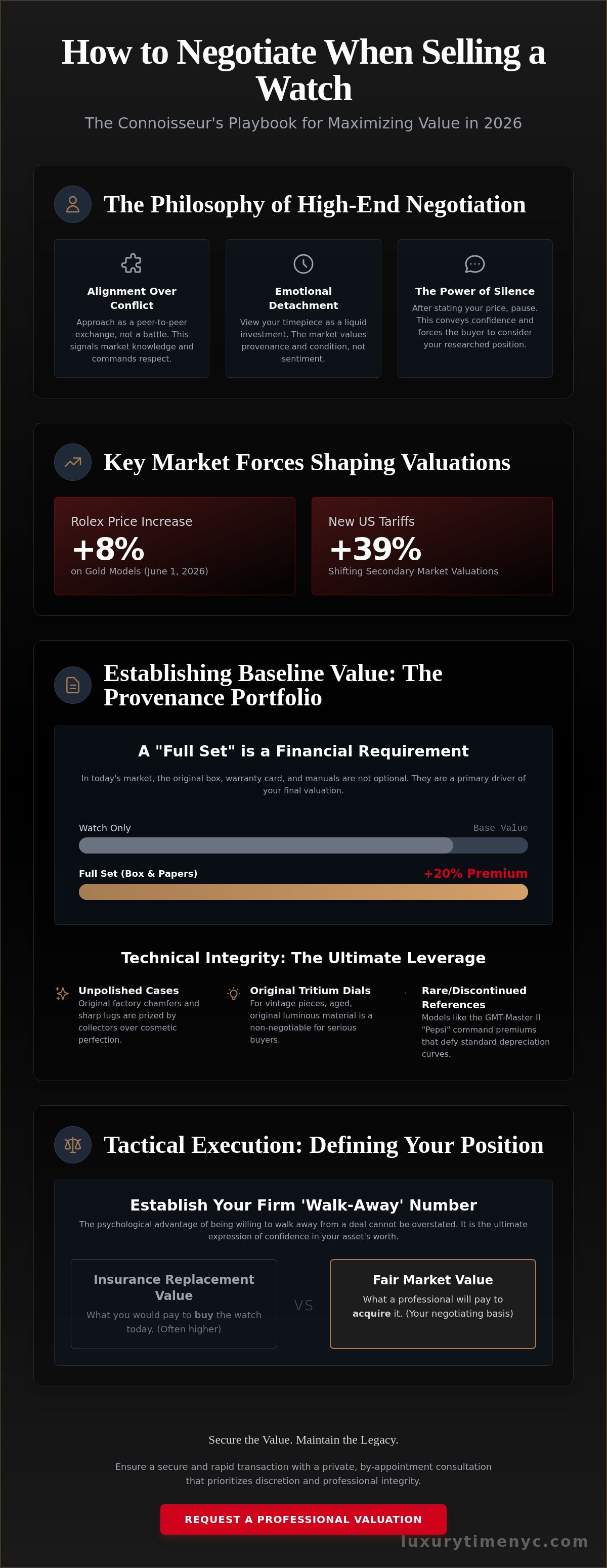
Successful transactions in the 2026 luxury market aren't born from aggressive posturing. They emerge from professional alignment. When you approach a dealer, you aren't merely selling a product; you're facilitating a high-value asset transfer. Shifting your mindset from a defensive stance to a peer-to-peer exchange is the first step in mastering how to negotiate when selling a watch. This perspective commands respect. It signals that you understand the gravity of the timepiece and the mechanics of the global market.
Emotional detachment is your greatest asset. While a Patek Philippe may carry years of personal history, the market recognizes only provenance and condition. Viewing your watch as an investment allows for objective analysis. Transparency regarding the watch’s condition further strengthens your position. Disclosing a minor scratch on a lug or a slight deviation in timekeeping builds immediate trust. While the principles of bargaining often suggest guardedness, in horology, total honesty prevents eleventh-hour price renegotiations. It positions you as a sophisticated seller who values integrity over a quick margin.
You must also recognize the dealer's "spread." Every professional buyer factors in risk, liquidity, and holding costs. In 2026, the market is increasingly polarized. Top-tier models maintain high demand, but the cost of capital remains a factor. A dealer isn't just buying your watch; they're taking on the market volatility of that specific reference. Acknowledging these professional realities makes your counter-offers more grounded and harder to dismiss.
Defining Your 'Walk-Away' Number
Distinguish clearly between insurance replacement value and fair market value. The former is what you'd pay to buy the watch today; the latter is what a professional will pay to acquire it. Factor in the recent June 1, 2026, Rolex price increases, where gold models saw hikes of up to 8%. These shifts affect the secondary market immediately. Establish a firm exit price based on this data. The psychological advantage of being entirely willing to walk away from a deal cannot be overstated. It is the ultimate expression of confidence in your asset's worth.
The Power of Silence in Luxury Transactions
In high-stakes environments, silence is a tool of the elite. After presenting your price, resist the urge to fill the void with justifications. The first person to speak often reveals their anxiety or a willingness to compromise. Use "The Pause" to signal that your offer is backed by research and technical certainty. This rhythmic stillness allows the buyer to process the quality of the item. It maintains an aura of understated elegance, ensuring the focus remains on the watch’s rarity and your own professional distance.
Establishing the Baseline: The Technical Preparation
Value is never a subjective feeling. In the elite horological market of 2026, value is a documented fact. Before engaging in any dialogue, you must curate what we term the "Provenance Portfolio." This is the definitive record of your timepiece’s life. A "full set"—the original box, warranty card, and manuals—is no longer a mere bonus. It is a financial requirement. Current data indicates that a complete set can add 20% to the final valuation of a watch. Without these components, you are selling an object; with them, you are selling a legacy.
Technical integrity remains the ultimate leverage. Understanding these technical nuances is fundamental to learning how to negotiate when selling a watch with authority. Certain "value drivers" dictate the ceiling of your return:
- Unpolished Cases: Original factory chamfers and sharp lugs are prized above cosmetic perfection.
- Tritium Dials: For vintage references, the presence of original, aged luminous material is a non-negotiable for serious collectors.
- Rare References: References like the discontinued GMT-Master II "Pepsi" command a premium that defies standard depreciation curves.
Conducting a multi-platform market audit is essential. Move beyond casual forum posts. Review realized auction results from the May 2026 Christie’s Geneva sales, which saw a 99% sell-through rate. Analyze grey market indices and current dealer inventory. This data provides the technical baseline for a professional exchange. For those seeking absolute certainty, a formal Watch Authentication serves as a definitive shield against price suppression.
The Documentation Checklist for 2026
Modern collectors demand precision. For Patek Philippe owners, an Extract from the Archives is a vital substitute when original papers are lost. However, nothing replaces the original warranty card for modern Rolex or Audemars Piguet references. A recent, documented movement overhaul acts as a 10-15% value multiplier. It proves the watch is not just a visual asset, but a functional masterpiece. Professional watch repair nyc ensures that the mechanical heart of your investment meets the highest standards of fine engineering.
Visual Presentation and Macro-Photography
In a world of digital scrutiny, your imagery must be as flawless as the movement. High-resolution macro-photography pre-empts condition-based lowballing by revealing the truth of the metal. Capture specific serial numbers between the lugs and hallmarks on the case back. This transparency signals confidence. Provenance is the most critical factor in 2026 valuations. High-quality visuals are the medium through which that provenance is communicated, establishing your piece as a premier asset before the first meeting begins.
Strategic Channels: Choosing Your Negotiation Ground
Where you choose to present your timepiece is as critical as the watch itself. In 2026, the global epicenter of liquidity remains New York’s Diamond District. On 47th Street, the market moves with a speed and technical precision that digital platforms cannot replicate. Negotiating in this environment requires a partner who understands the nuance of the metropolitan trade. Leveraging the reputation of a trusted NYC watch partner provides an immediate layer of credibility. It transforms a cold transaction into a professional consultation.
Many collectors are lured by the perceived higher margins of private sales. This is often a strategic error. Private transactions carry significant hidden costs that erode your net return. Specialized high-value insurance, secure shipping, and the rising threat of payment fraud in the digital age create a high-risk environment. A professional institution absorbs these risks. Understanding how to negotiate when selling a watch means looking past the gross offer to the final, secured net amount. In the high-stakes world of horology, certainty is the ultimate luxury.
The Case for Professional Consignment
Consignment is the preferred route for those who prioritize the highest possible return over immediate liquidity. By placing your watch with a reputable dealer, you tap into a global, vetted buyer network. This creates a "Consignment Premium." Buyers are willing to pay more for an authenticated, warrantied piece from a known institution than from an anonymous individual. When initiating this process, discuss commission rates based on the "sell-through" speed of your specific reference. A high-demand Patek Philippe or a discontinued Rolex should command a more favorable structure due to its inherent market desirability.
Direct Buy-Outs for Immediate Liquidity
There are moments when "Cash-in-Hand" is the superior strategy. A direct buy-out offers rapid capital deployment, bypassing the waiting period of a retail sale. This is an excellent tactic if you're looking to pivot your portfolio. You can often negotiate a more aggressive "Trade-In" value when applying the proceeds toward your next Rolex nyc. Professional watch traders may also offer buy-back guarantees. These agreements provide a safety net, ensuring you can return to liquidity if your investment goals shift. This level of institutional security is the hallmark of a sophisticated 2026 transaction.
Tactical Execution: Navigating the Conversation
The environment of a private, by-appointment consultation is the foundation of a successful exit. Presenting your timepiece within the quiet exclusivity of a professional office immediately elevates the perceived value of the asset. It distinguishes the transaction from the frantic pace of the public floor. Understanding how to negotiate when selling a watch requires a command of the room as much as a command of the data. When you begin the dialogue, lead with technical certainty. Use the phrase, "Based on the current market for this reference," to anchor the conversation in verifiable facts rather than personal opinion.
Dealers often utilize tactical posturing to test your resolve. The "Final Offer" trap is a common example. A professional buyer may present a figure as their absolute limit, yet this is frequently a baseline for a rare piece. Recognizing the difference between a genuine ceiling and a strategic pause is essential. If your watch is a discontinued icon like the GMT-Master II "Pepsi" or a high-complication Patek Philippe, the leverage remains in your favor. The 99% sell-through rate at the May 2026 Christie’s Geneva auction proves that demand for premier references remains absolute. To secure a professional valuation that reflects these current market highs, transparency and data must be your primary tools.
Step-by-Step: The Opening Move
- Step 1: Allow the buyer to make the first offer. This establishes their baseline and reveals how they value your specific reference relative to their current inventory.
- Step 2: Counter with data-backed evidence. If the offer is low, cite the June 1, 2026, Rolex price increases or recent realized auction results to justify your higher figure.
- Step 3: Offer a concession that carries no financial weight. Including an extra OEM strap or a period-correct travel pouch can bridge a small gap without eroding your net return.
Countering Common Dealer Objections
Expect the objection that "the market for this model is softening." Counter this by citing specific recent outliers, such as the $42.3 million achieved at the May 2026 Geneva sales. If a dealer claims the piece "needs a full service," present your recent service records as an absolute defense of the watch's mechanical integrity. This documentation transforms a potential discount into a confirmed value multiplier. Utilizing the "if-then" technique, such as stating that if the buyer meets your specific price then you will finalize the transfer immediately, creates a clear and professional path to a closing. This structured approach ensures you remain the peer of the professional, protecting the equity of your horological investment through every stage of the dialogue.
The Luxury Time NYC Standard: Transparency and Discretion
Luxury Time NYC represents a departure from the traditional merchant model. We prioritize the preservation of collector relationships over the extraction of one-off margins. This institutional philosophy ensures that when you seek to understand how to negotiate when selling a watch, you're met with technical expertise rather than sales pressure. We act as guardians of authenticity. Our NYC showroom provides a secure, private environment for the transfer of high-value assets. It's a setting designed for the discerning individual who values time as much as the timepiece itself. Privacy. Security. Efficiency. These are the cornerstones of our process.
The "Discreet Exit" is our signature service. It combines absolute security with rapid payment. We understand the need for confidentiality in high-value horological transactions. Every valuation we provide is a definitive reflection of the 2026 global market. This ensures your exit is as sophisticated as your initial acquisition. By maintaining a professional distance and a connoisseur’s eye, we facilitate a seamless transition of heritage. You aren't just selling an asset; you're engaging with a peer who respects the engineering and history of your Patek Philippe or Audemars Piguet.
A Peer-to-Peer Advisory Approach
We move beyond the simple dealer label. We're curators of fine mechanical arts. Our role often extends into expert sourcing for your next acquisition after a successful sale. This long-term advisory approach provides the peace of mind that comes with a certified authenticity guarantee. Whether you're liquidating a rare Richard Mille or a vintage Rolex, our commitment to technical truth remains absolute. We provide the data you need to understand how to negotiate when selling a watch in a market that values provenance above all else.
Securing Your 2026 Valuation Today
Modern asset management requires global reach. Our infrastructure includes secure global shipping and a robust payment system designed for high-limit transfers. To begin the process, we invite you to schedule a private consultation in our Diamond District showroom. This is where technical precision meets metropolitan prestige. The rhythmic stillness of our private office allows for a focused, meticulous evaluation of your timepiece. Don't leave your exit to chance in a volatile market. Request a professional valuation for your timepiece and experience the standard of excellence that defines Luxury Time NYC.
Securing Your Horological Legacy
Mastering the 2026 market requires more than a fine timepiece. It demands a meticulously curated Provenance Portfolio and a command of real-time market data. You've seen why technical transparency and the strategic use of silence are the essential tools of the elite collector. Protecting your equity means knowing how to negotiate when selling a watch by aligning with professional market realities rather than fighting them. Every detail, from a recent movement overhaul to the original warranty card, serves as a pillar of your leverage.
We invite you to experience a discreet valuation at our NYC showroom. As an established institution with NYC Diamond District authority, we provide the security of global secure shipping and the benefit of expert horological sourcing for your next acquisition. Our process ensures that your exit is as seamless as it is profitable. Your investment deserves a transition defined by professional respect and absolute security. Navigate the future of your collection with confidence.
Frequently Asked Questions
How do I know if a dealer's offer is fair for my Rolex?
A fair offer aligns with realized auction data from May 2026 and recent price adjustments for gold models. Review the Christie’s Geneva auction results to establish a technical baseline. Dealers must account for holding costs and market risk, but the figure should reflect the current scarcity of your specific reference. Understanding the technical nuances of your watch's condition ensures you recognize a professional valuation when it is presented.
Is it better to sell my watch privately or to a dealer in NYC?
Selling to an established NYC dealer is superior for security and rapid liquidity. Private sales often carry the risk of payment fraud and the hidden costs of high-value insurance and secure shipping. A metropolitan institution provides a controlled, private environment for the transaction. This professional setting ensures a discreet exit and immediate payment, which private marketplaces simply cannot guarantee in the 2026 market.
Should I get my watch polished before selling it?
Avoid polishing your timepiece before a sale. Serious collectors and professional curators value the integrity of an unpolished case, specifically the sharp factory chamfers and original lugs. Polishing is an irreversible process that often masks the watch’s true history. Presenting a watch in its authentic, honest condition signals a level of connoisseurship that commands a higher premium than a superficially perfect, over-polished item.
What documents are most important when negotiating a watch sale?
The original warranty card and a complete Provenance Portfolio are the most critical documents. A full set that includes the box and manuals can add 20% to the final sale price. For Patek Philippe, an Extract from the Archives is essential if original papers are missing. These documents transform an anonymous object into a verified asset with a documented history. They are the foundation of your negotiation.
Can I negotiate the commission rate on a watch consignment?
Standard commission rates are frequently flexible for investment-grade assets. High-demand references from manufacturers like Patek Philippe or Audemars Piguet provide you with significant leverage. Learning how to negotiate when selling a watch includes discussing these rates based on the projected sell-through speed. A rare piece that moves quickly should command a more favorable commission structure than a common model that may sit in inventory longer.
What happens if a dealer finds a technical issue during the inspection?
The offer will typically be adjusted to reflect the cost of a movement overhaul or pressure testing. Transparency about the watch's service history prevents these surprises during the final inspection. If you have recent records of a movement overhaul from a reputable center, present them immediately. This documentation acts as a shield, proving the watch is a functional masterpiece and protecting your price from unnecessary technical discounts.
How does the NYC Diamond District market differ from online platforms?
The Diamond District provides immediate liquidity and the security of a private, by-appointment consultation. Online platforms often involve protracted timelines and the persistent risk of shipping disputes. In the Diamond District, the market moves with technical precision and metropolitan authority. This environment allows for a peer-to-peer exchange where the physical condition of the watch is authenticated in real-time. It is the preferred venue for high-value asset transfers.
Is now a good time to sell a Patek Philippe in 2026?
The 2026 market remains exceptionally strong for Patek Philippe, as evidenced by the $42.3 million achieved at the Christie’s Geneva auction in May. Demand for high-complication pieces and rare references is at a historical peak. Knowing how to negotiate when selling a watch in this environment allows you to capitalize on the 99% sell-through rates currently seen. It is a period of significant opportunity for the serious collector to pivot their portfolio.


