


Is your timepiece a curated investment or a temporary accessory destined for a 90% loss in value within its first year? Many aspiring collectors find themselves attracted to the immediate visual appeal of New York and Company watches, believing that a polished exterior signifies a lasting financial asset. It’s a common starting point in a city that prizes appearance. We agree that your first acquisition should reflect your ambition without the risk of owning a rapidly depreciating object. This guide provides the clarity you need to distinguish between a high-street accessory and an investment-grade masterpiece with unrivaled provenance. You’ll learn to identify the superior caliber of true horology, decode the technical differences between quartz and mechanical movements, and discover the precise steps to building a collection that commands respect in the global market. Unrivaled precision. Timeless design. We’re moving beyond the marketing noise to focus on the exquisite craftsmanship that defines a true New York institution.
Key Takeaways
- Distinguish between ephemeral seasonal trends found in new york and company watches and the enduring value of investment-grade horology.
- Master the technical divide between mass-produced quartz movements and the intricate mechanical calibers that define haute horology.
- Uncover the economic reality of timepieces, contrasting the rapid depreciation of fashion labels with the historic price growth of iconic luxury models.
- Learn to transition from temporary purchases to legacy building by identifying the entry-level luxury brands that offer the most secure gateway to serious collecting.
- Discover how to navigate the Diamond District with the expertise of a New York institution to secure authentic masterpieces from Rolex and Patek Philippe.
Understanding the Landscape of New York and Company Watches
The distinction between a masterwork of horology and a fashion accessory is absolute. While the city of New York serves as a global epicenter for high-end watch collectors, the presence of new york and company watches represents a different segment of the market. These are style-first objects. They prioritize seasonal trends over mechanical longevity. They offer accessibility. They cater to a demographic that views a wristwatch as an extension of a wardrobe rather than a generational asset. The "New York" label here evokes the energy of Manhattan's fashion districts; however, it remains distinct from the city’s rigorous horological standards found in the workshops of master watchmakers.
The Role of Fashion Brands in the Watch Industry
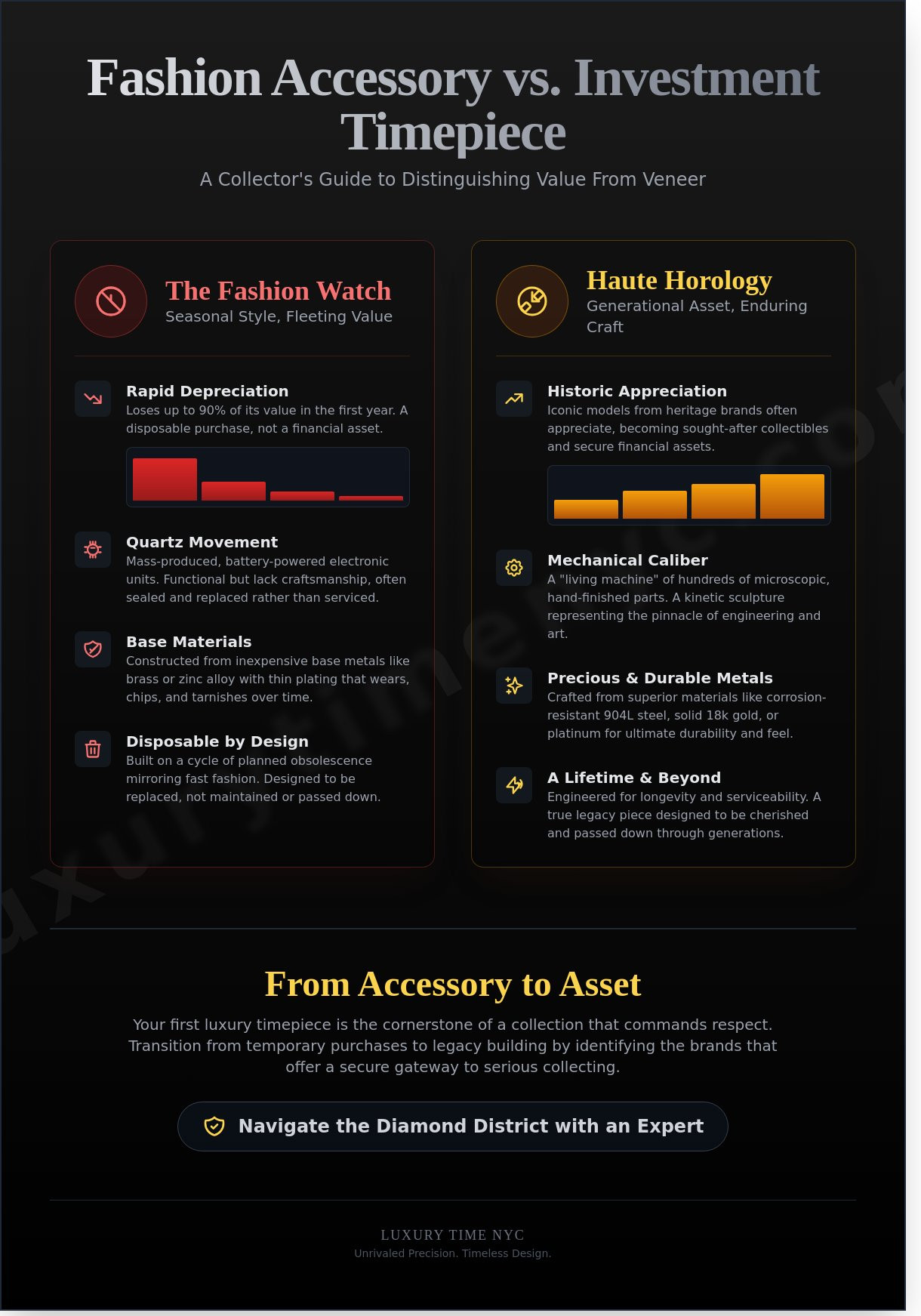
Most clothing retailers don't manufacture their own movements. Instead, they license their names to large-scale production facilities. A review of the New York & Company brand history reveals a trajectory rooted in mass-market retail since 1918. In this business model, the watch is a branded extension of a seasonal clothing line. The internal components are typically inexpensive quartz calibers. These movements are functional. They provide basic timekeeping. They lack the exquisite craftsmanship found in a Swiss-made mechanical heart. The focus remains on the exterior finish and the logo. Manufacturing costs are kept low to maintain accessible price points, reflecting a commitment to volume rather than the pursuit of perfection.
For those navigating the complexities of global manufacturing and quality assurance, you can discover The Inspection Company for expert factory audits and product inspections.
Disposable Style vs. Enduring Heritage
The fashion watch industry operates on a cycle of planned obsolescence. It mirrors the fast fashion movement. When a battery dies or a component fails, these pieces are rarely serviced. They're replaced. This stands in stark contrast to the world of fine horology. A mechanical masterpiece is designed for a lifetime. It's an investment in provenance. Collectors who choose new york and company watches often do so for a specific event or a particular outfit. The motivation is immediate aesthetic gratification. There's no expectation of future value. There's no mechanical soul to maintain.
True luxury requires more than a famous name on a dial. It requires a caliber that commands respect. Authenticity is found in the gears, not the branding. This is the fundamental divide between a temporary accessory and a timeless investment. In the quiet showrooms of elite collectors, the focus is on the movement's heartbeat. Fashion watches offer a silhouette. Mechanical watches offer a legacy. This dedication to enduring quality is also found in the bespoke garments from Your Tailor Robin. Timeless design. Unrivaled precision. These are the markers of a true timepiece.
Fashion Watches vs. Haute Horology: The Technical Divide
The distinction between a mass-produced fashion accessory and a mechanical masterpiece is foundational. While brands like new york and company watches serve a specific market seeking affordable, seasonal aesthetics, they exist in a different universe than high horology. One is a product of temporary trends; the other is a triumph of engineering. The technical divide begins at the assembly line and ends with a watch's ability to survive for generations.
Movement and Precision
Quartz movements are undeniably efficient. They rely on a battery and a vibrating crystal to keep time. However, they lack the "soul" that collectors demand. A quartz movement is often a sealed plastic unit. When it fails, it's discarded. In contrast, the mechanical calibers found in a Rolex or Patek Philippe are living machines. These movements consist of hundreds of microscopic parts, many hand-finished to meet the strict definition of Haute Horlogerie.
Precision in this world is an art form. A COSC-certified chronometer maintains accuracy within -4 to +6 seconds per day without a single electronic component. Complications like perpetual calendars or tourbillons add layers of mechanical intelligence that command a premium. These are not merely tools for telling time. They are kinetic sculptures. For those who appreciate this level of detail, our curated collection of mechanical icons offers a glimpse into true engineering excellence.
This pursuit of engineering excellence is a standard shared by other sectors of high-performance machinery. For those who value the same level of precision in motorcycle drivetrain components, check out Drive Systems USA.
Materials and Longevity
Durability is where the gap widens into a canyon. Fashion-tier timepieces, including many new york and company watches, typically utilize base metals like brass or zinc alloy with a thin layer of plating. This plating eventually wears thin, exposing the dull metal beneath. Luxury houses utilize 904L stainless steel or solid 18k gold. These materials don't just resist corrosion; they maintain a deep luster that can be restored through professional polishing decades later.
- Crystal: Fashion watches use mineral glass that scratches easily. Haute horology utilizes scratch-resistant sapphire crystal, second only to diamond in hardness.
- Water Resistance: While a standard watch might handle a light rain, professional-grade mechanical watches like the Rolex Submariner are tested to depths of 300 meters.
- Serviceability: A mechanical watch is designed to be overhauled. A master watchmaker can disassemble, clean, and oil a movement from 1950, returning it to factory specifications.
The choice is simple. You can own a watch that lasts a season, or you can invest in a legacy. New York City demand for authenticity has never been higher. Serious collectors know that a watch's value isn't just in its name, but in the integrity of its construction. True luxury is permanent, whether found in a Swiss movement or the high-end outdoor pieces from a modern furniture store San Diego that prioritize both form and function.
The Economics of Time: Depreciation vs. Appreciation
A smartwatch is a depreciating gadget; a mechanical timepiece is a portable asset. The moment a consumer unboxes a fashion-tier accessory or a mass-produced electronic device, its market value collapses. While new york and company watches serve a clear purpose for those seeking accessible style, they often lose up to 90% of their retail price within twenty-four months. The horological market operates on different principles. Scarcity and heritage dictate the curve. A stainless steel sports watch from a premier Swiss house often trades above its original MSRP the moment it leaves the boutique. This isn't mere speculation. It's the result of decades of brand equity and mechanical excellence.
Consider the cost per wear of a $10,000 mechanical asset. Over twenty years, the daily cost is negligible. More importantly, the principal remains intact or grows. A Rolex Submariner purchased in 1970 for roughly $230 would command upwards of $10,000 in the current market. Smartwatches require replacement every three to five years due to battery degradation and software obsolescence. They are expenses. Mechanical watches are capital. Timeless design. Unrivaled value.
Resale Value Analysis
The secondary market distinguishes between consumer goods and investment pieces. Data from the 2023 Knight Frank Wealth Report highlights that luxury watches have seen a 147% price growth over the last decade. This "Rolex Effect" is particularly visible in the New York Diamond District. Here, liquidity is absolute. A collection of new york and company watches might offer aesthetic variety, but a single Patek Philippe offers immediate cash solvency. Provenance and original documentation drive auction results, turning a personal passion into a financial fortress.
This pursuit of value through tangible assets is also evident in the world of rare visual media; for those curating a diverse portfolio, Galerie Prints offers access to investment-grade fine art photography and collectable cinema memorabilia.
The Concept of an Heirloom
You never actually own a Patek Philippe; you merely look after it for the next generation. This iconic sentiment captures the essence of horology. Digital devices are destined for landfills. A mechanical caliber is a masterpiece of engineering that survives centuries with proper service. Selecting a watch involves choosing a legacy. It's a vessel for sentimental and financial value that grows as it passes from parent to child. True luxury is found in items that refuse to become obsolete—a standard of endurance also found in the pure Himalayan offerings of Gold Rock Shilajit. For those seeking to complement their investment in legacy with a focus on personal vitality, Best Kept Montreal provides a guide to wellness and refined living. Heritage preserved. Future secured. To discover how this dedication to heritage and curated excellence can transform your travels through fully escorted small-group tours, click here.
Building a Collection: Why Your First Luxury Piece Matters
The transition from disposable technology to a curated collection marks a defining moment for any enthusiast. It is a shift from buying for the present to investing for the future. While a smartwatch loses its utility within 36 months, a mechanical masterpiece retains its soul for generations. This evolution requires a move away from the temporary appeal of fashion accessories, such as new york and company watches, toward the enduring prestige of Swiss horology. A true collection is built on the pillars of heritage, mechanical complexity, and long-term value retention.
Entry-level luxury serves as the foundation of your horological identity. Selecting a piece with a proven track record ensures that your capital is preserved. Provenance matters. Craftsmanship matters. In the high-stakes environment of the New York market, your first acquisition sets the tone for every piece that follows. It is the difference between owning a device and possessing a legacy—a commitment to heritage also reflected in the world-class experience of the Palace on Wheels Train or the premier family adventures offered by Celtic Quest Fishing.
How to Start Your Luxury Journey
Stability is the primary objective for a new collector. Models like the Rolex Datejust or the Omega Speedmaster offer unrivaled security in the secondary market. The 1953 debut of the Rolex Submariner established a blueprint for value that persists today. Starting with a pre-owned Rolex is often a strategic masterstroke; these pieces have already navigated the initial depreciation curve. This principle of value-based acquisition extends to other major assets; for instance, you can explore financing for a quality pre-owned vehicle to avoid the 'new' premium. Avoid the impersonal experience of department store clerks. Instead, seek the counsel of experts who understand the nuances of caliber and movement. A professional advisor provides the technical insight that a retail employee simply cannot match.
The Importance of Authenticity
The global trade in counterfeit timepieces is a sophisticated shadow industry. According to 2023 data from the Federation of the Swiss Watch Industry, millions of fraudulent watches enter the market annually. Buying from unverified online sources exposes you to the "fake" trap, where a cheap imitation results in a total loss of investment. Professional authentication is a non-negotiable requirement for any high-end transaction. In a city as fast-paced as New York, building a relationship with a trusted dealer is your greatest defense. A reputable NYC institution provides more than a product; they provide a guarantee of absolute legitimacy. This trust is the bedrock of a serious collection.
While trust in a dealer is vital, the physical safety of your collection is equally paramount. To ensure your high-value timepieces are protected with professional-grade security, you can learn more about Prestige Mobile Locksmith for expert mobile assistance.
Luxury Time NYC: Curating Your Legacy in the Diamond District
Luxury Time NYC is more than a boutique; it's a New York institution. Located in the heart of the historic Diamond District, our showroom serves as a sanctuary for collectors who understand that a watch is an investment in heritage. While casual shoppers might search for mass-produced new york and company watches at local department stores, serious horologists come to us for something far more significant. We offer a gateway to the world’s most prestigious mechanical arts.
Our curated selection features the pinnacle of Swiss engineering. From the rugged elegance of a Rolex Submariner to the intricate complications of a Patek Philippe, every piece in our inventory is chosen for its excellence. The Diamond District advantage gives us unparalleled access to the global secondary market. We secure rare models that never reach traditional retail shelves. Our white-glove service ensures your experience is as refined as the movement inside your timepiece—a level of professional care also found in the bespoke chauffeur services of Onyx Rental or the vibrant urban lifestyle curated by Detroit Furnished Rentals. Quiet confidence. Absolute authority.
Expert Sourcing and Curation
Finding the "unfindable" is our specialty. For our elite clientele, we locate specific references that are often subject to years-long waiting lists elsewhere. Whether you're seeking a discontinued Nautilus or a vintage GMT-Master, our network across 47th Street and beyond provides the necessary reach. We verify the provenance of every timepiece with clinical precision. Authenticity is a fact here, not a marketing claim.
Private appointments offer a sophisticated way to explore our collection. In a world of rushed retail, we provide a spacious, deliberate environment. You'll have the opportunity to examine the caliber and finishing of a masterpiece without the noise of the city. It's a peer-to-peer consultation designed for those who value discretion and deep industry knowledge. We don't just sell watches; we act as guardians of your collection’s integrity—a standard of security and precision also upheld by specialists like London Locks in the realm of high-end property protection.
Comprehensive Horological Services
The relationship between a collector and their watch lasts for decades. To support this longevity, we provide professional repairs and movement overhauls. Mechanical watches are living machines that require expert stewardship. Our technicians handle every caliber with the reverence it deserves, ensuring your investment remains as precise as the day it was forged. Similarly, for your high-performance mobile technology, you can explore iPhone Scherm Reparatie to find specialized care and screen restoration for your Apple devices.
For those looking to deepen their understanding of the market, we recommend reading The Essential Guide to Buying a Rolex in NYC: 2026 Collector’s Edition. It provides the technical and market data necessary for making informed acquisitions in the current landscape.
Elevate your collection today. Visit our 47th Street showroom to experience the unrivaled craftsmanship of the world's finest mechanical timepieces. Timeless design. Unrivaled precision. Your legacy begins at Luxury Time NYC.
Elevate Your Collection to a Legacy of Excellence
Selecting a timepiece is a definitive choice between fleeting trends and enduring value. While new york and company watches offer accessible style for a season, they lack the mechanical soul and appreciation potential of a true horological masterpiece. The divide is technical and economic. A mass-produced fashion watch depreciates the moment it leaves the store. Luxury pieces from heritage brands represent a different standard. Timeless design. Unrivaled precision.
Your collection represents your legacy. It's why every acquisition requires a partner who understands the gravity of your investment. At Luxury Time NYC, our expert horologists bring 20 years of industry experience to every consultation. We operate from the heart of the NYC Diamond District, ensuring every piece meets our uncompromising standards. Every watch in our vault carries a Certified Authenticity Guarantee to provide absolute peace of mind. This is more than a purchase; it's the preservation of horological craftsmanship. Provenance matters.
Just as a mechanical masterpiece secures your legacy, strategic real estate investments offer a parallel path for wealth preservation. For those seeking luxury riverfront living in Singapore's District 9, you can learn more about premier developments, while those looking to diversify their international portfolio can explore Apartments for Sale with NiSea.
Explore Our Curated Collection of Investment-Grade Timepieces
We invite you to secure a masterpiece that will define your style for generations.
Frequently Asked Questions
Is New York and Company a luxury watch brand?
New York and Company watches aren't classified as luxury timepieces; they're fashion accessories produced for the mass market. These items prioritize seasonal trends over horological substance. While a mechanical masterpiece features a complex caliber, new york and company watches typically house basic quartz movements sourced from high-volume manufacturers. They lack the hand-finished details and precious metals that define true luxury.
Why do Rolex watches hold their value so much better than fashion watches?
Rolex timepieces maintain their value because of controlled production and 100 percent in-house manufacturing. A 2023 report by Boston Consulting Group found that top-tier mechanical watches outperformed the S&P 500 in secondary market growth over a five-year period. Fashion watches lose 85 percent of their retail price immediately. Rolex uses 904L stainless steel and proprietary alloys that ensure 50 years of functional life.
Can I trade in a fashion watch for a luxury watch at Luxury Time NYC?
Luxury Time NYC doesn't accept fashion brands like new york and company watches for trade-in. Our showroom focuses exclusively on high-horology brands like Patek Philippe and Audemars Piguet. We maintain a curated inventory of 500 plus authenticated pieces. Trading requires a timepiece with verifiable provenance and a mechanical movement that meets our rigorous standards for craftsmanship and future investment potential.
What is the best entry-level luxury watch for a new collector in 2026?
The Tudor Black Bay remains the premier entry-level choice for collectors in 2026. Its MT5402 manufacture caliber offers a 70-hour power reserve and COSC certification. This model provides 95 percent of the Rolex experience at a fraction of the cost. It's a gateway into serious horology that holds its value better than almost any other sub-five-thousand-dollar timepiece on the market today.
How can I tell if a luxury watch I found online is authentic?
Authentic luxury watches are identified through microscopic inspection of the movement finishing and serial number verification. Genuine calibers oscillate at 28,800 vibrations per hour, creating a smooth sweep that's impossible to replicate perfectly with cheap components. Always demand original papers and a physical inspection by a certified watchmaker. 15 percent of luxury watches sold on unverified platforms are sophisticated fakes.
Does Luxury Time NYC offer repair services for fashion watches?
Our service center doesn't provide repairs for fashion brands or quartz-based items. We dedicate our master watchmakers' time to the restoration and maintenance of mechanical masterpieces. This ensures that every Rolex or Cartier leaving our 47th Street facility meets original factory specifications. We focus on 21-jewel movements and complex complications that require specialized horological tools and decades of expertise.
Why should I buy a watch in the NYC Diamond District instead of a mall?
The NYC Diamond District offers 90 percent more rare inventory than a standard retail mall. Located on 47th Street, this hub provides access to vintage references and limited editions that never reach traditional storefronts. You're dealing with experts who understand the 100-year history of a brand. It's an environment of absolute authority where the provenance of every timepiece is scrutinized by professional curators.
What is the difference between quartz and mechanical watch movements?
Quartz movements rely on a battery and a vibrating crystal, while mechanical movements use a mainspring and a complex gear train. A mechanical caliber is a handcrafted engine that can last 100 years with proper care. Quartz watches are often discarded after 5 years when the circuit fails. Mechanical watches represent 95 percent of the investment-grade market because they embody the pinnacle of human engineering.


