


A Rolex that stops is a tragedy. A Rolex that ticks inaccurately is a quiet liability. For the serious collector, the question of how often should a rolex be serviced is not merely about mechanical maintenance. It is a calculated decision regarding the preservation of a high-performing asset. While modern engineering suggests longer intervals, the reality of horological wear remains constant. In the world of fine movements, silence is rarely golden; it is often the precursor to avoidable friction.
You understand that your timepiece is a masterpiece of micro-engineering. It requires periodic attention to maintain its chronometric precision and aesthetic brilliance. This guide explores the precise intersection of mechanical necessity and investment protection for your collection. We will define the essential 2026 maintenance schedules, examine the significant ROI of a professional movement overhaul, and clarify why a documented service history can increase your watch's resale value by as much as 15 percent. Discover how to safeguard the soul of your timepiece within the heart of the global luxury market. Your legacy deserves nothing less than absolute precision.
Key Takeaways
- Distinguish between the heritage five-year cycle and the modern ten-year standard to optimize your maintenance strategy.
- Assess how often should a rolex be serviced by evaluating the specific era of your caliber and its daily usage patterns.
- Uncover the critical role of synthetic lubricants and how their degradation can lead to costly mechanical failure if left unaddressed.
- Leverage documented movement overhauls to secure the "Full Set" advantage and command a premium in the secondary market.
- Master the subtle warning signs of timing drift and power reserve loss to intervene before minor issues become permanent damage.
The 10-Year Recommendation: Understanding Rolex’s Official Maintenance Standard
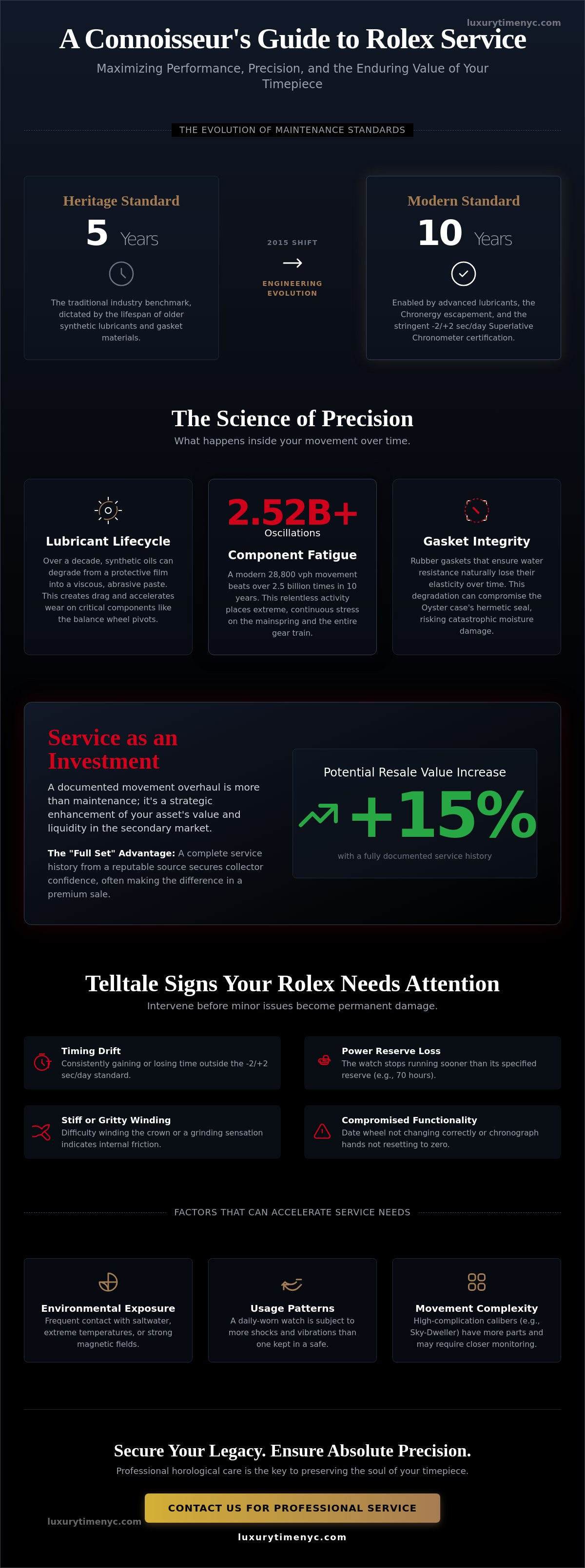
The horological landscape underwent a fundamental transformation in 2015. For decades, the five-year service rule remained the industry's gold standard. It was a practical necessity. Older synthetic lubricants would eventually dry or coagulate, leading to increased friction. Gaskets would lose their elasticity. Today, discerning collectors frequently ask how often should a rolex be serviced in an era of radical mechanical advancement. The official answer from Geneva has evolved alongside the technology itself. Engineering excellence. Absolute precision. These are the hallmarks of the modern crown.
The 2015 Paradigm Shift
Rolex redefined the boundaries of mechanical endurance nearly a decade ago. The catalyst was the introduction of the Superlative Chronometer certification. This internal standard surpassed COSC requirements, mandating a precision of -2/+2 seconds per day after casing. Engineers achieved this through the Chronergy escapement and improved lubricant chemistry. These innovations reduced wear on critical components. The modern 10-year interval is a testament to Rolex's engineering evolution. It reflects a level of confidence in movement longevity that was previously unattainable. It's a promise of enduring performance.
Official vs. Practical Intervals
Ten years represents a maximum threshold rather than a rigid target. While the official stance is clear, practical reality often demands a more nuanced approach. A complicated Sky-Dweller caliber faces different mechanical stresses than a simpler Oyster Perpetual movement. High-complication pieces involve more moving parts and greater potential for friction. Professional bodies, such as the American Watchmakers-Clockmakers Institute, highlight that environmental factors play a decisive role in a watch's health. Saltwater exposure, extreme temperatures, and magnetic fields can all accelerate the need for professional attention. When considering how often should a rolex be serviced, you must weigh official guidelines against your specific wear patterns.
There is also a critical distinction between a Movement Overhaul and a Pressure Test. A full service involves complete disassembly, ultrasonic cleaning, and genuine part replacement. A water resistance check is a targeted, preventative measure. This should occur more frequently, especially for those who use their Submariner or GMT-Master II in its natural aquatic habitat. Waiting for the ten-year mark is technically safe, but proactive care ensures optimal performance. It's the difference between mere ownership and the true stewardship of a mechanical masterpiece.
The Science of Precision: What Happens Inside Your Movement Over Time
The interior of an Oyster case is a vacuum of perfection. Or so it seems. In reality, the caliber is a theater of constant kinetic energy. Determining how often should a rolex be serviced requires an understanding of the micro-environment within the case. Even when a timepiece presents a flawless facade, the internal components are subject to the relentless physics of friction. A watch that appears to keep perfect time may actually be undergoing silent, internal degradation. Mechanical integrity is a fragile equilibrium.
The Lifecycle of Synthetic Oils
Synthetic lubricants are the lifeblood of the movement. Modern chemistry has produced oils that resist migration and oxidation with remarkable success. However, these substances are still finite. Over a decade, these oils begin to evaporate or coagulate. They transition from a protective film into a viscous paste. This substance no longer facilitates movement; it creates drag. The pivots of the balance wheel, which oscillate hundreds of millions of times between service cycles, bear the brunt of this change. Without the highest standards of workmanship during a professional cleaning, this paste becomes an abrasive that slowly grinds away at the hardened steel components. It's a microscopic erosion of value.
Component Fatigue in High-Beat Movements
The modern Rolex high-beat movement operates at 28,800 vibrations per hour. This translates to roughly 252 million beats per year. Such relentless activity places extreme demands on the mainspring and gear train. While the blue Parachrom hairspring offers exceptional resistance to magnetic fields and the Paraflex system absorbs significant shocks, they can't compensate for dry running. Metal-on-metal friction is the ultimate enemy. It causes microscopic burrs and irreversible scarring on the gear teeth. Gaskets and seals often fail long before the mechanical parts, compromising the hermetic seal and allowing moisture to accelerate this decay.
The escapement is the heart of the timepiece. It's where the energy is released in precise increments. When lubricants fail here, the friction increases exponentially. You might not notice a change in the daily drift immediately. The movement's inherent torque often overcomes initial resistance, masking the problem. This is the danger of the 'runs fine' mentality. By the time the timing deviates noticeably, the pivots may already be severely worn. This turns a standard service into a more complex restoration involving the replacement of essential parts. To preserve the integrity of your investment, a periodic movement overhaul is a strategic necessity rather than a reactive repair. True connoisseurs recognize that the question of how often should a rolex be serviced is answered by the calendar, not by the failure of the watch.
Preserving Asset Value: How Service History Dictates Resale Liquidity
A Rolex is more than a masterpiece of horological engineering. It's a portable asset of significant liquidity. In the competitive secondary market, the difference between a standard sale and a record breaking transaction often rests on a single card. Documentation. While the aesthetic condition of a timepiece is the first point of contact, its mechanical pedigree is the final word. Discerning collectors don't just buy a watch; they buy its history. Maintenance is the insurance policy for your investment.
The Value of Documentation
The "Full Set" remains the gold standard for serious acquisition. This includes the original box, the green hangtag, and, most critically, the service papers. When a watch lacks a verifiable maintenance record, it's effectively "taxed" in the secondary market. Buyers assume the worst. They factor in the immediate cost of a movement overhaul, reducing their offer accordingly. If you're considering how often should a rolex be serviced, remember that an unserviced movement is a liability. An Official Rolex Jeweler or Service Center provides the certification that guarantees authenticity and mechanical health. These documents act as currency. They provide the transparency required for a seamless luxury watch trade-in nyc experience. Precision is profitable.
Polishing: The Collector's Dilemma
To polish or not to polish? It's the most debated topic in the connoisseur's world. For professional grade models like the Sea-Dweller or the GMT-Master II, the case geometry is sacred. Sharp lugs. Defined chamfers. Mirror finishes. Over-polishing is a cardinal sin that can destroy a watch's value by softening its architectural edges. Once the original steel is gone, it can't be replaced. At Luxury Time NYC, we believe in a conservative approach. Professional watch polishing should only be performed by masters who understand how to preserve the "honest" wear of a vintage piece while restoring its luster. We prioritize the metal's integrity over a superficial shine.
The secondary market rewards stewardship. A timepiece that has been cared for according to the manufacturer's standards commands immediate respect. It suggests a level of ownership that values tradition over convenience. When determining how often should a rolex be serviced, view the decision through the lens of a curator. You aren't just fixing a machine. You're protecting a legacy of Swiss excellence. A well-documented Rolex isn't just a watch you wear; it's an asset that is ready for its next chapter at a moment's notice. Discretion. Authority. Value. These are the pillars of the elite collector's journey.
Beyond the Calendar: Environmental Triggers and Warning Signs
A Rolex is engineered for the peaks of the Himalayas and the depths of the Mariana Trench. Yet, even this robust construction can be compromised by the subtle pressures of a metropolitan lifestyle. When asking how often should a rolex be serviced, one must look beyond the ten-year recommendation. The environment often dictates a more aggressive schedule. Mechanical intuition is a collector's greatest asset. Performance is never accidental; it's a reflection of the conditions in which the timepiece lives.
The Impact of the NYC Environment
Manhattan is a magnetic minefield. Smartphones. High-speed tablets. The electromagnetic pulse of the subway system. These invisible forces can magnetize the hairspring, causing the watch to gain or lose time erratically. Temperature fluctuations between sweltering summers and freezing winters also stress the gaskets. For the active New Yorker, regular pressure testing is essential to ensure the Oyster case remains hermetically sealed against humidity and city grit. A breach in this seal is a breach in your investment's security.
Critical Signs of Immediate Need
Certain symptoms demand immediate horological intervention. A sudden loss of power reserve suggests a failing mainspring or excessive internal friction. A timing drift exceeding five seconds per day indicates that the movement is no longer operating within its superlative parameters. Perhaps most critical is the sensation of "dry winding." If the crown feels gritty or erratic when setting the time, the lubricants have effectively failed. This is the sound of metal-on-metal wear.
Moisture ingress is the emergency room of horology. Even a faint fog under the crystal is a catastrophic event. It signals a total failure of the seals. Saltwater or even simple humidity can oxidize the movement within hours, turning a routine service into a total movement replacement. If you detect any deviation in performance or see condensation, don't wait for the calendar. Bring your timepiece to Luxury Time NYC for a professional assessment to safeguard its mechanical integrity.
Internal debris is another silent killer. Microscopic fragments from gear wear can migrate into the escapement, causing a "stuttering" second hand. This irregular beat is a final warning before a complete mechanical seizure. Recognizing these signs early is the difference between a standard movement overhaul and a costly restoration. Your Rolex speaks to you through its rhythm and its feel. Listen closely. True connoisseurs don't wait for a failure; they anticipate the needs of the machine.
Professional Horological Care: Selecting a Trusted NYC Service Partner
The decision of where to entrust your timepiece is as significant as the decision to acquire it. While the question of how often should a rolex be serviced is settled by mechanical necessity; the choice of a service partner is defined by trust. You require more than a technician. You seek a guardian of authenticity. Whether opting for a Rolex Service Center or an elite independent watchmaker, the standard remains the same. Absolute precision. Uncompromising quality. Your timepiece is a legacy; its maintenance should reflect that gravity. Stewardship requires a partner who understands the nuance of the caliber.
The Diamond District Advantage
New York City's 47th Street remains the global epicenter for horological expertise. It's a landscape defined by deep heritage and unmatched technical skill. Within this concentrated square mile, collectors find access to rare components and vintage-specific knowledge that exists nowhere else. It's a place where tradition meets cutting-edge engineering. Navigating this market requires a sophisticated perspective and a discerning eye. For a deeper understanding of this unique environment, consult our Connoisseur’s Guide to 47th Street. Expertise is the only acceptable currency in this high-stakes arena.
The Luxury Time NYC Experience
Our approach to a movement overhaul is defined by a white-glove philosophy. It begins with a meticulous intake process. We document every nuance of your timepiece's condition before the first screw is turned. This isn't merely a repair; it's a strategic preservation of the watch's "soul." We recognize that a Daytona or a Day-Date carries both emotional and financial weight. We use only genuine Rolex parts for all internal replacements to maintain the caliber's integrity. Discretion is our hallmark. Precision is our promise. We treat every movement as a work of art.
A professional overhaul involves a complete disassembly of the Oyster case and movement. Each component undergoes ultrasonic cleaning to remove aged, coagulated lubricants. We apply specialized oils with surgical accuracy to the escapement and gear train. Following reassembly, your watch is subjected to rigorous pressure testing and timing calibration. This ensures it meets the -2/+2 second superlative standards. If you're determining how often should a rolex be serviced based on the 2026 guidelines, the final step is choosing a partner who values your investment as much as you do. We invite you to schedule a consultation for your Rolex service at our NYC showroom and experience the pinnacle of horological care.
The Stewardship of Excellence
Maintaining a Rolex is an act of preservation for a mechanical legacy. While the ten-year standard reflects Geneva's engineering prowess, the true health of your timepiece depends on proactive care and environmental awareness. Documented service history isn't just a maintenance record; it's a strategic asset that secures your watch's liquidity in a global market. The definitive answer to how often should a rolex be serviced lies at the intersection of official guidelines and the specific demands of your lifestyle.
Precision requires a partner who respects the heritage of your caliber. At Luxury Time NYC, we offer a bespoke service tailored to investment-grade watches. Our expert horologists bring decades of Diamond District experience to every movement overhaul, ensuring your timepiece operates within its superlative parameters. Every part we use carries a Certified Authenticity Guarantee, protecting the integrity of your collection. Trust is the ultimate luxury. It's the foundation of every significant acquisition.
Secure the future of your timepiece. Schedule a professional Rolex evaluation at Luxury Time NYC.
Your collection deserves a guardian that values excellence as much as you do. Protect your legacy with absolute confidence.
Frequently Asked Questions
Can I wait longer than 10 years if I don't wear my Rolex every day?
Lubricants evaporate regardless of daily wear. Even if your timepiece resides primarily in a safe, the synthetic oils will eventually coagulate or dry. This chemical degradation occurs independently of mechanical activity. Waiting beyond the recommended ten-year threshold risks internal friction when you finally choose to wear the watch. Stagnation is not preservation.
How much does a typical Rolex service cost in 2026?
The investment required for professional care depends on the complexity of the caliber and the specific model. A chronograph movement like the Daytona involves significantly more components and labor than a time-only Oyster Perpetual. While industry standards exist, a definitive quote is only possible after a physical assessment by an expert horologist. Condition remains the primary variable.
What is the difference between a movement overhaul and a simple regulation?
Regulation is a targeted adjustment of the balance wheel to correct timing drift. A movement overhaul is a comprehensive procedure involving total disassembly, cleaning, and replacement of worn parts. While regulation may solve a five-second deviation, it doesn't address the underlying lubricant failure that an overhaul resolves. It's the difference between a superficial fix and mechanical restoration.
Will Rolex replace my original dial or hands during a service?
Rolex may suggest replacing these components if they pose a risk to the movement's health. However, for many collectors, the original dial and hands are essential to the watch's heritage and resale value. You should specify your preference for conservation over replacement. Preserving the original aesthetics is often a priority for investment-grade pieces.
How long does a professional Rolex service take in NYC?
Turnaround times in the Manhattan market fluctuate based on the depth of the required work. A standard movement overhaul typically requires several weeks of dedicated attention. This period includes meticulous testing for accuracy and water resistance. Quality is never rushed. A spacious timeline is a hallmark of professional horological standards.
Is my Rolex still waterproof if it hasn't been serviced in 5 years?
Water resistance is never a permanent state. Gaskets are made of synthetic materials that lose elasticity over time, especially in a city with extreme temperature shifts. Even if the movement is accurate, the seals may have failed. Determining how often should a rolex be serviced for waterproofness involves annual pressure testing, regardless of the ten-year mechanical rule.
Does polishing my Rolex decrease its resale value?
Aggressive polishing that alters the case geometry will decrease resale value. Collectors prize sharp edges and original chamfers. However, a light, expert polish can enhance the aesthetic appeal without compromising the watch's architectural integrity. It's a delicate balance that requires a master's touch.
What should I do if my Rolex stops running entirely?
Cease all attempts to wind or set the watch immediately. Forcing a crown on a seized movement can cause catastrophic damage to the gear train. This is a primary indicator of how often should a rolex be serviced when mechanical failure occurs before the scheduled interval. Professional intervention is the only way to diagnose the internal cause safely.


