


If you believe your timepiece is merely a beautiful accessory, consider that a 1990 Cartier "London Crash" recently commanded over $2,024,956 at auction. This record-breaking sale reflects a pivotal shift in the secondary market that every serious collector should note. You're likely asking, what is my Cartier watch worth in a climate where retail prices rose by as much as 10% in May 2026. The answer isn't found in a generic price list. It lives at the intersection of heritage, reference-specific rarity, and the current appetite of elite Manhattan collectors.
It's natural to feel a sense of hesitation when moving from owner to seller. The discrepancy between a boutique's retail price and a secondary offer often feels opaque, particularly when authenticity and security are your primary concerns. This guide provides the clarity you require to secure a premium valuation that reflects the true prestige of your asset. We'll examine why the stainless steel Santos and Panthère are maintaining exceptional value, how the current "micro-watch" trend impacts your specific reference, and the precise path toward a secure, high-ticket sale in the heart of New York.
Key Takeaways
- Distinguish between insurance replacement value and the actual cash liquidity of your timepiece in the global secondary market.
- Identify why specific references like the Cartier Crash and the Collection Privée Cartier Paris (CPCP) command significant market premiums.
- Learn to evaluate technical nuances, including dial oxidation and case sharpness, to determine exactly what is my cartier watch worth today.
- Analyze the impact of the May 2026 retail price increases on the resale value of iconic stainless steel collections.
- Navigate the professional valuation process in the NYC Diamond District to ensure a secure and transparent high-ticket transaction.
Determining the Market Value of Your Cartier Timepiece
True value is never found in a static catalog. It's the fluid intersection of global demand and local liquidity. For a Manhattan collector, this means understanding that a watch's worth is dictated by the immediate appetite of the secondary market. When you ask, what is my cartier watch worth, you're looking for a figure that reflects real-world desirability rather than a theoretical retail price. In a city like New York, where the concentration of horological expertise is unmatched, this market value is often more dynamic than in any other global center.
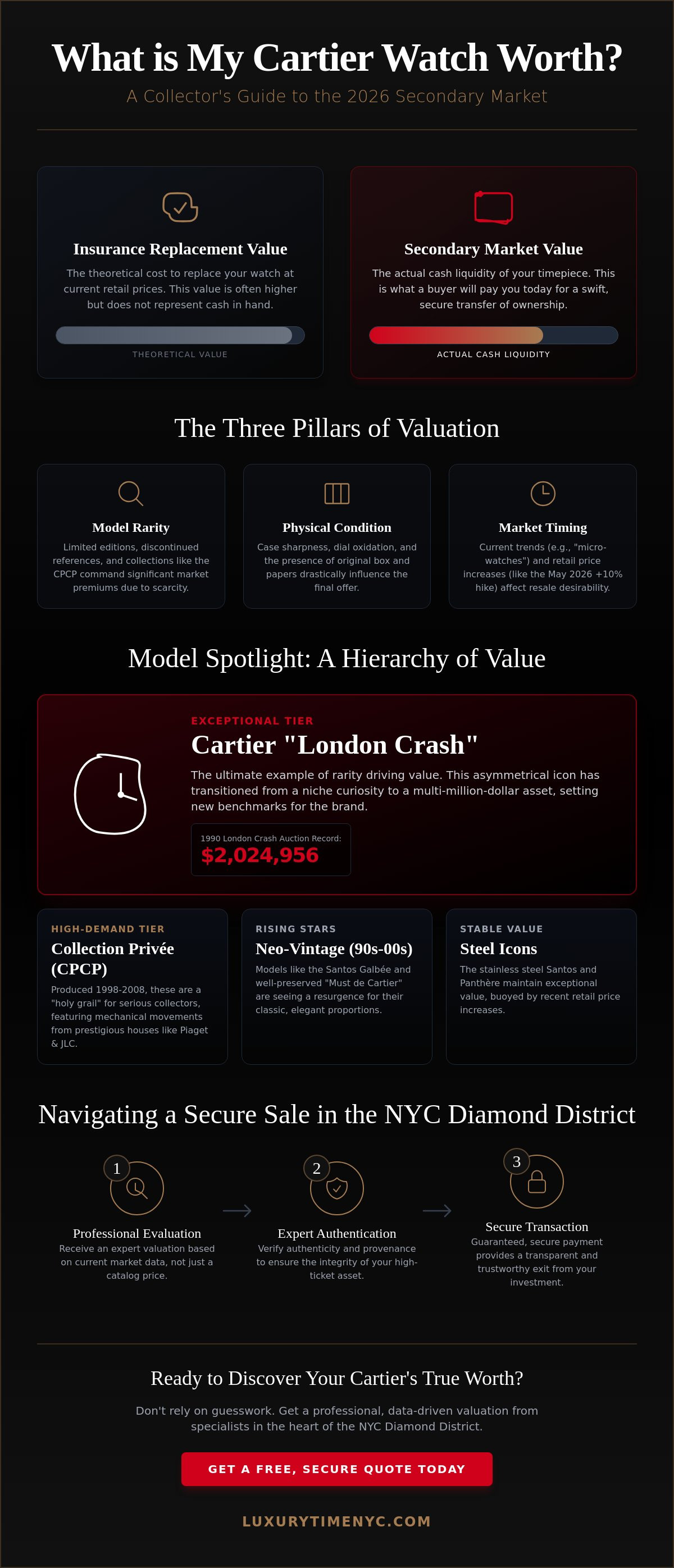
Distinguishing between insurance replacement value and the actual cash buy-back price is vital. Insurance appraisals are designed to cover the cost of replacing an item at current retail rates. They don't represent what a buyer will pay you today. The cash buy-back price is a reflection of the watch's liquidity. It's the amount you receive for a swift, secure transfer of ownership. Leading into 2026, we've seen a "Cartier Renaissance" where the brand has moved beyond its jewelry roots to be recognized as a premier horological investment. This shift is driven by three pillars: Model Rarity, Physical Condition, and Market Timing. These factors determine whether your timepiece is a standard asset or a sought-after rarity.
Primary Value Drivers in 2026
The History of Cartier is a narrative of enduring prestige that directly impacts your watch's bottom line. Solid gold Tank and Santos models are currently buoyed by the high performance of precious metals. However, the brand's intrinsic equity is what truly sustains these prices during broader market volatility. Collectors aren't just buying gold; they are buying a legacy of fine engineering. A secondary market premium is the additional value collectors are willing to pay for rare or limited editions that can no longer be sourced from a boutique.
Retail vs. Resale: Managing Expectations
Most modern Cartier models follow a standard depreciation curve once they leave the showroom. It's the price of being the first owner. There are, however, notable exceptions. Certain "Neo-vintage" pieces and high-complication references appreciate almost immediately due to their extreme scarcity. Understanding the dealer's margin is also part of a professional valuation. A reputable dealer in the NYC Diamond District provides more than just a check. They offer expert authentication and a guaranteed, secure exit from your investment. This professional oversight is what protects the integrity of your high-ticket sale and ensures you don't leave value on the table.
Model Spotlight: Which Cartier References Command the Highest Premiums?
The secondary market isn't a monolith. While the brand's aesthetic is universal, the financial performance of specific references varies wildly. If you're asking, what is my cartier watch worth, the answer often depends on whether your timepiece belongs to a standard production run or a curated collection of historical significance. The Cartier Crash remains the ultimate example of this disparity. This asymmetrical icon, particularly the rare London editions, has transitioned from a niche curiosity to a million-dollar asset. A 1990 18K gold "London Crash" recently fetched $2,024,956 at a Christie’s auction in Geneva, setting a new benchmark for the house.
Beyond the Crash, the Collection Privée Cartier Paris (CPCP) represents the pinnacle of 2026 collector interest. Produced between 1998 and 2008, these mechanical masterpieces utilized movements from prestigious houses like Piaget and Jaeger-LeCoultre. They're the "holy grail" for those who value horological substance over mere jewelry appeal. When evaluating the investment potential of Cartier watches, the CPCP series stands as a testament to the brand's serious watchmaking credentials. For those holding these references, a professional Cartier watch authentication is the first step toward realizing their significant market premium.
The Rise of Neo-Vintage Cartier
New York collectors are currently obsessed with the "Neo-vintage" era, roughly spanning the 1990s and early 2000s. During this period, Cartier maintained classical proportions that are now outperforming their oversized modern counterparts. The Santos Galbée, with its curved case and integrated bracelet, is seeing a resurgence in demand compared to the contemporary XL models. Even the "Must de Cartier" vermeil pieces, once considered entry-level, have seen values appreciate significantly for well-preserved examples. It's a market that rewards elegance and historical accuracy over sheer physical presence.
Complications and Limited Editions
Technical complexity adds another layer to the valuation. Skeletonized dials and tourbillons within the Drive and Rotonde lines command high prices, though they require meticulous maintenance to retain their value. Limited anniversary editions or boutique-exclusive dial colors often trade at a premium, as they're shielded from the depreciation typical of mass-produced models. However, be wary of aftermarket customizations. While factory-set diamonds significantly increase a watch's worth, non-factory "iced out" modifications often decrease the resale price for serious collectors who demand original specifications. Knowing exactly what is my cartier watch worth requires an expert eye to distinguish these subtle but expensive details.
The Condition and Provenance Checklist
A Cartier's value isn't merely a reflection of its reference number. It's a testament to its survival. When asking what is my cartier watch worth, you must first subject the piece to a rigorous physical audit. Condition is the primary differentiator between a standard resale and a premium acquisition. In the world of high-value horology, the smallest imperfection can shift a valuation by thousands of dollars.
- Step 1: The Dial. We look for 'spidering,' the intricate, spider-web-like crackling of the lacquer. On certain vintage references, this patina is a sought-after aesthetic choice that collectors prize. However, oxidation or moisture spotting is viewed as damage that requires costly restoration.
- Step 2: The Case. Sharp lugs are a premium indicator. A case that's been over-polished to remove scratches loses its original geometry. The architectural lines of a Santos or Tank must remain crisp and defined to command top dollar.
- Step 3: The Movement. Mechanical integrity is paramount. Providing documentation of a professional watch movement overhaul increases your Cartier's value by proving the timepiece has been maintained to manufacture standards.
- Step 4: The 'Full Set'. The original box, warranty card, and sales receipts serve as the watch's pedigree. This documentation confirms authenticity and simplifies the path to a high-ticket sale.
Physical Integrity and Aesthetics
The 'Blue Sapphire' test is a quick indicator of original care. Ensure the cabochon crown is the original stone and remains unchipped. On gold Santos models, we evaluate 'bracelet stretch.' A tight, resilient bracelet signifies a watch that hasn't been subjected to excessive wear or neglect. While a leather strap can be replaced, the metal bracelet's integrity is a permanent part of the valuation. A well-maintained movement and pristine exterior ensure your timepiece stands out in the Manhattan market.
The Power of Provenance
Provenance adds a layer of intangible value that generic marketplaces ignore. A Cartier watch with a documented New York history carries a certain metropolitan prestige. The 'Box and Papers' premium is significant, often resulting in a 15% to 25% increase in the final offer. If these documents are lost, valuation is still possible through expert authentication, but the ceiling for the offer naturally adjusts. Understanding these technical nuances is essential when determining exactly what is my cartier watch worth in today's competitive landscape.
Retail Price vs. Secondary Market Reality
Retail pricing is a manufacturer's aspiration. The secondary market is a collector's verdict. Understanding the delta between these two figures is essential for any serious divestment strategy. Determining what is my cartier watch worth requires more than a glance at a boutique window. On May 21, 2026, Cartier implemented significant price increases across core collections. For instance, the steel Santos ref. WSSA0062 rose from $8,650 to $9,200. These adjustments create a rising floor for pre-owned inventory, often narrowing the depreciation gap for those who bought prior to the hike.
The 'Waitlist Effect' remains a powerful driver of secondary premiums. While most contemporary models trade below their current MSRP, specific yellow gold Tank Louis Cartier references are experiencing high demand and limited boutique availability. In these instances, the secondary market price can approach or even exceed retail. Mechanical movements generally command higher retention than quartz, yet the 2026 "micro-watch" trend has made the quartz Panthère a surprisingly liquid asset. In the high-stakes environment of Manhattan, luxury asset liquidity is often a reflection of these shifting cultural preferences.
Why Some Cartier Models Depreciate
High-production models often fall into the 'fashion watch' trap. When a reference is readily available at every boutique globally, the secondary market lacks the scarcity required to drive prices upward. Rapid design iterations can also play a role. A modern model that feels like a departure from Cartier's classical DNA may feel 'dated' as trends cycle back toward heritage. Most critically, deferred maintenance is a silent equity killer. A watch with a scratchy movement or a worn crown will always underperform. If you're ready for a professional assessment, you can sell your Cartier watch to experts who understand these nuances.
Market Trends: The 2026 Outlook
The prevailing shift toward 'Quiet Luxury' has placed the Cartier Tank at the center of the collector's universe. Its understated profile aligns perfectly with the current metropolitan aesthetic. We're also seeing a definitive preference for yellow gold over rose gold or steel in the high-ticket segment. This return to classical materials is driving premiums for vintage and neo-vintage gold references. For a deeper analysis of where to position your timepiece for the best return, consult our guide on the best place to sell watches in the current climate.
Professional Valuation in the NYC Diamond District
New York remains the undisputed epicenter of the global horological trade. While digital platforms offer a veneer of convenience, they lack the immediate, tactile expertise required for high-ticket assets. To truly understand what is my cartier watch worth, one must look to the heart of the capital. Luxury Time NYC operates from a position of deep institutional knowledge. We don't rely on broad algorithms or speculative data. We rely on decades of experience within the Manhattan secondary market. Our location on 47th Street provides a strategic advantage that online-only aggregators simply cannot match. We operate at the pulse of global liquidity, allowing us to provide offers that reflect the true desirability of your timepiece among the world's most serious collectors.
Our valuation process is defined by a transparent, three-step methodology designed for the discerning seller. It begins with a meticulous technical inspection of the case and dial. We then move to a rigorous authentication of the movement and provenance. Finally, we deliver a definitive offer based on real-time market appetite. Unlike the long, uncertain wait associated with consignment, we prioritize immediate funding. Your time is a luxury; we treat it as such by providing a secure exit from your investment without the typical market delays.
The Luxury Time NYC Experience
We provide a sanctuary for high-net-worth individuals seeking a professional, discreet environment. Our showroom is designed for private consultations where every detail of your watch is appreciated. Our expert horologists possess a profound understanding of vintage Cartier movements and the nuances of the Collection Privée series. We aren't just buyers; we're guardians of authenticity. This commitment ensures that every offer we make is market-leading and rooted in absolute fact.
From Valuation to Sale: Your Next Steps
Preparing your watch for a professional appraisal is a straightforward yet essential task. Ensure the timepiece is clean and, if possible, gather all original documentation. Bringing the 'Full Set'—the box, warranty card, and service receipts—is the most effective way to maximize the final figure. Knowing what is my cartier watch worth in the context of the NYC Diamond District gives you the leverage to walk away with immediate capital. Once the valuation is accepted, we finalize the transaction with secure, immediate funding options that reflect the prestige of the asset you've entrusted to us.
Realizing the Full Potential of Your Cartier Investment
The journey from acquisition to divestment requires a nuanced understanding of horological heritage and current market dynamics. As we've explored, the secondary market in 2026 is defined by a return to classical proportions and a heightened appreciation for technical provenance. Determining what is my cartier watch worth is a process that rewards technical precision and local market insight. Whether you hold a Neo-vintage Santos or a rare Collection Privée reference, the final valuation hinges on the intersection of physical integrity and professional expertise.
Positioning your timepiece within the heart of the global watch trade ensures you capture the maximum possible return. Our showroom, located in the prestigious NYC Diamond District, provides the security and transparency necessary for such significant transactions. We offer expert authentication of all Cartier references and provide immediate payment for investment-grade timepieces, bypassing the uncertainty of global aggregators. Your collection represents a legacy of fine engineering; it deserves a valuation that reflects that stature.
Secure Your Complimentary Cartier Valuation at Luxury Time NYC
We invite you to experience a consultation defined by discretion and deep industry knowledge. Your masterpiece is more than an accessory; it's an enduring asset ready for its next chapter.
Frequently Asked Questions
Is a Cartier watch a good investment in 2026?
Cartier has solidified its position as a premier investment asset. In early 2026, the secondary market for these timepieces showed consistent quarterly gains of over 1%. While not every reference appreciates, the brand's ranking among the top five for secondary-market performance in 2025 proves its enduring financial viability. Collectors currently view these pieces as stable, liquid assets that rival traditional horological heavyweights.
How do I find the reference number on my Cartier watch?
The reference number is typically engraved on the case back of the timepiece. It's a specific four-digit code that identifies the model and movement type. You'll also find this information on the original warranty card or sales paperwork. Identifying this number is the essential first step when asking what is my cartier watch worth in the current Manhattan market.
Does Cartier offer its own trade-in or buy-back program?
Cartier doesn't operate a direct buy-back program at its retail boutiques. The manufacturer occasionally facilitates trade-ins through specific third-party partnerships. For collectors seeking immediate liquidity and competitive cash offers, established private dealers in the NYC Diamond District remain the preferred choice. These institutions provide a more direct path to realizing the full market value of your timepiece.
What is the most valuable Cartier watch ever sold?
A rare 18K gold Cartier "London Crash" from 1990 holds the current record. It sold for $2,024,956 at a Christie's auction in Geneva in May 2026. This milestone transaction highlighted the astronomical rise of the brand's most iconic asymmetrical designs. Such sales have redefined the ceiling for the house's rarest and most historically significant references.
How much does it cost to have a Cartier watch professionally appraised?
Professional appraisal costs in New York vary based on the complexity of the timepiece. Basic appraisals typically start at $75, while more intricate references or those requiring deep provenance research can range from $125 to $200. Some specialized dealers in the Diamond District offer complimentary initial valuations to facilitate potential sales and provide immediate market clarity for collectors.
Will polishing my Cartier watch lower its resale value?
Excessive or improper polishing can significantly diminish a watch's secondary market value. Serious collectors prize "unpolished" examples that retain their original factory lines and sharp lug geometry. While a light, professional touch-up is sometimes acceptable, preserving the architectural integrity of the case is paramount. A case that has lost its crisp edges will always command a lower premium.
Can I sell my Cartier watch if I don't have the original papers?
You can absolutely sell a Cartier watch without its original documentation. While a "Full Set" is the gold standard for collectors, expert dealers utilize technical authentication to verify legitimacy. The absence of papers will result in a price adjustment, but the watch remains a highly liquid asset. Professional authentication services can bridge the gap and provide the security required for a high-ticket sale.
How does the value of a quartz Cartier compare to an automatic one?
Mechanical movements generally command higher prices and demonstrate better long-term value retention. However, the 2026 trend toward smaller, "micro-watch" aesthetics has sustained high demand for quartz models like the Panthère. When determining what is my cartier watch worth, the specific movement is a critical factor, but it's often secondary to the rarity of the model and its current cultural desirability.


