


What if the most expensive mistake you ever make isn't the premium you pay, but the microscopic detail you failed to notice? In a global market projected to reach 35.7 billion dollars in 2026, the line between a timeless asset and a costly "frankenwatch" has never been thinner. You realize that at this level of horology, "good enough" is simply a liability. This is why a rigorous pre-owned watch inspection checklist is no longer optional; it's the signature of a true connoisseur.
We recognize the anxiety that comes with assessing a high-stakes timepiece, from the fear of undisclosed over-polishing to the subtle signs of a neglected movement. This guide promises to refine your due diligence by providing our professional 20-point framework for physical and mechanical verification. We will explore the critical importance of case geometry, the nuances of a "full set" provenance, and how to identify the silent indicators that a watch requires a professional movement overhaul or pressure testing before it enters your collection. With this knowledge, you'll possess the confidence to walk away from the wrong deal and secure an enduring legacy.
Key Takeaways
- Identify original factory bevels and sharp lug profiles to protect the historical integrity of your timepiece. Pristine case geometry is a primary driver of long-term resale value.
- Master the use of a 10x loupe to scrutinize dial typography and hand finishes. Subtle inconsistencies in ink or metal often reveal a "frankenwatch" that amateur eyes might overlook.
- Utilize our professional 20-point pre-owned watch inspection checklist to evaluate mechanical health. Learn to interpret the tactile resistance of the crown and the rhythmic beat of the movement.
- Verify the absolute alignment between case serial numbers and original warranty documentation. A "full set" provenance acts as a guardian of authenticity and secures the watch as an enduring asset.
- Prioritize acquisitions from established institutions that offer in-house expertise. A definitive authenticity guarantee and a professional movement overhaul provide the security required for high-stakes investments.
The External Geometry: Assessing Case, Bezel, and Bracelet
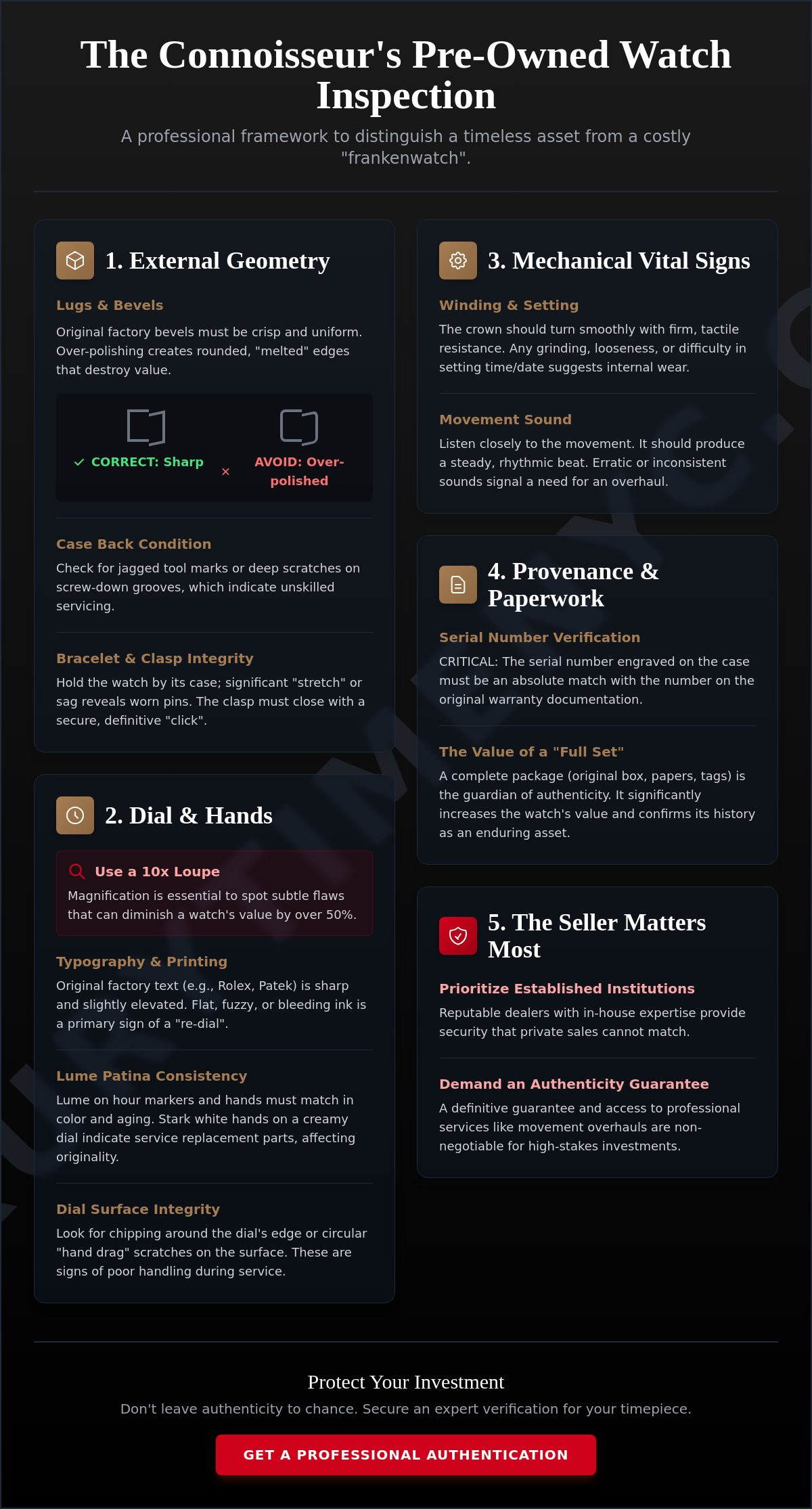
The silhouette of a fine timepiece is its architectural signature. It is the first point of contact between a collector and a potential acquisition, where the history of the watch is written in steel, gold, or platinum. When utilizing a pre-owned watch inspection checklist, the case geometry offers the most immediate evidence of a watch's journey. Lug sharpness is paramount. Original factory bevels should be crisp, deliberate, and uniform. If these edges appear rounded or "melted," the watch has likely lost the sharp lines that define its character and value.
Examine the case back with a critical eye. High-stakes horology requires specialized tools. Amateur service attempts often leave jagged tool marks or scratches on the screw-down grooves. These scars are more than cosmetic flaws; they suggest that the movement may have been accessed by someone lacking the precision of a master watchmaker. Similarly, evaluate the bezel alignment and the crispness of the knurling or fluting. Whether it's the iconic fluted bezel of a Rolex or the brushed finish of an Audemars Piguet, the texture should feel sharp to the touch, not smoothed by decades of friction or poor restoration.
Identifying the Over-Polished Case
A common pitfall for the unwary is the "soft" case. High-value timepieces often undergo aggressive polishing to hide deep scratches, but this process strips away the very metal that constitutes the watch's value. Look for edges that lack definition. Check if the spring bar holes remain flush with the lug surface. If they appear recessed or "sunken," significant material has been removed. Always compare the grain of the brushed surfaces against factory-fresh reference images. The contrast between brushed and mirror-polished surfaces must be stark, intentional, and balanced.
The Integrity of the Bracelet and Clasp
The bracelet is a complex piece of engineering that must be as secure as it is beautiful. Assess "stretch" by holding the watch sideways by the case; a significant sag indicates worn pins and tubes. This wear isn't just an aesthetic issue; it's a mechanical failure that can lead to the loss of the watch. Verify that the reference codes on the end links align with the specific production year of the case. The clasp mechanism should offer a secure, definitive "click" upon closing, signifying that the internal springs remain robust. While minor "desk diving" scratches are common on pre-owned pieces, significant marring may require a professional watch polishing service to restore the item to its original prestige. This level of scrutiny is a core component of any pre-owned watch inspection checklist, ensuring your investment remains an enduring asset.
The Dial and Hands: Searching for Horological Perfection
The dial remains the most critical component for value retention. It is the face of your investment. When applying a pre-owned watch inspection checklist, the eyes must be aided by a 10x loupe. This level of magnification reveals secrets hidden from the casual observer. Inspect the typography with clinical precision. High-end manufacturers like Patek Philippe or Rolex utilize pad printing that results in sharp, elevated ink with no bleeding. If the letters appear flat, fuzzy, or inconsistent, you may be looking at a "re-dial," a restoration that can diminish the value of a vintage piece by 50% or more.
Examine the dial’s perimeter for "chipping." This occurs where the dial meets the case or is secured by screws. Minor chips suggest the movement has been removed frequently or handled by an unskilled technician. Similarly, look for circular scratches known as "hand drag." These occur when the hands are misaligned and scrape against the dial surface. This is a mechanical failure that leaves permanent aesthetic damage. To ensure the piece you are considering meets these exacting standards, you may wish to consult with a specialist for professional watch authentication before finalizing the acquisition.
Consistency is the hallmark of authenticity. Verify that the lume patina is uniform across the hour markers and the hands. If the dial shows a warm, creamy tritium aging while the hands remain stark white, the hands are likely service replacements. While service parts maintain functionality, they disrupt the original aesthetic that serious collectors demand. A mismatch in patina is a significant red flag for any high-stakes purchase.
The Authenticity of the Printing
Era-appropriate markings are non-negotiable. A vintage piece from the late 1960s should feature signatures like "T Swiss T," indicating the use of tritium. Analyze the logo for three-dimensional depth. Modern coronets and logos are often applied rather than printed, offering a crispness that counterfeiters struggle to replicate. Additionally, ensure the date wheel font matches the specific caliber. The "open 6" or "hooked 7" are specific traits that verify a watch's production era and movement integrity.
Crystal and Gasket Inspection
The crystal is the guardian of the dial. Check the edges of sapphire or hesalite for "flea bites," which are microscopic chips that can compromise structural integrity. Look for signs of "fogging" or moisture under the glass. This indicates a failed gasket and potential water damage to the movement. On modern Rolex models, verify the presence of the laser-etched crown at the six o'clock position. It is a subtle, definitive mark of factory-original glass. Integrating these steps into your pre-owned watch inspection checklist protects you from the hidden costs of restoration.
Mechanical Vital Signs: Winding, Setting, and Sound
A masterwork of engineering reveals its true condition through the senses. While the exterior provides a visual history, the internal caliber communicates through vibration and frequency. A comprehensive pre-owned watch inspection checklist must move beyond the surface to evaluate the mechanical heartbeat of the timepiece. It's a dialogue between the collector and the machine. Silence and smoothness are the indicators of a well-maintained movement.
Unscrew the crown with care. The transition from the locked position to the winding state should feel intentional and secure. As you wind the movement, feel for a smooth, consistent resistance. It should feel buttery yet firm. Any sensation of slipping or erratic tension suggests worn gears or a failing mainspring. Listen closely. The "beat" of the movement should be a rapid, steady rhythm. Erratic metallic pings or a clunking sound indicate a lack of lubrication or loose components within the escapement. This auditory check is often the first warning of impending mechanical failure that a visual inspection misses.
Precision extends to the calendar and timing functions. Engage the quick-set date. The transition should be crisp. The date must snap over exactly at midnight. It shouldn't be a slow, agonizing crawl that begins at 10 PM and lingers until 2 AM. For those assessing a chronograph, the pushers are the primary interface. They require a definitive, tactile click. A mushy start or a reset hand that fails to hit zero perfectly indicates a movement that's been neglected or improperly serviced by an amateur.
The Haptic Feedback of the Crown
The crown is the most handled part of any watch. Feel for grittiness while setting the time. This often indicates dirt in the tube or a lack of essential oils. Ensure the hands move freely. There shouldn't be excessive "play" or wobble when the crown is pulled to the furthest position. Finally, check that the crown screws down tightly to the case. A cross-threaded or loose crown is the primary entry point for moisture, rendering even the most prestigious timepiece vulnerable to internal oxidation.
Complication Performance
Complex movements require specialized scrutiny. For GMT models, observe the synchronization between the local hour hand and the 24-hour hand. They must align perfectly at the top of the hour. Test the power reserve by fully winding the watch and monitoring its performance over 24 hours. If the watch stops prematurely or the timekeeping drifts significantly, the internal friction is too high. In such instances, a professional movement overhaul is essential to restore the watch to factory specifications. This mechanical audit is the most critical step in your pre-owned watch inspection checklist, ensuring the movement remains an enduring asset.
Provenance and Paperwork: The Value of the Full Set
The narrative of a high-stakes timepiece is incomplete without its paper trail. While a pre-owned watch inspection checklist focuses heavily on physical integrity, the documentation serves as the historical foundation of your asset. It's the difference between a simple timepiece and a curated investment. Every serious collector must begin by matching the serial number on the case to the warranty card. Depending on the manufacturer, this number is found between the lugs or engraved on the rehaut. A mismatch here is an absolute disqualifier. It suggests a "frankenwatch" or a stolen piece; both are toxic to your portfolio.
Verify the dealer stamp. Check the original date of purchase. These details are the DNA of the watch. Service records from authorized centers are equally vital. They verify the mechanical history and prove that previous owners didn't cut corners with amateur repairs. A verifiable history from a reputable watchmaker adds a layer of security that physical inspection alone cannot provide. It confirms that the movement has been maintained to factory standards, preserving its long-term reliability.
The "Naked" Watch vs. The Full Set
A missing box can impact the price of a Rolex in NYC by 10-15%. This delta exists because the "full set" represents the complete heritage of the item. Collectors prioritize the presence of original hangtags, booklets, and even the outer cardboard sleeve. If papers are absent, evaluate if the price reflects this loss and whether it's offset by a recent, verifiable service. Use the serial number to confirm the production year via a trusted watch trading company. This ensures the watch is era-correct and hasn't been assembled from mismatched parts.
Authenticating the Documentation
Document fraud is increasingly sophisticated. Look for watermarks and high-quality, sharp printing on warranty papers; blurry text is a common red flag. Check that the model reference number on the papers matches the watch exactly. Be wary of "replacement" boxes that don't match the era of the timepiece. A 1970s watch in a 2024 box suggests a lack of care in the watch's provenance. Before committing your capital, ensure every document reflects the watch's true history by utilizing our Watch Authentication services. This final step in your pre-owned watch inspection checklist provides the absolute certainty required for high-value acquisitions.
The Final Verdict: Why the Seller Matters Most
The most rigorous pre-owned watch inspection checklist is only as effective as the integrity of the institution offering the timepiece. In the world of high-value horology, the dealer acts as the primary guardian of authenticity. While your own eyes and loupe are essential, the seller's reputation provides the ultimate security for your capital. Prioritize dealers with a physical presence in established global centers, specifically the NYC Diamond District. A brick-and-mortar institution offers a level of accountability and permanence that digital-only platforms simply cannot replicate.
A professional consultation should never be rushed. Ensure the dealer provides an unambiguous in-house authenticity guarantee and a defined return period. This transparency is a non-negotiable standard for serious collectors. A reputable showroom must also employ an on-site horologist. This expert is essential for performing immediate pressure tests and timing checks. These technical verifications ensure that the watch isn't just aesthetically pleasing but mechanically sound and water-resistant. Trust is earned through technical proficiency and a history of excellence.
Inspecting Watches on 47th Street
Success in the New York market requires a nuanced approach to navigating 47th street watches. When visiting a showroom, request a timegrapher test. This diagnostic tool provides a real-time view of the watch's accuracy, amplitude, and beat error. A healthy movement typically shows an amplitude between 270 and 310 degrees. Anything significantly lower suggests the need for immediate service. Verify the dealer's standing within the professional community; a long-standing reputation is the best indicator of a safe investment.
The Luxury Time NYC Advantage
At Luxury Time NYC, we view ourselves as curators of fine mechanical art rather than mere retailers. Our commitment to sourcing only investment-grade, authenticated timepieces ensures that every acquisition meets the highest standards of the pre-owned watch inspection checklist. We provide exclusive access to rare Patek Philippe and Audemars Piguet models through our extensive global network. For those seeking absolute certainty, we invite you to schedule a private viewing at our Midtown showroom for a comprehensive, hands-on inspection. Your legacy deserves nothing less than perfection.
Securing Your Horological Legacy
Mastering the nuances of a pre-owned watch inspection checklist transforms a high-stakes purchase into a calculated investment. We've examined how razor-sharp lug geometry, era-appropriate dial printing, and the rhythmic beat of a healthy movement distinguish a true masterpiece from a compromised assembly. These details are the silent witnesses to a watch's history. They represent the difference between an enduring asset and a hidden liability.
Authenticity is the only currency that matters in the global luxury market. At our premier Diamond District showroom, we eliminate the ambiguity of the secondary market through our Certified Authenticity Guarantee and expert sourcing for rare models. We act as the discreet guardian of your collection. Every timepiece we offer has undergone the scrutiny of our master horologists to ensure factory-original integrity. Browse our curated collection of authenticated luxury watches to discover timepieces that have already passed our most rigorous internal standards. Your journey toward a flawless collection begins with a single, informed decision.
Frequently Asked Questions
How can I tell if a pre-owned watch has been over-polished?
Over-polishing is identified by "soft" lug profiles and recessed spring bar holes that no longer sit flush with the metal surface. Original factory bevels should be razor-sharp and clearly defined. If the metal appears melted or the transition between brushed and mirror finishes is blurred, the watch has lost significant structural integrity and historical value.
Does a missing original box significantly decrease a watch’s value?
A missing box typically reduces a timepiece's market value by 10% to 15% for premier brands like Rolex or Patek Philippe. While the watch remains mechanically sound, collectors view the original packaging as a vital component of a "full set" provenance. For high-stakes investments, the absence of original accessories often signals a gap in the item's historical care and preservation.
What is a "frankenwatch" and how can I spot one?
A "frankenwatch" is a timepiece composed of non-matching or aftermarket components harvested from various eras or models. Spotting one requires a 10x loupe to verify that the dial, hands, and movement caliber are era-correct for that specific reference. Mismatched lume patina between the dial markers and the hands is a primary indicator of a composite, non-original assembly.
How do I verify the serial number on a Rolex without removing the bracelet?
Modern Rolex timepieces produced after 2005 feature the serial number engraved on the rehaut, the inner bezel, at the six o'clock position. This allows for immediate verification against the warranty card without the risk of scratching the lugs during bracelet removal. For vintage models produced before this era, the serial remains hidden between the lugs, necessitating professional handling for verification.
Is a timegrapher test necessary when buying a pre-owned luxury watch?
A timegrapher test is an essential component of any professional pre-owned watch inspection checklist. It provides objective data on amplitude, beat error, and daily rate without the need to open the case back. A healthy movement should maintain a steady, rapid rhythm. Erratic readings or low amplitude often indicate that a movement overhaul is required to protect the caliber's longevity.
Can I trust a pre-owned watch that has no service history?
A watch without a documented service history can be a secure acquisition if it passes a rigorous physical audit and a timing analysis. However, the lack of paperwork should be reflected in a more conservative purchase price. In these instances, prioritizing a dealer with an in-house horologist ensures the piece has been vetted for mechanical integrity and pressure tested for water resistance.
What are the most common red flags when inspecting a Patek Philippe dial?
Red flags on a Patek Philippe dial include flat, fuzzy typography or inconsistent spacing in the branding. The manufacturer's pad printing is legendary for its three-dimensional crispness and ink density. Any signs of "chipping" at the dial edges or mismatched hand finishes suggest a "re-dial" or amateur restoration. Such flaws significantly destroy the piece's potential as an enduring asset.
Why is the NYC Diamond District considered the best place for watch inspections?
The NYC Diamond District serves as a global epicenter for horological excellence, offering unparalleled access to master watchmakers and advanced diagnostic equipment. This concentration of expertise allows for immediate authentication and technical verification in a high-stakes environment. It is a location where reputation is the primary currency, providing a level of security and transparency that digital-only platforms cannot match.


