


The largest Explorer isn’t necessarily the most capable choice for your daily routine. In this rolex explorer buying guide, start by distinguishing the time-only Explorer from the Explorer II, whose additional GMT function serves a different purpose. Case size matters too: current Explorer I models measure 36 or 40 mm, while the Explorer II measures 42 mm. The discontinued 39 mm Explorer I adds another option for collectors considering pre-owned watches.
Choosing among these models can feel less straightforward than their restrained designs suggest. A few millimetres can change how a watch looks and sits on your wrist, while dial preference, travel habits, and interest in a discontinued reference all shape the decision. When comparing pre-owned examples, give condition and original documentation the same attention as the reference number.
This guide compares Explorer and Explorer II sizes, dials, and functions to help you narrow your choice to your wrist, routine, and collecting priorities. It also offers a practical framework for reviewing pre-owned examples, including condition, box and papers, and authenticity. Luxury Time NYC presents authenticated Explorer references with a certified authenticity guarantee.
Key Takeaways
- Use this rolex explorer buying guide to shortlist watches by function, wrist presence, and dial preference instead of choosing by reputation alone.
- Match the reference number to the exact listing. Similar-looking models can differ in size, function, and details.
- Assess a pre-owned Explorer as a whole: review its condition, provenance, and included box or papers before deciding.
- Choose for your routine first, then consider whether a discontinued reference adds the collecting appeal you want.
Rolex Explorer Buying Guide: Start with the Watch You Actually Want to Wear
Explorer references share a restrained design language, but they can wear differently and serve distinct purposes. The first decision isn’t which reference is most celebrated. Decide whether you want the direct simplicity of an Explorer or the added timekeeping function of an Explorer II. Then compare size and dial to find what feels right for everyday wear.
The Explorer is an understated Rolex tool-watch family shaped by legibility and purposeful design. Its history, including its mountaineering associations, gives the line useful context; Rolex Explorer History offers a broader account of that evolution. Heritage alone, however, can’t tell you how a particular reference will wear or whether its functions suit your routine. Start with the practical differences: case size, dial, daily use, and travel functionality.
What separates the Rolex Explorer from the Explorer II?
The Explorer keeps timekeeping deliberately simple, with a legible three-hand display and classic dial layout but no second time zone function. The Explorer II adds a 24-hour bezel and an additional hand, which can help distinguish day from night and track another time zone. These are different expressions of the tool-watch idea, not steps on a ladder where one is automatically superior.
If you value a clear, uncluttered display, the Explorer may be the stronger fit. If you travel across time zones or would use a 24-hour indication, the Explorer II offers a function the standard Explorer doesn’t. Let the complication serve your habits, rather than choosing it simply because it adds features.
Which details should guide your first shortlist?
Begin with wrist presence. A smaller case may feel discreet and familiar, while a larger one may have more visual weight. Consider the dial next: colour and contrast shape the watch’s character and how readily you can read it at a glance. Then picture a typical day. Do you want straightforward timekeeping, or would a second time zone indication be useful?
Keep those priorities ahead of production year and accessories during your first pass. Age and included box or papers can matter when comparing individual pre-owned watches, but they don’t determine whether the watch fits your wrist or routine. Narrow the type and size first, then weigh those details against the specific listing.
Start your shortlist with three priorities: wrist presence, dial preference, and the functions your routine actually uses.
This sequence keeps the decision grounded. Historical significance can deepen your appreciation, and reference details can refine the final choice. Neither replaces the essential question: is this the Explorer you’ll want to wear?
Explorer Reference Differences: Compare 36 mm, 39 mm, 40 mm, and 42 mm
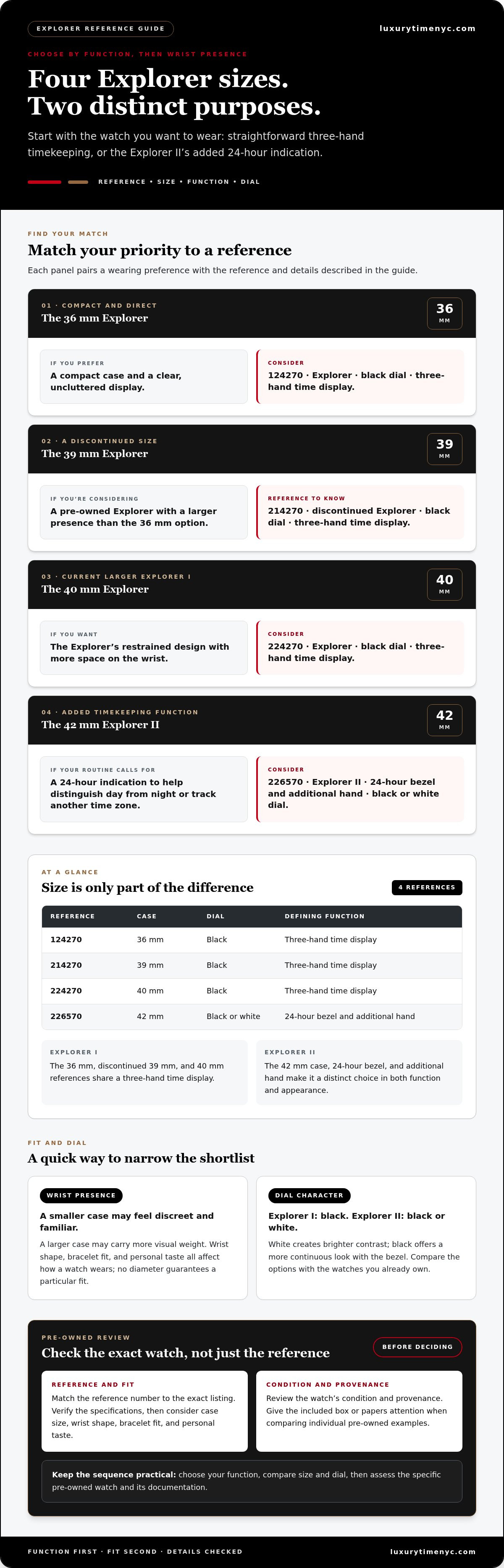
Case diameter is a useful starting point, but it doesn’t tell the whole story. The 36 mm Explorer 124270, discontinued 39 mm Explorer 214270, and 40 mm Explorer 224270 are time-only Explorer references. The 42 mm Explorer II adds a 24-hour hand and bezel, making it a different choice in both wrist presence and function.
| Reference | Case size | Dial | Model | Defining function |
|---|---|---|---|---|
| 124270 | 36 mm | Black | Explorer | Three-hand time display |
| 214270 | 39 mm | Black | Explorer | Three-hand time display |
| 224270 | 40 mm | Black | Explorer | Three-hand time display |
| 226570 | 42 mm | Black or white | Explorer II | 24-hour bezel and additional hand |
The 214270 is discontinued, while the 124270 and 224270 represent the 36 mm and 40 mm Explorer I sizes offered in 2026. For broader reference history, see Hodinkee’s Comprehensive Rolex Explorer I Collector's Guide. Use that history to understand a reference, then verify the specifications of the exact watch you’re considering.
How do Explorer case sizes change wrist presence?
The 36 mm 124270 is the compact option, with measured presence that may appeal if you prefer classic proportions. The 39 mm 214270 and 40 mm 224270 offer alternatives if you want the Explorer’s restrained design to occupy more space on your wrist. No diameter guarantees a particular fit.
Wrist shape, bracelet fit, and personal taste all affect how a watch wears. Consider the 42 mm Explorer II on its own terms: beyond its larger diameter, the bezel and additional hand give it a more instrument-like appearance than the simpler Explorer.
Should you choose a black dial, white dial, or Explorer II?
The Explorer I’s black dial keeps the display cohesive and familiar. The Explorer II’s black and white dial examples have distinct visual characters: white creates brighter contrast, while black offers a more continuous look with the bezel. Compare the options with the watches you already own rather than assuming one is universally preferable.
The Explorer favors three-hand simplicity; the Explorer II pairs a 24-hour bezel with an additional hand for a different kind of timekeeping. If that function and the larger case suit your routine, explore the Explorer II references as a focused next step in your rolex explorer buying guide.
Which Rolex Explorer Fits Your Priorities? Compare Standout Collection References
A useful shortlist starts with what you want from the watch, not a universal ranking. This needs-to-reference matrix connects Explorer examples with different preferences. Use it as a starting point, then compare the exact listing’s dial, condition, and specifications before deciding.
| Your priority | Reference to consider | Why it may fit |
|---|---|---|
| Compact Explorer proportions and a black dial | 124270 | 36 mm Explorer I with a classic, restrained profile |
| A broader Explorer I than 36 mm | 214270 | 39 mm black-dial reference; discontinued |
| The largest current Explorer I size | 224270 | 40 mm black-dial option |
| A 24-hour display and a larger case | 226570 or 216570 | 42 mm Explorer II references, with black- and white-dial examples |
Which Explorer reference suits a preference for a classic, restrained profile?
The 124270 is a clear option if you’re drawn to a 36 mm Explorer with a black dial. If you prefer a more expansive presence while keeping the three-hand Explorer layout, compare it with the 39 mm 214270. The 40 mm 224270 offers another size, but diameter alone can’t predict how a watch will sit on your wrist.
For a deeper historical view of the line and its references, consult Hodinkee’s Rolex Explorer history. Collector context can explain a reference’s place in the family; the practical choice still depends on how its proportions feel to you.
When does the Explorer II make more sense?
Consider the 226570 or 216570 if you want the 42 mm Explorer II format and its 24-hour display. That function can be useful for tracking another time zone, particularly for frequent travelers. If you rarely need that information, the Explorer’s simpler display may be the more natural daily companion.
Black- and white-dial Explorer II examples offer different visual impressions, not different levels of performance because of colour alone. Black can feel visually cohesive; white provides brighter contrast. Compare the dial with your existing watches and personal style, and confirm the dial and specifications against the individual listing. A useful rolex explorer buying guide helps you identify the right candidate, rather than declaring one reference best for everyone.
Rolex Explorer Buying Checklist: Avoid Reference, Condition, and Fit Mistakes
A considered purchase involves more than a photograph or case size. Use these five steps to compare individual watches while keeping your priorities in view.
- Confirm the reference. Match the reference number in the listing to the watch shown. Check that the stated model, case size, dial, and functions correspond to that reference. Similar names or family resemblance aren’t enough.
- Compare the fit. Think beyond diameter. Consider the watch’s overall presence and how it fits your everyday wardrobe and other watches. If possible, assess how the bracelet sits on your wrist instead of relying on dimensions alone.
- Inspect condition. Review the photographs and written description for the exact example. Look closely at the dial, case, and bracelet, and make sure the stated condition is clear. Condition can vary from one pre-owned watch to another.
- Review provenance. Check what documentation accompanies the watch, including any available box, papers, or service history. These details can add useful context, but papers alone don’t establish authenticity. Luxury Time NYC provides a certified authenticity guarantee.
- Make the decision. Compare the complete listing with your shortlist. Before deciding, confirm the reference, dial, bracelet, stated condition, and included accessories match what you want.
What should you check on a pre-owned Explorer?
Focus on the individual listing, not just the model name. Compare its photographs and description with the reference, and review the dial, bracelet, and stated condition. Box, papers, and service history can differ between pre-owned examples, so assess them for each watch instead of assuming every example comes with the same documentation.
Reference, condition, and provenance belong in the same assessment; none tells the whole story on its own.
How can you avoid choosing the wrong Explorer reference?
Don’t choose by case diameter alone. Wrist presence depends on the watch’s overall design and how it sits on you. Nor should you assume the Explorer and Explorer II offer the same function or wearing experience. Compare the specific watches in front of you, including their reference numbers and listing details, rather than generalizing from the family name.
With your priorities and checks in place, browse the Explorer collection to compare available references. A careful rolex explorer buying guide turns a broad search into a considered choice based on fit, function, and the particulars of each watch.
Choose Your Rolex Explorer with Confidence at Luxury Time NYC
Start with function. Decide whether the Explorer’s straightforward time display or the Explorer II’s additional 24-hour indication better suits your routine. Then narrow your options by case size and dial, and assess the condition of the individual watch. This rolex explorer buying guide offers a framework for making a careful comparison, not for declaring one reference universally superior.
What does a considered Explorer purchase look like?
Match the reference to how you expect to wear it. Daily wrist presence, dial character, and useful functions should all feel right. Before deciding, review the specific listing’s details, including its stated condition and included items. New and pre-owned examples can differ, so assess the watch in front of you rather than relying on assumptions about the model family.
Luxury Time NYC presents Explorer references from New York’s Diamond District and provides a certified authenticity guarantee. Its selection spans Explorer and Explorer II references. Compare the listing details with your priorities and give the individual watch careful attention.
Where can you browse Explorer and Explorer II references?
Compare the actual examples in the Explorer collection, using each listing to assess its reference, dial, condition, and included items. For broader New York purchasing context, read the 2026 Rolex buying guide. The 47th Street watch guide offers additional local perspective.
Take time to compare the details. A reference that looks compelling in isolation may feel different alongside your daily wardrobe or on your wrist. Let fit, function, and the particular listing guide your decision, with condition and documentation considered as part of the whole.
Explore Rolex Explorer watches and compare the available examples at Luxury Time NYC.
Make Your Explorer Choice with Confidence
The right reference begins with the right purpose. First decide whether you prefer the Explorer’s direct timekeeping or the Explorer II’s additional 24-hour function. Then narrow your shortlist by case size and dial, keeping wrist presence and daily wear in view.
A careful rolex explorer buying guide also looks beyond the model name. Match the reference to the exact listing, then review its condition and included documentation. Each pre-owned watch is an individual example, not simply a set of specifications.
Luxury Time NYC is an independent luxury-watch retailer in New York’s historic Diamond District and provides a certified authenticity guarantee. With your priorities clear, compare Explorer and Explorer II references on fit, function, and the details of the individual watch.
Explore Rolex Explorer watches and find the reference that suits your wrist, routine, and collecting interests.
Frequently Asked Questions
What is the difference between a Rolex Explorer and an Explorer II?
The Explorer is a time-only watch with a clear three-hand display, while the Explorer II adds a 24-hour bezel and an additional hand. That extra indication can help track another time zone or distinguish day from night. The models suit different preferences, not a simple hierarchy: choose the Explorer for a more restrained display or the Explorer II if its added function fits your routine.
Is the Rolex Explorer available in different case sizes?
Yes. In 2026, the Explorer I is offered in 36 mm and 40 mm sizes, while the current Explorer II measures 42 mm. The discontinued Explorer I 214270 is a 39 mm option if you’re considering a pre-owned reference. Diameter is only a starting point: the watch’s overall design, bracelet fit, and your wrist shape all influence how it wears.
Which Rolex Explorer reference is 36 mm?
The Rolex Explorer 124270 is the 36 mm Explorer I reference, with a black dial. It’s a compact option if you’re drawn to classic proportions, though the best fit depends on personal preference and how the watch sits on your wrist. Compare the reference number and stated specifications with the exact listing, particularly for a pre-owned example, since condition and included documentation can vary.
Is the Rolex Explorer II suitable for everyday wear?
Yes, the Explorer II can serve as an everyday watch if its 42 mm case, visual presence, and 24-hour function suit your habits. The additional hand and bezel may be useful if you travel or track another time zone; they may be less essential if you prefer a simple time display. Consider your wrist comfort and daily routine rather than assuming the model is right for every wearer.
What is the difference between the Explorer II 216570 and 226570?
The 216570 is an earlier 42 mm Explorer II reference; the 226570 is its successor, introduced in 2021. Both belong to the Explorer II family and have the 24-hour display, but they represent different generations. If you’re comparing them, verify the exact reference, dial, condition, and stated specifications in each listing. Don’t rely on a model-family description alone to assess an individual pre-owned watch.
Can you buy a pre-owned Rolex Explorer with its box and papers?
Yes, some pre-owned Rolex Explorer examples are offered with an original box, papers, or both, while others may not include those items. What accompanies the watch varies by individual listing. Review the included items and the watch’s condition together, and treat documentation as useful provenance rather than proof of authenticity on its own. Check that the listing clearly describes what is included.
How can you assess the authenticity of a pre-owned Rolex Explorer?
Start by matching the reference number and stated details to the exact watch listing, then review its condition and available provenance. Box and papers can provide context, but they don’t independently establish authenticity. A considered rolex explorer buying guide also emphasizes buying through a trusted source. Luxury Time NYC provides a certified authenticity guarantee, giving shoppers a clear point of confidence when comparing Explorer references.


