


A striking material is not automatically a meaningful engineering choice. In Richard Mille watches, the case and its construction are part of a wider design approach. That makes richard mille materials science about more than a list of advanced-sounding names: it’s about understanding how a material is used in a particular watch.
Collectors should look beyond terminology. Carbon TPT®, Quartz TPT® and Grade 5 titanium each have distinct roles, but a material name alone doesn’t explain how it relates to a watch’s structure, performance or ownership. The reference, construction and condition matter, too.
This guide gives you a practical framework for comparing Richard Mille’s key material families and assessing what their descriptions do, and don’t, establish. You’ll learn how to connect a material to a component, what to look for in technical descriptions, and which details deserve closer attention when evaluating a specific pre-owned watch. That context helps distinguish a compelling material choice from an assumption based on its name alone.
Key Takeaways
- Use richard mille materials science to understand a watch’s documented engineering choices, not just the names of its materials.
- Assess each material in context: identify the component it forms and the role stated for that specific reference.
- Compare materials using documented properties only; don’t assume performance or ownership benefits that specifications don’t support.
- Begin with the exact reference and its specifications, then assess the individual watch’s condition and provenance.
- For a pre-owned Richard Mille, material knowledge complements authentication and inspection by a certified watchmaker.
Richard Mille Materials Science: Why Material Choice Is Part of the Watch’s Design
What does an advanced material contribute beyond appearance? Start with its role in the specific watch. A material choice can shape how a component is designed and made, but its name alone doesn’t establish its function or how the complete watch performs. The useful questions are: Why was this material selected for this component, and what does the documentation for this reference actually say?
Materials science in watchmaking is the selection and engineering of materials to meet the requirements of specific components. This practical definition separates documented engineering purpose from assumptions about prestige, rarity or visual impact.
What materials science means in a luxury watch
Material properties can influence a component’s form and the methods used to manufacture it. But composition, finishing and function are different things. Composition describes what a material is; finishing describes the treatment or appearance of its surface; function identifies the component’s role in the watch. A polished surface, for example, doesn’t reveal the material’s composition or engineering purpose.
These distinctions matter because a material doesn’t act in isolation. Its relevance depends on where it is used, how the component is constructed and which reference is being considered. A case and a movement component have different design requirements, and a broad claim about a material family may not apply to every implementation. Read specifications at the component level and keep each claim tied to its reference.
Why Richard Mille’s approach attracts collector attention
Richard Mille presents materials innovation as part of its wider watchmaking identity. The brand’s history and use of advanced materials offer general context, while documentation for an individual watch is the more relevant guide to its construction. Carbon TPT®, Quartz TPT® and Grade 5 titanium are part of the brand’s material vocabulary, but naming them is only the starting point for evaluation.
Technical choices can also shape a watch’s visual identity. A material’s appearance, its arrangement with other components and the way surfaces are finished all contribute to what collectors see. Construction and aesthetics are connected, but they aren’t interchangeable: a distinctive pattern may be visually striking without proving a particular performance benefit.
This is where richard mille materials science becomes a useful lens rather than a catalogue of impressive terms. Ask three questions of each claim: Which component uses the material? What role is documented? Does the information apply to the exact reference? Avoid treating a material name as a promise of superior real-world performance. For a considered collector, that distinction is essential.
How Richard Mille’s Advanced Materials Relate to Watch Components
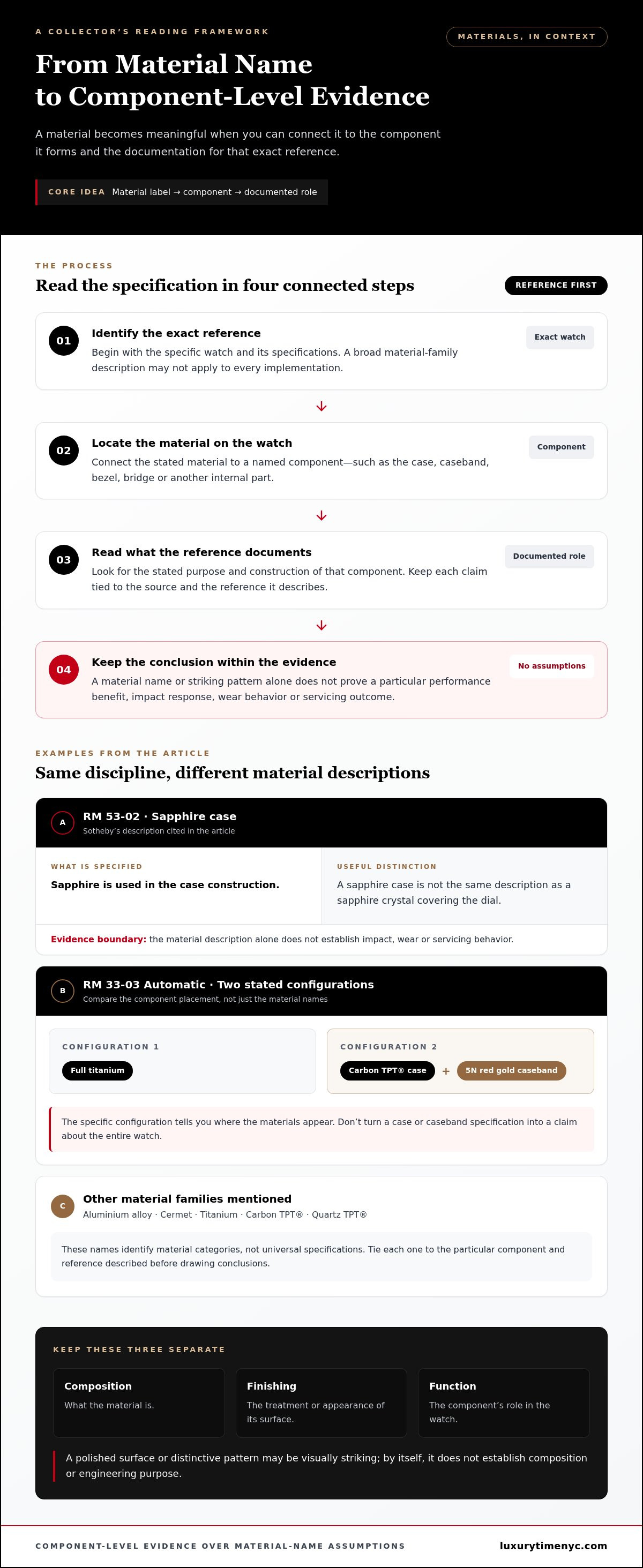
A material name becomes meaningful when it’s connected to a component. The case, bezel, movement bridges and other parts serve different roles, so one material doesn’t automatically suit every part of a watch. For collectors, the useful path is to connect the stated material to the component, then to the documented purpose in that exact reference.
A material choice is most informative when the reference identifies both the material and the component it serves. The RM53-02 provides a clear example: Sotheby’s describes it as having a sapphire case and notes the precision craftsmanship involved. That’s more specific than simply calling a watch “sapphire.”
Sapphire and transparent case construction
A sapphire case is different from a conventional sapphire crystal. A crystal usually means the transparent cover over the dial; in the RM53-02 example, sapphire is used in the case construction itself. That distinction clarifies which component the material description refers to. It doesn’t, by itself, establish how the watch responds to impact, wear or servicing.
Case construction is only one part of the picture. Bezel material, movement architecture and the material used for a bridge or another internal component each need to be read in context. Don’t extend a specification for one element to the rest of the watch. A material’s visual prominence also doesn’t reveal its precise engineering role.
Carbon composites, aluminium alloys, titanium and cermet
Richard Mille references illustrate several material families, but attribution matters. The RM 33-03 Automatic, for example, was presented in full titanium or with a Carbon TPT case and 5N red gold caseband. Sotheby’s also discusses aluminium alloy and cermet among the brand’s material examples. These names identify categories, not universal specifications for every reference.
For a collector, the practical comparison is about placement and documentation. Carbon TPT in a named case configuration isn’t interchangeable with a broad claim that a watch is “carbon.” Aluminium alloy and cermet should likewise be tied to the particular component and reference described by the source. Apply the same discipline to titanium: establish where it appears before drawing conclusions about the whole watch. This is the value of richard mille materials science as a research lens: it shifts attention from material labels to component-level evidence.
When examining a watch, compare its reference and stated construction with reliable descriptions, then keep your conclusion specific. A case material can help define the case’s construction and appearance; without supporting evidence, it doesn’t prove a particular ownership benefit or performance result. Collectors can use this approach while exploring Richard Mille watches at Luxury Time NYC, where pre-owned watches are inspected and serviced by certified watchmakers.
Comparing Richard Mille Materials: Properties, Trade-Offs, and Evidence
A useful comparison starts with the component, not a ranking of material names. A case, caseband or crystal has a different role in a watch, and a material’s suitability depends on that role and the design priorities of its specific reference. No single material is automatically best for every collector or use.
The table below sticks to documented reference descriptions. Where a source identifies a material and component but doesn’t establish a practical benefit, the table leaves that benefit unstated. This keeps evidence separate from impressions about rarity, comfort or durability.
Which material properties are meaningful to compare?
Compare documented composition, component placement, construction and stated purpose. Weight or hardness is useful only when a reliable source provides a figure or claim tied to the specific watch. Finishing describes the surface, not necessarily the material beneath it. Record the reference and source beside each claim, and distinguish a measured property from a subjective description such as “light” or “striking.”
| Material | Component or reference | Documented purpose or description | Ownership consideration |
|---|---|---|---|
| Sapphire | RM53-02 case | Sotheby’s describes a sapphire case and notes the precision craftsmanship involved. | Assess the case as a specific construction, not as an ordinary sapphire crystal. Don’t infer impact behavior or service needs from the material name. |
| Carbon TPT | RM 33-03 Automatic, case | Identified in the model’s Carbon TPT case configuration, paired with a 5N red gold caseband. | Confirm the material’s placement on the exact reference; the description doesn’t establish a general performance advantage. |
| Grade 5 titanium | RM 33-03 Automatic, full-titanium configuration | The model is described as available in full titanium. | Verify the precise configuration and its condition. Don’t assume every titanium component has the same finish or role. |
| White and Azure Blue Quartz TPT | RM 64-01 Tourbillon Colnago, case | The reference is described with a white and blue Quartz TPT case. | Keep the material claim tied to this case and reference; it doesn’t describe all components of the watch. |
How to read material claims without overvaluing novelty
A technically unusual material is a documented design choice, not proof of a practical benefit on its own. Treat durability, comfort and servicing implications as reference-specific questions rather than conclusions to draw from a material family. Apply the same standard to promotional language: look for a named component, an explicit function and evidence that applies to the exact model under consideration.
Compare the documented material, its component and its stated role, then leave unsupported performance claims out of the assessment. That’s a disciplined way to use richard mille materials science without mistaking novelty for evidence. For a pre-owned watch, read the specifications alongside the individual reference’s condition and provenance. A material description informs the evaluation; it doesn’t replace it.
A Collector’s Checklist for Evaluating Materials in a Richard Mille Reference
Material research is one part of evaluating a pre-owned watch. Begin with the exact reference, then compare its documented construction with the individual watch. This sequence helps keep technical claims separate from condition, authenticity and ownership history.
- Start with the exact reference. Record the full reference and compare it with the available specifications. Don’t rely on a broad model-family description: material configurations can differ between references or versions.
- Match the material to the component. Identify whether the specification names the case, bezel, crystal, movement or another part. Don’t assume a material stated for one component extends across the entire watch.
- Trace the claim to reliable documentation. Compare the description with manufacturer information or reputable specialist material that identifies the same reference. Note exactly what the source says, and separate its stated purpose from claims about rarity or prestige.
- Assess the individual watch’s condition. A material description can’t show the condition of a pre-owned example. Consider the watch as a whole, including its visible condition and whether its components are consistent with the reference documentation.
- Review authenticity and provenance separately. Check serial numbers and available ownership or service records as distinct elements of the evaluation. Material identification is not authentication, and neither establishes a complete provenance history.
- Consider service history and ongoing care. Review available service documentation alongside the watch’s condition. Specialist inspection matters for a complex timepiece; a material label alone doesn’t establish service needs or predict trouble-free ownership. For broader context on maintenance, consult this luxury watch repair guide.
Keep the evidence in separate categories: reference and specification, component and material, condition, serial number and provenance, then service history. This simple method gives each claim its proper weight and prevents an impressive material description from overshadowing unanswered questions about the individual watch.
At Luxury Time NYC, Richard Mille watches are pre-owned unless a listing states otherwise. Every watch comes with a 100% authenticity guarantee and its original serial numbers, and watches are inspected and serviced by certified watchmakers. These details support a careful evaluation, but they don’t imply a particular material test or replace reference-specific research.
Use richard mille materials science as a framework for reading specifications, not as a shortcut to conclusions about value or performance. Apply the checklist to the details of a specific pre-owned reference when exploring Richard Mille watches at Luxury Time NYC.
Explore Richard Mille Watches with a Materials-Informed Perspective
The central principle is simple: evaluate a material by its documented role in a specific watch. A name may signal an unusual design choice, but it doesn’t tell you everything about the component, the watch’s condition or its history. Bring those details together without letting technical language stand in for evidence.
What a retailer’s authentication context adds
For a high-value pre-owned watch, material research and authentication answer different questions. Reference documentation helps establish how a watch is described; authentication and examination concern the individual timepiece. Neither should substitute for the other.
At Luxury Time NYC, every watch comes with a 100% authenticity guarantee, and original serial numbers are included. Watches are inspected and serviced by certified watchmakers. This provides useful context for evaluating a specific watch, but it shouldn’t be mistaken for a particular material test or a conclusion about every aspect of its condition. A documented case material, for example, doesn’t establish the watch’s provenance or service history.
Collectors interested in the setting around New York’s luxury watch trade can also explore this 47th Street collector’s guide. The city’s watch scene has its own character, and understanding that context can add to the experience of researching a reference.
From technical curiosity to considered ownership
Before forming a view of a watch, carry a few precise questions forward: Is the reference exact? Which component uses the stated material? What role does the documentation assign to it? Do the watch’s condition, serial numbers and available service records tell a consistent story? These questions keep materials analysis grounded in the individual timepiece rather than broad claims about a model family.
This is the practical value of richard mille materials science for a collector. It offers a way to read design choices carefully, while leaving questions of authenticity, condition and provenance to their own evidence. No material name alone promises a particular ownership experience or establishes a watch’s future value. A considered assessment rests on the full picture.
Luxury Time NYC offers Richard Mille watches for collectors who value that measured approach. Explore the Richard Mille selection at Luxury Time NYC with attention to each reference’s documented construction and the details of the individual pre-owned watch.
Make Your Next Richard Mille Evaluation More Deliberate
Technical curiosity is most useful when it sharpens your questions about a particular watch. Let richard mille materials science guide how you read a reference, while keeping material claims in perspective alongside the timepiece’s documentation and condition. A considered choice rests on the details, not on a material name alone.
For added confidence, Luxury Time NYC includes original serial numbers with every watch, offers a 100% authenticity guarantee on every watch, and has watches inspected and serviced by certified watchmakers. These assurances complement careful research; they don’t replace it.
Explore Richard Mille watches at Luxury Time NYC and bring a more informed eye to your search. Start with the exact reference, then compare its documented materials and the condition of the individual watch.
Frequently Asked Questions
What materials does Richard Mille use in its watches?
Richard Mille uses materials including Carbon TPT, Quartz TPT, titanium and sapphire, with choices varying by reference and component. Gold Quartz TPT, introduced in 2025, integrates gold leaf into Quartz TPT. These names describe different material families, not a single formula used throughout the range. For a specific watch, check the exact reference documentation to establish which material appears, where it’s used and how the manufacturer describes it.
What is Carbon TPT, and how is it used in Richard Mille watches?
Carbon TPT is a Richard Mille material designation used in some watch constructions, including the case configuration of the RM 33-03 Automatic. The name alone doesn’t tell you the full composition or how every component is made. Verify the exact reference and identify which part is described as Carbon TPT. Don’t assume the designation applies to the bezel, movement or entire watch.
What is Graph TPT?
Graph TPT is a Richard Mille material designation, but the name alone shouldn’t be treated as a complete composition statement. For a particular watch, consult reference-specific manufacturer documentation to establish what the term describes, which component uses it and whether the construction is explained. Branded material names aren’t necessarily standardized terms, so don’t infer that Graph TPT means a component is made from graphite alone.
Why does Richard Mille use sapphire in some watch cases?
Sapphire can be used to create a transparent case construction, as illustrated by the RM53-02. That differs from a conventional sapphire crystal, which serves as the transparent cover over the dial. In a case, the material forms part of the watch’s external structure and visual design. This doesn’t, on its own, establish impact resistance, scratch behavior or servicing requirements; those claims need evidence specific to the reference.
Are Richard Mille watches made from titanium?
Yes. Titanium appears in specific Richard Mille configurations, including the full-titanium version of the RM 33-03 Automatic. The precise description matters: a reference may offer more than one case configuration, and a listing’s mention of titanium doesn’t establish that every component uses it. Compare the wording with documentation for the exact reference, especially when distinguishing a fully titanium configuration from a watch that uses titanium for only one part.
Are Richard Mille composite cases scratch-resistant?
There isn’t a reliable blanket answer for every Richard Mille composite case. Scratch behavior depends on the material, its finish, the component’s construction and the specific reference. A composite name alone doesn’t prove that a case resists scratches in ordinary wear. For an individual pre-owned watch, assess its visible condition directly and treat performance statements as meaningful only when supported by reference-specific documentation.
Do different Richard Mille materials require different care?
Care should follow the guidance for the specific reference and its construction, rather than a general rule for all composites, titanium or sapphire. Don’t assume that a cleaning or polishing approach suitable for one case material is appropriate for another. For ongoing care, rely on documentation and specialist watchmaker advice. This is especially relevant for a pre-owned watch, where condition and previous servicing may affect the care discussion.
How can I verify the material used in a specific Richard Mille reference?
Start with the complete reference number, then compare the material description with manufacturer documentation or a reputable specialist record that identifies the same model and component. Check whether the claim refers to the case, bezel, crystal or another part. On a pre-owned watch, keep that research separate from authentication and condition assessment. Serial numbers and examination by a qualified watchmaker provide additional context, but don’t replace reference-specific material documentation.


